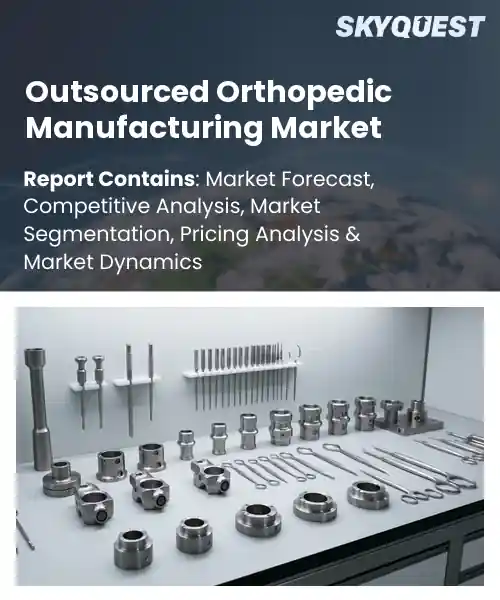
Outsourced Orthopedic Manufacturing Market
Report ID: SQMIG35A4161
Report ID: SQMIG35A4161
[email protected]
USA +1 351-333-4748
Report ID:
SQMIG35A4161 |
Region:
Global |
Published Date: July, 2026
Pages:
157
|Tables:
126
|Figures:
77


Global Outsourced Orthopedic Manufacturing Market size was valued at USD 19.57 Billion in 2024 and is poised to grow from USD 20.96 Billion in 2025 to USD 36.28 Billion by 2033, growing at a CAGR of 7.1% during the forecast period (2026-2033).
The outsourced orthopedic manufacturing market comprises third‑party providers that design, produce, and assemble implants, instrumentation, and ancillary devices for hospitals and equipment manufacturers. Its importance stems from the need to reduce capital expenditure while accessing engineering capabilities, a demand that has intensified as the population ages and musculoskeletal disorders rise. Historically, the sector evolved from simple component stamping in the 1990s to sophisticated, regulatory‑compliant production lines that incorporate additive manufacturing and AI‑driven quality control. For example, an implant maker shifted 70 % of its titanium‑fusion processes to an Asian contract manufacturer in 2018, achieving a 25 % cost reduction and faster time‑to‑market.
Building on cost advantage, regulatory alignment is the key trend driving global outsourced orthopedic manufacturing sector as manufacturers that master complex approval pathways enable partners to launch products faster and reduce liability. Standards such as ISO 13485 and MDSAP have prompted contract manufacturers to invest in compliant cleanrooms and digital traceability. This creates opportunities for firms focused on personalized implants; a U.S. start‑up contracted a South Korean facility to produce patient‑specific 3‑D‑printed knee components, shrinking lead time from eight weeks to three. The blend of compliance and customization therefore expands market, attracting Tier‑1 OEMs and innovators seeking scalable, quality‑assured production.
How is AI-Driven Automation Reshaping the Outsourced Orthopedic Manufacturing Market?
AI driven automation is redefining outsourced orthopedic manufacturing by linking design, production and logistics through intelligent software. Manufacturers now use machine learning to refine implant geometry, reduce material waste and accelerate prototyping. Real time sensor data enables predictive maintenance of CNC equipment, cutting downtime and extending tool life. Automated visual inspection systems catch defects earlier, raising product consistency and regulatory compliance. Cloud based platforms share production schedules with contract factories, allowing rapid scaling and better inventory control. Together these capabilities make outsourcing more reliable, cost effective and responsive to surgeon demand. The integration of AI also supports data driven demand forecasting, helping OEMs align supply with clinical trends.
In April 2026, Orthoworld launched an AI driven robotic machining line that automates the finishing of titanium knee components for contract manufacturers. The system reduces manual handling, improves dimensional accuracy and shortens lead times, illustrating how intelligent automation is boosting efficiency and scalability in outsourced orthopedic production.
Market snapshot - (2026-2033)
Global Market Size
USD 19.57 Billion
Largest Segment
Implants
Fastest Growth
Trays
Growth Rate
7.1% CAGR
To get more insights on this market click here to Request a Free Sample Report
Global outsourced orthopedic manufacturing market is segmented by product type, material base, service component, clinical application and region. Based on product type, the market is segmented into implants, surgical instruments, cases, trays and others. Based on material base, the market is segmented into titanium, stainless steel, cobalt-chromium, ceramics, polymers and others. Based on service component, the market is segmented into manufacturing services, engineering services, quality services and regulatory services. Based on clinical application, the market is segmented into joint reconstruction, spine surgery, trauma surgery, sports medicine, extremities and others. Based on region, the market is segmented into North America, Europe, Asia Pacific, Latin America and Middle East & Africa.
Implants segment dominates because its inherent clinical importance drives consistent demand from hospitals and surgeons, prompting OEMs to outsource complex machining and finishing processes. The high precision required, combined with strict regulatory scrutiny, incentivizes manufacturers to partner with specialized providers that can guarantee biocompatibility and reliability. Consequently, outsourcing offers cost efficiencies while preserving quality, reinforcing implants as the cornerstone of outsourced orthopedic production throughout the product lifecycle and after market support.
However, surgical instruments segment is witnessing the strongest growth momentum as minimally invasive techniques proliferate, requiring highly engineered reusable tools. Outsourced partners provide prototyping and advanced surface treatments that meet evolving ergonomic standards, enabling surgeons to adopt newer procedures. This acceleration fuels broader market expansion and opens opportunities for contract manufacturers.
Titanium segment dominates because its superior strength to weight ratio and inherent biocompatibility make it the preferred material for load bearing implants, compelling original equipment manufacturers to rely on external expertise for precision alloying and additive manufacturing. The stringent purity and microstructure controls demanded by regulators drive firms toward specialized partners who can ensure consistent quality while reducing capital outlay. This reliance entrenches titanium as the flagship material in outsourced orthopedic production.
Meanwhile, polymers segment is emerging as the key high growth area as demand for lightweight patient specific components rises, driven by advances in 3D printing and bio resorbable technologies. Outsourced manufacturers can swiftly adapt material formulations and produce complex geometries, unlocking new therapeutic possibilities. This momentum expands the market scope and creates attractive opportunities for service focused providers.
To get detailed segments analysis, Request a Free Sample Report
As per the global outsourced orthopedic manufacturing market share, North America leads through a combination of sophisticated technology infrastructure, deep integration of medical device firms with contract manufacturers, and a regulatory environment that emphasizes quality and compliance. A mature healthcare ecosystem drives demand for high‑performance implants, encouraging original equipment manufacturers to partner with specialized suppliers that can deliver precision engineering and rapid prototyping. Robust intellectual property protections and a skilled workforce further reinforce the region’s appeal, while strong financing options enable continuous investment in advanced manufacturing capabilities. Collaborative networks between academic research institutions and industry accelerate innovation, positioning North America as the benchmark for outsourced orthopedic production excellence.
Outsourced orthopedic manufacturing market in the United States benefits from a concentration of leading orthopedic firms and a culture of innovation that encourages close partnerships with contract manufacturers. The presence of world‑class research hospitals and a highly regulated environment ensures rigorous quality standards, while abundant venture capital supports the scaling of advanced manufacturing techniques such as additive manufacturing and robotic assembly.
Outsourced orthopedic manufacturing market in Canada is characterized by a supportive policy framework and a collaborative industry landscape that links manufacturers with health‑care providers. Emphasis on cost‑effective solutions and stringent compliance drives adoption of specialized outsourcing, and a well‑educated engineering talent pool underpins the region’s capability to produce high‑quality orthopedic components for both domestic and international markets.
Based on global outsourced orthopedic manufacturing regional forecast, Europe’s expansion is propelled by a strong emphasis on clinical research, a harmonized regulatory environment, and a tradition of engineering excellence. The region’s manufacturers leverage precision machining and emerging digital technologies to meet stringent product specifications demanded by health‑care systems across the continent. Collaborative clusters that bring together universities, research institutes, and OEMs foster continuous innovation, while sustainability initiatives encourage the adoption of efficient, low‑waste production processes. Patient‑centric health policies and reimbursement structures further stimulate demand for customized orthopedic solutions, prompting original equipment manufacturers to rely increasingly on outsourced partners capable of delivering rapid, high‑quality, and cost‑effective production.
Outsourced orthopedic manufacturing market in Germany is anchored by world‑renowned engineering expertise and a dense network of specialized suppliers that excel in precision machining and material science. Rigorous quality standards and an established tradition of collaboration between OEMs and contract manufacturers enable the delivery of complex implants that meet exacting clinical requirements.
Outsourced orthopedic manufacturing market in the United Kingdom benefits from a dynamic research ecosystem and a proactive regulatory framework that supports innovation in orthopedic solutions. Strong links between academic institutions and industry accelerate technology transfer, while flexible manufacturing partners provide rapid scaling capabilities for emerging product lines.
Outsourced orthopedic manufacturing market in France is emerging through strategic investments in digital design and advanced manufacturing techniques. Close cooperation between health‑care providers and specialized manufacturers facilitates the development of patient‑specific implants, and a growing emphasis on cost containment drives the adoption of outsourced production models.
As per global outsourced orthopedic manufacturing regional outlook, Asia Pacific is strengthening its role through rapid adoption of cutting‑edge manufacturing technologies and an expanding network of qualified contract manufacturers. Nations in the region emphasize skill development and technology transfer, enabling the production of high‑precision orthopedic components at competitive cost structures. Growing health‑care expenditure and increasing access to orthopedic surgery create a robust demand base, encouraging original equipment manufacturers to seek local outsourcing partners capable of delivering both volume and customization. Collaborative initiatives among industry associations, government agencies, and research institutions further enhance capabilities, positioning the region as a key hub for innovative and efficient outsourced orthopedic manufacturing.
Outsourced orthopedic manufacturing market in Japan is distinguished by a commitment to precision engineering and a culture of continuous improvement. Advanced automation and meticulous quality control processes enable the production of highly reliable orthopedic implants, while strong collaboration between device makers and contract manufacturers supports rapid development cycles.
Outsourced orthopedic manufacturing market in South Korea is propelled by aggressive investment in smart manufacturing and a proactive approach to integrating digital technologies into production. A skilled labor force and supportive government policies foster an environment where contract manufacturers can deliver innovative, cost‑effective orthopedic solutions to both domestic and global markets.
To know more about the market opportunities by region and country, click here to
Buy The Complete Report
Increasing Demand for Custom Implants
Cost Efficiency Through Outsourced Production
Regulatory Complexity Across Regions
Supply Chain Vulnerabilities and Lead Times
Request Free Customization of this report to help us to meet your business objectives.
The competitive landscape in the global outsourced orthopedic manufacturing market outlook is shaped by aggressive M&A activity, strategic investments, and rapid tech integration, driving firms to secure end‑to‑end capabilities and differentiate through AI‑enabled design and additive manufacturing; Boston Scientific’s $1.5 billion investment in MiRus LLC exemplifies consolidation, while CustoMED’s partnership with leading hospital networks and Restor3D’s multimillion‑dollar funding round illustrate the race to embed advanced digital workflows.
Top Player’s Company Profile
Recent Developments
SkyQuest’s ABIRAW (Advanced Business Intelligence, Research & Analysis Wing) is our Business Information Services team that Collects, Collates, Correlates, and Analyses the Data collected by means of Primary Exploratory Research backed by robust Secondary Desk research.
As per SkyQuest analysis the global outsourced orthopedic manufacturing industry is propelled primarily by the rising demand for custom implants that push original equipment manufacturers toward specialized partners for rapid scaling and design innovation. A second key driver is the cost efficiency gained by converting fixed capital expenses into variable costs, allowing firms to preserve cash flow and focus on R&D. The implants segment remains dominant because of its critical clinical role and strict regulatory scrutiny. North America leads the market thanks to advanced technology infrastructure and strong compliance culture, while fragmented international regulations act as a restraint that can delay product launches and increase compliance burdens.
| Report Metric | Details |
|---|---|
| Market size value in 2024 | USD 19.57 Billion |
| Market size value in 2033 | USD 36.28 Billion |
| Growth Rate | 7.1% |
| Base year | 2024 |
| Forecast period | (2026-2033) |
| Forecast Unit (Value) | USD Billion |
| Segments covered |
|
| Regions covered | North America (US, Canada), Europe (Germany, France, United Kingdom, Italy, Spain, Rest of Europe), Asia Pacific (China, India, Japan, Rest of Asia-Pacific), Latin America (Brazil, Rest of Latin America), Middle East & Africa (South Africa, GCC Countries, Rest of MEA) |
| Companies covered |
|
| Customization scope | Free report customization with purchase. Customization includes:-
|
To get a free trial access to our platform which is a one stop solution for all your data requirements for quicker decision making. This platform allows you to compare markets, competitors who are prominent in the market, and mega trends that are influencing the dynamics in the market. Also, get access to detailed SkyQuest exclusive matrix.
Table Of Content
Executive Summary
Market overview
Parent Market Analysis
Market overview
Market size
KEY MARKET INSIGHTS
COVID IMPACT
MARKET DYNAMICS & OUTLOOK
Market Size by Region
KEY COMPANY PROFILES
Methodology
For the Outsourced Orthopedic Manufacturing Market, our research methodology involved a mixture of primary and secondary data sources. Key steps involved in the research process are listed below:
1. Information Procurement: This stage involved the procurement of Market data or related information via primary and secondary sources. The various secondary sources used included various company websites, annual reports, trade databases, and paid databases such as Hoover's, Bloomberg Business, Factiva, and Avention. Our team did 45 primary interactions Globally which included several stakeholders such as manufacturers, customers, key opinion leaders, etc. Overall, information procurement was one of the most extensive stages in our research process.
2. Information Analysis: This step involved triangulation of data through bottom-up and top-down approaches to estimate and validate the total size and future estimate of the Outsourced Orthopedic Manufacturing Market.
3. Report Formulation: The final step entailed the placement of data points in appropriate Market spaces in an attempt to deduce viable conclusions.
4. Validation & Publishing: Validation is the most important step in the process. Validation & re-validation via an intricately designed process helped us finalize data points to be used for final calculations. The final Market estimates and forecasts were then aligned and sent to our panel of industry experts for validation of data. Once the validation was done the report was sent to our Quality Assurance team to ensure adherence to style guides, consistency & design.
Analyst Support
Customization Options
With the given market data, our dedicated team of analysts can offer you the following customization options are available for the Outsourced Orthopedic Manufacturing Market:
Product Analysis: Product matrix, which offers a detailed comparison of the product portfolio of companies.
Regional Analysis: Further analysis of the Outsourced Orthopedic Manufacturing Market for additional countries.
Competitive Analysis: Detailed analysis and profiling of additional Market players & comparative analysis of competitive products.
Go to Market Strategy: Find the high-growth channels to invest your marketing efforts and increase your customer base.
Innovation Mapping: Identify racial solutions and innovation, connected to deep ecosystems of innovators, start-ups, academics, and strategic partners.
Category Intelligence: Customized intelligence that is relevant to their supply Markets will enable them to make smarter sourcing decisions and improve their category management.
Public Company Transcript Analysis: To improve the investment performance by generating new alpha and making better-informed decisions.
Social Media Listening: To analyze the conversations and trends happening not just around your brand, but around your industry as a whole, and use those insights to make better Marketing decisions.
REQUEST FOR SAMPLE
 REQUEST FREE CUSTOMIZATION
Global Outsourced Orthopedic Manufacturing Market size was valued at USD 19.57 Billion in 2024 and is poised to grow from USD 20.96 Billion in 2025 to USD 36.28 Billion by 2033, growing at a CAGR of 7.1% during the forecast period (2026-2033).
The competitive landscape of outsourced orthopedic manufacturing is shaped by aggressive M&A activity, strategic investments, and rapid tech integration, driving firms to secure end‑to‑end capabilities and differentiate through AI‑enabled design and additive manufacturing; Boston Scientific’s $1.5 billion investment in MiRus LLC exemplifies consolidation, while CustoMED’s partnership with leading hospital networks and Restor3D’s multimillion‑dollar funding round illustrate the race to embed advanced digital workflows. 'LISI S.A.', 'NN, Inc.', 'Integer Holdings Corporation', 'Tecomet, Inc.', 'Orchid Orthopedic Solutions LLC', 'Paragon Medical, Inc.', 'Autocam Medical', 'Avalign Technologies Inc.', 'Intech Medical SAS', 'Marle Group', 'Norman Noble Inc.', 'Norwood Medical', 'Resolve Surgical Technologies', 'SpiTrex Orthopedics', 'Tegra Medical', 'Velocity Medtech', 'Viant Medical', 'Elos Medtech AB', 'Cretex Medical', 'Sandvik Applied Manufacturing'
The growing preference for patient‑specific orthopedic solutions drives manufacturers to outsource, enabling rapid scaling and access to specialized expertise. By leveraging outsourced facilities, companies can focus on design innovation while reducing capital investment in equipment and labor. This collaborative model shortens time‑to‑market, enhances product differentiation, and meets surgeon and patient expectations for tailored fit and improved outcomes, thereby stimulating overall market expansion. Additionally, the ability to integrate advanced manufacturing technologies such as 3D printing within outsourced networks further supports customization and accelerates innovation cycles, reinforcing the market’s upward trajectory.
Digital Twin Integration: Manufacturers are increasingly adopting digital twin technology to simulate the entire orthopedic implant lifecycle, from design through post‑operative performance. Virtual replicas enable real‑time adjustments, reduce physical prototyping, and enhance collaboration between engineers, surgeons, and patients. This immersive approach shortens development cycles, improves fit accuracy, and anticipates potential failure modes before production, fostering higher confidence in outsourced partners and creating a more agile value chain that responds swiftly to evolving clinical requirements throughout global health systems and reimbursement frameworks and patient.
Why does North America Dominate the Global Outsourced Orthopedic Manufacturing Market? |@12


Want to customize this report? This report can be personalized according to your needs. Our analysts and industry experts will work directly with you to understand your requirements and provide you with customized data in a short amount of time. We offer $1000 worth of FREE customization at the time of purchase.
Feedback From Our Clients


 USA (+1) 351-333-4748

