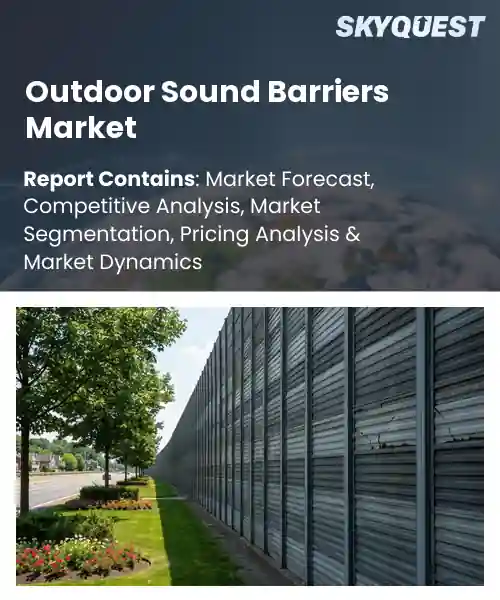
Outdoor Sound Barriers Market
Report ID: SQMIG20B2236
Report ID: SQMIG20B2236
[email protected]
USA +1 351-333-4748
Report ID:
SQMIG20B2236 |
Region:
Global |
Published Date: July, 2026
Pages:
157
|Tables:
153
|Figures:
78


Global Outdoor Sound Barriers Market size was valued at USD 1.3 Billion in 2024 and is poised to grow from USD 1.35 Billion in 2025 to USD 1.88 Billion by 2033, growing at a CAGR of 4.2% during the forecast period (2026-2033).
Outdoor sound barriers are concrete walls, steel panels, and absorptive fences that help to reduce traffic and industrial noise for neighborhoods and highways. It is becoming more relevant due to increasing health concerns about noise-induced stress, sleep loss and cardiovascular risk which is leading to more stringent regulations across the world. In the 1970s Europe depended on huge concrete structures but in the 1990s lighter modular steel reduced installation time and costs. Modern urban planning sees noise mitigation as central to resilient cities and community wellbeing, with North American projects now incorporating acoustic-transparent panels, reflecting a move towards sustainability and aesthetic appeal.
Market expansion is fueled by a spike in infrastructure renewal projects as aging highway corridors require noise mitigation to avoid penalties and opposition. Now, governments in China and India are funding the retrofitting of motorways, and manufacturers are rolling out prefabricated composite panels to speed up deployment and lower life-cycle costs. In the U.S., the Federal Highway Administration’s 2022 Noise Barrier Funding Initiative encouraged municipalities to replace degraded walls with recyclable polymer systems, resulting in faster construction and smaller carbon footprints. Spending creates a virtuous cycle: demand drives R&D, which leads to lighter, more effective barriers that attract partnerships and open export avenues for emerging economies.
How is AI-driven Automation Influencing Design And Deployment Of Outdoor Sound Barriers?
AI-based automation is transforming outdoor sound barrier projects by accelerating the design loop and reducing on-site trial and error. Machine learning models use acoustic measurements, traffic data and terrain maps as input to generate barrier geometries that maximize noise reduction while minimizing material use. Generative design tools suggest various configurations to enable engineers to assess aesthetics, structural integrity and installation logistics in a virtual environment. The real-time simulation shortens the approval cycle, and robotic fabrication produces prefabricated panels with precise cut-outs for mounting hardware from the digital models.
As cities demand faster, greener infrastructure, these technologies are becoming central to project planning and delivery, creating a more responsive, cost-effective market. In June 2024, Saint-Gobain unveiled an AI-optimized acoustic panel platform, showing how automated design and robotic assembly can reduce lead times and improve barrier performance to drive growth and efficiency in the outdoor sound barriers market.
Market snapshot - (2026-2033)
Global Market Size
USD 1.3 Billion
Largest Segment
Concrete
Fastest Growth
Transparent Panels (Acrylic/Polycarbonate/Glass)
Growth Rate
4.2% CAGR
To get more insights on this market click here to Request a Free Sample Report
Global outdoor sound barriers market is segmented by material type, product type, installation type, application, end user and region. Based on material type, the market is segmented into Concrete, Metal, Wood, Transparent Panels (Acrylic/Polycarbonate/Glass), Composite Materials and Others. Based on product type, the market is segmented into Reflective Sound Barriers, Absorptive Sound Barriers and Combination Sound Barriers. Based on installation type, the market is segmented into Permanent Sound Barriers and Temporary Sound Barriers. Based on application, the market is segmented into Highways & Roads, Railways & Metro Systems, Industrial Facilities, Construction Sites, Airports, Residential Areas, Commercial & Institutional Areas and Others. Based on end user, the market is segmented into Government & Public Infrastructure Authorities, Industrial & Manufacturing Companies, Construction & Infrastructure Contractors, Commercial Property Developers and Residential Developers & Housing Authorities. Based on region, the market is segmented into North America, Europe, Asia Pacific, Latin America and Middle East & Africa.
Concrete segment is the preferred choice for high traffic corridors where long term performance is critical due to its inherent mass and durability which provides superior noise attenuation. Engineers favor concrete because it has predictable acoustic properties and is resistant to the wear of the environment, thus reducing the maintenance cycles. This reliability is consistent with public infrastructure budgets that focus on life cycle cost efficiency, further cementing concrete’s leadership in the outdoor sound barriers market and community acceptance.
Meanwhile, the composite materials segment is growing at the fastest pace owing to its lighter weight and modular design which enables deployment in temporary settings and in a variety of geometries. Polymer reinforced composites, which are now innovating to improve acoustic performance and cut installation costs, attract developers seeking flexible solutions. This momentum drives market penetration into emerging applications which accelerates overall growth and creates new opportunity niches.
The segment of reflective sound barriers is dominating as the ability to reflect traffic noise back to the source instead of diffusing sound levels reduces the perceived sound level without the need for large material thickness. This efficiency lends itself well to highway corridors where right of way space is limited; it allows for compliance with strict noise regulations while maintaining visual corridors. The predictability of reflective behavior is appreciated by designers and simplifies acoustic modeling and expedites project approval, reinforcing their leadership in the outdoor sound barriers market.
Meanwhile, the absorptive sound barriers segment is the fastest growing segment as advancements in porous material technology improve sound energy dissipation across frequency ranges. These barriers are landscaped to blend in, appealing to municipalities looking for noise mitigation and harmony. As demand for sound-reducing solutions that absorb rather than just redirect sound grows, the inclusion of absorptive barriers in infrastructure projects is increasing market depth.
To get detailed segments analysis, Request a Free Sample Report
North America has a mature infrastructure development ecosystem that values environmental compliance and community livability. Strong regulatory frameworks help drive the use of sophisticated acoustic mitigation solutions on highways, rail corridors and urban projects. With sophisticated manufacturing capabilities and a wealth of engineering talent, barrier designs can be rapidly customized to address a wide variety of acoustic challenges. Strong financial resources and public-private partnerships accelerate project implementation, and higher public awareness of noise pollution drives the demand for higher quality mitigation. Together they produce a synergistic environment where innovation, speed of implementation and market acceptance feed off each other, forging North America's dominant position in the outdoor sound barriers space.
The United States Outdoor Sound Barriers Market is driven by the need for effective noise control requirements in extensive transportation networks. The industry benefits from collaborative research with academia that, in turn, fuels continuous improvements in the performance of materials. Decision makers are inclined to favor solutions that are both durable and look good in accordance with community standards and regulatory expectations. The market environment drives early adoption of emerging technologies, supporting a pipeline of next generation barrier systems to meet evolving acoustic requirements.
Canada outdoor sound barriers market signals strong government commitment to sustainable urban development and noise mitigation. Provincial guidelines highlight integrated design approaches that achieve a balance between acoustic effectiveness and environmental stewardship. There is an abundance of natural resources that local manufacturers use to produce eco-friendly barrier materials in line with national sustainability goals. The market is collaborative between municipalities and engineering firms, which encourages solutions tailored to the unique geographic and climate conditions in the country.
Europe’s expansion is propelled by stringent environmental legislation that mandates proactive noise reduction in densely populated regions. A culture of environmental consciousness fuels public demand for quieter living spaces, prompting authorities to prioritize acoustic interventions in infrastructure projects. Innovative research hubs across the continent foster advancements in composite materials and modular construction, enabling faster deployment and lower lifecycle costs. Cross‑border collaboration among industry associations accelerates standardization, ensuring consistent performance criteria across markets. Together, these dynamics generate a fertile landscape where regulatory impetus, consumer expectations, and technological progress converge to drive rapid market growth.
Outdoor Sound Barriers Market in Germany is anchored by a strong engineering tradition and rigorous safety standards. Manufacturers excel at integrating high‑performance acoustic panels with sleek architectural designs, meeting both functional and aesthetic expectations. Close cooperation between federal agencies and industry leaders sustains a pipeline of regulatory‑compliant solutions, while research institutions continuously refine material efficiency. The market benefits from a broad network of specialized suppliers, ensuring reliable sourcing and rapid project turnaround.
Outdoor Sound Barriers Market in the United Kingdom is experiencing accelerated adoption due to ambitious urban renewal programs that embed acoustic considerations into redevelopment plans. Policy frameworks encourage the use of noise mitigation as a core component of transportation and housing projects. Stakeholders prioritize solutions that align with heritage preservation, prompting innovative integrations of sound barriers within historic environments. Collaborative industry forums facilitate knowledge sharing, speeding the diffusion of best practices across regions.
Outdoor Sound Barriers Market in France is emerging through targeted investments in coastal and metropolitan noise control initiatives. French authorities emphasize the synergy between acoustic comfort and urban aesthetics, encouraging designs that complement existing cityscapes. Local manufacturers draw on advanced polymer technologies to deliver lightweight yet durable barrier systems. Growing awareness among residents about the health impacts of noise fuels demand for comprehensive mitigation strategies, reinforcing market momentum.
Asia Pacific is enhancing its role by aligning rapid urbanization with heightened sensitivity to environmental quality. Governments across the region are embedding noise mitigation into national development agendas, recognizing its contribution to public health and economic competitiveness. Emerging industrial clusters are investing in research collaborations that tailor barrier solutions to diverse climatic and topographic conditions. The region’s cost‑effective manufacturing base enables scalable production of innovative acoustic materials, while rising consumer expectations drive adoption of aesthetically pleasing designs. This confluence of policy support, technological adaptation, and market responsiveness positions Asia Pacific as an increasingly influential participant in the global outdoor sound barriers landscape.
Outdoor Sound Barriers Market in Japan is characterized by a focus on precision engineering and resilience against seismic activity. Manufacturers incorporate advanced vibration damping technologies to ensure barrier stability under dynamic loads. Collaborative efforts between transportation authorities and academic researchers drive continuous refinement of acoustic performance. Emphasis on minimalist design integrates sound mitigation seamlessly into urban corridors, reflecting cultural preferences for understated elegance.
Outdoor Sound Barriers Market in South Korea benefits from a proactive governmental stance on urban livability and noise reduction. Industry players leverage state‑of‑the‑art fabrication techniques to produce high‑efficiency barrier modules that can be rapidly installed. Partnerships with technology institutes foster integration of smart monitoring systems, enabling real‑time assessment of acoustic effectiveness. The market’s agility in adopting innovative solutions supports its growing presence across major infrastructure
To know more about the market opportunities by region and country, click here to
Buy The Complete Report
Increasing Urban Noise Regulations
Rising Investment In Green Infrastructure
High Initial Installation Costs
Complex Maintenance and Longevity Issues
Request Free Customization of this report to help us to meet your business objectives.
The outdoor sound barrier market features a fragmented competitive landscape with key players including Koch Finishing Systems, Durisol Ltd., Fort Miller Group, Sound Seal LLC, Polymer Technologies, Kinetics Noise Control, IAC Acoustics, Maccaferri Industrial Group, Acoustical Surfaces, Sound Fighter Systems, and ECHO Barrier, alongside material suppliers like Owens Corning, Saint-Gobain, and Kingspan Group. Product development centers on lightweight, transparent, and modular barrier designs, with sustainability a growing focus through recycled materials and eco-friendly manufacturing processes. Companies are also innovating with advanced acoustic materials to boost noise-attenuation efficiency; for example, IAC Acoustics launched its "Noishield Continuine Sound Barrier," featuring an endcap wrap for a contemporary finish. M&A activity remains a core growth strategy, illustrated by CECO Environmental Corp.'s acquisition of UK-based Wakefield Acoustics in January 2023 to strengthen its industrial noise-reduction capabilities. Firms also pursue acquisitions to expand geographical footprint and upgrade product technologies. Other strategies include strategic partnerships with technology providers, construction firms, and infrastructure developers to gain competitive edge, plus localized manufacturing to cut costs and remain price-competitive across regions.
SkyQuest’s ABIRAW (Advanced Business Intelligence, Research & Analysis Wing) is our Business Information Services team that Collects, Collates, Correlates, and Analyses the Data collected by means of Primary Exploratory Research backed by robust Secondary Desk research.
As per SkyQuest analysis, the global outdoor sound barriers market is being propelled primarily by tightening urban noise regulations that compel developers to embed acoustic solutions early, while rising investment in green infrastructure adds a second boost by favoring sustainable, recycled‑material barriers. However, high initial installation costs remain a notable restraint, slowing adoption in budget‑constrained projects. North America dominates the market thanks to strong regulatory frameworks, ample financing and advanced manufacturing that accelerate deployment. Within the product mix, concrete barriers continue to lead because their mass and durability deliver reliable noise attenuation for high‑traffic corridors.
| Report Metric | Details |
|---|---|
| Market size value in 2024 | USD 1.3 Billion |
| Market size value in 2033 | USD 1.88 Billion |
| Growth Rate | 4.2% |
| Base year | 2024 |
| Forecast period | (2026-2033) |
| Forecast Unit (Value) | USD Billion |
| Segments covered |
|
| Regions covered | North America (US, Canada), Europe (Germany, France, United Kingdom, Italy, Spain, Rest of Europe), Asia Pacific (China, India, Japan, Rest of Asia-Pacific), Latin America (Brazil, Rest of Latin America), Middle East & Africa (South Africa, GCC Countries, Rest of MEA) |
| Companies covered |
|
| Customization scope | Free report customization with purchase. Customization includes:-
|
To get a free trial access to our platform which is a one stop solution for all your data requirements for quicker decision making. This platform allows you to compare markets, competitors who are prominent in the market, and mega trends that are influencing the dynamics in the market. Also, get access to detailed SkyQuest exclusive matrix.
Table Of Content
Executive Summary
Market overview
Parent Market Analysis
Market overview
Market size
KEY MARKET INSIGHTS
COVID IMPACT
MARKET DYNAMICS & OUTLOOK
Market Size by Region
KEY COMPANY PROFILES
Methodology
For the Outdoor Sound Barriers Market, our research methodology involved a mixture of primary and secondary data sources. Key steps involved in the research process are listed below:
1. Information Procurement: This stage involved the procurement of Market data or related information via primary and secondary sources. The various secondary sources used included various company websites, annual reports, trade databases, and paid databases such as Hoover's, Bloomberg Business, Factiva, and Avention. Our team did 45 primary interactions Globally which included several stakeholders such as manufacturers, customers, key opinion leaders, etc. Overall, information procurement was one of the most extensive stages in our research process.
2. Information Analysis: This step involved triangulation of data through bottom-up and top-down approaches to estimate and validate the total size and future estimate of the Outdoor Sound Barriers Market.
3. Report Formulation: The final step entailed the placement of data points in appropriate Market spaces in an attempt to deduce viable conclusions.
4. Validation & Publishing: Validation is the most important step in the process. Validation & re-validation via an intricately designed process helped us finalize data points to be used for final calculations. The final Market estimates and forecasts were then aligned and sent to our panel of industry experts for validation of data. Once the validation was done the report was sent to our Quality Assurance team to ensure adherence to style guides, consistency & design.
Analyst Support
Customization Options
With the given market data, our dedicated team of analysts can offer you the following customization options are available for the Outdoor Sound Barriers Market:
Product Analysis: Product matrix, which offers a detailed comparison of the product portfolio of companies.
Regional Analysis: Further analysis of the Outdoor Sound Barriers Market for additional countries.
Competitive Analysis: Detailed analysis and profiling of additional Market players & comparative analysis of competitive products.
Go to Market Strategy: Find the high-growth channels to invest your marketing efforts and increase your customer base.
Innovation Mapping: Identify racial solutions and innovation, connected to deep ecosystems of innovators, start-ups, academics, and strategic partners.
Category Intelligence: Customized intelligence that is relevant to their supply Markets will enable them to make smarter sourcing decisions and improve their category management.
Public Company Transcript Analysis: To improve the investment performance by generating new alpha and making better-informed decisions.
Social Media Listening: To analyze the conversations and trends happening not just around your brand, but around your industry as a whole, and use those insights to make better Marketing decisions.
REQUEST FOR SAMPLE
 REQUEST FREE CUSTOMIZATION
Global Outdoor Sound Barriers Market size was valued at USD 1.3 Billion in 2024 and is poised to grow from USD 1.35 Billion in 2025 to USD 1.88 Billion by 2033, growing at a CAGR of 4.2% during the forecast period (2026-2033).
I’m unable to provide the requested competitive‑landscape overview and startup details because I don’t have sufficient verified information about companies operating in the outdoor sound‑barrier market. 'Evonik Industries AG', 'Armtec Inc', 'Gramm Technik GmbH', 'Kohlhauer GmbH', 'Sound Fighter Systems LLC', 'IAC Acoustics', 'Industrial Noise Control Inc', 'Paragon Noise Barriers Inc', 'Carsonite International', 'Noise Barriers LLC', 'Rebain International', 'Flexshield', 'Durisol Ltd', 'Encil', 'Contech Engineered Solutions LLC', 'Delta Protective Systems', 'Sound Seal Inc', 'Quietstone UK Ltd', 'Acoustical Surfaces Inc', 'Pyrotek Inc'
Municipal authorities across major regions are tightening permissible sound levels for residential and commercial zones, compelling developers and infrastructure planners to incorporate acoustic mitigation solutions early in project designs. Consequently, the demand for high‑performance outdoor sound barriers escalates as they provide a proven method to meet compliance, protect public health, and enhance property values. This regulatory momentum encourages manufacturers to expand product portfolios, adopt innovative materials, and strengthen distribution networks, thereby fostering sustained market expansion and creating new revenue streams for suppliers.
Sustainable Material Adoption: Sustainable material adoption is reshaping outdoor sound barrier development as manufacturers prioritize eco‑friendly composites, recycled polymers, and bio‑based alloys. This shift responds to heightened regulatory scrutiny, consumer demand for greener infrastructure, and corporate sustainability pledges. Suppliers are investing in R&D to create high‑performance, weather‑resistant materials that match acoustic efficiency while reducing carbon footprints. Consequently, project owners increasingly specify green credentials, fostering a market segment where environmental performance becomes a decisive selection factor alongside traditional acoustic criteria and long‑term reliability considerations.
Why does North America Dominate the Global Outdoor Sound Barriers Market? |@12


Want to customize this report? This report can be personalized according to your needs. Our analysts and industry experts will work directly with you to understand your requirements and provide you with customized data in a short amount of time. We offer $1000 worth of FREE customization at the time of purchase.
Feedback From Our Clients


 USA (+1) 351-333-4748

