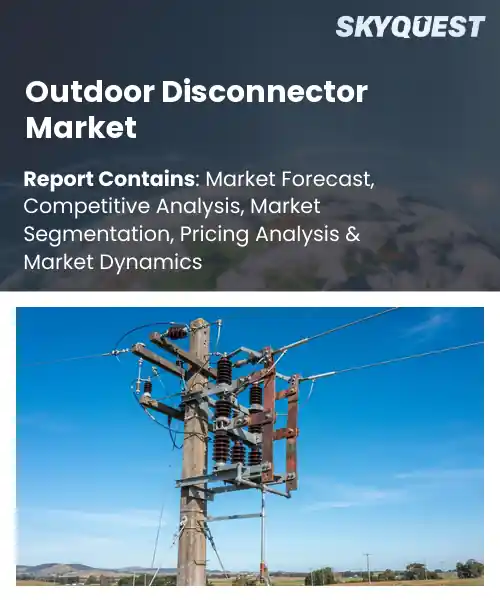
Outdoor Disconnector Market
Report ID: SQMIG20D2870
Report ID: SQMIG20D2870
[email protected]
USA +1 351-333-4748
Report ID:
SQMIG20D2870 |
Region:
Global |
Published Date: August, 2026
Pages:
157
|Tables:
144
|Figures:
78


Global Outdoor Disconnector Market size was valued at USD 2.42 Billion in 2024 and is poised to grow from USD 2.57 Billion in 2025 to USD 4.13 Billion by 2033, growing at a CAGR of 6.1% during the forecast period (2026-2033).
The outdoor disconnector market comprises devices that isolate electrical circuits in installations such as substations, renewable‑energy farms, and utility networks. Its relevance stems from the need to protect personnel, equipment, and the grid from fault currents, especially as power systems become more decentralized and exposed to harsh conditions. Historically, the market was dominated by legacy oil‑filled breakers, but the shift toward vacuum and SF6‑free technologies accelerated after 2010 when regulatory pressure and the 2015 IEEE standards raised safety thresholds. The expansion of solar farms in India and United States created demand for disconnectors that can be serviced without de‑energizing site. Regulatory incentives for low‑emission grids drive the growth factor for outdoor disconnectors, because utilities must meet carbon‑reduction targets while maintaining reliability. The cause‑effect chain begins with stricter emission caps, which compel operators to replace aging oil‑filled breakers with vacuum or gas‑alternative units that emit negligible greenhouse gases. In practice, European transmission operators have launched retrofit programs that allocate billions of euros to upgrade substations, creating a pipeline of orders for modular disconnectors that support maintenance. This trend simultaneously opens opportunities for manufacturers to introduce smart devices that integrate monitoring sensors, allowing predictive maintenance that reduces outage time and operational expense.
What impact does IoT integration have on reliability in the outdoor disconnector market?
IoT integration enhances reliability in outdoor disconnectors by adding continuous monitoring, remote diagnostics and predictive maintenance capabilities. Sensors embedded in the switch can track temperature, vibration and contact wear, sending data to cloud platforms where algorithms flag anomalies before a fault occurs. This real‑time insight reduces unexpected outages and extends equipment life, which is critical for utilities operating in harsh weather and remote locations. The technology also enables automated shutdowns when unsafe conditions are detected, improving operator safety. As the market expands to meet growing demand for resilient power distribution, manufacturers are embedding IoT modules to differentiate their products and meet stricter reliability expectations.Siemens introduced an IoT enabled outdoor disconnector in March 2024, demonstrating how real‑time data collection can streamline maintenance schedules and boost overall system uptime, reinforcing market growth through enhanced efficiency.
Market snapshot - (2026-2033)
Global Market Size
USD 2.42 Billion
Largest Segment
Medium Voltage
Fastest Growth
Extra High Voltage
Growth Rate
6.1% CAGR
To get more insights on this market click here to Request a Free Sample Report
Global outdoor disconnector market is segmented by voltage rating, disconnector type, installation, operation, end user and region. Based on voltage rating, the market is segmented into Medium Voltage, High Voltage and Extra High Voltage. Based on disconnector type, the market is segmented into Center Break, Double Break, Vertical Break and Pantograph. Based on installation, the market is segmented into Transmission Substations, Distribution Substations and Renewable Energy Facilities. Based on operation, the market is segmented into Manual and Motorized. Based on end user, the market is segmented into Utilities, Industrial Facilities and Infrastructure. Based on region, the market is segmented into North America, Europe, Asia Pacific, Latin America and Middle East & Africa.
Medium Voltage segment dominates because it aligns with the bulk of existing grid infrastructure, where most outdoor disconnectors are required for both transmission and distribution loops. Its widespread adoption is reinforced by mature design standards, reliable performance, and cost effective manufacturing, which together create a low barrier to entry for manufacturers and a predictable procurement cycle for buyers. These factors sustain strong demand and cement its leading position in the market across utilities, industrial sites and infrastructure projects.
However, High Voltage segment is witnessing the strongest growth momentum as grid modernization initiatives drive the need for higher capacity outdoor disconnectors. Advanced insulation technologies and expanded renewable integration create new demands, prompting manufacturers to innovate and expand product lines, thereby accelerating market expansion and opening fresh opportunities for stakeholders.
Manual segment leads because it offers proven simplicity and low maintenance, traits highly valued in remote outdoor installations where reliability and ease of service are paramount. Operators favor tactile control that does not depend on power supply, reducing complexity and risk of failure. This reliability, combined with lower upfront cost and established engineering standards, sustains strong procurement preference and secures its dominant market position across utilities, industrial sites and infrastructure projects.
Meanwhile, Motorized segment is emerging as the key high growth area as digitalization and remote operation become critical for grid management. Integration with SCADA systems and advances in actuation reduce response time and labor costs, spurring adoption across transmission and renewable projects, thereby accelerating market expansion and creating value chains for manufacturers.
To get detailed segments analysis, Request a Free Sample Report
North America leads due to mature infrastructure, extensive utility networks, strong emphasis on safety standards, and robust supply chain integration. The region benefits from advanced engineering capabilities and a high adoption rate of modern grid technologies that demand reliable outdoor disconnectors. End users in industrial, commercial, and residential sectors prioritize resilience and compliance, driving sustained procurement. Regulatory frameworks in both United States and Canada encourage the deployment of high‑performance disconnectors, while local manufacturers invest heavily in research and development. Collaborative partnerships between equipment makers and service providers further cement the market position, ensuring that North America remains the reference point for innovation and product reliability in the outdoor disconnector space.
Outdoor Disconnector Market in United States is shaped by a strong focus on grid modernization and stringent safety codes. Utility operators prioritize advanced disconnectors to support increasing renewable integration and demand response programs. Domestic manufacturers leverage extensive engineering expertise to deliver customized solutions, while a network of distributors ensures wide availability. The emphasis on reliability and compliance sustains a vibrant ecosystem that continually refines product performance across diverse applications.
Outdoor Disconnector Market in Canada benefits from a collaborative regulatory environment that promotes safety and reliability across expansive transmission networks. Provincial utilities invest in resilient disconnectors to address harsh climatic conditions and remote infrastructure challenges. Local manufacturers emphasize robust design and testing, aligning with national standards that prioritize performance under extreme temperatures. This focus on durability and strategic partnerships with service providers sustains a steady demand for high‑quality outdoor disconnectors throughout the country.
Europe sees rapid expansion due to strong emphasis on renewable integration, harmonized safety directives, and a culture of engineering excellence. The region’s commitment to decarbonization compels utilities to upgrade aging infrastructure with modern disconnectors that can handle variable generation. Cross‑border collaboration and standardized technical specifications simplify market entry, fostering competition among manufacturers. Furthermore, the presence of highly skilled research institutions drives continuous innovation in materials and design, enhancing performance and longevity. Policy frameworks encourage investment in smart grid solutions, positioning outdoor disconnectors as essential components for grid resilience. Together, these factors create a dynamic environment where demand accelerates across both established and emerging European markets.
Outdoor Disconnector Market in Germany is anchored by a rigorous engineering culture and stringent national safety standards. Utilities prioritize high‑performance disconnectors to support extensive renewable energy projects and complex grid interconnections. Domestic producers benefit from close collaboration with research institutes, leading to advanced material applications and compact designs. The emphasis on reliability and lifecycle efficiency drives procurement strategies that favor long‑term solutions, reinforcing Germany’s role as a benchmark for quality and innovation within the European landscape.
Outdoor Disconnector Market in United Kingdom experiences rapid growth fueled by aggressive grid modernization initiatives and a strong focus on resilience. The shift toward distributed generation and smart network technologies amplifies the need for adaptable disconnectors that can operate under diverse load conditions. Domestic manufacturers are expanding capabilities to meet evolving regulatory expectations, while import channels provide complementary expertise. This dynamic environment, combined with policy incentives for infrastructure upgrades, positions the United Kingdom as the fastest‑growing market for outdoor disconnectors across Europe.
Outdoor Disconnector Market in France is emerging as a vibrant segment driven by national commitments to energy transition and grid reinforcement. French utilities seek robust disconnectors to accommodate increasing renewable integration and to enhance system reliability in varied climatic zones. Local engineering firms are adopting innovative design approaches that emphasize modularity and ease of maintenance. Collaborative projects with European research bodies further stimulate product development, establishing France as a promising arena for future growth in outdoor disconnectors.
Asia Pacific is strengthening its position through a combination of rapid industrialization, expanding power infrastructure, and a proactive focus on safety and reliability. Nations in the region are undertaking extensive grid extensions to serve burgeoning urban populations and emerging economies, creating a substantial demand for dependable outdoor disconnectors. Technological advancements in manufacturing processes enable local producers to deliver cost‑effective yet high‑quality solutions tailored to diverse environmental conditions. Strategic investments in research and development foster innovation in compact and weather‑resistant designs, while government initiatives promote standardization and compliance. This confluence of infrastructure growth, engineering capability, and regulatory support propels Asia Pacific toward a more prominent role in the global outdoor disconnector landscape.
Outdoor Disconnector Market in Japan reflects a deep commitment to precision engineering and resilience against seismic activity. Utilities prioritize disconnectors that can sustain performance under stringent safety regulations and frequent natural disturbances. Domestic manufacturers integrate advanced materials and meticulous testing protocols to achieve high reliability. Collaborative efforts with research institutions drive continuous improvements in compact form factors and rapid deployment techniques, supporting the nation’s extensive high‑voltage network and evolving renewable integration strategies.
Outdoor Disconnector Market in South Korea benefits from aggressive modernization of its power grid and strong governmental support for smart energy solutions. The emphasis on digitalization and renewable incorporation drives demand for versatile disconnectors capable of seamless integration with intelligent monitoring systems. Local manufacturers leverage cutting‑edge technology platforms to produce robust, compact units that meet rigorous performance criteria. This focus on innovation and strategic policy alignment enhances South Korea’s capacity to expand its presence in the regional outdoor disconnector market.
To know more about the market opportunities by region and country, click here to
Buy The Complete Report
Increasing Renewable Energy Adoption
Advancements In Smart Grid Technologies
High Initial Capital Expenditure
Regulatory Compliance Complexity
Request Free Customization of this report to help us to meet your business objectives.
The outdoor disconnector market is intensely competitive, driven by the need for higher safety and operational efficiency in power distribution. Leading manufacturers are accelerating growth through strategic M&A, forming joint ventures to expand geographic reach, and investing in digital‑enabled switch designs that incorporate real‑time monitoring and predictive maintenance, thereby differentiating their product portfolios.
Top Player’s Company Profile
Recent Developments
SkyQuest’s ABIRAW (Advanced Business Intelligence, Research & Analysis Wing) is our Business Information Services team that Collects, Collates, Correlates, and Analyses the Data collected by means of Primary Exploratory Research backed by robust Secondary Desk research. As per SkyQuest analysis the outdoor disconnector market is being propelled primarily by the rapid uptake of renewable energy, which creates strong demand for reliable isolation equipment across new solar and wind sites, while a second important driver is the rollout of smart‑grid technologies that embed connectivity and predictive maintenance into the switches. The market is still constrained by the high upfront capital required to purchase and install rugged, certified units, a factor that can deter smaller players. North America remains the dominant region thanks to its mature grid, strict safety standards and robust supply chain, and the medium‑voltage segment leads in volume because it matches the bulk of existing transmission and distribution infrastructure.
| Report Metric | Details |
|---|---|
| Market size value in 2024 | USD 2.42 Billion |
| Market size value in 2033 | USD 4.13 Billion |
| Growth Rate | 6.1% |
| Base year | 2024 |
| Forecast period | (2026-2033) |
| Forecast Unit (Value) | USD Billion |
| Segments covered |
|
| Regions covered | North America (US, Canada), Europe (Germany, France, United Kingdom, Italy, Spain, Rest of Europe), Asia Pacific (China, India, Japan, Rest of Asia-Pacific), Latin America (Brazil, Rest of Latin America), Middle East & Africa (South Africa, GCC Countries, Rest of MEA) |
| Companies covered |
|
| Customization scope | Free report customization with purchase. Customization includes:-
|
To get a free trial access to our platform which is a one stop solution for all your data requirements for quicker decision making. This platform allows you to compare markets, competitors who are prominent in the market, and mega trends that are influencing the dynamics in the market. Also, get access to detailed SkyQuest exclusive matrix.
Table Of Content
Executive Summary
Market overview
Parent Market Analysis
Market overview
Market size
KEY MARKET INSIGHTS
COVID IMPACT
MARKET DYNAMICS & OUTLOOK
Market Size by Region
KEY COMPANY PROFILES
Methodology
For the Outdoor Disconnector Market, our research methodology involved a mixture of primary and secondary data sources. Key steps involved in the research process are listed below:
1. Information Procurement: This stage involved the procurement of Market data or related information via primary and secondary sources. The various secondary sources used included various company websites, annual reports, trade databases, and paid databases such as Hoover's, Bloomberg Business, Factiva, and Avention. Our team did 45 primary interactions Globally which included several stakeholders such as manufacturers, customers, key opinion leaders, etc. Overall, information procurement was one of the most extensive stages in our research process.
2. Information Analysis: This step involved triangulation of data through bottom-up and top-down approaches to estimate and validate the total size and future estimate of the Outdoor Disconnector Market.
3. Report Formulation: The final step entailed the placement of data points in appropriate Market spaces in an attempt to deduce viable conclusions.
4. Validation & Publishing: Validation is the most important step in the process. Validation & re-validation via an intricately designed process helped us finalize data points to be used for final calculations. The final Market estimates and forecasts were then aligned and sent to our panel of industry experts for validation of data. Once the validation was done the report was sent to our Quality Assurance team to ensure adherence to style guides, consistency & design.
Analyst Support
Customization Options
With the given market data, our dedicated team of analysts can offer you the following customization options are available for the Outdoor Disconnector Market:
Product Analysis: Product matrix, which offers a detailed comparison of the product portfolio of companies.
Regional Analysis: Further analysis of the Outdoor Disconnector Market for additional countries.
Competitive Analysis: Detailed analysis and profiling of additional Market players & comparative analysis of competitive products.
Go to Market Strategy: Find the high-growth channels to invest your marketing efforts and increase your customer base.
Innovation Mapping: Identify racial solutions and innovation, connected to deep ecosystems of innovators, start-ups, academics, and strategic partners.
Category Intelligence: Customized intelligence that is relevant to their supply Markets will enable them to make smarter sourcing decisions and improve their category management.
Public Company Transcript Analysis: To improve the investment performance by generating new alpha and making better-informed decisions.
Social Media Listening: To analyze the conversations and trends happening not just around your brand, but around your industry as a whole, and use those insights to make better Marketing decisions.
REQUEST FOR SAMPLE
 REQUEST FREE CUSTOMIZATION


Want to customize this report? This report can be personalized according to your needs. Our analysts and industry experts will work directly with you to understand your requirements and provide you with customized data in a short amount of time. We offer $1000 worth of FREE customization at the time of purchase.
Feedback From Our Clients


 USA (+1) 351-333-4748

