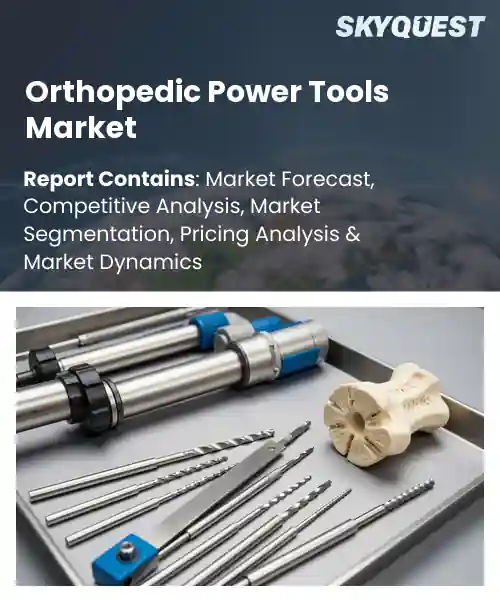
Orthopedic Power Tools Market
Report ID: SQMIG35A3770
Report ID: SQMIG35A3770
[email protected]
USA +1 351-333-4748
Report ID:
SQMIG35A3770 |
Region:
Global |
Published Date: June, 2026
Pages:
157
|Tables:
119
|Figures:
77


Global Orthopedic Power Tools Market size was valued at USD 1.52 Billion in 2024 and is poised to grow from USD 1.63 Billion in 2025 to USD 2.85 Billion by 2033, growing at a CAGR of 7.22% during the forecast period (2026-2033).
The orthopedic power tools market is about high-precision electric and pneumatic instruments, used for bone cutting, drilling, reaming, and fixation during joint replacement, trauma work, and spine surgeries. And it matters because these devices end up shaping operative efficiency, patient outcomes, and even how fast hospitals can move cases through. The main pull is the growth in musculoskeletal disorders, tied to aging populations, obesity, and sports injuries, so demand for arthroplasty as well as trauma procedures keeps climbing.
On top of that, one of the big growth factors is navigation and robotic interfaces getting stitched in more deeply, which boosts procedural accuracy, and that in turn nudges hospitals to invest in power tools that work with those systems. So manufacturers lean toward interoperable, software-enabled handpieces. As surgeons keep adopting minimally invasive and outpatient arthroplasty methods, the demand also tilts toward lighter cordless systems, mostly because they can shorten operating time and help with faster patient turnover. Same-day knee replacement is a good example here, and it depends on compact drills. At the same time infection control is getting more attention, plus hospitals are watching costs closely, so modular disposable attachments and predictive maintenance services are drawing interest. That creates opportunities in developed markets, but also in emerging healthcare settings, where upgrades are still rolling out.
AI helps by connecting smarter preoperative planning with intraoperative navigation, and then adding adaptive control to the instrument itself. The big pieces include AI-driven anatomy modeling, sensor-based motion compensation, and real time feedback that guides drilling and cutting. Right now, the landscape shows major manufacturers embedding AI into handheld robotics and connected power tools, aiming to reduce variability and to streamline the steps surgeons follow. The market environment tends to reward solutions that improve reproducibility and reduce revision risk. Advanced handheld robotics and new powered instrument platforms that mix vision, force sensing, and workflow intelligence, all so surgeons can turn a plan into precise action more consistently.
Market snapshot - (2026-2033)
Global Market Size
USD 1.52 Billion
Largest Segment
Surgical Drills
Fastest Growth
Reamers
Growth Rate
7.22% CAGR
To get more insights on this market click here to Request a Free Sample Report
The global orthopedic power tools market is segmented by product type, power source, application, end-user and region. Based on product type, the market is segmented into Surgical Drills, Sagittal Saws, Oscillating Saws, Pin Drivers and Reamers. Based on power source, the market is segmented into Battery-Operated, Pneumatic (Air-Powered) and Electric (Corded). Based on application, the market is segmented into Joint Replacement, Spine Surgery and Trauma Surgery. Based on end-user, the market is segmented into Hospitals, Orthopedic Clinics and ASCs. Based on region, the market is segmented into North America, Europe, Asia Pacific, Latin America and Middle East & Africa.
As per the orthopedic power tools market analysis, the Surgical Drills segment dominates because these instruments are plainly indispensable across a broad mix of orthopedic surgeries, giving careful bone preparation plus implant fixation. The reason they stay on top is continuous progress in ergonomic design and motor control, plus surgeon familiarity, and also compatibility with various implant systems. That combination helps operating theater workflows move faster, and keeps clinical results more predictable so procurement teams keep leaning their way, which keeps demand steady and makes hospitals and clinics keep prioritizing equipment purchases.
Still, Reamers are getting the fastest growth, and it’s visible since surgeons are switching to more advanced bone-shaping tools for intricate implant work and navigated procedures. New cutting geometries, better materials, and tighter integration with guided systems expand where these tools can actually be used. With more people asking for procedure-tailored reamers, and with improved efficiency, procurement focus is being pulled toward them faster, opening room for specialized product portfolios too.
According to the orthopedic power tools market forecast, Battery-Operated segment leads because cordless setups, basically let clinicians move around more freely during surgery and cut down the time spent on set up stuff, which matches the preference for streamlined workflows. Battery energy density is improving, and brushless motor efficiency is helping extend run time and keep torque more consistent, so coverage across more procedures becomes practical. Also there’s lower operating overhead, simpler sterility processes, and it fits with modular handpieces, so purchasing decisions stay strong in hospitals, clinics, and ambulatory centers. All of that builds clinician advocacy and keeps shifting procurement preference toward cordless.
However, Pneumatic (Air-Powered) units are showing the fastest growth right now, mostly due to dependable high torque, long durability, and easier sterilization when procedures drag on for a while. More spending on centralized air infrastructure is helping too, plus handpiece ergonomics improvements are making them feel better during long sessions. This is expanding interest in high volume trauma and spine environments, and it creates chances for suppliers offering durable, serviceable tools.
To get detailed segments analysis, Request a Free Sample Report
As per the orthopedic power tools market regional forecast, North America dominates, mostly because there is this integrated healthcare, plus the surgical stuff is advanced, and a bunch of the biggest manufacturers are concentrated there too. There are strong clinical research networks, and the reimbursement environment is favorable, so people actually adopt the technologically advanced instruments faster than other regions. Big hospital systems and dedicated orthopedic centers keep demand steady, especially for precision power tools and those related disposables. Also, there is close collaboration between manufacturers , surgeons, and regulatory stakeholders, and it speeds up clinical validation and makes product refinement more fluid. On top of that, there is availability of capital for innovation with active private and public investment, which helps development and commercialization move quickly. And once regulators are clear, with established device safety standards , barriers drop. That basically strengthens competitive advantage and keeps investor confidence higher.
United States Orthopedic Power Tools Market
The Orthopedic Power Tools sector in the United States benefits from early clinical adoption, and see a widespread presence of specialized orthopedic centers plus proximity to major device manufacturers and research institutions. Clinician involvement in device design, along with strong surgical training programs, helps push uptake of innovative powered instruments. Integrated supply chains and service networks make maintenance and upgrades easier, so adoption keeps building. With a receptive regulatory and reimbursement landscape, and ongoing investment , the environment stays dynamic for product refinement and commercialization.
Canada Orthopedic Power Tools Market
The Orthopedic Power Tools industry in Canada is supported by academic hospitals and regional training centers, there is collaborative research happening too, and growing engagement with international device developers and manufacturers. Clinician-led evaluations and centralized procurement tends to stress quality , but also cost effectiveness, in a way. Integrated maintenance and training services improve usability, and the policy frameworks around patient safety and value based care encourage selective adoption of powered instrumentation. That also supports partnerships for localized product adaptation and skill development, which is kind of the whole point.
European Orthopedic Power Tools market penetration is driven by advanced clinical expertise, plus concentrated centers of excellence in orthopedics, and also pan regional research and procurement initiatives that work together. There’s a strong manufacturer presence, and the distribution network is well established, so access to high quality powered instruments stays consistent. More focus on surgical outcomes, plus standardization across healthcare systems, pushes adoption of precision devices and training programs. Then reimbursement frameworks that recognize device value help too, and combined with cross border partnerships and clinical registries, they support evidence generation and product refinement. Market dynamics also show strategic investments from domestic and international players, they’re aligning portfolios with regional clinical needs and regulatory expectations. So Europe is maturing quickly, but with differentiated national profiles. On top of that, the emphasis on minimally invasive techniques, and surgeon training , keeps raising market sophistication.
Germany Orthopedic Power Tools Market
The Orthopedic Power Tools Market in Germany is anchored by a strong medical device manufacturing base, specialized orthopedic hospitals, and strict regulatory plus quality standards. There are tight links between industry and clinical experts , so product development and domestic production of advanced powered instruments can move along. Procurement and hospital networks enable reliable supply and service, and the focus stays on clinical evidence and surgical training, which helps physician confidence. That reinforces preference for precision devices aligned with national procedural practices.
United Kingdom Orthopedic Power Tools Market
The Orthopedic Power Tools Market in United Kingdom shows clinical adoption that’s helped by private and public hospital engagement, academic partnerships, and participation in innovation ecosystems. Surgeons and procurement teams often prioritize instruments that support minimally invasive approaches, while also aiming for reproducible outcomes. Training programs plus vendor relationships help accelerate integration of advanced powered devices and adoption. And because there’s a policy focus on outcome driven procurement, solutions tend to blend performance, service, and clinical value across care pathways.
France Orthopedic Power Tools Market
The Orthopedic Power Tools Market in France is emerging through collaboration between public hospitals, academic centers, and manufacturers. There’s emphasis on cost effectiveness and evidence based procurement guides, so they guide the evaluation of powered instruments. Pilot adoption at specialized orthopedic centers, along with regional networks, supports wider diffusion. Clinician training and after sales support add to usability, and partnerships with international suppliers plus some local adaptation help tailor solutions to national clinical pathways, budgetary priorities, and scalability.
Asia Pacific is strengthening its position not only because of technological advancement , but also from expanding clinical capacity. This can be also seen in the closer collaboration with global device manufacturers, and the whole thing feels like it’s moving in tandem. In different places, emerging centers of excellence and specialized orthopedic units are improving surgical capabilities, which then creates demand for reliable powered instruments. At the same time, local manufacturing capability together with supply chain diversification helps improve access and cost competitiveness across a variety of healthcare settings. Government initiatives that support medical technology, plus investments in clinician training, push adoption forward. Also strategic alliances between international vendors and regional partners help with product localization and slightly customized service models that match distinct procedural preferences and procurement practices, so the region keeps rising in the global market. And then there is the clinical side, rising clinical demand coming from expanding surgical volumes and also the focus on minimally invasive care, which increases the need for durable and precise instrumentation. Finally, enhanced post market surveillance and regional clinical registries support evidence generation that backs localized product refinement and builds clinician confidence.
Japan Orthopedic Power Tools Market
In Japan, the Orthopedic Power Tools Market is driven by advanced manufacturing capabilities, an integration between device makers and clinical research institutions, and a clear focus on precision engineering. There are also standards for device quality plus surgeon training , and these factors support the adoption of more sophisticated powered instruments. Collaborative research and programs at leading hospitals help with validation and refinement. Partnerships with global suppliers, and the emphasis on minimally invasive techniques, shape product specifications and service models that are tailored to local surgical practice.
South Korea Orthopedic Power Tools Market
In South Korea, the Orthopedic Power Tools Market benefits from precision engineering capabilities, plus the integration of electronics in device design. There’s also cooperation between technology firms and clinical teams, which matters. Specialized hospitals and a strong focus on minimally invasive procedures foster demand for reliable powered instruments. Collaboration with global medical device companies supports localization and helps with regulatory alignment. And there is an emphasis on surgeon training, service support , and quality assurance , which supports clinician confidence and broader clinical adoption. It also strengthens export potential.
To know more about the market opportunities by region and country, click here to
Buy The Complete Report
Technological Innovation and Precision Control
Integration With Navigation and Robotics
High Cost Of Advanced Systems
Regulatory Complexity and Reimbursement Challenges
Request Free Customization of this report to help us to meet your business objectives.
In the orthopedic power tools space, the whole competitive landscape kind of gets pushed around by a mix of product innovation, M&A activity, and partnerships that link tools into navigation and robotics ecosystems. Big players are doing acquisitions and system launches, like DePuy Synthes UNIUM and Arthrex Synergy Power, while also threading drills into robotic platforms so OR workflows basically stay “locked in” and consumables keep flowing. Then there are distribution deals, those tend to speed up startup access to surgeons, and they also crank up the rivalry around integrated procedure paths, not just standalone devices.
Top Player’s Company Profile
Recent Developments in the Orthopedic Power Tools Market
SkyQuest’s ABIRAW (Advanced Business Intelligence, Research & Analysis Wing) is our Business Information Services team that Collects, Collates, Correlates, and Analyses the Data collected by means of Primary Exploratory Research backed by robust Secondary Desk research.
As per SkyQuest analysis, the global orthopedic power tools market is growing as a key factor the rising incidence of musculoskeletal disorders. Aging, obesity and sports injuries are part of the reason, and that increases demand for joint replacement, spine work, and trauma procedures. Another driver is the expanding integration with navigation and robotic platforms, which is improving both accuracy and procedure efficiency. That makes hospitals more likely to invest. Still, a major limitation stays the high purchase and upkeep costs of advanced systems, which tends to slow adoption among smaller centers. North America is the leading region due to advanced surgical infrastructure and early tech uptake, and surgical drills are the top product segment because they cover a wide range of procedures and surgeons are already very used to them.
| Report Metric | Details |
|---|---|
| Market size value in 2024 | USD 1.52 Billion |
| Market size value in 2033 | USD 2.85 Billion |
| Growth Rate | 7.22% |
| Base year | 2024 |
| Forecast period | (2026-2033) |
| Forecast Unit (Value) | USD Billion |
| Segments covered |
|
| Regions covered | North America (US, Canada), Europe (Germany, France, United Kingdom, Italy, Spain, Rest of Europe), Asia Pacific (China, India, Japan, Rest of Asia-Pacific), Latin America (Brazil, Rest of Latin America), Middle East & Africa (South Africa, GCC Countries, Rest of MEA) |
| Companies covered |
|
| Customization scope | Free report customization with purchase. Customization includes:-
|
To get a free trial access to our platform which is a one stop solution for all your data requirements for quicker decision making. This platform allows you to compare markets, competitors who are prominent in the market, and mega trends that are influencing the dynamics in the market. Also, get access to detailed SkyQuest exclusive matrix.
Table Of Content
Executive Summary
Market overview
Parent Market Analysis
Market overview
Market size
KEY MARKET INSIGHTS
COVID IMPACT
MARKET DYNAMICS & OUTLOOK
Market Size by Region
KEY COMPANY PROFILES
Methodology
For the Orthopedic Power Tools Market, our research methodology involved a mixture of primary and secondary data sources. Key steps involved in the research process are listed below:
1. Information Procurement: This stage involved the procurement of Market data or related information via primary and secondary sources. The various secondary sources used included various company websites, annual reports, trade databases, and paid databases such as Hoover's, Bloomberg Business, Factiva, and Avention. Our team did 45 primary interactions Globally which included several stakeholders such as manufacturers, customers, key opinion leaders, etc. Overall, information procurement was one of the most extensive stages in our research process.
2. Information Analysis: This step involved triangulation of data through bottom-up and top-down approaches to estimate and validate the total size and future estimate of the Orthopedic Power Tools Market.
3. Report Formulation: The final step entailed the placement of data points in appropriate Market spaces in an attempt to deduce viable conclusions.
4. Validation & Publishing: Validation is the most important step in the process. Validation & re-validation via an intricately designed process helped us finalize data points to be used for final calculations. The final Market estimates and forecasts were then aligned and sent to our panel of industry experts for validation of data. Once the validation was done the report was sent to our Quality Assurance team to ensure adherence to style guides, consistency & design.
Analyst Support
Customization Options
With the given market data, our dedicated team of analysts can offer you the following customization options are available for the Orthopedic Power Tools Market:
Product Analysis: Product matrix, which offers a detailed comparison of the product portfolio of companies.
Regional Analysis: Further analysis of the Orthopedic Power Tools Market for additional countries.
Competitive Analysis: Detailed analysis and profiling of additional Market players & comparative analysis of competitive products.
Go to Market Strategy: Find the high-growth channels to invest your marketing efforts and increase your customer base.
Innovation Mapping: Identify racial solutions and innovation, connected to deep ecosystems of innovators, start-ups, academics, and strategic partners.
Category Intelligence: Customized intelligence that is relevant to their supply Markets will enable them to make smarter sourcing decisions and improve their category management.
Public Company Transcript Analysis: To improve the investment performance by generating new alpha and making better-informed decisions.
Social Media Listening: To analyze the conversations and trends happening not just around your brand, but around your industry as a whole, and use those insights to make better Marketing decisions.
REQUEST FOR SAMPLE
 REQUEST FREE CUSTOMIZATION
Global Orthopedic Power Tools Market size was valued at USD 1.52 Billion in 2024 and is poised to grow from USD 1.63 Billion in 2025 to USD 2.85 Billion by 2033, growing at a CAGR of 7.22% during the forecast period (2026-2033).
Competitive landscape in orthopedic power tools is shaped by product innovation, M&A, and partnerships that tie tools into navigation and robotics ecosystems. Large incumbents pursue acquisitions and system launches such as DePuy Synthes UNIUM and Arthrex Synergy Power while integrating drills into robotic platforms to lock in OR workflows and consumable streams. Strategic distribution deals accelerate startup access to surgeons and intensify competition over integrated workflows. 'Stryker Corporation', 'Johnson & Johnson (DePuy Synthes)', 'Zimmer Biomet', 'Medtronic plc', 'Smith & Nephew', 'Arthrex Inc.', 'ConMed Corporation', 'Aesculap (B. Braun)', 'Biomet (Zimmer)', 'Exactech Inc.', 'Symmetry Medical', 'MicroAire Surgical Instruments', 'Brasseler USA', 'Integra LifeSciences', 'CONMED Corporation', 'Jai Healthcare', 'NSK Ltd.', 'Nouvag AG', 'Dentsply IH AB', 'Mopec Medical'
Technological advances in motor efficiency, control systems, and instrument miniaturization enhance surgical performance and surgeon confidence, leading to broader adoption. Improved precision control reduces risk to surrounding tissues and supports complex procedures previously considered challenging, which encourages hospitals to invest in updated equipment. Enhanced ergonomic design and smoother integration with surgical workflows increase procedural efficiency and reduce fatigue, making these tools more attractive. Overall, continued innovation raises clinical utility and perceived value, driving procurement decisions and expanding the market for orthopedic power tools.
Minimally Invasive Surgery Shift: The rising preference for minimally invasive orthopedic procedures is reshaping power tool design toward smaller, precision-driven instruments with improved ergonomics and quieter operation. Manufacturers prioritize adaptability to constrained anatomical access, compatibility with sterilization protocols, and surgeon-centered controls that facilitate refined tactile feedback. Hospitals and surgical teams favor systems that support streamlined workflows, reduce soft tissue trauma, and enable faster patient recovery pathways, prompting suppliers to invest in specialized handpieces, modular attachments, and targeted surgeon training and support services.
Why does North America Dominate the Global Orthopedic Power Tools Market? |@12


Want to customize this report? This report can be personalized according to your needs. Our analysts and industry experts will work directly with you to understand your requirements and provide you with customized data in a short amount of time. We offer $1000 worth of FREE customization at the time of purchase.
Feedback From Our Clients


 USA (+1) 351-333-4748

