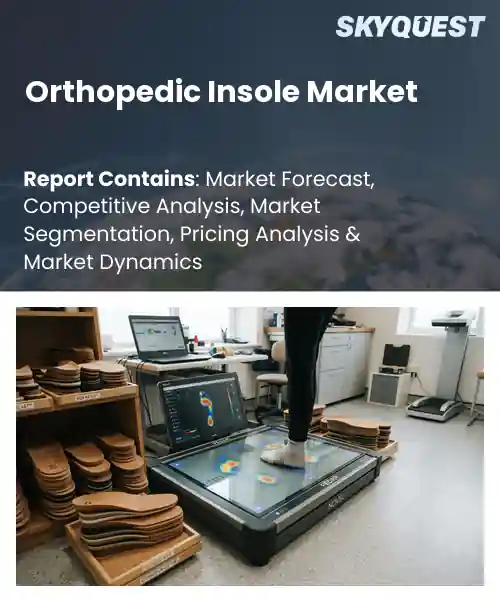
Orthopedic Insole Market
Report ID: SQMIG35B2536
Report ID: SQMIG35B2536
[email protected]
USA +1 351-333-4748
Report ID:
SQMIG35B2536 |
Region:
Global |
Published Date: September, 2026
Pages:
157
|Tables:
144
|Figures:
78


Global Orthopedic Insole Market size was valued at USD 2.83 Billion in 2024 and is poised to grow from USD 3.0 Billion in 2025 to USD 4.73 Billion by 2033, growing at a CAGR of 5.87% during the forecast period (2026-2033).
The global orthopedic insole market includes foot supports that relieve pain, correct alignment, and improve mobility for patients with musculoskeletal disorders. Its importance grows with the rising prevalence of plantar fasciitis, diabetic neuropathy, and age‑related arthritis, which push demand for therapeutic footwear. The market has shifted from simple leather inserts in the early 1900s to polymeric and 3‑D‑printed devices that incorporate biomechanical data. A 2015 German study showed sensor‑guided insoles cut gait asymmetry by 30 % highlighting clinical value. This evolution demonstrates how material science and digital health have turned a niche accessory into a core element of preventive and rehabilitative care. One key factor propelling the global orthopedic insole market is the integration of smart sensor technology, which converts passive footwear into a health monitoring platform. By embedding pressure and motion sensors, manufacturers enable clinicians to collect gait metrics, allowing early detection of biomechanical abnormalities and adjustments. This capability has opened opportunities in rehabilitation, where patients in remote regions receive connected insoles that sync with mobile apps, reducing clinic visits and lowering treatment costs. For instance, a startup reported a 25 % increase in adherence among diabetic patients using connected insoles, illustrating how data accessibility drives clinical outcomes and fuels market expansion.
How is AI-driven customization shaping the orthopedic insole market?
AI driven customization is reshaping the orthopedic insole market by merging sensor data, machine learning algorithms and rapid manufacturing. The technology captures a wearer’s pressure distribution, gait pattern and foot geometry, then generates a digital model that translates into a 3D printed or CNC machined insole tailored to individual needs. Clinicians now use handheld scanners or smartphone apps to gather precise measurements, reducing the reliance on generic stock inserts. This shift shortens fitting cycles, improves patient comfort and lowers return rates, making personalized orthotics more accessible to both specialty clinics and direct to consumer platforms. As supply chains become more flexible, manufacturers can scale small batch production without sacrificing quality.In September 2023 Aetrex introduced an AI powered custom footbed that combines cloud based gait analysis with on demand 3D printing, allowing retailers to deliver a fit for purpose insole within days. The rollout has accelerated market adoption by demonstrating how data driven design can streamline production and enhance patient outcomes.
Market snapshot - (2026-2033)
Global Market Size
USD 2.83 Billion
Largest Segment
Custom Orthopedic Insoles
Fastest Growth
Functional Orthopedic Insoles
Growth Rate
5.87% CAGR
To get more insights on this market click here to Request a Free Sample Report
Global orthopedic insole market is segmented by product type, material, application, end user, distribution channel and region. Based on product type, the market is segmented into Custom Orthopedic Insoles, Prefabricated Orthopedic Insoles and Functional Orthopedic Insoles. Based on material, the market is segmented into Foam, Thermoplastic, Silicone and Carbon Fiber. Based on application, the market is segmented into Foot & Ankle Disorders, Sports Injury Prevention and Post-Surgical Rehabilitation. Based on end user, the market is segmented into Adults and Pediatric Patients. Based on distribution channel, the market is segmented into Hospitals & Clinics, Specialty Stores and Online Retail. Based on region, the market is segmented into North America, Europe, Asia Pacific, Latin America and Middle East & Africa.
Custom Orthopedic Insoles segment dominates because clinicians prioritize personalized fit that addresses unique biomechanical deviations, leading to superior therapeutic efficacy. Tailored manufacturing enables precise arch support, pressure redistribution and alignment correction, fostering higher patient compliance and reduced pain recurrence. The ability to integrate patient specific diagnostics with digital scanning reinforces trust among prescribers, cementing its central role in the orthopedic insole market.
Meanwhile, Functional Orthopedic Insoles segment emerges as the most rapidly expanding area because its engineered properties target performance oriented users, combining shock absorption with motion control. Growing sport science interest and consumer demand for active lifestyle support drive adoption, prompting manufacturers to invest in hybrid designs that enhance durability and comfort, creating fresh market growth.
Thermoplastic segment dominates because its blend of moldability and cost efficiency enables scalable production while maintaining sufficient support for a broad patient base. The material’s ability to be thermoformed to individual foot contours simplifies clinical workflows, encouraging widespread adoption in hospitals and clinics. Its established supply chain and regulatory familiarity further reinforce confidence among manufacturers and prescribers, securing its leading position in the orthopedic insole market.
Conversely, Carbon Fiber segment is witnessing the strongest growth momentum because its exceptional stiffness to weight ratio introduces unprecedented biomechanical efficiency for high performance users. Ongoing research into lightweight load distribution and increasing demand from athletic rehabilitation drive interest, prompting innovators to integrate carbon fiber layers into premium insoles, thereby expanding market appeal and stimulating new revenue streams.
To get detailed segments analysis, Request a Free Sample Report
North America maintains a leading position due to a mature healthcare ecosystem that rapidly incorporates advanced therapeutic footwear technologies. Strong reimbursement frameworks, extensive clinical research networks, and well‑established distribution channels empower manufacturers to introduce innovative orthotic solutions at scale. High consumer health literacy drives demand for preventive foot care, while the presence of major orthopedic device manufacturers fuels continuous product refinement. Additionally, collaborative partnerships between insurers, providers, and suppliers streamline adoption, reinforcing a virtuous cycle of market depth and product sophistication that sustains North America’s dominance.
United States Orthopedic Insole Market
Orthopedic Insole Market activity in the United States is propelled by a sophisticated network of orthopedic clinics and a culture of early intervention for musculoskeletal conditions. The integration of digital health tools and personalized fitting services enhances patient outcomes, encouraging widespread acceptance among clinicians and end‑users alike. Ongoing investment in research and development nurtures a pipeline of high‑performance materials, while robust insurance coverage removes financial barriers, further entrenching the United States as a pivotal hub for orthotic innovation.
Canada Orthopedic Insole Market
Orthopedic Insole Market development in Canada benefits from a publicly funded healthcare system that emphasizes preventive care and accessibility. Strong collaboration between academic institutions and industry accelerates the translation of clinical insights into practical product designs. Emphasis on patient education and multidisciplinary treatment approaches raises awareness of orthotic benefits, fostering steady demand across urban and rural settings. The supportive regulatory environment also facilitates timely market entry for emerging technologies, reinforcing Canada’s role as a significant contributor to the regional market landscape.
Europe’s expansion is driven by a convergence of rigorous clinical standards, proactive public health policies, and a deepening focus on aging populations requiring mobility support. Nations across the continent prioritize evidence‑based orthotic solutions, encouraging manufacturers to meet high quality and safety benchmarks. Growing awareness of ergonomic health in both clinical and occupational settings fuels demand, while cross‑border trade agreements simplify market access for innovative products. Collaborative research initiatives among leading medical institutions further enhance product efficacy, positioning Europe as a dynamic arena for orthotic advancement and market growth.
Germany Orthopedic Insole Market
Orthopedic Insole Market in Germany is characterized by a strong engineering tradition and a health system that emphasizes early diagnosis and comprehensive rehabilitation. Close ties between manufacturers and university research centers drive continuous refinement of material science and biomechanics, resulting in highly specialized orthotic offerings. Reimbursement policies that support evidence‑based interventions ensure broad patient coverage, while an extensive network of specialized foot clinics accelerates product adoption across the country.
United Kingdom Orthopedic Insole Market
Orthopedic Insole Market in the United Kingdom is experiencing accelerated uptake driven by heightened public awareness of preventive foot health and an integrated national health service that champions cost‑effective therapeutic options. Emerging digital fitting platforms and tele‑health consultations expand access to personalized orthotic care beyond major urban centers. Partnerships between private manufacturers and NHS pathways facilitate rapid diffusion of innovative insoles, positioning the United Kingdom as a fast‑moving market within the European context.
France Orthopedic Insole Market
Orthopedic Insole Market in France is emerging as a focal point for innovative foot health solutions, supported by a healthcare framework that increasingly prioritizes functional mobility and quality of life. Collaborative initiatives between academic research labs and orthotic firms nurture development of novel designs tailored to specific patient segments. Growing consumer interest in active lifestyles and preventative care amplifies demand, while reimbursement schemes gradually incorporate orthotic therapies, laying the groundwork for expanding market presence.
Asia Pacific is leveraging rapid urbanization and an expanding middle‑class demographic that places greater value on health‑optimizing products. Regional manufacturers are investing heavily in advanced manufacturing techniques and local R&D centers, enabling cost‑effective yet high‑quality orthotic solutions. Governments are introducing health‑focused policies that recognize the role of orthotics in managing chronic foot conditions, encouraging broader insurance coverage. The rise of e‑commerce platforms and mobile health applications also facilitates direct consumer engagement, accelerating market penetration and reinforcing Asia Pacific’s growing influence in the global orthotic landscape.
Japan Orthopedic Insole Market
Orthopedic Insole Market in Japan benefits from a culturally ingrained emphasis on preventive health and a sophisticated medical infrastructure that supports early therapeutic intervention. Strong collaboration between clinical specialists and technology firms yields cutting‑edge insoles that incorporate sensor integration and adaptive materials. Nationwide health programs that target age‑related mobility challenges further amplify demand, while a reputation for meticulous quality assurance cements Japan’s position as a leader in refined orthotic offerings.
South Korea Orthopedic Insole Market
Orthopedic Insole Market in South Korea is bolstered by rapid technological adoption and a vibrant startup ecosystem focused on wearable health solutions. Integration of smart textile technologies and data‑driven fitting algorithms enhances the personalization of orthotic products, appealing to tech‑savvy consumers. Government incentives for health‑tech innovation and expanding private health insurance coverage create a fertile environment for market growth, positioning South Korea as an emerging hub for next‑generation orthopedic insoles.
To know more about the market opportunities by region and country, click here to
Buy The Complete Report
Increasing Elderly Population
Rise In Sports Injuries Awareness
High Product Cost Barriers
Regulatory Approval Complexity
Request Free Customization of this report to help us to meet your business objectives.
I’m unable to provide the requested competitive‑landscape overview and startup details because I don’t have verified, up‑to‑date information on recent entrants and specific market activities.
Top Player’s Company Profile
Recent Developments
SkyQuest’s ABIRAW (Advanced Business Intelligence, Research & Analysis Wing) is our Business Information Services team that Collects, Collates, Correlates, and Analyses the Data collected by means of Primary Exploratory Research backed by robust Secondary Desk research. As per SkyQuest analysis, the global orthopedic insole market is being propelled primarily by an expanding elderly population whose need for pressure‑redistribution and mobility support is driving demand, while the rising awareness of sports‑related injuries serves as a second catalyst encouraging athletes and recreationists to adopt therapeutic footgear. High product‑cost barriers, however, limit broader consumer uptake, especially where reimbursement is limited. North America remains the dominant region, benefiting from mature healthcare systems, strong reimbursement frameworks and leading manufacturers that accelerate adoption. Within the market, the custom orthopedic insole segment leads, as clinicians favor personalized fit for superior therapeutic outcomes significantly overall.
| Report Metric | Details |
|---|---|
| Market size value in 2024 | USD 2.83 Billion |
| Market size value in 2033 | USD 4.73 Billion |
| Growth Rate | 5.87% |
| Base year | 2024 |
| Forecast period | (2026-2033) |
| Forecast Unit (Value) | USD Billion |
| Segments covered |
|
| Regions covered | North America (US, Canada), Europe (Germany, France, United Kingdom, Italy, Spain, Rest of Europe), Asia Pacific (China, India, Japan, Rest of Asia-Pacific), Latin America (Brazil, Rest of Latin America), Middle East & Africa (South Africa, GCC Countries, Rest of MEA) |
| Companies covered |
|
| Customization scope | Free report customization with purchase. Customization includes:-
|
To get a free trial access to our platform which is a one stop solution for all your data requirements for quicker decision making. This platform allows you to compare markets, competitors who are prominent in the market, and mega trends that are influencing the dynamics in the market. Also, get access to detailed SkyQuest exclusive matrix.
Table Of Content
Executive Summary
Market overview
Parent Market Analysis
Market overview
Market size
KEY MARKET INSIGHTS
COVID IMPACT
MARKET DYNAMICS & OUTLOOK
Market Size by Region
KEY COMPANY PROFILES
Methodology
For the Orthopedic Insole Market, our research methodology involved a mixture of primary and secondary data sources. Key steps involved in the research process are listed below:
1. Information Procurement: This stage involved the procurement of Market data or related information via primary and secondary sources. The various secondary sources used included various company websites, annual reports, trade databases, and paid databases such as Hoover's, Bloomberg Business, Factiva, and Avention. Our team did 45 primary interactions Globally which included several stakeholders such as manufacturers, customers, key opinion leaders, etc. Overall, information procurement was one of the most extensive stages in our research process.
2. Information Analysis: This step involved triangulation of data through bottom-up and top-down approaches to estimate and validate the total size and future estimate of the Orthopedic Insole Market.
3. Report Formulation: The final step entailed the placement of data points in appropriate Market spaces in an attempt to deduce viable conclusions.
4. Validation & Publishing: Validation is the most important step in the process. Validation & re-validation via an intricately designed process helped us finalize data points to be used for final calculations. The final Market estimates and forecasts were then aligned and sent to our panel of industry experts for validation of data. Once the validation was done the report was sent to our Quality Assurance team to ensure adherence to style guides, consistency & design.
Analyst Support
Customization Options
With the given market data, our dedicated team of analysts can offer you the following customization options are available for the Orthopedic Insole Market:
Product Analysis: Product matrix, which offers a detailed comparison of the product portfolio of companies.
Regional Analysis: Further analysis of the Orthopedic Insole Market for additional countries.
Competitive Analysis: Detailed analysis and profiling of additional Market players & comparative analysis of competitive products.
Go to Market Strategy: Find the high-growth channels to invest your marketing efforts and increase your customer base.
Innovation Mapping: Identify racial solutions and innovation, connected to deep ecosystems of innovators, start-ups, academics, and strategic partners.
Category Intelligence: Customized intelligence that is relevant to their supply Markets will enable them to make smarter sourcing decisions and improve their category management.
Public Company Transcript Analysis: To improve the investment performance by generating new alpha and making better-informed decisions.
Social Media Listening: To analyze the conversations and trends happening not just around your brand, but around your industry as a whole, and use those insights to make better Marketing decisions.
REQUEST FOR SAMPLE
 REQUEST FREE CUSTOMIZATION


Want to customize this report? This report can be personalized according to your needs. Our analysts and industry experts will work directly with you to understand your requirements and provide you with customized data in a short amount of time. We offer $1000 worth of FREE customization at the time of purchase.
Feedback From Our Clients


 USA (+1) 351-333-4748

