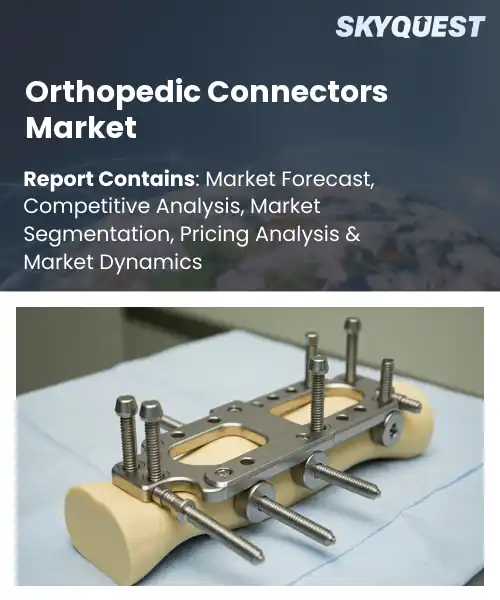
Orthopedic Connectors Market
Report ID: SQMIG35A4291
Report ID: SQMIG35A4291
[email protected]
USA +1 351-333-4748
Report ID:
SQMIG35A4291 |
Region:
Global |
Published Date: July, 2026
Pages:
157
|Tables:
144
|Figures:
78


Global Orthopedic Connectors Market size was valued at USD 438.6 Million in 2024 and is poised to grow from USD 471.06 Million in 2025 to USD 833.89 Million by 2033, growing at a CAGR of 7.4% during the forecast period (2026-2033).
The increasing prevalence of osteoporosis, osteoarthritis, sports injuries, and road accidents is driving a higher number of orthopedic procedures worldwide. As more fracture fixation, spinal fusion, and joint reconstruction surgeries are performed, demand for reliable orthopedic connectors such as screws, rods, plates, and coupling components rises accordingly. This growing surgical volume encourages manufacturers to develop stronger, biocompatible, and minimally invasive connector systems that improve implant stability and patient outcomes. Consequently, healthcare providers continue investing in advanced orthopedic technologies, accelerating market growth through greater procedural adoption and replacement surgeries.
One pivotal growth driver stems from expanding adoption of minimally invasive surgical (MIS) techniques, which rely on connectors to reduce tissue trauma and operative time. As surgeons increasingly prefer percutaneous pedicle‑screw fixation for lumbar degenerative disease, manufacturers have responded by launching rods that improve imaging clarity while maintaining strength. This synergy between demand and product innovation fuels market expansion, evidenced by a 12 % rise in North American MIS procedures between 2020 and 2023. Opportunities arise from economies where rising disposable income and aging demographics boost orthopedic surgery volumes, prompting distributors to seek FDA‑cleared connector kits integrated in global hospital inventories.
How is AI-Driven Automation Influencing the Growth of the Orthopedic Connectors Market?
AI‑driven automation is reshaping the orthopedic connectors market by streamlining design, production and supply‑chain processes. Machine‑learning algorithms analyze patient anatomy and surgical data to generate optimized connector geometries, reducing the need for manual iteration. Robotic assembly lines execute precise machining and welding, improving consistency while cutting cycle times. Predictive maintenance powered by AI keeps equipment running smoothly, minimizing downtime. Real‑time inventory analytics align component availability with surgeon demand, preventing stockouts and excess inventory. These efficiencies lower costs and accelerate product launches, making it easier for manufacturers to meet the growing demand for personalized orthopedic solutions and to expand into new clinical indications.
In January 2026, Bishop launched an AI‑enabled design platform for orthopedic connectors, streamlining component selection and cutting lead times, thereby boosting market growth and operational efficiency.
Market snapshot - (2026-2033)
Global Market Size
USD 438.6 Million
Largest Segment
Rod Connectors
Fastest Growth
Modular Connectors
Growth Rate
7.4% CAGR
To get more insights on this market click here to Request a Free Sample Report
Global orthopedic connectors market is segmented by product type, material, application, end user, patient group and region. Based on product type, the market is segmented into rod connectors, cross connectors, clamp connectors and modular connectors. Based on material, the market is segmented into titanium, stainless steel and cobalt-chromium. Based on application, the market is segmented into spinal fixation, trauma fixation and limb reconstruction. Based on end user, the market is segmented into hospitals, orthopedic clinics and ambulatory surgical centers. Based on patient group, the market is segmented into adult and pediatric. Based on region, the market is segmented into North America, Europe, Asia Pacific, Latin America and Middle East & Africa.
Based on the global orthopedic connectors market growth, rod connectors segment dominates because they provide the most direct load‑sharing capability in spinal and trauma constructs, enabling surgeons to achieve rigid alignment with minimal hardware bulk. Their linear design simplifies implantation, reduces operative time, and aligns with surgeons’ preference for predictable mechanical behavior. Consequently, they have become the go‑to choice for complex fixation cases, reinforcing their leading position in the orthopedic connectors market through enhanced biomechanical reliability and patient recovery.
However, cross connectors segment emerges as the most rapidly expanding because their multidirectional linkage offers unparalleled versatility for hybrid fixation strategies, allowing surgeons to combine spinal and limb reconstruction within a single construct. This adaptability fuels heightened adoption, propelling market expansion and opening new avenues for innovative surgical solutions.
Titanium segment dominates because its superior biocompatibility and corrosion resistance align with surgeons’ demand for long‑term implant stability, especially in young and active patients. The material’s lower modulus reduces stress shielding, promoting natural bone healing while minimizing implant fatigue failures. These attributes reinforce clinician confidence, driving widespread selection of titanium connectors across diverse orthopedic procedures and supporting faster postoperative recovery in complex spinal fusion cases as well as trauma fixation.
On the other hand, cobalt‑chromium segment is witnessing the strongest growth momentum because its high strength‑to‑weight ratio enables the design of slimmer, high‑load‑bearing connectors suitable for demanding trauma and limb reconstruction applications. Manufacturers leverage these mechanical advantages to launch innovative product lines, accelerating market uptake and creating new opportunities for advanced fixation solutions.
To get detailed segments analysis, Request a Free Sample Report
As per the global orthopedic connectors market share, North America leads the industry through a combination of advanced research ecosystems, strong regulatory frameworks, and high adoption of innovative surgical technologies. The region benefits from deep collaborations between academic institutions, medical device manufacturers, and healthcare providers, fostering rapid product development and clinical validation. Robust reimbursement policies and a mature healthcare infrastructure support widespread implementation of cutting‑edge connector solutions. Additionally, the presence of several multinational firms with extensive manufacturing capabilities ensures a reliable supply chain and continuous improvement of product quality, reinforcing the region’s leadership position.
Orthopedic connectors market in United States thrives on a dynamic innovation environment where leading research universities and biotech clusters drive next‑generation connector designs. The market is reinforced by extensive clinical trial networks and a regulatory system that balances safety with accelerated product approvals, encouraging rapid market entry for novel technologies.
Orthopedic connectors market in Canada benefits from a collaborative healthcare system that emphasizes evidence‑based practice and early adoption of advanced surgical tools. Strong government support for medical research and a well‑integrated network of hospitals and specialty clinics create a favorable environment for the deployment of high‑performance connector systems.
Based on global orthopedic connectors regional forecast, Europe expands rapidly due to a convergence of stringent quality standards, widespread implementation of minimally invasive surgical techniques, and a growing emphasis on patient‑centered outcomes. The region’s strong emphasis on clinical research and cross‑border collaboration accelerates the diffusion of innovative connector technologies across national markets. Harmonized regulatory pathways within the European framework streamline product approvals, while comprehensive reimbursement structures encourage hospitals to adopt sophisticated solutions. Moreover, a skilled workforce and established manufacturing hubs sustain high production quality, reinforcing Europe’s position as a leading growth engine for orthopedic connectors.
Orthopedic connectors market in Germany is anchored by world‑class engineering expertise and a dense network of specialized medical device firms. The market leverages rigorous quality certifications and a proactive approach to clinical integration, ensuring that advanced connector solutions are rapidly adopted in leading orthopedic centers.
Orthopedic connectors market in United Kingdom experiences swift expansion driven by progressive healthcare policies that promote early adoption of innovative implant technologies. Strong research collaborations between universities and industry accelerate development cycles, while a focus on outpatient surgical pathways fuels demand for efficient connector systems.
Orthopedic connectors market in France emerges as an evolving segment supported by a growing number of specialized clinics and a national emphasis on orthopedic research. Government initiatives that fund medical technology innovation encourage local manufacturers to enhance product portfolios and align with international standards.
As per global orthopedic connectors regional outlook, Asia Pacific is strengthening its industry through a blend of expanding healthcare infrastructure, rising surgical volumes, and increasing investment in domestic medical device capabilities. The region’s focus on developing cost‑effective yet high‑quality connector solutions aligns with the broader push toward accessible advanced orthopedic care. Collaborative ventures between multinational firms and local partners accelerate technology transfer, while rising expertise in minimally invasive procedures drives demand for sophisticated connector designs. Government incentives for research and manufacturing, coupled with an emerging talent pool, position Asia Pacific as a burgeoning hub for both production and adoption of cutting‑edge orthopedic connector technologies.
Orthopedic connectors market in Japan benefits from an entrenched culture of precision engineering and a healthcare system that prioritizes advanced surgical interventions. Strong partnerships between device manufacturers and leading orthopedic hospitals facilitate seamless integration of innovative connector solutions into clinical practice.
Orthopedic connectors market in South Korea is propelled by rapid technological adoption and a supportive regulatory environment that encourages swift market entry for new connector products. A vibrant ecosystem of biotech start‑ups and established manufacturers fosters continuous innovation and expansion of the market base.
To know more about the market opportunities by region and country, click here to
Buy The Complete Report
Aging Population Drives Demand
The growing number of senior citizens worldwide increases the prevalence of degenerative bone conditions, requiring surgical interventions that rely on orthopedic connectors for stable fixation. As age‑related fractures become more common, clinicians preferentially select advanced connector systems that offer enhanced biomechanical performance and ease of implantation, thereby expanding the overall market. This demographic shift also encourages manufacturers to invest in product development tailored to elderly patient needs, reinforcing a cycle of sustained demand across multiple therapeutic areas in global clinical practice.
Technological Advancements Enhance Performance
Innovation in material science and manufacturing processes has produced lightweight, high‑strength alloys and additive‑manufactured connector designs that improve load distribution and reduce implant failure rates. Surgeons benefit from components that integrate seamlessly with minimally invasive techniques, shortening operative time and minimizing patient trauma. These advancements also enable customization to patient‑specific anatomy, fostering broader clinical acceptance and encouraging hospitals to upgrade their inventory, thereby propelling market expansion through heightened confidence in clinical outcomes across orthopedic care settings worldwide and supporting long‑term cost effectiveness for providers.
Regulatory Hurdles Impede Adoption
Stringent regulatory requirements across major regions demand extensive clinical testing and documentation for each new orthopedic connector, extending product approval timelines considerably. Companies must allocate substantial resources to satisfy safety and efficacy standards, which can delay market entry and increase development costs. As a result, smaller manufacturers may struggle to bring innovative solutions to market, limiting competitive diversity and slowing the overall pace of technology diffusion within the industry while also creating uncertainty for investors evaluating long‑term project viability in the orthopedic devices sector.
High Cost Limits Accessibility
Advanced orthopedic connectors often incorporate premium materials and sophisticated manufacturing techniques, resulting in price points that exceed budgets of many healthcare providers, especially in developing economies. The elevated acquisition cost can deter hospitals from adopting the latest technologies, leading them to rely on legacy devices with lower performance. Consequently, market growth is constrained as price sensitivity restricts broader diffusion, and reimbursement frameworks may not fully cover the added value offered by cutting‑edge connector solutions for patients seeking faster recovery and improved quality of life.
Request Free Customization of this report to help us to meet your business objectives.
The competitive landscape in the global orthopedic connectors market outlook is shaped by aggressive M&A activity, strategic partnerships, and rapid tech innovation as companies vie for market share in orthopedic connector solutions; for example, a leading implant maker acquired a 3D‑printing specialist to integrate patient‑specific connector designs, while another established a joint venture with a material science firm to accelerate bio‑resorbable connector development, driving differentiation and entry barriers across the market.
Top Player’s Company Profile
Recent Developments
SkyQuest’s ABIRAW (Advanced Business Intelligence, Research & Analysis Wing) is our Business Information Services team that Collects, Collates, Correlates, and Analyses the Data collected by means of Primary Exploratory Research backed by robust Secondary Desk research.
As per SkyQuest analysis the global orthopedic connectors industry is propelled first by an aging population that raises demand for stable fixation in spine and trauma surgeries, and second by technological advancements such as AI‑driven design and high‑strength titanium alloys that improve performance and enable minimally invasive procedures. The rod connectors segment leads the market because its direct load‑sharing design simplifies implantation and shortens operative time. North America dominates due to its strong research ecosystem, robust reimbursement and early adoption of innovative solutions, while stringent regulatory requirements pose a key restraint limiting the speed of new product introductions.
| Report Metric | Details |
|---|---|
| Market size value in 2024 | USD 438.6 Million |
| Market size value in 2033 | USD 833.89 Million |
| Growth Rate | 7.4% |
| Base year | 2024 |
| Forecast period | (2026-2033) |
| Forecast Unit (Value) | USD Million |
| Segments covered |
|
| Regions covered | North America (US, Canada), Europe (Germany, France, United Kingdom, Italy, Spain, Rest of Europe), Asia Pacific (China, India, Japan, Rest of Asia-Pacific), Latin America (Brazil, Rest of Latin America), Middle East & Africa (South Africa, GCC Countries, Rest of MEA) |
| Companies covered |
|
| Customization scope | Free report customization with purchase. Customization includes:-
|
To get a free trial access to our platform which is a one stop solution for all your data requirements for quicker decision making. This platform allows you to compare markets, competitors who are prominent in the market, and mega trends that are influencing the dynamics in the market. Also, get access to detailed SkyQuest exclusive matrix.
Table Of Content
Executive Summary
Market overview
Parent Market Analysis
Market overview
Market size
KEY MARKET INSIGHTS
COVID IMPACT
MARKET DYNAMICS & OUTLOOK
Market Size by Region
KEY COMPANY PROFILES
Methodology
For the Orthopedic Connectors Market, our research methodology involved a mixture of primary and secondary data sources. Key steps involved in the research process are listed below:
1. Information Procurement: This stage involved the procurement of Market data or related information via primary and secondary sources. The various secondary sources used included various company websites, annual reports, trade databases, and paid databases such as Hoover's, Bloomberg Business, Factiva, and Avention. Our team did 45 primary interactions Globally which included several stakeholders such as manufacturers, customers, key opinion leaders, etc. Overall, information procurement was one of the most extensive stages in our research process.
2. Information Analysis: This step involved triangulation of data through bottom-up and top-down approaches to estimate and validate the total size and future estimate of the Orthopedic Connectors Market.
3. Report Formulation: The final step entailed the placement of data points in appropriate Market spaces in an attempt to deduce viable conclusions.
4. Validation & Publishing: Validation is the most important step in the process. Validation & re-validation via an intricately designed process helped us finalize data points to be used for final calculations. The final Market estimates and forecasts were then aligned and sent to our panel of industry experts for validation of data. Once the validation was done the report was sent to our Quality Assurance team to ensure adherence to style guides, consistency & design.
Analyst Support
Customization Options
With the given market data, our dedicated team of analysts can offer you the following customization options are available for the Orthopedic Connectors Market:
Product Analysis: Product matrix, which offers a detailed comparison of the product portfolio of companies.
Regional Analysis: Further analysis of the Orthopedic Connectors Market for additional countries.
Competitive Analysis: Detailed analysis and profiling of additional Market players & comparative analysis of competitive products.
Go to Market Strategy: Find the high-growth channels to invest your marketing efforts and increase your customer base.
Innovation Mapping: Identify racial solutions and innovation, connected to deep ecosystems of innovators, start-ups, academics, and strategic partners.
Category Intelligence: Customized intelligence that is relevant to their supply Markets will enable them to make smarter sourcing decisions and improve their category management.
Public Company Transcript Analysis: To improve the investment performance by generating new alpha and making better-informed decisions.
Social Media Listening: To analyze the conversations and trends happening not just around your brand, but around your industry as a whole, and use those insights to make better Marketing decisions.
REQUEST FOR SAMPLE
 REQUEST FREE CUSTOMIZATION
Global Orthopedic Connectors Market size was valued at USD 438.6 Million in 2024 and is poised to grow from USD 471.06 Million in 2025 to USD 833.89 Million by 2033, growing at a CAGR of 7.4% during the forecast period (2026-2033).
The competitive landscape is shaped by aggressive M&A activity, strategic partnerships, and rapid tech innovation as companies vie for market share in orthopedic connector solutions; for example, a leading implant maker acquired a 3D‑printing specialist to integrate patient‑specific connector designs, while another established a joint venture with a material science firm to accelerate bio‑resorbable connector development, driving differentiation and entry barriers across the market. 'Stryker Corporation', 'Zimmer Biomet Holdings, Inc.', 'Johnson & Johnson', 'Smith & Nephew plc', 'Medtronic plc', 'Globus Medical, Inc.', 'Orthofix Medical Inc.', 'NuVasive, Inc.', 'MicroPort Scientific Corporation', 'Meril Life Sciences Pvt. Ltd.', 'Aesculap AG', 'B. Braun SE', 'Precision Spine, Inc.', 'Xtant Medical Holdings, Inc.', 'DePuy Synthes', 'Alphatec Holdings, Inc.', 'SeaSpine Holdings Corporation', 'Life Spine, Inc.', 'Spine Wave, Inc.', 'Captiva Spine, Inc.'
Minimally Invasive Integration Surge: Surgeons increasingly prefer modular connector systems that facilitate percutaneous implantation, reducing tissue disruption and accelerating patient recovery. Manufacturers respond by engineering low‑profile, lock‑type designs compatible with robot‑assisted platforms, enabling precise alignment through small incisions. This shift is driven by growing evidence of reduced infection risk, shorter hospital stays, and enhanced functional outcomes. Consequently, product development pipelines prioritize ease of insertion, adaptability to varied anatomical sites, and seamless integration with emerging minimally invasive surgical techniques for improved long‑term joint stability and
Why does North America Dominate the Global Orthopedic Connectors Market? |@12


Want to customize this report? This report can be personalized according to your needs. Our analysts and industry experts will work directly with you to understand your requirements and provide you with customized data in a short amount of time. We offer $1000 worth of FREE customization at the time of purchase.
Feedback From Our Clients


 USA (+1) 351-333-4748

