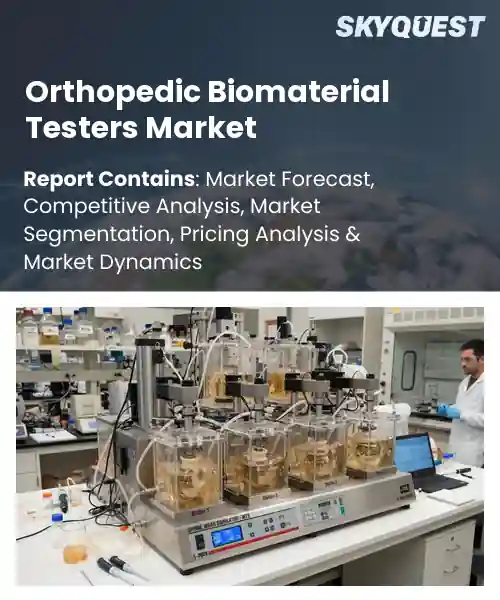
Orthopedic Biomaterial Testers Market
Report ID: SQMIG35J2818
Report ID: SQMIG35J2818
[email protected]
USA +1 351-333-4748
Report ID:
SQMIG35J2818 |
Region:
Global |
Published Date: September, 2026
Pages:
157
|Tables:
151
|Figures:
78


Global Orthopedic Biomaterial Testers Market size was valued at USD 185.0 Million in 2024 and is poised to grow from USD 194.62 Million in 2025 to USD 291.96 Million by 2033, growing at a CAGR of 5.2% during the forecast period (2026-2033).
The Global Orthopedic Biomaterial Testers market includes instruments and software that assess mechanical, chemical, and biological performance of implants such as hip stems, spinal cages, and cartilage scaffolds. Its importance derives from regulatory safety demands and the clinical need to lower revision surgeries, prompting manufacturers to validate new alloys, ceramics, and polymer composites before launch. The market originated in the early 2000s when finite‑element analysis combined with fatigue testing became standard for titanium prostheses. In the last decade, additive manufacturing has pushed tester sophistication, illustrated by multi‑axis load simulators that replicate gait cycles for customized implants in orthopedic clinical research. The surge in personalized medicine now acts as the principal catalyst driving the Orthopedic Biomaterial Testers market toward rapid expansion. Surgeons request implants tailored to patient anatomy, forcing manufacturers to produce extensive biomechanical data that prove 3‑D‑printed titanium lattices can endure physiological loads, which directly fuels demand for high‑throughput testing rigs. Companies such as Instron and MTS have launched automated fatigue systems capable of processing dozens of specimens daily, shortening regulatory submissions and time‑to‑market. Consequently, research labs partner with device firms to co‑develop predictive algorithms, creating a feedback loop where richer test data accelerate material innovation and generate licensing revenue.
How is AI adoption impacting the orthopedic biomaterial testers market growth?
AI adoption is reshaping the orthopedic biomaterial testers market by turning traditional mechanical testing into a data rich predictive process. Machine learning algorithms now analyze load displacement curves in real time, flagging anomalies and suggesting optimal test parameters without manual intervention. This accelerates product development cycles and reduces the need for repeat experiments, allowing manufacturers to bring implants to market faster. AI also enhances material characterization by correlating microstructure images with mechanical performance, giving engineers deeper insight into bone compatible composites. As laboratories integrate these intelligent systems, the overall efficiency of testing labs improves and the demand for advanced AI enabled equipment risesZwickRoell February 2023, introduced an AI driven testing platform that automatically adjusts load protocols based on real time feedback, cutting setup time and improving data reliability. This innovation demonstrates how AI fuels market expansion by delivering faster, more accurate biomaterial assessments for orthopedic researchers and clinicians worldwide across the industry
Market snapshot - (2026-2033)
Global Market Size
USD 185.0 Million
Largest Segment
Mechanical Testers
Fastest Growth
Tribological Testers
Growth Rate
5.2% CAGR
To get more insights on this market click here to Request a Free Sample Report
Global orthopedic biomaterial testers market is segmented by tester type, test type, biomaterial, application, end user and region. Based on tester type, the market is segmented into Mechanical Testers, Wear Testers, Fatigue Testers, Tribological Testers and Other Testers. Based on test type, the market is segmented into Tensile & Compression Testing, Fatigue Testing, Wear & Friction Testing, Impact Testing and Other Tests. Based on biomaterial, the market is segmented into Metals, Ceramics, Polymers and Composite Biomaterials. Based on application, the market is segmented into Joint Implants, Bone Fixation Devices, Spinal Implants and Other Orthopedic Devices. Based on end user, the market is segmented into Medical Device Manufacturers, Research Institutions, Testing Laboratories and Academic Institutions. Based on region, the market is segmented into North America, Europe, Asia Pacific, Latin America and Middle East & Africa.
Mechanical testers segment dominates because they provide the fundamental load bearing evaluations essential for every orthopedic device, from initial design through final validation. Their ability to simulate tensile, compressive, and bending stresses gives manufacturers confidence in product durability and regulatory compliance. Moreover, the widespread reliance on universally accepted standards makes mechanical testing the baseline requirement, cementing its central position in the market ecosystem and drive ongoing innovation across the testing ecosystem worldwide.
However, tribological testers segment emerges as the most rapidly expanding area in the orthopedic biomaterial testers market. Rising demand for joint implants with low wear surfaces drives focus on friction and wear characterization. Simulation advances enable precise replication of physiological motions, attracting makers seeking longer implant life and opening revenue streams for equipment providers.
Metals segment leads because they remain the primary load bearing material for most orthopedic implants, offering unparalleled strength and established processing routes. Their longstanding clinical track record simplifies regulatory pathways, encouraging manufacturers to prioritize metal testing during design verification. Consequently, testing protocols for titanium alloys, stainless steel, and cobalt chromium dominate laboratory schedules, reinforcing the central role of metal evaluation in market activity and drive ongoing innovation across the testing ecosystem worldwide.
Meanwhile, composite biomaterials segment is witnessing the strongest growth momentum in the orthopedic biomaterial testers market. Surge in patient specific implant designs and bio inspired material research pushes demand for hybrid testing capabilities that assess both mechanical integrity and biologic interaction. This drives equipment makers to develop multimodal platforms, unlocking market niches and expanding tester adoption.
To get detailed segments analysis, Request a Free Sample Report
North America leads the market through a combination of deep research expertise, sophisticated regulatory environments, and a concentrated presence of major medical device manufacturers. The region benefits from close collaboration between academic institutions, industry innovators, and clinical networks that accelerate product development cycles. A mature reimbursement landscape and high adoption rates in advanced healthcare facilities further reinforce demand. Additionally, robust supply chain capabilities and a skilled engineering workforce enable rapid prototyping and large‑scale testing, solidifying the region’s position as the benchmark for quality and performance standards.
Orthopedic Biomaterial Testers Market in the United States is shaped by extensive investment in translational research and a dense network of specialized testing laboratories. Leading universities and research hospitals partner with device makers to refine biomaterial performance, while stringent FDA guidelines drive adherence to rigorous validation protocols. The market enjoys strong support from venture capital that fuels innovative startups, creating a dynamic ecosystem where new testing methodologies can be quickly commercialized.
Orthopedic Biomaterial Testers Market in Canada is distinguished by a collaborative framework that links federal research agencies with provincial health authorities. Emphasis on evidence‑based practice and a proactive approach to regulatory alignment encourage early engagement with testing services. The presence of multidisciplinary research centers fosters integration of biomechanics, materials science, and clinical insights, enabling comprehensive evaluation of emerging orthopedic solutions across diverse patient populations.
Europe’s expansion is propelled by a strong focus on innovation within a harmonized regulatory context that encourages cross‑border collaboration. The region’s extensive network of research consortia and public‑private partnerships accelerates development of next‑generation biomaterials, while health systems prioritize value‑based procurement that emphasizes performance verification. A culture of standardization across member states supports the adoption of uniform testing protocols, enhancing market confidence. Moreover, strategic investments in digitalization and advanced analytics enable more efficient testing workflows, strengthening Europe’s reputation as a hub for high‑quality orthopedic validation.
Orthopedic Biomaterial Testers Market in Germany benefits from world‑class engineering expertise and a dense concentration of high‑tech manufacturing clusters. Close ties between research universities and industry leaders foster continuous refinement of testing methodologies, while rigorous national standards drive meticulous quality assurance. The market is further supported by strong governmental programs that fund collaborative projects, ensuring a steady pipeline of innovative testing solutions aligned with clinical requirements.
Orthopedic Biomaterial Testers Market in the United Kingdom experiences rapid growth through a vibrant ecosystem of academic research and commercial innovation. The country’s emphasis on translational science encourages early‑stage testing collaborations, while evolving regulatory guidance promotes agility in adopting novel assessment techniques. A proactive venture environment and supportive policy frameworks attract investment, accelerating the development of cutting‑edge testing platforms that meet the demands of a dynamic orthopedic sector.
Orthopedic Biomaterial Testers Market in France is emerging as a focal point for collaborative research initiatives that blend materials science with clinical insight. National health agencies prioritize evidence‑based validation, encouraging manufacturers to engage with specialized testing facilities. Growing clusters of biotech and medtech enterprises, coupled with supportive funding mechanisms, nurture the development of refined testing protocols that address the nuanced needs of the French orthopedic landscape.
Asia Pacific is advancing its role by leveraging rapid industrialization and a surge in orthopedic procedure volumes across major economies. The region embraces cutting‑edge manufacturing techniques and integrates artificial intelligence into testing processes, enhancing accuracy and throughput. Strategic government initiatives aim to bolster domestic innovation capabilities, reducing dependence on external validation services. Collaborative networks that connect manufacturers with emerging research institutions foster knowledge transfer, while increasing awareness of international quality standards drives adoption of sophisticated testing solutions throughout the market.
Orthopedic Biomaterial Testers Market in Japan is characterized by a meticulous approach to quality and a strong tradition of precision engineering. Partnerships between leading universities and device firms enable the development of highly specialized testing equipment that aligns with rigorous domestic regulations. Government incentives promote research into biomaterial durability and biocompatibility, supporting a vibrant ecosystem where advanced testing services are seamlessly integrated into product development cycles.
Orthopedic Biomaterial Testers Market in South Korea benefits from a dynamic combination of high‑tech manufacturing prowess and proactive governmental support for medical innovation. The country’s emphasis on rapid prototyping and digital simulation accelerates testing workflows, while collaborations with leading hospitals ensure clinical relevance. Investment in talent development and strategic industry clusters cultivates a robust testing infrastructure that positions South Korea as an emerging hub for orthopedic biomaterial validation.
To know more about the market opportunities by region and country, click here to
Buy The Complete Report
Growing Demand for Personalized Implants
Adoption of AI-Enabled Testing
Regulatory Compliance Complexity
High Cost of Advanced Equipment
Request Free Customization of this report to help us to meet your business objectives.
The market is shaped by intense rivalry among established instrument makers and emerging innovators, driving rapid adoption of integrated digital platforms and AI‑based analysis to shorten product‑development cycles. Recent M&A activity, such as the acquisition of biomechanical sensor specialist VeloSense by a leading tester manufacturer, and strategic partnerships linking material‑science firms with orthopedic OEMs, underscore a push for end‑to‑end testing solutions that enhance data fidelity and regulatory compliance.
Top Player’s Company Profile
Recent Developments
SkyQuest’s ABIRAW (Advanced Business Intelligence, Research & Analysis Wing) is our Business Information Services team that Collects, Collates, Correlates, and Analyses the Data collected by means of Primary Exploratory Research backed by robust Secondary Desk research. As per SkyQuest analysis the Global Orthopedic Biomaterial Testers market is being propelled primarily by the growing demand for personalized implants, which pushes manufacturers to seek sophisticated testing platforms that can replicate patient‑specific loading conditions. A second strong catalyst is the rapid adoption of AI‑enabled testing systems that accelerate data analysis and improve predictive accuracy, further shortening development cycles. The market faces a notable restraint in the complexity of regulatory compliance across regions, where divergent standards increase validation costs and delay product launches. North America remains the dominant region thanks to its deep research ecosystem and concentration of device makers, while mechanical testers continue to lead the segment landscape by providing essential load‑bearing evaluations for virtually all orthopedic products.
| Report Metric | Details |
|---|---|
| Market size value in 2024 | USD 185.0 Million |
| Market size value in 2033 | USD 291.96 Million |
| Growth Rate | 5.2% |
| Base year | 2024 |
| Forecast period | (2026-2033) |
| Forecast Unit (Value) | USD Million |
| Segments covered |
|
| Regions covered | North America (US, Canada), Europe (Germany, France, United Kingdom, Italy, Spain, Rest of Europe), Asia Pacific (China, India, Japan, Rest of Asia-Pacific), Latin America (Brazil, Rest of Latin America), Middle East & Africa (South Africa, GCC Countries, Rest of MEA) |
| Companies covered |
|
| Customization scope | Free report customization with purchase. Customization includes:-
|
To get a free trial access to our platform which is a one stop solution for all your data requirements for quicker decision making. This platform allows you to compare markets, competitors who are prominent in the market, and mega trends that are influencing the dynamics in the market. Also, get access to detailed SkyQuest exclusive matrix.
Table Of Content
Executive Summary
Market overview
Parent Market Analysis
Market overview
Market size
KEY MARKET INSIGHTS
COVID IMPACT
MARKET DYNAMICS & OUTLOOK
Market Size by Region
KEY COMPANY PROFILES
Methodology
For the Orthopedic Biomaterial Testers Market, our research methodology involved a mixture of primary and secondary data sources. Key steps involved in the research process are listed below:
1. Information Procurement: This stage involved the procurement of Market data or related information via primary and secondary sources. The various secondary sources used included various company websites, annual reports, trade databases, and paid databases such as Hoover's, Bloomberg Business, Factiva, and Avention. Our team did 45 primary interactions Globally which included several stakeholders such as manufacturers, customers, key opinion leaders, etc. Overall, information procurement was one of the most extensive stages in our research process.
2. Information Analysis: This step involved triangulation of data through bottom-up and top-down approaches to estimate and validate the total size and future estimate of the Orthopedic Biomaterial Testers Market.
3. Report Formulation: The final step entailed the placement of data points in appropriate Market spaces in an attempt to deduce viable conclusions.
4. Validation & Publishing: Validation is the most important step in the process. Validation & re-validation via an intricately designed process helped us finalize data points to be used for final calculations. The final Market estimates and forecasts were then aligned and sent to our panel of industry experts for validation of data. Once the validation was done the report was sent to our Quality Assurance team to ensure adherence to style guides, consistency & design.
Analyst Support
Customization Options
With the given market data, our dedicated team of analysts can offer you the following customization options are available for the Orthopedic Biomaterial Testers Market:
Product Analysis: Product matrix, which offers a detailed comparison of the product portfolio of companies.
Regional Analysis: Further analysis of the Orthopedic Biomaterial Testers Market for additional countries.
Competitive Analysis: Detailed analysis and profiling of additional Market players & comparative analysis of competitive products.
Go to Market Strategy: Find the high-growth channels to invest your marketing efforts and increase your customer base.
Innovation Mapping: Identify racial solutions and innovation, connected to deep ecosystems of innovators, start-ups, academics, and strategic partners.
Category Intelligence: Customized intelligence that is relevant to their supply Markets will enable them to make smarter sourcing decisions and improve their category management.
Public Company Transcript Analysis: To improve the investment performance by generating new alpha and making better-informed decisions.
Social Media Listening: To analyze the conversations and trends happening not just around your brand, but around your industry as a whole, and use those insights to make better Marketing decisions.
REQUEST FOR SAMPLE
 REQUEST FREE CUSTOMIZATION


Want to customize this report? This report can be personalized according to your needs. Our analysts and industry experts will work directly with you to understand your requirements and provide you with customized data in a short amount of time. We offer $1000 worth of FREE customization at the time of purchase.
Feedback From Our Clients


 USA (+1) 351-333-4748

