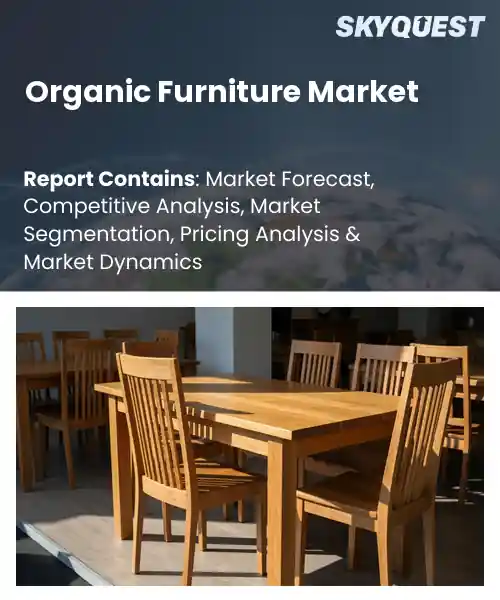
Organic Furniture Market
Report ID: SQMIG25F2113
Report ID: SQMIG25F2113
[email protected]
USA +1 351-333-4748
Report ID:
SQMIG25F2113 |
Region:
Global |
Published Date: June, 2026
Pages:
157
|Tables:
113
|Figures:
77


Global Organic Furniture Market size was valued at USD 1.9 Billion in 2024 and is poised to grow from USD 2.02 Billion in 2025 to USD 3.29 Billion by 2033, growing at a CAGR of 6.3% during the forecast period (2026-2033).
Consumer demand driven by health and sustainability concerns is the primary driver shaping the organic furniture market, as buyers equate sustainable materials with long term value and reduced chemical exposure. The market includes furniture made from certified organic fibers, reclaimed timber, and low emission finishes, serving residential and commercial buyers who require transparency about materials and production. It matters because shifting procurement norms reshape supply chains, regulatory frameworks, and brand differentiation, forcing legacy manufacturers to adapt. Past decade the sector progressed from niche artisanal pieces to mainstream assortments, exemplified by Nordic firms adopting FSC timber, and hotels specifying organic fabrics.Because hospitality groups and health focused consumers demand verifiable sustainability, manufacturers respond by investing in certified supply chains and low toxicity production processes, which increases availability and reduces premium pricing. This dynamic enables broader adoption by corporate offices and healthcare facilities seeking WELL compliant interiors, creating stable B2B revenue streams and justifying scale investments. Scarcity of certified timber raises costs but also spurs innovation in reclaimed wood, hemp composites, and circular business models, offering market niches. Meanwhile ecommerce and augmented reality tools make customized organic pieces accessible, translating consumer willingness to pay into growth and opportunities for private label brands.
How is IoT enhancing supply chain transparency in the organic furniture market?
IoT enhances supply chain transparency in the organic furniture market by linking physical materials to verifiable digital records. Key aspects include sensor based tagging for provenance, real time location and condition monitoring, and integration with digital certificates and product passports. Today many brands face complex multi tier sourcing for organic wood, cotton and latex so visibility across stages matters. IoT lets manufacturers detect deviations early, validate eco certifications and present clear provenance to consumers. Examples range from sensor tagged timber shipments to QR enabled finished pieces offering verified origin stories. The result is stronger brand trust and more efficient supplier oversight.IKEA January 2026, reported steps to digitalise its supply chain and pilot IoT solutions to improve traceability and responsible data use. That move supports organic furniture by providing verified product histories to buyers, speeding supplier checks and reducing uncertainty, which helps market trust and operational efficiency.
Market snapshot - (2026-2033)
Global Market Size
USD 1.9 Billion
Largest Segment
Living Room Furniture
Fastest Growth
Bedroom Furniture
Growth Rate
6.3% CAGR
To get more insights on this market click here to Request a Free Sample Report
Global organic furniture market is segmented by consumer furniture, office furniture, outdoor furniture, specialty furniture and region. Based on consumer furniture, the market is segmented into Living Room Furniture and Bedroom Furniture. Based on office furniture, the market is segmented into Desks and Chairs. Based on outdoor furniture, the market is segmented into Patio Sets and Loungers. Based on specialty furniture, the market is segmented into Custom-made Furniture and Multifunctional Furniture. Based on region, the market is segmented into North America, Europe, Asia Pacific, Latin America and Middle East & Africa.
Living Room Furniture segment dominates because it serves as the primary showcase for sustainability choices, with high consumer emphasis on visible, statement pieces that communicate environmental values. Demand for organic sofas, tables and upholstery motivates designers and retailers to prioritize certified materials and low impact finishes, which in turn concentrates supplier investment, distribution focus, and product innovation around living room assortments, reinforcing their leading market position through visibility driven purchasing behavior.
However, Bedroom Furniture is emerging as the fastest growing area due to rising focus on sleep wellness and demand for non toxic, sustainably sourced beds and storage. Innovations in breathable organic upholstery, modular designs and direct to consumer channels are accelerating adoption and creating new tiers that broaden organic furniture market opportunities.
Custom-made Furniture segment stands out because personalized, small batch production aligns tightly with organic material sourcing and traceability expectations, enabling brands to offer certified woods, natural finishes and bespoke manufacturing practices that minimize waste. This customization driven model compels designers and workshops to adopt transparent supply chains and sustainable craftsmanship, which strengthens consumer trust and channels investment into artisan networks and integrated sourcing that reinforce its leadership in the organic furniture market.
Meanwhile, Multifunctional Furniture is witnessing the strongest growth momentum driven by demand for versatile, space saving organic pieces in compact living. Design innovations combining sustainable materials with convertible functions, and rising interest from urban consumers seeking low impact multifunctionality, are accelerating adoption and creating new retail opportunities that expand the organic furniture market.
To get detailed segments analysis, Request a Free Sample Report
North America dominates the global organic furniture market through a combination of mature consumer awareness, sophisticated retail ecosystems, and deep integration of sustainability into supply chain practices. The region benefits from established certification frameworks and a culture of transparency that reinforces trust in organic claims. Design leadership and a strong base of manufacturers enable innovation in materials and production techniques that align with environmental and health priorities. Distribution networks spanning specialty boutiques to large home furnishing retailers facilitate broad market penetration. Institutional procurement and lifestyle trends that prioritize low impact interiors further support demand, while collaboration among suppliers, designers, and policy bodies accelerates standardization and scale, cementing regional leadership and shaping global expectations.
Organic Furniture Market United States is led by diverse consumer demand for healthier interiors and environmental stewardship, supported by established design centers and specialty retail channels. Manufacturers emphasize certified materials, transparent sourcing, and artisanal craftsmanship alongside scalable production. Strong collaboration among designers, suppliers, and retailers fosters premium product lines and enhanced consumer education, reinforcing preference for organic options in core metropolitan and lifestyle segments across the country and beyond.
Organic Furniture Market Canada reflects consumer interest in natural and low impact furnishings driven by regional emphasis on sustainable forestry and material provenance. Local manufacturers prioritize small batch production, reclaimed and certified timber, and low emission finishes to appeal to health conscious buyers. Retailers and design communities promote educational initiatives and partnerships that highlight ethical sourcing and craftsmanship, supporting premium positioning and steady expansion of organic furniture assortments across markets.
The rapid expansion in Europe is driven by a convergence of regulatory support for sustainable materials, well established certification schemes, and elevated consumer expectations around health and environmental performance. Longstanding design traditions and an emphasis on craftsmanship create demand for organic furniture that marries provenance with contemporary aesthetics. Retailers and mainstream distributors are incorporating organic lines through stronger supplier partnerships and responsible sourcing policies. Growing interest from institutional buyers and municipal procurement further stimulates supply chain transparency and circular practices. Industry collaboration with certification bodies and public initiatives enhances market credibility, enabling wider market access and positioning Europe as a dynamic and influential region within the global organic furniture landscape.
Organic Furniture Market Germany leads through a strong manufacturing base that emphasizes engineered quality, certified materials, and rigorous environmental standards. Producers balance industrial scale with craftsmanship and technical expertise, enabling strong traceability and durability. Procurement practices and institutional demand support market depth, while designers integrate sustainability into mainstream aesthetics. This combination of technical rigor, design leadership, and policy alignment secures Germany position as the dominant European hub for organic furniture.
Organic Furniture Market United Kingdom shows expansion driven by rising consumer interest in sustainable lifestyles, strong online retail ecosystems, and agile design studios that translate eco principles into contemporary furniture. Startups and established brands pursue circular business models, rental services, and transparent sourcing to capture conscious buyers. City centric demand for compact, multifunctional organic pieces supports innovation, while collaborations between designers, influencers, and retailers accelerate mainstream adoption and market momentum.
Organic Furniture Market France is emerging through a blend of artisanal traditions, design culture, and increasing attention to provenance and low impact materials. Local workshops and independent designers emphasize handcrafted regional timber pieces, while retailers curate collections reflecting sustainable luxury aspirations. Policy initiatives and certification recognition support market credibility, encouraging broader retailer engagement and growing visibility of organic furniture within urban design scenes and upscale segments for discerning domestic buyers.
Asia Pacific is strengthening its position through expanded manufacturing capability, growing emphasis on sustainable resource management, and rising design sophistication that adapts organic principles to regional preferences. Markets across the region are enhancing supply chain transparency through improved sourcing practices and responsible forestry initiatives, while closer collaboration between material suppliers and furniture makers improves traceability. Urbanization and heightened awareness of interior health motivate demand for low emission, natural products. Investment in production technology, cross border partnerships, and a growing cohort of design led brands support both domestic market development and export potential. Policy alignment and digital channels further amplify visibility and accessibility of organic furniture across diverse consumer segments.
Organic Furniture Market Japan reflects deep cultural affinity for natural materials, minimal forms, and meticulous craftsmanship that prioritize longevity and functional beauty. Small and medium manufacturers focus on precision woodworking, locally sourced timber, and low emission finishes to meet discerning consumer expectations. Collaboration between traditional artisans and contemporary designers produces refined organic collections that appeal to domestic buyers and connoisseurs, reinforcing Japan role as a quality market for sustainable furniture.
Organic Furniture Market South Korea is advancing as urban consumers favor health oriented interiors and modern design, with online retail enabling product discovery. Designers blend contemporary aesthetics with eco friendly materials and compact modular forms for urban living. Manufacturers enhance sourcing transparency and quality of finishes to meet buyer expectations. Collaborations among designers, lifestyle retailers, and digital platforms amplify visibility and support broader adoption of organic furniture across metropolitan markets.
To know more about the market opportunities by region and country, click here to
Buy The Complete Report
Rising Consumer Preference For Sustainability
Growth In Sustainable Supply Chains
Higher Manufacturing and Material Costs
Limited Consumer Awareness and Education
Request Free Customization of this report to help us to meet your business objectives.
Competitive landscape is driven by rapid material innovation and supply chain tie ups as brands secure differentiation through partnerships acquisitions and tech pilots. Large retailers and luxury houses are running material pilots with biotech firms for credibility and scale, for example IKEA piloting Ecovative mycelium solutions, and Hermès collaborating with MycoWorks, while material startups commercialize mycelium panels and bio composites to supply the furniture sector.
Top Player’s Company Profile
Recent Developments
SkyQuest’s ABIRAW (Advanced Business Intelligence, Research & Analysis Wing) is our Business Information Services team that Collects, Collates, Correlates, and Analyses the Data collected by means of Primary Exploratory Research backed by robust Secondary Desk research. As per SkyQuest analysis, the global organic furniture market is propelled by strong consumer demand for sustainability, with one key driver being rising consumer preference for ecofriendly and health conscious interiors and a second driver being improvements in sustainable supply chains and certification that enable scalable sourcing. A restraint is higher manufacturing and material costs that keep price premiums and limit broader adoption. North America is the dominating region due to mature awareness and retail infrastructure, while Living Room Furniture is the dominating segment as visible statement pieces drive purchasing. Overall the market is shifting from niche artisanal supply to mainstream assortments supported by digital channels and circular design initiatives.
| Report Metric | Details |
|---|---|
| Market size value in 2024 | USD 1.9 Billion |
| Market size value in 2033 | USD 3.29 Billion |
| Growth Rate | 6.3% |
| Base year | 2024 |
| Forecast period | (2026-2033) |
| Forecast Unit (Value) | USD Billion |
| Segments covered |
|
| Regions covered | North America (US, Canada), Europe (Germany, France, United Kingdom, Italy, Spain, Rest of Europe), Asia Pacific (China, India, Japan, Rest of Asia-Pacific), Latin America (Brazil, Rest of Latin America), Middle East & Africa (South Africa, GCC Countries, Rest of MEA) |
| Companies covered |
|
| Customization scope | Free report customization with purchase. Customization includes:-
|
To get a free trial access to our platform which is a one stop solution for all your data requirements for quicker decision making. This platform allows you to compare markets, competitors who are prominent in the market, and mega trends that are influencing the dynamics in the market. Also, get access to detailed SkyQuest exclusive matrix.
Table Of Content
Executive Summary
Market overview
Parent Market Analysis
Market overview
Market size
KEY MARKET INSIGHTS
COVID IMPACT
MARKET DYNAMICS & OUTLOOK
Market Size by Region
KEY COMPANY PROFILES
Methodology
For the Organic Furniture Market, our research methodology involved a mixture of primary and secondary data sources. Key steps involved in the research process are listed below:
1. Information Procurement: This stage involved the procurement of Market data or related information via primary and secondary sources. The various secondary sources used included various company websites, annual reports, trade databases, and paid databases such as Hoover's, Bloomberg Business, Factiva, and Avention. Our team did 45 primary interactions Globally which included several stakeholders such as manufacturers, customers, key opinion leaders, etc. Overall, information procurement was one of the most extensive stages in our research process.
2. Information Analysis: This step involved triangulation of data through bottom-up and top-down approaches to estimate and validate the total size and future estimate of the Organic Furniture Market.
3. Report Formulation: The final step entailed the placement of data points in appropriate Market spaces in an attempt to deduce viable conclusions.
4. Validation & Publishing: Validation is the most important step in the process. Validation & re-validation via an intricately designed process helped us finalize data points to be used for final calculations. The final Market estimates and forecasts were then aligned and sent to our panel of industry experts for validation of data. Once the validation was done the report was sent to our Quality Assurance team to ensure adherence to style guides, consistency & design.
Analyst Support
Customization Options
With the given market data, our dedicated team of analysts can offer you the following customization options are available for the Organic Furniture Market:
Product Analysis: Product matrix, which offers a detailed comparison of the product portfolio of companies.
Regional Analysis: Further analysis of the Organic Furniture Market for additional countries.
Competitive Analysis: Detailed analysis and profiling of additional Market players & comparative analysis of competitive products.
Go to Market Strategy: Find the high-growth channels to invest your marketing efforts and increase your customer base.
Innovation Mapping: Identify racial solutions and innovation, connected to deep ecosystems of innovators, start-ups, academics, and strategic partners.
Category Intelligence: Customized intelligence that is relevant to their supply Markets will enable them to make smarter sourcing decisions and improve their category management.
Public Company Transcript Analysis: To improve the investment performance by generating new alpha and making better-informed decisions.
Social Media Listening: To analyze the conversations and trends happening not just around your brand, but around your industry as a whole, and use those insights to make better Marketing decisions.
REQUEST FOR SAMPLE
 REQUEST FREE CUSTOMIZATION


Want to customize this report? This report can be personalized according to your needs. Our analysts and industry experts will work directly with you to understand your requirements and provide you with customized data in a short amount of time. We offer $1000 worth of FREE customization at the time of purchase.
Feedback From Our Clients


 USA (+1) 351-333-4748

