Organic Food Market
Report ID: SQMIG30H2215
Report ID: SQMIG30H2215
[email protected]
USA +1 351-333-4748
Report ID:
SQMIG30H2215 |
Region:
Global |
Published Date: October, 2025
Pages:
173
|Tables:
0
|Figures:
0


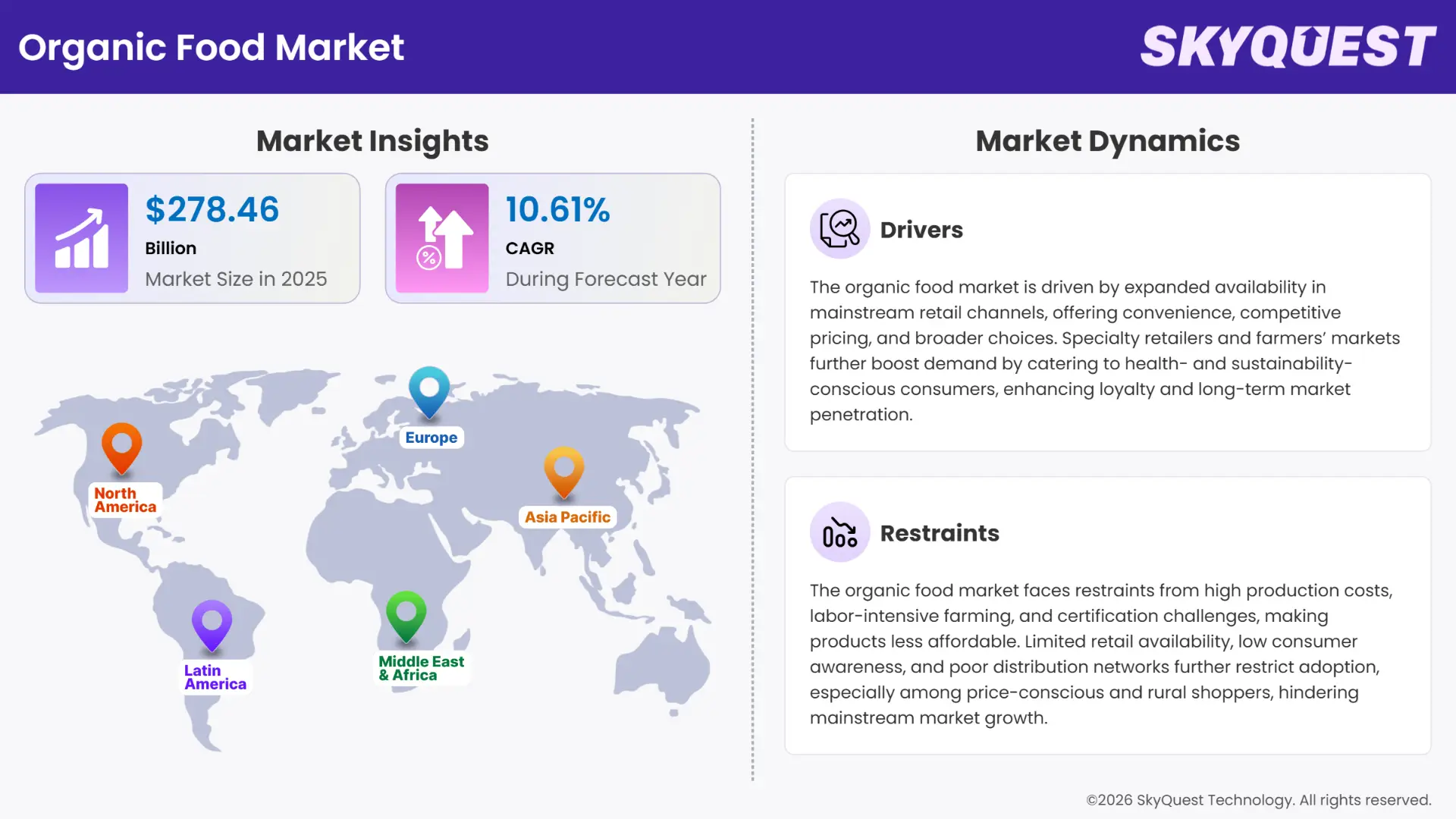
Global Organic Food Market size was valued at USD 251.75 Billion in 2024 and is poised to grow from USD 278.46 Billion in 2025 to USD 623.9 Billion by 2033, growing at a CAGR of 10.61% in the forecast period (2026–2033).
Global Organic Food Market growth is supported and financed directly with subsidies by governments to convert farms into organic farms, enhancing green certification scores, and investments in sustainable packaging. Tech-enabled innovations such as sophisticated AI inventory diagnostics, QR code-marked trackable packaging, and automation logistics in the cold chain have minimized spoilage and rebuilt consumer confidence.
Italian and French public–private partnerships have brought pioneering compostable packaging pilot programs to meet new sustainability standards. Two significant shifts magnifying "clean label" themes and the merger of regional grower cooperatives are revolutionizing sourcing and distribution. Even with the industry being underpinned by powerful drivers, weather-sensitive yield uncertainty, poor weather in major agricultural regions in particular, still puts pressure on reliability of supply and price stability.
Underpinned by policy, technology, and increasing consumer knowledge, the organic food market is set to dominate the future of global organic foods health and security through 2032.
How Is AI Converting the Organic Foods Industry into a Predictive, Zero-Waste Machine?
Artificial intelligence revolutionized the global organic foods industry in 2024 by streamlining freshness cycles, ingredient procurement, and compliance monitoring. Amy's Kitchen and Organic Valley are some of the brands that embrace AI to help handle variable ingredient inputs, enable recall avoidance automation, and enhance end-to-end traceability. Cloud-based platforms detected spoilage risks before they happened, enabling retailers to reship near-expire products to within-range distribution centers. Wearable Agri-sensors allow farmers to track soil nutrient variation and forecast weather-driven irrigation patterns. These developments are the way of the future intelligent, self-sustaining retail outlets where innovation and excellence intersect sealing the fate of AI in the research industry development of the industry.
To get more insights on this market click here to Request a Free Sample Report
The organic food market is segmented into product type, distribution channel, end use, source type, packaging type, sales format, and region. Based on product type, the market is segmented into fruits and vegetables, dairy products, meat & poultry, packaged foods, and beverages. Based on distribution channel, the market is segmented into supermarkets & hypermarkets, specialty organic stores, online retail platforms, convenience stores, and direct-to-consumer. Based on end use, the market is segmented into households, restaurants & cafés, schools & hospitals, airlines, and hotels & resorts.
Based on source type, the market is segmented into plant-based, animal-based, and mixed source. Based on packaging type, the market is segmented into glass bottles, cartons & paperboard, pouches & sachets, cans, and biodegradable packaging. Based on sales format, the market is segmented into mass market, mid-premium, and premium & artisanal. Based on region, the market is segmented into North America, Europe, Asia-Pacific, Latin America, and Middle East & Africa.
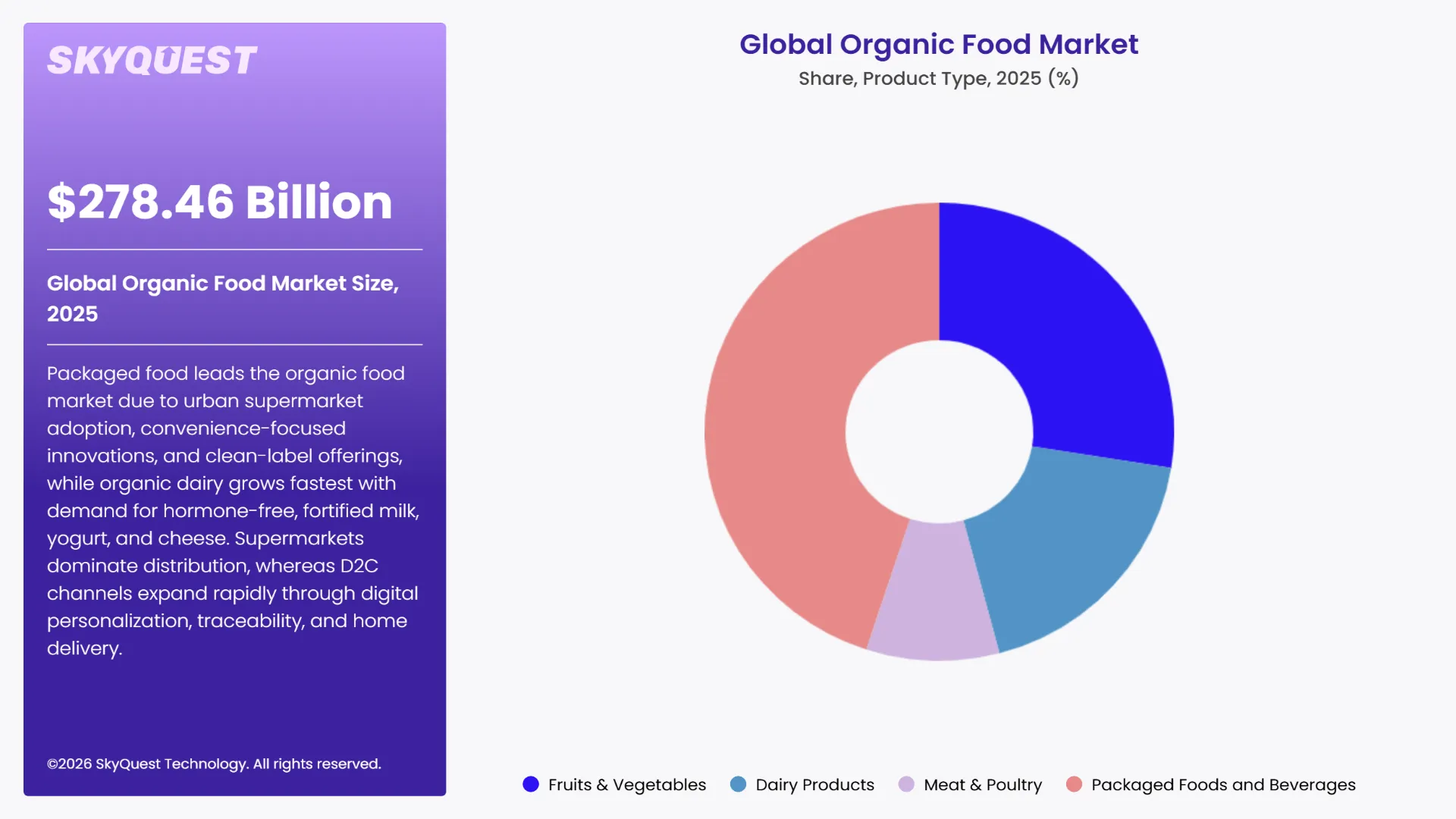
Packaged food was the leading subsegment of the global Organic Food Market in 2024 due to mass adoption in urban supermarkets and explosive innovation in snacks, frozen foods, and ready-to-eat meals. Expansion was fueled by increasing customers' desire for convenience at no compromise on health. Industry-best performance was offered by companies launching compostable packs and vitamin-enriched variants of breakfast items, snacking bars, and children's lunchboxes. They won over mass retailers and subscription platforms with offers succeeding as increased global demand for clean-label everyday staples came to fruition.
Organic dairy products was the growth leader in the subsegment, fueled by growth in demand for organic milk, yogurt, and cheese with clean-label, hormone-free, and functional descriptors. Growth leadership was led by North America and Western Europe where health-concerned consumers selected traceable dairy alternatives with low processing. Organic Valley, Danone's Horizon, and local suppliers developed lactose-free and fortified milk lines through aid by improved refrigeration logistics and government-supported cold-chain enhancements. The path is on the way to expansion in developing economies of gut health, luxury sourcing, and cold-store retailing.
Hypermarkets & supermarkets were the distribution powerhouse channel for organic food in 2024, depicting high traffics, wide availability of brands, and shelf-based trust factor. Large retailing chains like Walmart, Tesco, and Reliance Fresh extended organic shelf space, introduced QR code for traceability, and collaborated with certified farmers to provide assured supply. Consumers benefited from physical product interaction, in-store promotions, and bundled organic offerings, helping supermarkets hold the highest market share across multiple product types and regions.
Direct-to-consumer (D2C) platforms were the fastest-growing subsegment of 2024, driven by digital health consciousness, personalized shopping, and traceability-first branding. Subscription-based models, home-delivery of smart homes, and blockchain tracing changed the delivery of organic produce to city dwellings. Amy's Kitchen and Organic India brands pioneered meal kits with sustainable packaging and QR-marked produce harvest information. The channel was pioneered by American, Indian, and British consumers with growing dependence on app-based food systems, making D2C the most responsive and adaptive extension of contemporary market reach.
To get detailed segments analysis, Request a Free Sample Report
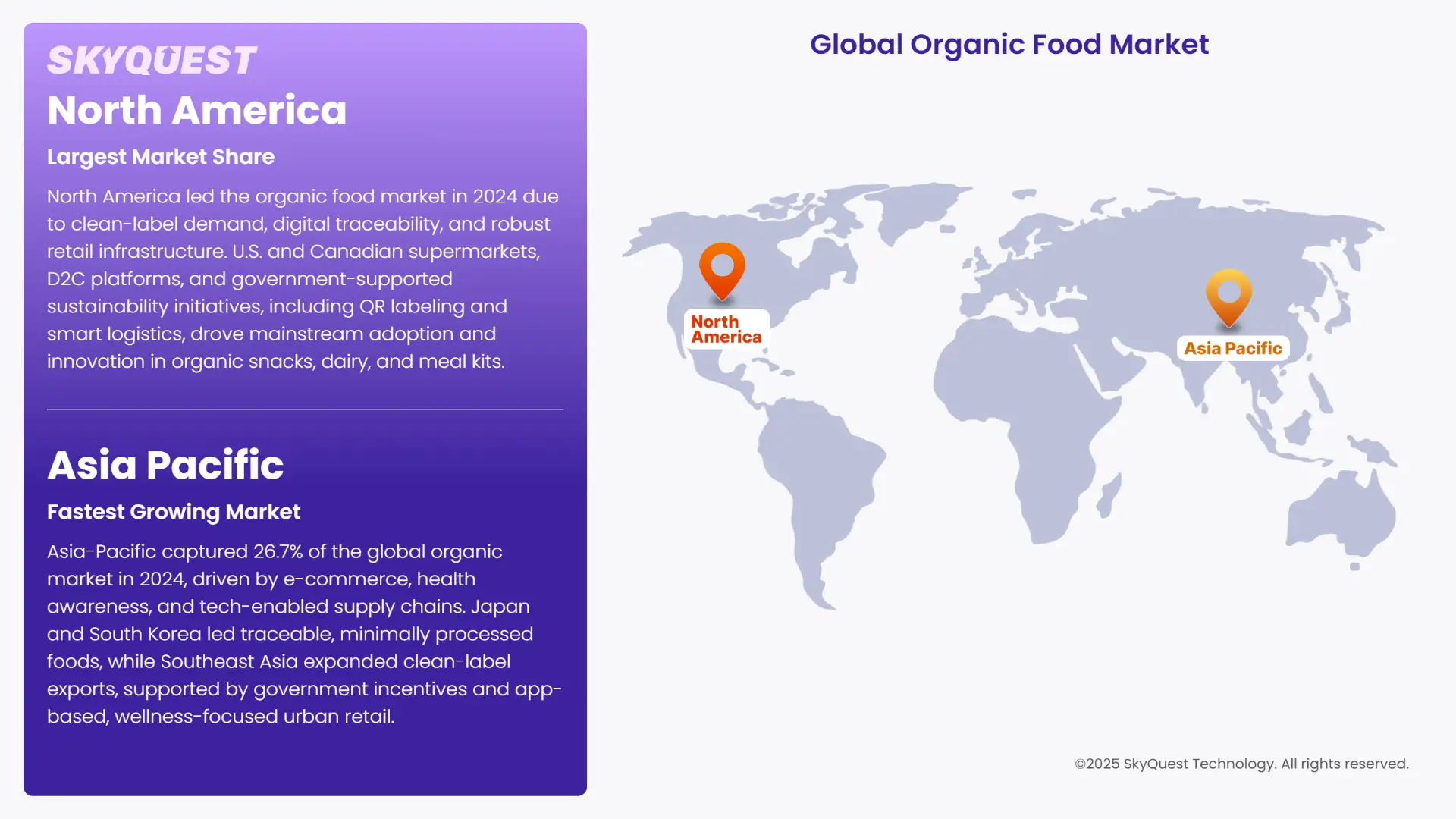
As per the global Organic Food Market analysis, North America accounted for the largest regional forecast share in 2024, driven by deep-rooted clean-label preferences, digital traceability innovation, and extensive public-private retail infrastructure. Three distinct drivers propelled this dominance: the rapid expansion of certified organic assortments in traditional supermarkets, increased funding for sustainable agriculture and food labeling, and a robust ecosystem of health-focused subscription platforms.
The region is widely known for its retail innovation Federal subsidies in 2024 encouraged compostable packaging from leading organic brands, and D2C websites supported modular meal kit customization by nutrition category and diet. AI-powered freshness-monitoring third-party logistics startups were everywhere. Canadian and U.S. governments facilitated smart farm retrofits and real-time QR labeling systems. Meal kit brands like HelloFresh and Goodfood scaled blockchain-traceable ingredient sourcing across metro areas, and mainstream grocery chains deepened organic integration in frozen, baby, and functional food categories.
Organic Food Market in United States
The United States was the most advanced national market during 2024, with food retail growth across the country of organic snacks, ready-to-eat foods, and milk alternatives. Kroger and Whole Foods expanded their clean-label products and regenerative supply collaborations. New York and California launched sustainability scoring platforms for urban retail markets, such as plastic-free shelf-stable products whose demand increased across all markets. Online-first operators and real-time provenance tracking further endorsed consumer confidence and drove the roll-out of health and lifestyle categories. Such a drive ensures strong global Organic Food Market strategies influencing the national agenda.
Organic Food Market in Canada
Canada's Organic Food Market in 2024 saw consistent growth within urban metropolitans like Toronto, Vancouver, and Montreal. Retail chains like Loblaws and Sobeys endorsed bilingual labelling of their organics and started smart-packaged product lines. Government encouragement supported farm conversion and countrywide cold chain upgrading. QR-provenance solutions and compost packaging came into the mainstream of urban supermarket formats and enabled organics to escape niche shelf space and transition to mainstream shopping baskets. Sustained high levels of government and retail partnership drove long-term market penetration.
In 2024, Asia-Pacific represented 26.7% of the global Organic Food Market, driven by e-commerce ecosystem growth, rising health awareness, and technology-driven supply models. Japan and South Korea invested in intelligent farming and digital traceability infrastructure, and Southeast Asia experienced robust export demand for clean-label grains and functional foods. Tax incentives, pesticide-cutting regulations, and consumer mobile apps in 2024 fueled fast uptake among urban consumers seeking wellness. The Asia-Pacific confluence of traceability, health-tech, and customized delivery made the region a growth engine for organic retail. Here is just one such case of continued Market Growth founded on government and consumer solidarity.
Organic Food Market in Japan
Organic food channels in Japan grew in 2024 as consumers sought minimally processed and portioned foods. Aeon and Seijo Ishii spearheaded the move to introduce traceable snacks and ready meals with clean ingredients. Tokyo and Osaka cities enabled app-based systems of provenance and zero-packaging pilots. Domestic farms benefitted from low-input cultivation subsidies, while digital platforms enabled rapid scaling of seasonal organic offerings. These patterns are indicative of Industry Trends that combine quality with transparency.
Organic Food Market in South Korea
South Korea recorded strong 2024 growth in organic grains, beverages, and baby food, with Seoul and Busan driving clean-label innovation. Retailers such as Emart expanded QR-code ingredient tracing, and Coupang scaled AI-based demand prediction for organic SKUs. Government policy supported greenhouse organic farming, and exports of shelf-stable organic items increased across ASEAN markets. Smart packaging and wellness marketing fueled Market Revenue in metro areas.
Europe maintained a 31.5% share of the global Organic Food Market in 2024, anchored by region-wide carbon labeling laws, refill station innovation, and farm-to-retail certification mandates. Countries like Germany, France, Italy, and the U.K. led packaging reform, ingredient transparency, and cooperative farming structures. Retailers responded with AI-driven labeling systems, zero-waste formats, and QR-coded sourcing. Public-private partnerships fostered traceable, climate-resilient supply chains across the bloc. Europe’s fusion of regulation, clean technology, and eco-storytelling made it the global leader in sustainable organic food retail. These advances shape the region’s long-term global Organic Food Market forecast.
Organic Food Market in Germany
Germany strengthened its organic leadership in 2024 through retailer collaborations with regenerative farm networks and compostable-packaging startups. REWE and Edeka led national initiatives to remove single-use plastics and scale short-haul organic sourcing. Urban consumers in Berlin and Munich increasingly demanded traceable, pesticide-free daily food items, supported by national agroecology policy incentives. These shifts contribute to enhanced organic foods industry analysis across product categories.
Organic Food Market in United Kingdom
The U.K. Organic Food Market matured in 2024 via innovations in subscription groceries and local sourcing. Waitrose, Tesco, and Sainsbury’s invested in compost-based packaging pilots and carbon-score labeling. Government realignment of certification post-Brexit created new domestic standards, while digital-first retail formats helped expand clean-label adoption across urban and semi-urban regions. Evolving consumer values signal ongoing Market Trends in transparency and tech-driven access
Organic Food Market in Italy
Italy’s Organic Food Market growth was concentrated in heritage-based product categories such as olive oil, grains, and legumes. In 2024, agritourism zones and regional cooperatives emphasized zero-pesticide certifications and origin-specific branding. Milan and Rome piloted refill-friendly retail zones, and EU-backed funding supported farm conversion and packaging modernization across artisan supply chains. Localized supply and consumer preference are boosting Market Size across Italian regions.
Organic Food Market in France
France saw a strong shift toward traceable and agroecology-compliant formats in 2024. Carrefour and Biocoop expanded climate-resilient food assortments and compostable packaging lines. Paris and Lyon led implementation of AI-driven traceability systems for origin verification. State-led farm transition grants supported smaller producers, and local sourcing saw strong growth in seasonal, ready-to-eat organic meals. These advancements are among the Key Trends Driving the Organic Food Market across the region.
To know more about the market opportunities by region and country, click here to
Buy The Complete Report
Increased access via extension of conventional channels of retailing
Growing demand by natural sales channels makes niche consumption broader
High production costs and non-scalability are impediments to organic food affordability
Constrained visibility and availability at retail restrict broader consumer adoption region-wide
Request Free Customization of this report to help us to meet your business objectives.
The competitive landscape of the global Organic Food Market is shaped by clean-label innovation, climate-aligned packaging, and AI powered supply chain optimization. Startups are entering the industry with highly customized D2C models, regenerative sourcing tools, and digitally traceable product claims.
Startups are focusing on allergen-free formulations, compostable wrappers, and QR-coded certifications to build trust among health and wellness-focused consumers. In 2023, companies across North America, Europe, and Asia launched platform driven food tracking systems, partnered with sustainable agriculture networks, and raised venture capital in its early stage to expand its operations. EU and U.S. observed shifts in packaging and transparency regulations that further supported global organic foods global Organic Food Market penetration for digitally native, compliance-first organic food brands.
Biodegradable Packaging Picks Up Speed with Regulatory Change
Growth in D2C Subscription and Blockchain Traceability to Drive Retail Innovation
SkyQuest’s ABIRAW (Advanced Business Intelligence, Research & Analysis Wing) is our Business Information Services team that Collects, Collates, Correlates, and Analyses the Data collected by means of Primary Exploratory Research backed by robust Secondary Desk research.
As per SkyQuest analysis, key drivers of Organic Food Market growth include key drivers of adoption include the rising demand for plant-based diets, clean-label nutrition and traceable sourcing in premium organic segments. Combining artificial intelligence-driven farm surveillance and digital certification platforms is now critical to supply future consumer and institutional purchasing requirements. Regenerative farming and supply chain transparency are influencing industry studies, especially with North American and European exporters and private label food manufacturers. Danone and SunOpta set the pace in 2024 with soil and supply chain transparency using satellite imaging and blockchain. Indian, German, and American governments' subsidies propelled certified dairy, grain, and packaged food demand and organic land. Berlin and San Francisco cities built cold-chain subsidy infrastructure and last-mile organic food logistics infrastructure. Nature Bio Foods and Tierra Farm firms built AI-based demand forecast and climate-resilient warehousing infrastructure. Such technologies are transforming the market to a digitally empowered, climate-resilient, and scalable and driving the organic ecosystem through 2032.
| Report Metric | Details |
|---|---|
| Market size value in 2024 | USD 251.75 Billion |
| Market size value in 2033 | USD 623.9 Billion |
| Growth Rate | 10.61% |
| Base year | 2024 |
| Forecast period | 2026–2033 |
| Forecast Unit (Value) | USD Billion |
| Segments covered |
|
| Regions covered | North America (US, Canada), Europe (Germany, France, United Kingdom, Italy, Spain, Rest of Europe), Asia Pacific (China, India, Japan, Rest of Asia-Pacific), Latin America (Brazil, Rest of Latin America), Middle East & Africa (South Africa, GCC Countries, Rest of MEA) |
| Companies covered |
|
| Customization scope | Free report customization with purchase. Customization includes:-
|
To get a free trial access to our platform which is a one stop solution for all your data requirements for quicker decision making. This platform allows you to compare markets, competitors who are prominent in the market, and mega trends that are influencing the dynamics in the market. Also, get access to detailed SkyQuest exclusive matrix.
Table Of Content
Executive Summary
Market overview
Parent Market Analysis
Market overview
Market size
KEY MARKET INSIGHTS
COVID IMPACT
MARKET DYNAMICS & OUTLOOK
Market Size by Region
KEY COMPANY PROFILES
Methodology
For the Organic Food Market, our research methodology involved a mixture of primary and secondary data sources. Key steps involved in the research process are listed below:
1. Information Procurement: This stage involved the procurement of Market data or related information via primary and secondary sources. The various secondary sources used included various company websites, annual reports, trade databases, and paid databases such as Hoover's, Bloomberg Business, Factiva, and Avention. Our team did 45 primary interactions Globally which included several stakeholders such as manufacturers, customers, key opinion leaders, etc. Overall, information procurement was one of the most extensive stages in our research process.
2. Information Analysis: This step involved triangulation of data through bottom-up and top-down approaches to estimate and validate the total size and future estimate of the Organic Food Market.
3. Report Formulation: The final step entailed the placement of data points in appropriate Market spaces in an attempt to deduce viable conclusions.
4. Validation & Publishing: Validation is the most important step in the process. Validation & re-validation via an intricately designed process helped us finalize data points to be used for final calculations. The final Market estimates and forecasts were then aligned and sent to our panel of industry experts for validation of data. Once the validation was done the report was sent to our Quality Assurance team to ensure adherence to style guides, consistency & design.
Analyst Support
Customization Options
With the given market data, our dedicated team of analysts can offer you the following customization options are available for the Organic Food Market:
Product Analysis: Product matrix, which offers a detailed comparison of the product portfolio of companies.
Regional Analysis: Further analysis of the Organic Food Market for additional countries.
Competitive Analysis: Detailed analysis and profiling of additional Market players & comparative analysis of competitive products.
Go to Market Strategy: Find the high-growth channels to invest your marketing efforts and increase your customer base.
Innovation Mapping: Identify racial solutions and innovation, connected to deep ecosystems of innovators, start-ups, academics, and strategic partners.
Category Intelligence: Customized intelligence that is relevant to their supply Markets will enable them to make smarter sourcing decisions and improve their category management.
Public Company Transcript Analysis: To improve the investment performance by generating new alpha and making better-informed decisions.
Social Media Listening: To analyze the conversations and trends happening not just around your brand, but around your industry as a whole, and use those insights to make better Marketing decisions.
REQUEST FOR SAMPLE
 REQUEST FREE CUSTOMIZATION
Global Organic Food Market size was valued at USD 251.75 Billion in 2024 and is poised to grow from USD 278.46 Billion in 2025 to USD 623.9 Billion by 2033, growing at a CAGR of 10.61% in the forecast period (2026–2033).
B Danone S.A., Hain Celestial Group, General Mills, Inc., Organic Valley, Amy’s Kitchen, Eden Foods, Inc., Whole Earth Brands, Nature’s Path Foods, Clif Bar & Company, Green & Black’s
The key driver of the organic food market is the increasing consumer awareness of health, safety, and environmental sustainability, which boosts demand for chemical-free, natural, and organically produced food products that promote wellness and reduce exposure to pesticides and additives.
A key market trend in the organic food market is the rising availability of convenient and ready-to-eat organic products, including snacks, beverages, and meal kits, along with the growth of online and e-commerce channels to meet consumer demand for accessible, healthy, and sustainable food options.
North America accounted for the largest share in the organic food market, driven by high consumer awareness of health and sustainability, strong demand for organic products, well-established retail and e-commerce channels, and supportive regulatory frameworks.


Want to customize this report? This report can be personalized according to your needs. Our analysts and industry experts will work directly with you to understand your requirements and provide you with customized data in a short amount of time. We offer $1000 worth of FREE customization at the time of purchase.
Feedback From Our Clients


 USA (+1) 351-333-4748

