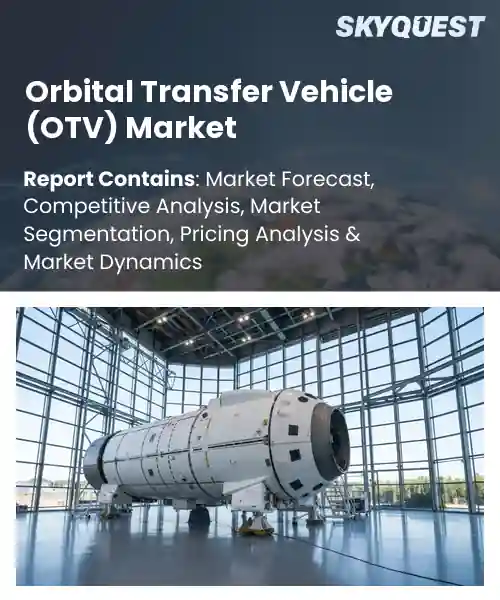
Orbital Transfer Vehicle (OTV) Market
Report ID: SQMIG20A2894
Report ID: SQMIG20A2894
[email protected]
USA +1 351-333-4748
Report ID:
SQMIG20A2894 |
Region:
Global |
Published Date: August, 2026
Pages:
157
|Tables:
147
|Figures:
78


Global Orbital Transfer Vehicle (Otv) Market size was valued at USD 2.31 Billion in 2024 and is poised to grow from USD 2.71 Billion in 2025 to USD 9.87 Billion by 2033, growing at a CAGR of 17.5% during the forecast period (2026-2033).
The global orbital transfer vehicle (OTV) market comprises services that relocate payloads between distinct Earth orbits using reusable spacecraft, tug modules, or propulsion stages. Its importance stems from the rising demand for satellite constellations, on‑orbit servicing, and debris mitigation, which require flexible, cost‑effective relocation capabilities. Historically the sector evolved from single‑use upper stages in the 1990s to today’s multi‑mission tugs demonstrated by companies such as Northrop Grumman’s Mission Extension Vehicle and SpaceX’s planned in‑orbit refueling depot. This shift reflects a broader industry move toward orbital sustainability and has been accelerated by the proliferation of low‑Earth‑orbit constellations across varied mission sets.
The key trend driving the global orbital transfer vehicle (OTV) sector is the cost advantage of on‑orbit reuse, which cuts launch mass and prolongs satellite service life, thereby lowering constellation expenses. By moving a satellite to a congested slot, operators avoid building a replacement and can capture revenue. Astroscale’s tug that captures defunct payloads and transfers them to graveyard orbits illustrates this benefit, while Leo‑One plans to raise medium‑Earth‑orbit assets into trajectories for coverage. As these successes demonstrate savings, investors fund modular propulsion, autonomous docking and interfaces, creating a cycle in which reduced unit costs spur adoption across telecom, Earth‑observation and scientific missions.
How is AI-Driven Automation Influencing the Growth of the Orbital Transfer Vehicle (OTV) Market?
AI-driven automation is reshaping the orbital transfer vehicle market by embedding intelligent decision‑making into every phase of a mission. Machine‑learning algorithms now predict optimal transfer windows, adjust thrust profiles in real time, and manage collision avoidance without human intervention. This capability shortens turnaround times, lowers operational risk and makes multi‑orbit servicing economically viable. Companies such as Momentus and Astroscale are integrating AI to coordinate autonomous docking and payload delivery, turning what was once a niche capability into a core service offering. The market is moving from experimental demonstrations toward routine commercial flights, with satellite operators seeking flexible, on‑demand repositioning to extend mission life and respond to market demand.
In July 2025, Intuitive Machines advanced its Orbital Transfer Vehicle (OTV) through Critical Design Review under a $9.8 million government contract. While the announcement does not explicitly identify AI as part of the OTV, the company’s broader autonomous-navigation and mission-optimization capabilities can support future OTV operations by improving trajectory planning, navigation, and mission efficiency across complex orbital environments.
Market snapshot - (2026-2033)
Global Market Size
USD 2.31 Billion
Largest Segment
Chemical Propulsion
Fastest Growth
Electric Propulsion
Growth Rate
17.5% CAGR
To get more insights on this market click here to Request a Free Sample Report
Global orbital transfer vehicle (otv) market is segmented by propulsion type, orbit type, application, payload capacity, end user and region. Based on propulsion type, the market is segmented into chemical propulsion, electric propulsion and hybrid propulsion. Based on orbit type, the market is segmented into low earth orbit (LEO), medium earth orbit (MEO), geostationary earth orbit (GEO) and beyond earth orbit. Based on application, the market is segmented into satellite deployment, orbit raising, satellite servicing, debris removal and deep space missions. Based on payload capacity, the market is segmented into small payload, medium payload and heavy payload. Based on end user, the market is segmented into commercial, government and defense. Based on region, the market is segmented into North America, Europe, Asia Pacific, Latin America and Middle East & Africa.
Based on the global orbital transfer vehicle (OTV) market growth, chemical propulsion segment dominates because it provides the highest thrust levels required for rapid orbit insertion and payload delivery, making it the preferred choice for missions that demand swift maneuverability. Its proven reliability, extensive heritage, and mature supply chain reduce technical risk, encouraging manufacturers to adopt it for a wide range of OTV designs. Consequently, customers prioritize chemical solutions when mission timelines and performance certainty are paramount, reinforcing its market leadership.
However, electric propulsion segment is witnessing the strongest growth momentum because its high efficiency and ability to perform low thrust maneuvers enable orbit raising and deep space transfers. Advances in power processing and ion thruster durability are expanding its applicability, attracting operators seeking lower launch mass and extended mission lifespans, thus driving rapid market expansion.
Satellite deployment segment dominates because it directly addresses the core demand for placing operational assets into orbit, making OTVs essential for commercial constellations and government missions. This function leverages established launch contracts and straightforward integration processes, ensuring predictable revenue streams. The perpetual growth of satellite constellations further entrenches deployment services as the cornerstone of the OTV market, sustaining its leading position across varied orbital regimes and launch schedules, reinforcing its strategic relevance.
Meanwhile, satellite servicing segment is emerging as the key high growth area because it unlocks new business models through on orbit refueling upgrades and life extension of existing assets. Technological maturity of robotic interfaces and policy support for sustainable space operations are catalyzing demand, prompting OTV developers to prioritize modular designs that can capture expanding service contracts.
To get detailed segments analysis, Request a Free Sample Report
As per the global orbital transfer vehicle (OTV) market share, North America leads the industry through a confluence of mature launch infrastructure, deep venture capital ecosystems, and a longstanding tradition of aerospace innovation. Robust collaboration between government agencies, research institutions, and commercial entities creates a pipeline of advanced propulsion technologies and autonomous navigation solutions. The presence of multiple major launch providers and a vibrant supplier base enables rapid development cycles and cost-effective testing environments. Strong policy frameworks encourage private investment while fostering regulatory certainty, allowing firms to scale operations efficiently. Moreover, the region’s talent pool, cultivated by premier engineering schools and research labs, fuels continual advancement in orbital logistics, positioning North America as the benchmark for reliability and performance in the global OTV landscape.
Orbital transfer vehicle (OTV) market benefits from a dense network of launch sites and a high concentration of specialized manufacturers, creating a fertile ground for rapid prototyping and iterative design. Government programs prioritize technological autonomy and partnership with leading aerospace firms, driving forward capabilities in high‑efficiency propulsion and AI‑guided maneuvering. Commercial demand for reusable in‑orbit services further accelerates investment, while academic collaborations feed a steady stream of cutting‑edge research into the commercial sector.
Orbital transfer vehicle (OTV) market in Canada leverages strong governmental support for space technology and a collaborative ecosystem linking universities, research centers, and emerging startups. Emphasis on sustainable and low‑emission propulsion aligns with national environmental goals, fostering innovation in electric and hybrid thrusters. Close ties with North American partners enhance access to test facilities and supply chains, while indigenous expertise in avionics and software contributes to differentiated service offerings in orbital logistics.
Based on global orbital transfer vehicle (OTV) regional forecast, Europe expands rapidly due to coordinated policy initiatives, cross‑border research collaborations, and a diversified industrial base that spans propulsion, avionics, and mission design. The region’s emphasis on shared standards and regulatory harmonization reduces entry barriers for new entrants, encouraging a dynamic startup ecosystem. Strong government funding aligns with private venture interest, fostering a cycle of innovation in reusable transfer stages and autonomous docking technologies. Collaborative projects between leading aerospace nations amplify technology transfer, while a focus on sustainable space operations resonates with broader environmental commitments, positioning Europe as a hub for next‑generation orbital logistics solutions.
Orbital transfer vehicle (OTV) market in Germany is anchored by a robust engineering tradition and a dense cluster of precision manufacturing firms. Collaborative research institutes drive advances in high‑performance propulsion and modular vehicle architectures, while strong government incentives support long‑term technology development. Integration with established launch services creates a seamless value chain, enabling efficient in‑orbit refueling and payload repositioning capabilities.
Orbital transfer vehicle (OTV) market in the United Kingdom experiences accelerated growth through aggressive investment in commercial space ventures and a thriving venture capital scene. Policy frameworks encourage private sector participation, while research alliances between universities and industry accelerate breakthroughs in autonomous navigation and lightweight structures. The focus on rapid development cycles and service diversification positions the United Kingdom as a leading exporter of innovative OTV solutions.
Orbital transfer vehicle (OTV) market in France emerges from a strong tradition of aerospace excellence and targeted governmental programs encouraging new service models. Partnerships between national research agencies and emerging firms nurture expertise in electric propulsion and in‑orbit servicing. Emphasis on collaborative European projects enhances access to testing facilities and financing, supporting the development of niche capabilities that complement broader market offerings.
As per global orbital transfer vehicle (OTV) regional outlook, Asia Pacific advances its industry position by capitalizing on rapidly expanding national space programs, ambitious satellite deployment strategies, and a growing manufacturing base focused on cost‑effective solutions. Regional governments prioritize strategic autonomy, fostering domestic capabilities in propulsion, guidance, and on‑orbit servicing. Collaboration across borders accelerates technology diffusion, while a surge in demand for satellite constellations drives the need for flexible, reusable transfer platforms. Investment in advanced materials and miniaturized components aligns with the region’s emphasis on high‑density payloads, reinforcing its role as a competitive player in the global OTV ecosystem.
Orbital transfer vehicle (OTV) market in Japan benefits from a mature satellite industry and strong governmental support for orbital logistics research. Emphasis on precision engineering and reliable autonomous systems underpins the development of high‑efficiency transfer vehicles. Integration with existing launch infrastructure and a focus on sustainable propulsion technologies reinforce Japan’s capacity to offer comprehensive in‑orbit services for both domestic and international customers.
Orbital transfer vehicle (OTV) market in South Korea is propelled by vigorous state‑backed initiatives that encourage private sector participation in space logistics. Investments in cutting‑edge propulsion research and AI‑driven navigation systems foster rapid prototyping and deployment. The synergy between a growing launch sector and emerging OTV providers creates a cohesive ecosystem aimed at supporting the nation’s expanding satellite constellation ambitions.
To know more about the market opportunities by region and country, click here to
Buy The Complete Report
Increasing Demand for Space Infrastructure
Advancements in Reusable Propulsion
Regulatory Uncertainty Across Jurisdictions
High Development and Certification Costs
Request Free Customization of this report to help us to meet your business objectives.
The competitive landscape of the global orbital transfer vehicle (OTV) market outlook is shaped by intense rivalry among established propulsion specialists and emerging transfer‑vehicle providers, driving rapid technology upgrades and strategic collaborations; Momentus’s recent partnership with SpaceX to test its Vigor engine, Exotrail’s alliance with Airbus for electric‑thruster integration, and the acquisition of a niche OTV software firm by a major aerospace conglomerate illustrate how M&A, joint ventures and breakthrough propulsion concepts are accelerating market momentum.
Top Player’s Company Profile
Recent Developments
SkyQuest’s ABIRAW (Advanced Business Intelligence, Research & Analysis Wing) is our Business Information Services team that Collects, Collates, Correlates, and Analyses the Data collected by means of Primary Exploratory Research backed by robust Secondary Desk research.
As per SkyQuest analysis, the global orbital transfer vehicle (OTV) industry is being propelled primarily by the growing demand for space infrastructure as operators seek flexible, cost‑effective ways to reposition expanding satellite constellations, and a second powerful catalyst is the rapid advancement of reusable propulsion and AI‑driven navigation that lowers launch mass and operational expenses. The market is led by North America, where mature launch ecosystems and strong venture capital underpin development, and chemical propulsion remains the dominant segment owing to its high thrust and proven reliability. However, regulatory uncertainty across jurisdictions poses a significant restraint, creating compliance complexities that can delay projects and curb investment.
| Report Metric | Details |
|---|---|
| Market size value in 2024 | USD 2.31 Billion |
| Market size value in 2033 | USD 9.87 Billion |
| Growth Rate | 17.5% |
| Base year | 2024 |
| Forecast period | (2026-2033) |
| Forecast Unit (Value) | USD Billion |
| Segments covered |
|
| Regions covered | North America (US, Canada), Europe (Germany, France, United Kingdom, Italy, Spain, Rest of Europe), Asia Pacific (China, India, Japan, Rest of Asia-Pacific), Latin America (Brazil, Rest of Latin America), Middle East & Africa (South Africa, GCC Countries, Rest of MEA) |
| Companies covered |
|
| Customization scope | Free report customization with purchase. Customization includes:-
|
To get a free trial access to our platform which is a one stop solution for all your data requirements for quicker decision making. This platform allows you to compare markets, competitors who are prominent in the market, and mega trends that are influencing the dynamics in the market. Also, get access to detailed SkyQuest exclusive matrix.
Table Of Content
Executive Summary
Market overview
Parent Market Analysis
Market overview
Market size
KEY MARKET INSIGHTS
COVID IMPACT
MARKET DYNAMICS & OUTLOOK
Market Size by Region
KEY COMPANY PROFILES
Methodology
For the Orbital Transfer Vehicle (OTV) Market, our research methodology involved a mixture of primary and secondary data sources. Key steps involved in the research process are listed below:
1. Information Procurement: This stage involved the procurement of Market data or related information via primary and secondary sources. The various secondary sources used included various company websites, annual reports, trade databases, and paid databases such as Hoover's, Bloomberg Business, Factiva, and Avention. Our team did 45 primary interactions Globally which included several stakeholders such as manufacturers, customers, key opinion leaders, etc. Overall, information procurement was one of the most extensive stages in our research process.
2. Information Analysis: This step involved triangulation of data through bottom-up and top-down approaches to estimate and validate the total size and future estimate of the Orbital Transfer Vehicle (OTV) Market.
3. Report Formulation: The final step entailed the placement of data points in appropriate Market spaces in an attempt to deduce viable conclusions.
4. Validation & Publishing: Validation is the most important step in the process. Validation & re-validation via an intricately designed process helped us finalize data points to be used for final calculations. The final Market estimates and forecasts were then aligned and sent to our panel of industry experts for validation of data. Once the validation was done the report was sent to our Quality Assurance team to ensure adherence to style guides, consistency & design.
Analyst Support
Customization Options
With the given market data, our dedicated team of analysts can offer you the following customization options are available for the Orbital Transfer Vehicle (OTV) Market:
Product Analysis: Product matrix, which offers a detailed comparison of the product portfolio of companies.
Regional Analysis: Further analysis of the Orbital Transfer Vehicle (OTV) Market for additional countries.
Competitive Analysis: Detailed analysis and profiling of additional Market players & comparative analysis of competitive products.
Go to Market Strategy: Find the high-growth channels to invest your marketing efforts and increase your customer base.
Innovation Mapping: Identify racial solutions and innovation, connected to deep ecosystems of innovators, start-ups, academics, and strategic partners.
Category Intelligence: Customized intelligence that is relevant to their supply Markets will enable them to make smarter sourcing decisions and improve their category management.
Public Company Transcript Analysis: To improve the investment performance by generating new alpha and making better-informed decisions.
Social Media Listening: To analyze the conversations and trends happening not just around your brand, but around your industry as a whole, and use those insights to make better Marketing decisions.
REQUEST FOR SAMPLE
 REQUEST FREE CUSTOMIZATION
Global Orbital Transfer Vehicle (Otv) Market size was valued at USD 2.31 Billion in 2024 and is poised to grow from USD 2.71 Billion in 2025 to USD 9.87 Billion by 2033, growing at a CAGR of 17.5% during the forecast period (2026-2033).
The competitive landscape of the global OTV market is shaped by intense rivalry among established propulsion specialists and emerging transfer‑vehicle providers, driving rapid technology upgrades and strategic collaborations; Momentus’s recent partnership with SpaceX to test its Vigor engine, Exotrail’s alliance with Airbus for electric‑thruster integration, and the acquisition of a niche OTV software firm by a major aerospace conglomerate illustrate how M&A, joint ventures and breakthrough propulsion concepts are accelerating market momentum. 'Northrop Grumman Corporation', 'Lockheed Martin Corporation', 'The Boeing Company', 'Impulse Space, Inc.', 'Exotrail SA', 'D-Orbit S.p.A.', 'Astroscale Holdings Inc.', 'Rocket Lab Corporation', 'Blue Origin, LLC', 'SpaceX', 'Thales Alenia Space', 'OHB SE', 'Airbus SE', 'Mitsubishi Electric Corporation', 'L3Harris Technologies, Inc.', 'Firefly Aerospace, Inc.', 'Momentus Inc.', 'Orbit Fab, Inc.', 'Sierra Space Corporation', 'Maxar Technologies Inc.'
Growing commercial interest in satellite constellations and lunar missions fuels the need for flexible, cost‑effective transport solutions. Orbital Transfer Vehicles enable rapid repositioning of payloads, extending mission lifetimes and reducing launch dependencies. This capability encourages operators to plan more ambitious projects, knowing that in‑orbit mobility can mitigate schedule risks. Consequently, the market experiences heightened activity as spacecraft manufacturers and service providers integrate OTVs into their service portfolios, driving demand for advanced transfer technologies and supporting ecosystem growth through collaborative innovation.
On‑Demand Debris Removal Services: Space agencies and commercial operators are increasingly viewing orbital debris as a serviceable asset, prompting the emergence of on‑demand debris removal platforms integrated with transfer vehicles. By coupling reusable capture mechanisms with propulsion modules, providers can offer clients the ability to clear congested orbits while simultaneously delivering payloads to higher altitudes. This dual‑use model creates new revenue streams, extends satellite lifecycles, and aligns with sustainability mandates, driving demand for versatile OTV architectures capable of both payload transport and debris mitigation.
Why does North America Dominate the Global Orbital Transfer Vehicle (OTV) Market? |@12


Want to customize this report? This report can be personalized according to your needs. Our analysts and industry experts will work directly with you to understand your requirements and provide you with customized data in a short amount of time. We offer $1000 worth of FREE customization at the time of purchase.
Feedback From Our Clients


 USA (+1) 351-333-4748

