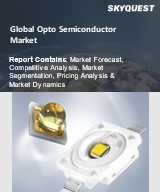
Opto Semiconductor Market
Report ID: SQMIG45O2071
Report ID: SQMIG45O2071
[email protected]
USA +1 351-333-4748
Report ID:
SQMIG45O2071 |
Region:
Global |
Published Date: November, 2025
Pages:
176
|Tables:
99
|Figures:
71


Global Opto Semiconductor Market size was valued at USD 42.5 Billion in 2024 poised to grow between USD 44.01 Billion in 2025 to USD 58.13 Billion by 2033, growing at a CAGR of 3.54% in the forecast period (2026–2033).
The increasing worldwide need for energy-efficient and high-performance electronic components is fueling demand in the opto semiconductor market. Opto semiconductors, which include light-emitting diodes, laser diodes, image sensors, and infrared components, are essential to higher-level capabilities such as high-resolution imaging, biometric identification, optical data transmission, and intelligent lighting. Requested capabilities are increasingly being combined into next-generation applications spanning consumer electronics, automotive systems and applications, telecommunication systems, and industrial automation systems. As a result, demand for opto semiconductors has substantial growth across all major end-user market sectors.
At the same time, the expansion of investment in new technologies that include electric vehicles, autonomous driving, and as examples, the expansion of 5G infrastructure will accelerate the adoption of opto semiconductor components. Recent advancements in compound semiconductor materials such as gallium nitride and indium phosphide, as examples, are also providing new performance levels, improving speed, efficiency, and thermal stability. All of which represent ongoing material, and application-based innovations to augment and scale the global opto semiconductor market share, as itself a foundational enabler to every digital technology.
How is Artificial Intelligence Revolutionizing Innovation and Efficiency in the Opto Semiconductor Market?
The global opto semiconductor market trends is being significantly impacted by the use of Artificial Intelligence to improve product innovations, simplify manufacturing processes, and increase design accuracy. In some cases, Artificial Intelligence enables manufacturers to utilize predictive analytics, automate defect identification, and achieve accelerated designs of photonic devices, resulting in better performing and faster developing components. These data-rich developments are easy to process, face less scrutiny, enabling faster decisions, and higher yield, elongating the lifecycle of costs, improved costs, and reliability for the intended end use.
Artificial Intelligence is also being introduced across fabrication lines by intelligent robotics and vision systems, enabling quicker quality assurance, and adapted controls in process. As this process continues, the cycle with opto semiconductors is enabling opto semiconductors to explore new heights, namely in telecommunications, automotive lighting, medical diagnostics, and consumer electronics. To illustrate, in April 2025, a partnership between Synopsys and a preeminent photonics institute based in Europe launched an AI-enabled design automation platform capable of reducing the development of photonic integrated circuits by almost 40 percent. The platform uses machine learning algorithms to assist in determining behaviours of devices, optimising layouts of design, and simulating interactions of photonic systems more efficiently than ever before at a quality level to accelerate the development cycle for scalable innovation in next generation optical applications.
Market snapshot - 2026-2033
Global Market Size
USD 41.05 Billion
Largest Segment
Light-Emitting Diodes
Fastest Growth
Laser diodes
Growth Rate
3.54% CAGR
To get more insights on this market click here to Request a Free Sample Report
The global opto semiconductor market is segmented based on component, application, material, and region. In terms of component, the market is divided into light-emitting diodes, laser diodes, image sensors, optocouplers, infrared components, and others. Based on application, the market is segmented into automotive, consumer electronics, telecommunication, medical, industrial, and aerospace and defense. By material, the market is categorized into gallium nitride, gallium arsenide, silicon, silicon carbide, indium phosphide, and others. Based on region, the market is segmented into North America, Europe, Asia-Pacific, Central and South America, and the Middle East and Africa.
Based on the global opto semiconductor market forecast, light-emitting diodes dominate the global opto semiconductor market across various end-use sectors. This is largely because they are found in many applications related to display backlighting, general lighting, automotive headlamps and signage. With the increase in statutory requirements, promoting energy-efficient lighting and the continuing shift away from traditional incandescent and fluorescent lamps to solid-state lighting, we expect to see the light-emitting diode segment continue to generate the largest segments in the global market.
Laser diodes should see the most rapid growth over the duration of the forecast. The growth of this segment is driven by the rapid acceptance of these types of diodes in optical communications, industrial laser processing, medical diagnostics and advanced sensing applications. The continued increase in data consumption and internet bandwidth has led to increased prominence for similar networks in the form of fiber-optic networks. At the same time, continued growth in precision-based manufacturing, and minimally invasive medical procedures has also driven the need for high-powered and wavelength-specific laser diodes, providing the fastest-growth share in the component category.
The consumer electronics segment currently dominates the application landscape of the global opto semiconductors industry. The proliferation of smartphones, tablets, smart televisions, and wearable devices has significantly increased the demand for light-emitting diodes, image sensors, and infrared components. Opto semiconductors enable advanced user-interface features such as biometric authentication, facial recognition, gesture control, and augmented reality. Furthermore, the continuous push toward more compact, energy-efficient, and multifunctional electronic devices have made opto semiconductors indispensable to the consumer electronics industry.
The automotive segment is anticipated to witness the highest growth rate in the forecast period, supported by the rising integration of opto semiconductor technologies in advanced driver-assistance systems, adaptive lighting, and in-vehicle entertainment. As electric and autonomous vehicles gain traction globally, demand for enhanced sensing, vision, and illumination capabilities is rising sharply. From forward-looking cameras to rear-view image sensors and dynamic laser headlights, the incorporation of opto semiconductors is rapidly transforming the automotive value chain, establishing it as the fastest-growing application area in the global market.
To get detailed segments analysis, Request a Free Sample Report
As per the global opto semiconductor market analysis, North America leads the global opto semiconductor market due to its strong electronics manufacturing ecosystem, substantial R&D investment, and growing demand for advanced display and sensing technologies. The area benefits from high optoelectronics adoption in automobile, aerospace, defense, and consumer electronics. Notable semiconductor manufacturers have a significant presence in the region, and the semiconductor industry is increasingly focused on high performance photonics to sustain its predominant position in the region.
The United States represents the strongest North American market in opto semiconductors, with rapid growth in optical sensors, infrared devices, and applications utilizing LED technologies across all sectors. The country's existing research infrastructure and solid funding for photonics innovations also underpin the country's advanced development of next-gen products. American companies are at the forefront of utilizing optoelectronic components for applications in LiDAR, medical imaging, AR/VR systems, among others, which strengthens regional leadership throughout the continent.
Canada's opto semiconductor market outlook, inclusive of private and part time users, is concurrently a fast-emerging regional market with significant advances in infrastructure utilization of opto semiconductors across telecommunications, defense, and clean technology. Government backed investments in photonics research across academics and industry in North America are also complimentary supports to market growth. Furthermore, with a growing emphasis on energy-efficient lighting and fibre-optic infrastructure development, Canada is growing as an important contributor to North America's optoelectronic ecosystem.
The Asia Pacific region is growing as per the global opto semiconductor market regional forecast within the forecast period, propelled by the rapidly growing electronics and automotive industries, rising penetration of smart devices, and increased investments in 5G infrastructure. Countries such as Japan, South Korea and China are driving growth in demand for LEDs, photodiodes, image sensors and laser components. Increased levels of government support for self-sufficiency in semiconductors, along with the world's largest consumer electronics production hubs will further fuel the development of the region.
Japan continues to play a key role in the opto semiconductor market in Asia Pacific, as it is a leader in precision electronics, automotive technology, and optical communication. The demand for sensors in self-driving cars and industrial robotics is expecting to grow substantially. Japanese companies continue to invest heavily into high-reliability optoelectronic components, enabling Japan to carve out a significant position in specialized or high-performance optical sensor applications.
The opto semiconductor market in South Korea continues to develop rapidly along with Japan, driven by the advancement of the electronics and semiconductor fabrication industries. South Korean companies are continuing to invest in OLED display technology, advanced camera modules, and optical communication systems. South Korea's strong R&D accomplishments, and government backing for chip manufacturing have established South Korea as a major growth factor of the optoelectronics market in Asia Pacific.
Europe is making steady progress in the opto semiconductors industry, driven by demand in industrial automation, energy-efficient lighting, and automotive safety systems. EU initiatives to promote microelectronics and cross-border collaboration are encouraging innovation. Countries like Germany, the United Kingdom, and Italy are playing significant roles in developing photonic integrated circuits and laser-based technologies for commercial and defense applications.
Germany is leading the opto semiconductor market in Europe because of its dominant automotive and industrial sectors. Germany's push towards incorporating optical components into ADAS, smart lighting and industrial sensing applications is fueling growth in demand. The country also excels at photonic research and is actively participating in governmental supported innovation hubs with university and semiconductor collaborations. These factors aid in accelerating opto semiconductor market growth.
The UK is experiencing the highest growth rate in the opto semiconductors industry analysis, and this growth is being driven by advancements in photonics and the development of optoelectronic medical devices. Increased investment in quantum technology, telecommunications and the connected nature of devices are creating demand for high-performance laser and sensor systems. The strength of the UK is based around its innovation-friendly ecosystem, which is driving adoption across the aerospace/defense and smart infrastructure projects.
Italy is an emerging opto semiconductor market in Europe with optical components that are increasingly applied in renewable energy, lighting, and manufacturing. Italy's initiatives to digitize infrastructure and improve energy efficiencies are important drivers that create new demand for optoelectronic devices, contributing to its emerging market.
To know more about the market opportunities by region and country, click here to
Buy The Complete Report
Rising Demand for High-Speed Optical Communication
Expanding Adoption in Automotive and Consumer Electronics
High Cost of Fabrication and Integration
Thermal Management and Performance Challenges
Request Free Customization of this report to help us to meet your business objectives.
The competitive landscape of the global opto semiconductors industry is marked by continuous technological innovation, strategic partnerships, and vertical integration efforts. Key industry players such as Osram Opto Semiconductors, Broadcom Inc., Hamamatsu Photonics, ROHM Semiconductor, and Infineon Technologies are investing in next-generation product development and expanding their presence in high-growth verticals. For instance, while Osram is adopting minaturized infrared LED for facial recognition and automotive LiDAR, Broadcom is pushing forward on for optical interconnect solutions to hyperscale data centers. Each of the participants leverage proprietary technologies and unique intellectual property to develop market share and maintain their spot at the top of the market.
At the same time, the emergence of niche participants and deep-tech startups focused on newer applications, such as quantum photonics, medical imaging and industrial automation have also emerged and are also making use of additional elements of the industry, by advancing signal and performance limits, combining Artificial Intelligence, photonic design automation, and material platforms.
SkyQuest’s ABIRAW (Advanced Business Intelligence, Research & Analysis Wing) is our Business Information Services team that Collects, Collates, Correlates, and Analyses the Data collected by means of Primary Exploratory Research backed by robust Secondary Desk research.
As per SkyQuest analysis, the global opto semiconductor market is undergoing rapid transformation fueled by rising demand for high-speed optical communication, energy-efficient lighting, and intelligent sensing technologies. The continued movement toward using opto semiconductors in consumer electronics, automotive systems, and telecommunication infrastructure is leading to that widespread adoption. The introduction of new materials, including specialized compound semiconductors, such as gallium nitride and indium phosphide lead to improved performance and a growing application range.
Regionally, the Asia-Pacific region leads the market mainly due to its firm presence in electronics manufacturing and investments in 5G, while North America and Europe follow, boosted by a history of excellent research and helping to automate an industrially based economy. While the industry continues to face pressing cost pressures and thermal management issues, the interactive nature of the market appears to encourage new ways to enhance performance and scale.
| Report Metric | Details |
|---|---|
| Market size value in 2024 | USD 42.5 Billion |
| Market size value in 2033 | USD 58.13 Billion |
| Growth Rate | 3.54% |
| Base year | 2024 |
| Forecast period | 2026-2033 |
| Forecast Unit (Value) | USD Billion |
| Segments covered |
|
| Regions covered | North America (US, Canada), Europe (Germany, France, United Kingdom, Italy, Spain, Rest of Europe), Asia Pacific (China, India, Japan, Rest of Asia-Pacific), Latin America (Brazil, Rest of Latin America), Middle East & Africa (South Africa, GCC Countries, Rest of MEA) |
| Companies covered |
|
| Customization scope | Free report customization with purchase. Customization includes:-
|
To get a free trial access to our platform which is a one stop solution for all your data requirements for quicker decision making. This platform allows you to compare markets, competitors who are prominent in the market, and mega trends that are influencing the dynamics in the market. Also, get access to detailed SkyQuest exclusive matrix.
Table Of Content
Executive Summary
Market overview
Parent Market Analysis
Market overview
Market size
KEY MARKET INSIGHTS
COVID IMPACT
MARKET DYNAMICS & OUTLOOK
Market Size by Region
KEY COMPANY PROFILES
Methodology
For the Opto Semiconductor Market, our research methodology involved a mixture of primary and secondary data sources. Key steps involved in the research process are listed below:
1. Information Procurement: This stage involved the procurement of Market data or related information via primary and secondary sources. The various secondary sources used included various company websites, annual reports, trade databases, and paid databases such as Hoover's, Bloomberg Business, Factiva, and Avention. Our team did 45 primary interactions Globally which included several stakeholders such as manufacturers, customers, key opinion leaders, etc. Overall, information procurement was one of the most extensive stages in our research process.
2. Information Analysis: This step involved triangulation of data through bottom-up and top-down approaches to estimate and validate the total size and future estimate of the Opto Semiconductor Market.
3. Report Formulation: The final step entailed the placement of data points in appropriate Market spaces in an attempt to deduce viable conclusions.
4. Validation & Publishing: Validation is the most important step in the process. Validation & re-validation via an intricately designed process helped us finalize data points to be used for final calculations. The final Market estimates and forecasts were then aligned and sent to our panel of industry experts for validation of data. Once the validation was done the report was sent to our Quality Assurance team to ensure adherence to style guides, consistency & design.
Analyst Support
Customization Options
With the given market data, our dedicated team of analysts can offer you the following customization options are available for the Opto Semiconductor Market:
Product Analysis: Product matrix, which offers a detailed comparison of the product portfolio of companies.
Regional Analysis: Further analysis of the Opto Semiconductor Market for additional countries.
Competitive Analysis: Detailed analysis and profiling of additional Market players & comparative analysis of competitive products.
Go to Market Strategy: Find the high-growth channels to invest your marketing efforts and increase your customer base.
Innovation Mapping: Identify racial solutions and innovation, connected to deep ecosystems of innovators, start-ups, academics, and strategic partners.
Category Intelligence: Customized intelligence that is relevant to their supply Markets will enable them to make smarter sourcing decisions and improve their category management.
Public Company Transcript Analysis: To improve the investment performance by generating new alpha and making better-informed decisions.
Social Media Listening: To analyze the conversations and trends happening not just around your brand, but around your industry as a whole, and use those insights to make better Marketing decisions.
REQUEST FOR SAMPLE
 REQUEST FREE CUSTOMIZATION


Want to customize this report? This report can be personalized according to your needs. Our analysts and industry experts will work directly with you to understand your requirements and provide you with customized data in a short amount of time. We offer $1000 worth of FREE customization at the time of purchase.
Feedback From Our Clients


 USA (+1) 351-333-4748

