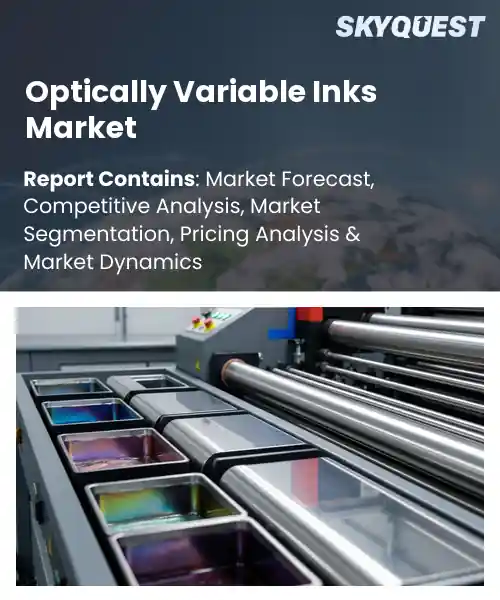
Optically Variable Inks Market
Report ID: SQMIG15E4049
Report ID: SQMIG15E4049
[email protected]
USA +1 351-333-4748
Report ID:
SQMIG15E4049 |
Region:
Global |
Published Date: July, 2026
Pages:
157
|Tables:
118
|Figures:
77


Global Optically Variable Inks Market size was valued at USD 742.6 Million in 2024 and is poised to grow from USD 785.67 Million in 2025 to USD 1233.46 Million by 2033, growing at a CAGR of 5.8% during the forecast period (2026-2033).
Optically variable inks (OVIs) are specialty pigments that shift color when viewed from different angles, serving as a key element in security printing, brand protection, and decorative packaging. The primary market driver is the rising demand for anti‑counterfeit measures in currencies, passports, and high‑value consumer goods, where visual verification provides a low-cost effective safeguard. Initially confined to governmental documents in the 1990s, OVI adoption broadened in the 2000s as digital commerce and sophisticated cloning techniques pressured manufacturers to secure product labels and luxury packaging. The market, now worth hundreds of millions, is set to expand as regulatory scrutiny intensifies worldwide. The second critical factor driving the global OVI market is its integration with packaging, RFID authentication, and applications that turn visual security into experiences. When a brand pairs an OVI color shift with a mobile app scanning a QR code, counterfeiters encounter a barrier, prompting cosmetics and electronics companies to adopt the technology for product differentiation and supply‑chain protection. This convergence opens revenue streams for ink producers, who now supply formulations compatible with digital presses, reducing entry costs for luxury items. As result, market growth stems from regulatory demand and the added value of linking cues to digital trust mechanisms.
How is AI influencing authentication solutions in the optically variable inks market?
AI is reshaping authentication in the optically variable inks market by embedding machine‑learning models into ink formulation and verification workflows. AI analyses microscopic color shifts and light‑reflection patterns, enabling instant detection of counterfeits that traditional visual checks miss. Manufacturers now train algorithms on large datasets of genuine and fake samples, improving the reliability of on‑device scanners and mobile apps. This data‑driven approach reduces human error, speeds up verification at points of sale, and supports dynamic security features that can be updated remotely. As supply chains become more complex, AI‑enhanced OVI offers a scalable way to maintain brand integrity and regulatory compliance.SICPA introduced an AI‑powered authentication platform in June 2024, combining real‑time image analysis with cloud‑based verification, which has accelerated rollout of secure inks and boosted confidence among high‑value product manufacturers.
Market snapshot - (2026-2033)
Global Market Size
USD 742.6 Million
Largest Segment
Color-Shifting Inks
Fastest Growth
Multi-Layer Optically Variable Inks
Growth Rate
5.8% CAGR
To get more insights on this market click here to Request a Free Sample Report
Global optically variable inks market is segmented by product type, application, printing process, end user and region. Based on product type, the market is segmented into Color-Shifting Inks, Multi-Layer Optically Variable Inks and High-Security Optically Variable Inks. Based on application, the market is segmented into Banknotes, Identity Documents, Brand Protection and Security Labels. Based on printing process, the market is segmented into Screen Printing, Intaglio Printing and Flexographic Printing. Based on end user, the market is segmented into Government, Printing Companies and Packaging Industry. Based on region, the market is segmented into North America, Europe, Asia Pacific, Latin America and Middle East & Africa.
Color‑shifting inks segment dominates because its visual effect of changing hue with viewing angle provides an instantly recognizable security cue that is both difficult to counterfeit and easily verified by the public. This intrinsic optical characteristic aligns with the core requirement of high‑value document authentication, driving widespread adoption across central banks and security printers. Its versatility in integrating with various printing techniques further reinforces its pre‑eminence in the optically variable inks market.
Meanwhile, Multi‑layer optically variable inks are witnessing the strongest growth momentum as they enable complex color transitions and hidden images that cater to emerging anti‑counterfeit strategies. Ongoing research on nanostructured pigments and expanding use in premium packaging are accelerating demand, positioning this ink class as a catalyst for future market expansion.
Banknotes segment stands out because they represent the highest‑value security item where visual authentication is paramount, compelling governments to embed the most advanced optically variable inks. The necessity for public confidence, combined with continuous upgrades to deter sophisticated counterfeit methods, creates a relentless demand for cutting‑edge ink technologies, cementing banknotes as the driving force behind market activity. Additionally, close collaboration with specialized printers drives continual formulation refinement.
Conversely, Brand protection is emerging as the key high‑growth area as firms strive to secure trademarks against sophisticated replication. Rising e‑commerce activity and consumer demand for authenticity drive adoption of optically variable inks in labels and packaging. Emerging digital verification tools that read these inks broaden use cases, unlocking new revenue streams and accelerating market expansion.
To get detailed segments analysis, Request a Free Sample Report
North America maintains a leadership position through a combination of deep technological expertise, extensive supply chain integration, and a regulatory climate that promotes innovation in security printing. The region benefits from a concentration of research universities and corporate R&D labs that continuously push the boundaries of pigment formulation and application methods. Close collaboration between ink manufacturers and end‑user industries such as automotive, packaging, and government identification fosters rapid adoption of advanced variable‑color solutions. Strong intellectual‑property protections encourage investment in proprietary technologies, while mature distribution networks ensure reliable delivery to high‑volume customers. Moreover, a culture of stringent brand protection and anti‑counterfeiting measures drives sustained demand for sophisticated optical effects across the continent.
Optically Variable Inks Market in United States is shaped by intensive security‑focused initiatives across government documents, high‑value consumer goods, and sophisticated aerospace components. Leading formulators leverage advanced nanostructures to create vivid color‑shifting effects that deter counterfeit attempts. Collaborative ecosystems linking academic research centers with commercial producers accelerate product development cycles. End‑users benefit from a robust certification framework that validates performance under diverse environmental conditions, reinforcing confidence in ink reliability and durability.
Optically Variable Inks Market in Canada is propelled by a growing emphasis on secure product authentication within the pharmaceutical and luxury goods sectors. Regional chemical manufacturers integrate sustainable practices with high‑performance pigment technologies, aligning with broader environmental expectations. Close proximity to United States innovation hubs facilitates technology transfer and joint ventures, enriching the local expertise base. Government incentives for advanced manufacturing further nurture a supportive environment for scaling sophisticated ink solutions.
Europe’s expansion is underpinned by a strong commitment to brand integrity, sophisticated anti‑counterfeiting legislation, and a mature printing ecosystem that embraces cutting‑edge color‑shift technologies. The region’s deep design heritage fuels creative demands for visually striking effects in fashion, premium packaging, and high‑security documents. Collaborative research initiatives across academic and industrial partners generate continuous improvements in pigment stability and environmental resilience. A well‑established network of specialized suppliers and high‑precision applicators ensures seamless integration of variable inks into complex production lines. Additionally, heightened consumer awareness of product authenticity amplifies market momentum across multiple verticals.
Optically Variable Inks Market in Germany benefits from a robust engineering culture and a dense cluster of specialty chemical firms that prioritize precision formulation. Integration with automotive and industrial labeling sectors drives the adoption of durable, high‑visibility security features. Strong standards bodies coordinate testing protocols that guarantee consistent performance, reinforcing confidence among OEMs and downstream printers. Continuous investment in research institutions sustains a pipeline of innovative color‑changing technologies that keep German offerings at the forefront of the market.
Optically Variable Inks Market in United Kingdom experiences accelerated growth through vibrant creative industries and a proactive regulatory stance on counterfeit prevention. Leading branding agencies collaborate with ink producers to embed dynamic visual elements into premium packaging and event authentication. Financial services and passport authorities also drive demand for tamper‑evident features that leverage optical variability. Emerging digital‑print capabilities enable rapid prototyping, allowing marketers to experiment with novel effects, thereby fueling a dynamic market environment.
Optically Variable Inks Market in France is emerging as a niche yet influential segment, supported by a strong luxury goods heritage and a growing emphasis on secure pharmaceutical packaging. French design houses value the aesthetic appeal of color‑shift pigments, incorporating them into haute couture accessories and limited‑edition product lines. Collaborative efforts between research labs and boutique manufacturers foster tailored solutions that meet both artistic and security requirements. Government initiatives encouraging sustainable chemistry further guide the development of eco‑friendly ink formulations.
Asia Pacific is reinforcing its role through rapid industrialization, heightened focus on anti‑counterfeit measures, and a surge in high‑tech printing capabilities. The region’s expansive manufacturing base creates a large demand for secure labeling across electronics, automotive components, and consumer goods. Investment in advanced pigment research, often in partnership with local universities, yields formulations that balance vivid optical effects with environmental compliance. Growing expertise in precision coating techniques enables the seamless integration of variable inks into ultra‑thin substrates, expanding application possibilities. Additionally, supportive trade policies and regional standards harmonization facilitate cross‑border collaboration, accelerating the diffusion of innovative ink technologies throughout the market.
Optically Variable Inks Market in Japan thrives on a culture of meticulous craftsmanship and a strong emphasis on high‑performance materials. Leading chemical conglomerates develop ultra‑fine pigment particles that deliver sharp color transitions under varied lighting. Close ties with electronics manufacturers promote the use of variable inks for secure component marking and premium product packaging. Continuous improvement programs focus on enhancing ink stability under humid and temperature‑fluctuating conditions, ensuring reliability for demanding applications.
Optically Variable Inks Market in South Korea is driven by a vibrant consumer electronics sector and an aggressive stance toward brand protection. Tech startups collaborate with established pigment producers to create dynamic visual effects that differentiate devices and accessories. Government support for smart manufacturing encourages the adoption of advanced printing processes that incorporate optical variable inks at scale. Emphasis on rapid innovation cycles ensures that new shade‑shifting formulations reach the market swiftly, reinforcing South Korea’s competitive edge in the region.
To know more about the market opportunities by region and country, click here to
Buy The Complete Report
Rising Demand For Authentication
Advancements In Ink Technology
High Production Costs
Regulatory Uncertainty Across Regions
Request Free Customization of this report to help us to meet your business objectives.
The competitive landscape of the global optically variable inks market is shaped by intense rivalry among specialty chemical producers, security‑printing firms, and emerging material innovators. Companies are accelerating M&A activity to acquire proprietary pigment technologies, forming strategic partnerships with authentication solution providers, and investing in nanostructured ink formulations that enhance color‑shifting performance for anti‑counterfeiting applications. These moves aim to secure premium contracts with governments and high‑value brand owners, driving market consolidation and technological differentiation.
Top Player’s Company Profile
Recent Developments
SkyQuest’s ABIRAW (Advanced Business Intelligence, Research & Analysis Wing) is our Business Information Services team that Collects, Collates, Correlates, and Analyses the Data collected by means of Primary Exploratory Research backed by robust Secondary Desk research. As per SkyQuest analysis, the global optically variable inks market is being propelled primarily by the rising demand for authentication across banknotes, passports and brand packaging, while recent advancements in nanostructured pigment technology provide a second driver by expanding color‑shifting capabilities and durability. High production costs act as the main restraint, limiting adoption among cost‑sensitive manufacturers. North America remains the dominating region thanks to strong R&D ecosystems, robust supply chains and proactive anti‑counterfeit regulations. Within the market, color‑shifting inks hold the largest share because their instantly recognizable hue change offers an effective, low‑tech security cue that is widely embraced by governments and brands alike.
| Report Metric | Details |
|---|---|
| Market size value in 2024 | USD 742.6 Million |
| Market size value in 2033 | USD 1233.46 Million |
| Growth Rate | 5.8% |
| Base year | 2024 |
| Forecast period | (2026-2033) |
| Forecast Unit (Value) | USD Million |
| Segments covered |
|
| Regions covered | North America (US, Canada), Europe (Germany, France, United Kingdom, Italy, Spain, Rest of Europe), Asia Pacific (China, India, Japan, Rest of Asia-Pacific), Latin America (Brazil, Rest of Latin America), Middle East & Africa (South Africa, GCC Countries, Rest of MEA) |
| Companies covered |
|
| Customization scope | Free report customization with purchase. Customization includes:-
|
To get a free trial access to our platform which is a one stop solution for all your data requirements for quicker decision making. This platform allows you to compare markets, competitors who are prominent in the market, and mega trends that are influencing the dynamics in the market. Also, get access to detailed SkyQuest exclusive matrix.
Table Of Content
Executive Summary
Market overview
Parent Market Analysis
Market overview
Market size
KEY MARKET INSIGHTS
COVID IMPACT
MARKET DYNAMICS & OUTLOOK
Market Size by Region
KEY COMPANY PROFILES
Methodology
For the Optically Variable Inks Market, our research methodology involved a mixture of primary and secondary data sources. Key steps involved in the research process are listed below:
1. Information Procurement: This stage involved the procurement of Market data or related information via primary and secondary sources. The various secondary sources used included various company websites, annual reports, trade databases, and paid databases such as Hoover's, Bloomberg Business, Factiva, and Avention. Our team did 45 primary interactions Globally which included several stakeholders such as manufacturers, customers, key opinion leaders, etc. Overall, information procurement was one of the most extensive stages in our research process.
2. Information Analysis: This step involved triangulation of data through bottom-up and top-down approaches to estimate and validate the total size and future estimate of the Optically Variable Inks Market.
3. Report Formulation: The final step entailed the placement of data points in appropriate Market spaces in an attempt to deduce viable conclusions.
4. Validation & Publishing: Validation is the most important step in the process. Validation & re-validation via an intricately designed process helped us finalize data points to be used for final calculations. The final Market estimates and forecasts were then aligned and sent to our panel of industry experts for validation of data. Once the validation was done the report was sent to our Quality Assurance team to ensure adherence to style guides, consistency & design.
Analyst Support
Customization Options
With the given market data, our dedicated team of analysts can offer you the following customization options are available for the Optically Variable Inks Market:
Product Analysis: Product matrix, which offers a detailed comparison of the product portfolio of companies.
Regional Analysis: Further analysis of the Optically Variable Inks Market for additional countries.
Competitive Analysis: Detailed analysis and profiling of additional Market players & comparative analysis of competitive products.
Go to Market Strategy: Find the high-growth channels to invest your marketing efforts and increase your customer base.
Innovation Mapping: Identify racial solutions and innovation, connected to deep ecosystems of innovators, start-ups, academics, and strategic partners.
Category Intelligence: Customized intelligence that is relevant to their supply Markets will enable them to make smarter sourcing decisions and improve their category management.
Public Company Transcript Analysis: To improve the investment performance by generating new alpha and making better-informed decisions.
Social Media Listening: To analyze the conversations and trends happening not just around your brand, but around your industry as a whole, and use those insights to make better Marketing decisions.
REQUEST FOR SAMPLE
 REQUEST FREE CUSTOMIZATION


Want to customize this report? This report can be personalized according to your needs. Our analysts and industry experts will work directly with you to understand your requirements and provide you with customized data in a short amount of time. We offer $1000 worth of FREE customization at the time of purchase.
Feedback From Our Clients


 USA (+1) 351-333-4748

