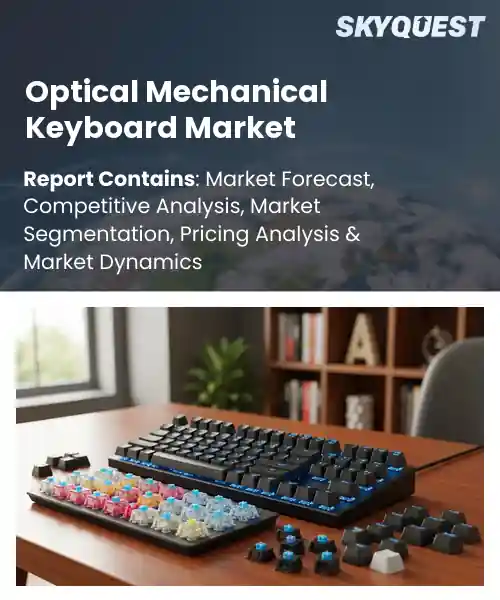
Optical Mechanical Keyboard Market
Report ID: SQMIG45I2505
Report ID: SQMIG45I2505
[email protected]
USA +1 351-333-4748
Report ID:
SQMIG45I2505 |
Region:
Global |
Published Date: August, 2026
Pages:
157
|Tables:
143
|Figures:
78


Global Optical Mechanical Keyboard Market size was valued at USD 1.8 Billion in 2024 and is poised to grow from USD 2.01 Billion in 2025 to USD 4.96 Billion by 2033, growing at a CAGR of 11.9% during the forecast period (2026-2033).
The global optical mechanical keyboard market comprises devices that replace metal‑contact switches with infrared or photonic actuation, delivering faster keystroke registration and longer lifespan. Its importance stems from growing demand for high‑performance input solutions in gaming, data‑center administration, and professional typing environments where latency and durability directly affect productivity. The market emerged in the early 2010s when companies such as Razer and Kingston introduced prototype optical switches, and it accelerated after 2017 as semiconductor advances reduced component costs. Over the past five years, adoption has widened from niche enthusiast circles to mainstream enterprise procurement, illustrating a shift toward optoelectronic reliability.
The key trend driving the global optical mechanical keyboard sector lies in quest for low latency competitive gaming, because decisions depend on instant key registration. Optical switches remove debounce lag, allowing players to execute combos milliseconds faster than with traditional mechanical keys; this advantage prompted teams such as Team SoloMid to adopt Razer’s optical‑switch models. Same reliability appeals to data‑center operators who need command entry under workloads, as optical keyboards cut key‑miss rates and reduce maintenance, lowering cost of ownership. In response, manufacturers are scaling production while adding RGB lighting and programmable macros to attract gamers and enterprises, creating virtuous cycle of adoption.
How is AI-Driven Automation Influencing Design Trends in the Optical Mechanical Keyboard Market?
AI driven automation is reshaping design trends in the optical mechanical keyboard market by introducing data rich insight into every stage of product development. Designers now rely on machine learning models to predict ergonomic comfort, acoustic signature and key travel based on user profiles. Generative algorithms suggest novel keycap geometries and lighting patterns that balance aesthetics with performance. AI powered simulation shortens the prototyping loop, allowing rapid iteration of switch housings and PCB layouts. Manufacturers use automated tooling guided by these models to produce consistent optical switch assemblies at scale, creating a more responsive and personalized offering for enthusiasts.
In January 2026, Razer unveiled Project AVA, an AI-powered gaming companion at CES 2026, alongside its broader AI gaming initiatives. Although not embedded directly into optical keyboards, the development strengthens Razer’s AI ecosystem and could support future intelligent keyboard features, including personalized gaming assistance, adaptive controls, and software-driven optimization for optical mechanical keyboard users.
Market snapshot - (2026-2033)
Global Market Size
USD 1.8 Billion
Largest Segment
Linear
Fastest Growth
Tactile
Growth Rate
11.9% CAGR
To get more insights on this market click here to Request a Free Sample Report
Global optical mechanical keyboard market is segmented by switch type, connectivity, keyboard size, application, distribution channel and region. Based on switch type, the market is segmented into linear, tactile and clicky. Based on connectivity, the market is segmented into wired and wireless. Based on keyboard size, the market is segmented into full size, tenkeyless (TKL), 75% and 65% & below. Based on application, the market is segmented into gaming, commercial and personal. Based on distribution channel, the market is segmented into online and offline. Based on region, the market is segmented into North America, Europe, Asia Pacific, Latin America and Middle East & Africa.
Based on the global optical mechanical keyboard market growth, linear segment dominates because its smooth actuation delivers consistent keystroke feedback that aligns with the precision demands of optical actuation technology. The absence of tactile bumps reduces mechanical resistance, allowing the optical interrupter to register each press with minimal latency. This synergy enhances gaming performance and professional typing efficiency, prompting manufacturers to prioritize linear designs in product roadmaps and fueling broader market acceptance across diverse user segments globally.
However, tactile segment is witnessing the strongest growth momentum as users seek a balanced feel that combines audible feedback with enhanced tactile resistance. Emerging ergonomic designs and customizable stem options are attracting creators and content professionals, driving demand for tactile switches that complement optical sensors and open new niche applications.
Wired segment leads because it guarantees uninterrupted power delivery and eliminates latency concerns inherent in wireless protocols. The dedicated cable ensures stable signal transmission, which is crucial for the high speed actuation of optical switches, especially in competitive gaming and mission critical commercial environments. This reliability continues to make wired keyboards the preferred choice for performance focused consumers and enterprise deployments throughout the product lifecycle and support infrastructure.
Meanwhile, wireless segment emerges as the key high growth area as Bluetooth Low Energy advancements enable seamless multi device pairing and extended battery life. The convenience of clutter free setups is resonating with remote workers and mobile gamers, prompting OEMs to integrate optimized RF modules that accelerate market expansion and unlock new use cases.
To get detailed segments analysis, Request a Free Sample Report
As per the global optical mechanical keyboardmarket share, dominance of Asia Pacific is rooted in a convergence of advanced manufacturing expertise, deep technical talent, and a culture that embraces high‑performance computing. The region benefits from a robust supply chain that integrates precision optics with cutting‑edge switch engineering, enabling rapid prototyping and scalable production. Consumer demand for premium peripherals is amplified by a large base of gaming enthusiasts and professional users who value speed and durability. Strategic collaboration between component suppliers and original equipment manufacturers fosters continuous innovation, while strong intellectual property frameworks encourage investment in research. Collectively, these factors create an ecosystem where optical mechanical keyboards evolve swiftly, securing Asia Pacific as the leading driver of global market momentum.
Optical mechanical keyboard market in Japan thrives on a reputation for meticulous craftsmanship and a strong orientation toward ergonomic design. Local manufacturers prioritize high reliability and incorporate sophisticated lighting effects that appeal to both business professionals and gaming communities. Collaborative efforts between electronics conglomerates and niche design studios accelerate the introduction of feature‑rich keyboards that align with consumer expectations for speed and tactile precision.
Optical mechanical keyboard market in South Korea is propelled by a vibrant gaming culture and a tech‑savvy consumer base that seeks ultra‑responsive input devices. The country’s strong semiconductor and optical sensor capabilities enable integration of low‑latency technologies, while domestic brands focus on sleek aesthetics and customizable interfaces. Close ties between hardware developers and online esports platforms foster rapid feedback loops, driving continuous refinement of keyboard performance and functionality.
Based on global optical mechanical keyboard regional forecast, North America, the rapid expansion is fueled by a growing emphasis on productivity tools and immersive gaming experiences that demand faster, more accurate input solutions. Consumers and enterprises alike prioritize keyboards that deliver minimal latency and robust durability for intensive use. Innovation hubs in technology corridors encourage collaboration between software developers and peripheral manufacturers, leading to the integration of advanced customization software and adaptive lighting. Additionally, a strong retail ecosystem supports early adoption of premium products, while content creators and professional gamers act as influential advocates, amplifying market visibility and encouraging broader acceptance of optical mechanical technology.
Optical mechanical keyboard market in United States benefits from a large community of professional gamers and technology enthusiasts who value cutting‑edge performance. Leading manufacturers emphasize low‑latency actuation and extensive macro programming to meet the demands of competitive play and high‑speed typing. Partnerships with software platforms enable seamless integration of lighting and key‑mapping features, enhancing the overall user experience and driving widespread adoption across both consumer and enterprise segments.
Optical mechanical keyboard market in Canada reflects a strong interest in high‑performance peripherals among creative professionals and remote workers. Market participants focus on ergonomic considerations and reliability to support long‑duration usage. Collaborative initiatives between local design firms and global component suppliers foster the development of keyboards that combine precision optics with customizable interfaces, aligning with the preferences of a discerning user base that values both functionality and aesthetic appeal.
As per global optical mechanical keyboard regional outlook, Europe strengthens its position through a combination of rigorous standards, design excellence, and a growing ecosystem of specialized manufacturers. The region places a premium on sustainable production practices, encouraging the adoption of recyclable materials and energy‑efficient manufacturing processes. Collaborative research initiatives across multiple countries stimulate advances in optical sensor technology and tactile feedback mechanisms. A strong tradition of ergonomic design integrates user‑centered approaches, while high‑end consumer segments and professional work environments drive demand for premium keyboards that deliver speed, durability, and aesthetic refinement. These strategic priorities reinforce Europe’s role as a dynamic contributor to market development.
Optical mechanical keyboard market in Germany emphasizes engineering precision and durability, catering to both industrial users and high‑performance gamers. Manufacturers focus on integrating robust optical switches with sophisticated software suites that allow deep customization of key functions and lighting profiles. The strong engineering culture encourages continuous refinement of actuation mechanisms, ensuring consistent performance under demanding conditions.
Optical mechanical keyboard market in United Kingdom is shaped by a vibrant community of tech influencers and a thriving gaming sector that values low‑latency input devices. Brands prioritize sleek design and modularity, offering interchangeable keycaps and programmable layouts that appeal to creative professionals and enthusiasts seeking personalized setups.
Optical mechanical keyboard market in France blends aesthetic sensibility with functional performance, attracting users who appreciate refined visual elements alongside rapid response. Companies focus on integrating high‑resolution backlighting with tactile precision, delivering keyboards that meet the expectations of both design‑oriented professionals and avid gamers.
To know more about the market opportunities by region and country, click here to
Buy The Complete Report
Increasing Remote Work Adoption
Advancements In Optical Sensor Technology
Higher Production Costs
Limited Compatibility With Existing Systems
Request Free Customization of this report to help us to meet your business objectives.
The global optical mechanical keyboard market outlook is shaped by intense competition as incumbents and new entrants race to differentiate through optical‑switch technology, low‑latency performance, and premium design. Keychron’s partnership with Kailh to co‑develop next‑gen optical switches, Logitech’s acquisition of the optical‑switch specialist Input Labs, and Razer’s launch of the Razer Optical‑Hybrid series illustrate how M&A, collaborations and rapid tech innovation drive market positioning.
Top Player’s Company Profile
Recent Developments
SkyQuest’s ABIRAW (Advanced Business Intelligence, Research & Analysis Wing) is our Business Information Services team that Collects, Collates, Correlates, and Analyses the Data collected by means of Primary Exploratory Research backed by robust Secondary Desk research.
As per SkyQuest analysis, the global optical mechanical keyboard industry is being propelled primarily by the surge in remote‑work adoption, which pushes users toward faster, more durable keyboards, while higher production costs act as a key restraint limiting price‑sensitive uptake. Asia Pacific remains the dominant region thanks to its advanced manufacturing ecosystem and a large gamer‑tech community, and the linear‑switch segment leads the market because its smooth actuation pairs perfectly with low‑latency optical technology. A second growth catalyst is AI‑driven automation that speeds up design and customization, enabling manufacturers to launch personalized, high‑performance products faster and fueling further expansion across both consumer and enterprise segments.
| Report Metric | Details |
|---|---|
| Market size value in 2024 | USD 1.8 Billion |
| Market size value in 2033 | USD 4.96 Billion |
| Growth Rate | 11.9% |
| Base year | 2024 |
| Forecast period | (2026-2033) |
| Forecast Unit (Value) | USD Billion |
| Segments covered |
|
| Regions covered | North America (US, Canada), Europe (Germany, France, United Kingdom, Italy, Spain, Rest of Europe), Asia Pacific (China, India, Japan, Rest of Asia-Pacific), Latin America (Brazil, Rest of Latin America), Middle East & Africa (South Africa, GCC Countries, Rest of MEA) |
| Companies covered |
|
| Customization scope | Free report customization with purchase. Customization includes:-
|
To get a free trial access to our platform which is a one stop solution for all your data requirements for quicker decision making. This platform allows you to compare markets, competitors who are prominent in the market, and mega trends that are influencing the dynamics in the market. Also, get access to detailed SkyQuest exclusive matrix.
Table Of Content
Executive Summary
Market overview
Parent Market Analysis
Market overview
Market size
KEY MARKET INSIGHTS
COVID IMPACT
MARKET DYNAMICS & OUTLOOK
Market Size by Region
KEY COMPANY PROFILES
Methodology
For the Optical Mechanical Keyboard Market, our research methodology involved a mixture of primary and secondary data sources. Key steps involved in the research process are listed below:
1. Information Procurement: This stage involved the procurement of Market data or related information via primary and secondary sources. The various secondary sources used included various company websites, annual reports, trade databases, and paid databases such as Hoover's, Bloomberg Business, Factiva, and Avention. Our team did 45 primary interactions Globally which included several stakeholders such as manufacturers, customers, key opinion leaders, etc. Overall, information procurement was one of the most extensive stages in our research process.
2. Information Analysis: This step involved triangulation of data through bottom-up and top-down approaches to estimate and validate the total size and future estimate of the Optical Mechanical Keyboard Market.
3. Report Formulation: The final step entailed the placement of data points in appropriate Market spaces in an attempt to deduce viable conclusions.
4. Validation & Publishing: Validation is the most important step in the process. Validation & re-validation via an intricately designed process helped us finalize data points to be used for final calculations. The final Market estimates and forecasts were then aligned and sent to our panel of industry experts for validation of data. Once the validation was done the report was sent to our Quality Assurance team to ensure adherence to style guides, consistency & design.
Analyst Support
Customization Options
With the given market data, our dedicated team of analysts can offer you the following customization options are available for the Optical Mechanical Keyboard Market:
Product Analysis: Product matrix, which offers a detailed comparison of the product portfolio of companies.
Regional Analysis: Further analysis of the Optical Mechanical Keyboard Market for additional countries.
Competitive Analysis: Detailed analysis and profiling of additional Market players & comparative analysis of competitive products.
Go to Market Strategy: Find the high-growth channels to invest your marketing efforts and increase your customer base.
Innovation Mapping: Identify racial solutions and innovation, connected to deep ecosystems of innovators, start-ups, academics, and strategic partners.
Category Intelligence: Customized intelligence that is relevant to their supply Markets will enable them to make smarter sourcing decisions and improve their category management.
Public Company Transcript Analysis: To improve the investment performance by generating new alpha and making better-informed decisions.
Social Media Listening: To analyze the conversations and trends happening not just around your brand, but around your industry as a whole, and use those insights to make better Marketing decisions.
REQUEST FOR SAMPLE
 REQUEST FREE CUSTOMIZATION
Global Optical Mechanical Keyboard Market size was valued at USD 1.8 Billion in 2024 and is poised to grow from USD 2.01 Billion in 2025 to USD 4.96 Billion by 2033, growing at a CAGR of 11.9% during the forecast period (2026-2033).
The global optical mechanical keyboard market is shaped by intense competition as incumbents and new entrants race to differentiate through optical‑switch technology, low‑latency performance, and premium design. Keychron’s partnership with Kailh to co‑develop next‑gen optical switches, Logitech’s acquisition of the optical‑switch specialist Input Labs, and Razer’s launch of the Razer Optical‑Hybrid series illustrate how M&A, collaborations and rapid tech innovation drive market positioning. 'Logitech International S.A.', 'Razer Inc.', 'Corsair Gaming, Inc.', 'SteelSeries ApS', 'Keychron Technology Co., Ltd.', 'DuckyChannel International Co., Ltd.', 'CHERRY SE', 'ASUSTeK Computer Inc.', 'Micro-Star International Co., Ltd.', 'Cooler Master Technology Inc.', 'A4Tech Co., Ltd.', 'Shenzhen Rapoo Technology Co., Ltd.', 'ZOWIE GEAR', 'Glorious PC Gaming Race LLC', 'Epomaker Technology Co., Ltd.', 'IQUNIX Technology Co., Ltd.', 'Lofree Technology Co., Ltd.', 'Varmilo Technology Co., Ltd.', 'Akko Technology Co., Ltd.', 'Darmoshark Technology Co., Ltd.'
The shift toward remote and hybrid work environments encourages users to seek keyboards that provide tactile feedback and precise tracking, enhancing typing comfort over prolonged periods. Optical switches offer faster actuation and longer lifespan, aligning with the demands of home offices where durability and performance are valued. Consequently, corporate procurement and individual consumers alike prioritize optical mechanical keyboards, driving market expansion as organizations upgrade employee workstations and individuals invest in higher‑quality peripherals for enhanced productivity and overall user satisfaction significantly.
Ai‑Driven Customization: Manufacturers are integrating AI algorithms into firmware to dynamically adjust actuation force, key travel, and debounce timing based on individual typing patterns. This capability enables keyboards to learn user preferences, delivering a personalized tactile experience that reduces fatigue and improves accuracy. As remote work and gaming demand longer sessions, AI‑driven customization is becoming a differentiator, encouraging premium pricing and fostering brand loyalty among enthusiasts who value adaptive performance without manual reconfiguration and seamless integration with existing software ecosystems for productivity.
Why does Asia Pacific Dominate the Global Optical Mechanical Keyboard Market? |@12


Want to customize this report? This report can be personalized according to your needs. Our analysts and industry experts will work directly with you to understand your requirements and provide you with customized data in a short amount of time. We offer $1000 worth of FREE customization at the time of purchase.
Feedback From Our Clients


 USA (+1) 351-333-4748

