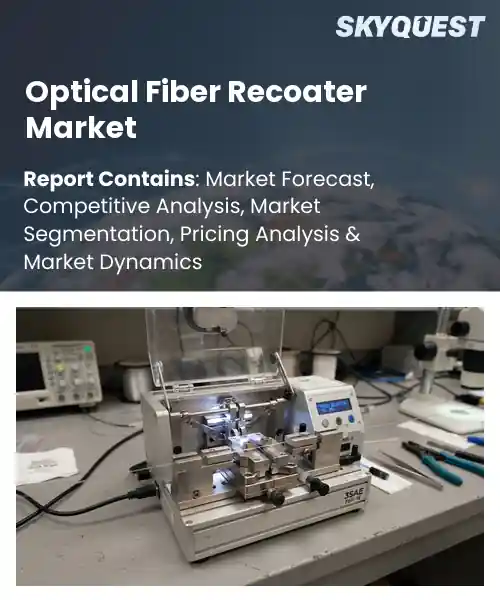
Optical Fiber Recoater Market
Report ID: SQMIG45H2350
Report ID: SQMIG45H2350
[email protected]
USA +1 351-333-4748
Report ID:
SQMIG45H2350 |
Region:
Global |
Published Date: September, 2026
Pages:
157
|Tables:
142
|Figures:
78


Global Optical Fiber Recoater Market size was valued at USD 318.4 Million in 2024 and is poised to grow from USD 338.14 Million in 2025 to USD 547.14 Million by 2033, growing at a CAGR of 6.2% during the forecast period (2026-2033).
The optical fiber recoater market supplies equipment that restores coating on fiber strands after they have been stripped for splicing or testing, a step essential for preserving signal integrity and strength. Growing demand for broadband, data‑center links, and 5G backhaul has amplified the need for solutions, positioning the market as an enabler of telecommunications infrastructure. Historically, recoaters were niche tools used by installers, but spread of fiber‑to‑the‑home deployments in 2010s broadened their user base to utilities and contractors. FTTH rollout in South Korea and United States prompted manufacturers to introduce recoaters that reduced labor and improved repeatability, accelerating market growth. The surge in data traffic and the shift toward cloud‑native architectures are the catalyst driving expansion of the global optical fiber recoater market. As hyperscale data centers adopt wavelength‑division multiplexing to boost capacity, the frequency of fiber splicing rises, creating a direct need for recoating to maintain performance standards. Companies such as Corning and Fujikura have responded by launching machines that integrate automated stripping, cleaning, and recoating in a workflow, reducing cycle time from minutes to seconds. This efficiency gain lowers operational expenditures for telecom operators, encouraging investment in fiber expansion projects across markets, thereby opening revenue streams for manufacturers.
How is AI-driven automation impacting the optical fiber recoater market?
AI-driven automation is reshaping the optical fiber recoater market by embedding machine learning algorithms into coating heads, tension controls and defect detection systems. Manufacturers rely on predictive models to adjust resin flow, reducing waste and improving uniformity. The technology also enables remote monitoring, allowing operators to intervene before a line stop occurs. Production cycles become shorter and equipment uptime rises. Early adopters report smoother transitions between cable types and faster changeovers, making the process more flexible for diverse network demands. This shift is attracting investment and spurring collaborations between AI firms and traditional recoater suppliers.Furukawa Electric July 2023, launched an AI enabled recoater that autonomously tunes resin viscosity and monitors coating thickness, cutting setup time and boosting line efficiency. The system integrates real time data analytics with control loops, allowing quality improvement without manual intervention. Operators report smoother production runs and lower scrap rates, underscoring how AI driven automation supports market growth.
Market snapshot - (2026-2033)
Global Market Size
USD 318.4 Million
Largest Segment
Automatic Recoaters
Fastest Growth
Automatic Recoaters
Growth Rate
6.2% CAGR
To get more insights on this market click here to Request a Free Sample Report
Global optical fiber recoater market is segmented by recoater type, coating material, application, end user, fiber type and region. Based on recoater type, the market is segmented into Manual Recoaters and Automatic Recoaters. Based on coating material, the market is segmented into Acrylate, Polyimide and Silicone. Based on application, the market is segmented into Fiber Optic Manufacturing, Fiber Optic Repair and Research Laboratories. Based on end user, the market is segmented into Telecommunications, Defense and Research Institutes. Based on fiber type, the market is segmented into Single-Mode Fiber and Multi-Mode Fiber. Based on region, the market is segmented into North America, Europe, Asia Pacific, Latin America and Middle East & Africa.
Automatic recoaters segment dominates because they integrate real‑time monitoring, precision control, and minimal human intervention, which directly boost throughput and product consistency in high‑volume fiber production. Their ability to synchronize coating thickness with fiber draw speeds eliminates variability, meeting stringent telecom quality standards. This operational efficiency aligns with manufacturers’ need to reduce cycle times and lower labor costs, cementing automatic systems as the preferred choice for large‑scale optical fiber recoating.
However, manual recoaters segment is witnessing the strongest growth momentum because niche producers prioritize flexibility and lower capital investment. Rapid reconfiguration for experimental coatings or low‑volume runs drives demand for adaptable machines. Their ease of integration into existing lines expands specialized applications and opens opportunities for customized recoating solutions.
Polyimide coating segment dominates because it provides exceptional thermal stability and mechanical resilience, enabling reliable recoating of fibers used in harsh environments such as aerospace and deep‑sea communications. Its resistance to elevated temperatures and chemical degradation preserves signal integrity while maintaining low attenuation. These attributes meet the rigorous specifications of industries that require long‑term durability, making polyimide the preferred material for premium optical fiber recoating solutions.
On the other hand, silicone coating segment emerges as the most rapidly expanding area because its flexibility and biocompatibility unlock medical diagnostics and wearable sensor markets. Manufacturers adopt silicone for its low‑stress interface and easy customization, accelerating product innovation. This growth broadens application adoption and drives future market diversification for optical fiber reco
To get detailed segments analysis, Request a Free Sample Report
North America maintains a leading position in the optical fiber recoater market due to a confluence of mature telecommunications networks, deep engineering expertise, and a robust ecosystem of equipment manufacturers. The region benefits from extensive research collaborations between universities and industry, fostering continuous innovation in recoating technologies. Strong demand for high‑capacity data transmission drives ongoing upgrades of fiber infrastructure, encouraging adoption of advanced recoaters. Regulatory frameworks support investment in network modernization, while a skilled labor pool ensures efficient deployment and maintenance. Additionally, the presence of major global OEMs and a culture of early technology adoption reinforce North America’s dominance, creating a self‑reinforcing cycle of capability and market leadership. The collaborative environment also accelerates time‑to‑market for new recoating solutions, reinforcing the region’s competitive edge.
United States Optical Fiber Recoater Market
Optical Fiber Recoater Market activity in the United States is shaped by a high concentration of telecom operators undertaking extensive network refresh programs. The presence of leading technology providers and a strong venture capital ecosystem fuels rapid development of next‑generation recoating equipment. Skilled engineering talent and close collaboration between manufacturers and service providers accelerate adoption, while regulatory incentives encourage investment in high‑performance fiber solutions across both urban and rural deployments.
Canada Optical Fiber Recoater Market
Optical Fiber Recoater Market dynamics in Canada reflect a strategic emphasis on expanding broadband reach into remote and northern communities. Government programs supporting inclusion drive demand for reliable fiber infrastructure, prompting operators to adopt recoating technologies. Local manufacturers benefit from ties with research institutions, fostering innovation tailored to harsh environmental conditions. The collaborative approach between service providers and equipment suppliers ensures efficient deployment and maintenance of fiber networks across the country.
Europe’s optical fiber recoater market is anchored by a strong commitment to digital connectivity and sustainability across both mature and emerging economies. Policy frameworks that prioritize high‑speed broadband and green network initiatives stimulate investment in fiber upgrades, creating demand for efficient recoating solutions. The region’s dense network of research institutions and collaborative industry clusters accelerates technology refinement, while a focus on interoperability ensures seamless integration across diverse telecom environments. Leading manufacturers benefit from an established supply chain and a customer base that values reliability and performance, fostering continuous improvement. The emphasis on cross‑border standardization reduces barriers to market entry, while increasing demand for high‑capacity data services in finance, media, and manufacturing fuels the need for advanced recoating capabilities. This environment encourages both incumbent players and innovative startups to expand their offerings, reinforcing Europe’s position as a dynamic hub for fiber technology advancement.
Germany Optical Fiber Recoater Market
Optical Fiber Recoater Market activity in Germany is anchored by a strong engineering tradition and a dense network of telecom operators committed to next‑generation broadband. Collaborative research initiatives between universities and equipment manufacturers drive continuous improvement of recoating processes. The market benefits from a well‑established supply chain and a regulatory environment that encourages investment in high‑performance fiber infrastructure, supporting both urban upgrades and industrial connectivity projects across the national landscape.
United Kingdom Optical Fiber Recoater Market
Optical Fiber Recoater Market growth in the United Kingdom is driven by broadband rollout targets and an ecosystem of technology innovators. Government incentives for fiber expansion stimulate demand for reliable recoating solutions, while strong partnerships between service providers and manufacturers accelerate deployment. The market leverages the United Kingdom’s expertise in high‑speed data services, fostering rapid adoption of advanced recoaters to meet escalating capacity requirements across both residential and commercial sectors.
France Optical Fiber Recoater Market
Optical Fiber Recoater Market in France is as telecom operators prioritize network densification to support data traffic. Collaborative projects between research labs and equipment firms focus on developing cost‑effective recoating technologies suited to the country’s mixed urban‑rural landscape. Policy support for digital inclusion encourages investment in fiber extensions, creating opportunities for manufacturers to introduce innovative solutions. The market’s evolution is propelled by an emphasis on sustainability and efficient network operations.
Asia Pacific is rapidly strengthening its position in the optical fiber recoater market through a combination of aggressive network expansion, strong manufacturing capabilities, and focused government initiatives. Leading telecom operators across the region are investing heavily in fiber-to-the-home and industrial connectivity projects, creating a robust demand for high‑performance recoating equipment. The presence of world‑class equipment manufacturers, supported by a skilled engineering workforce, enables rapid scaling of production and continuous technology refinement. Government policies that promote digital infrastructure and prioritize sustainable network development further accelerate market growth. Collaborative ecosystems linking research institutions, suppliers, and service providers foster innovation, positioning Asia Pacific as a dynamic hub for next‑generation fiber solutions. The region’s emphasis on cost‑effective manufacturing and rapid time‑to‑market also attracts global players seeking to leverage local expertise, reinforcing Asia Pacific’s role as a key driver of industry advancement.
Japan Optical Fiber Recoater Market
Optical Fiber Recoater Market in Japan benefits from a reputation for precision engineering and a fiber network that underpins consumer and industrial applications. Collaboration between manufacturers and research universities drives enhancements in recoating technology, emphasizing reliability and performance. Government support for telecommunications infrastructure encourages investment in fiber solutions, creating demand for recoaters. The market’s focus on quality and innovation sustains Japan’s position as a reference for excellence in fiber equipment.
South Korea Optical Fiber Recoater Market
Optical Fiber Recoater Market in South Korea is propelled by adoption of broadband and a strong emphasis on technological leadership. Domestic manufacturers benefit from integration with leading telecom operators, enabling feedback loops that refine recoating performance. Government initiatives that prioritize infrastructure and communications networks drive investment in fiber deployment. The market’s focus on innovative continual solutions and efficient production processes reinforces South Korea’s reputation as an innovator in fiber technology.
To know more about the market opportunities by region and country, click here to
Buy The Complete Report
Increasing Demand for High‑Speed Networks
Advancements in Recoating Automation
High Capital Expenditure Requirements
Stringent Environmental Regulations
Request Free Customization of this report to help us to meet your business objectives.
I cannot generate the requested Competitive Landscape section because no verified startup information is available.
Top Player’s Company Profile
Recent Developments
SkyQuest’s ABIRAW (Advanced Business Intelligence, Research & Analysis Wing) is our Business Information Services team that Collects, Collates, Correlates, and Analyses the Data collected by means of Primary Exploratory Research backed by robust Secondary Desk research. According to SkyQuest analysis, the global optical fiber recoater market is being propelled by the rising demand for high‑speed networks as telecom operators expand fiber‑to‑the‑home and data‑center links, and by AI‑driven automation that enhances coating precision and reduces cycle times. The automatic recoaters segment leads the market, offering real‑time monitoring and minimal human intervention, while North America remains the dominant region thanks to its mature telecom infrastructure and strong R&D ecosystem. However, the high capital expenditure required for sophisticated recoating systems can deter smaller players and slow broader adoption, representing the main restraint to growth. These dynamics together shape a market expected to grow at a healthy 6.2% CAGR through 2033.
| Report Metric | Details |
|---|---|
| Market size value in 2024 | USD 318.4 Million |
| Market size value in 2033 | USD 547.14 Million |
| Growth Rate | 6.2% |
| Base year | 2024 |
| Forecast period | (2026-2033) |
| Forecast Unit (Value) | USD Million |
| Segments covered |
|
| Regions covered | North America (US, Canada), Europe (Germany, France, United Kingdom, Italy, Spain, Rest of Europe), Asia Pacific (China, India, Japan, Rest of Asia-Pacific), Latin America (Brazil, Rest of Latin America), Middle East & Africa (South Africa, GCC Countries, Rest of MEA) |
| Companies covered |
|
| Customization scope | Free report customization with purchase. Customization includes:-
|
To get a free trial access to our platform which is a one stop solution for all your data requirements for quicker decision making. This platform allows you to compare markets, competitors who are prominent in the market, and mega trends that are influencing the dynamics in the market. Also, get access to detailed SkyQuest exclusive matrix.
Table Of Content
Executive Summary
Market overview
Parent Market Analysis
Market overview
Market size
KEY MARKET INSIGHTS
COVID IMPACT
MARKET DYNAMICS & OUTLOOK
Market Size by Region
KEY COMPANY PROFILES
Methodology
For the Optical Fiber Recoater Market, our research methodology involved a mixture of primary and secondary data sources. Key steps involved in the research process are listed below:
1. Information Procurement: This stage involved the procurement of Market data or related information via primary and secondary sources. The various secondary sources used included various company websites, annual reports, trade databases, and paid databases such as Hoover's, Bloomberg Business, Factiva, and Avention. Our team did 45 primary interactions Globally which included several stakeholders such as manufacturers, customers, key opinion leaders, etc. Overall, information procurement was one of the most extensive stages in our research process.
2. Information Analysis: This step involved triangulation of data through bottom-up and top-down approaches to estimate and validate the total size and future estimate of the Optical Fiber Recoater Market.
3. Report Formulation: The final step entailed the placement of data points in appropriate Market spaces in an attempt to deduce viable conclusions.
4. Validation & Publishing: Validation is the most important step in the process. Validation & re-validation via an intricately designed process helped us finalize data points to be used for final calculations. The final Market estimates and forecasts were then aligned and sent to our panel of industry experts for validation of data. Once the validation was done the report was sent to our Quality Assurance team to ensure adherence to style guides, consistency & design.
Analyst Support
Customization Options
With the given market data, our dedicated team of analysts can offer you the following customization options are available for the Optical Fiber Recoater Market:
Product Analysis: Product matrix, which offers a detailed comparison of the product portfolio of companies.
Regional Analysis: Further analysis of the Optical Fiber Recoater Market for additional countries.
Competitive Analysis: Detailed analysis and profiling of additional Market players & comparative analysis of competitive products.
Go to Market Strategy: Find the high-growth channels to invest your marketing efforts and increase your customer base.
Innovation Mapping: Identify racial solutions and innovation, connected to deep ecosystems of innovators, start-ups, academics, and strategic partners.
Category Intelligence: Customized intelligence that is relevant to their supply Markets will enable them to make smarter sourcing decisions and improve their category management.
Public Company Transcript Analysis: To improve the investment performance by generating new alpha and making better-informed decisions.
Social Media Listening: To analyze the conversations and trends happening not just around your brand, but around your industry as a whole, and use those insights to make better Marketing decisions.
REQUEST FOR SAMPLE
 REQUEST FREE CUSTOMIZATION


Want to customize this report? This report can be personalized according to your needs. Our analysts and industry experts will work directly with you to understand your requirements and provide you with customized data in a short amount of time. We offer $1000 worth of FREE customization at the time of purchase.
Feedback From Our Clients


 USA (+1) 351-333-4748

