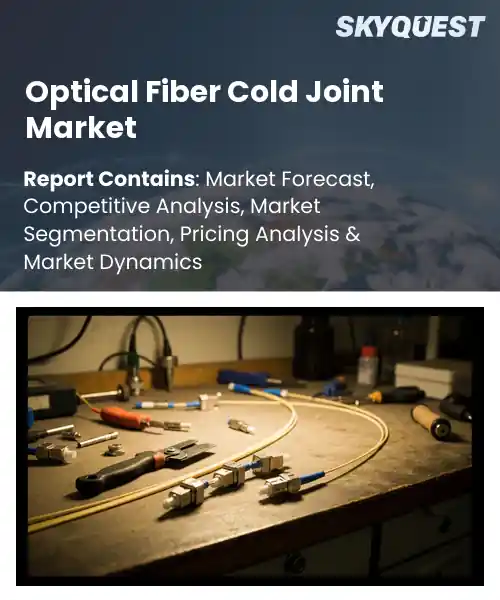
Optical Fiber Cold Joint Market
Report ID: SQMIG45H2315
Report ID: SQMIG45H2315
[email protected]
USA +1 351-333-4748
Report ID:
SQMIG45H2315 |
Region:
Global |
Published Date: August, 2026
Pages:
157
|Tables:
142
|Figures:
78


Global Optical Fiber Cold Joint Market size was valued at USD 214.8 Million in 2024 and is poised to grow from USD 227.9 Million in 2025 to USD 366.0 Million by 2033, growing at a CAGR of 6.1% during the forecast period (2026-2033).
The global optical fiber cold joint market includes components that enable low‑temperature splicing of fiber strands without high‑heat fusion, a capability essential for submarine cable repairs, aerospace installations, and remote‑sensing networks. Its significance lies in preserving signal integrity while cutting downtime and equipment costs, especially where conventional fusion splicers cannot operate.
One key growth driver for the optical fiber cold joint market is the rising demand for swift deployment of offshore wind farms, where harsh marine conditions limit conventional splicing equipment. Cold‑joint technology enables technicians to perform on‑site repairs at sub‑freezing temperatures, cutting vessel idle time and overall project cost. This efficiency boosts profitability for developers, prompting specifications of cold‑joint modules in new turbine arrays. Consequently, manufacturers are expanding capacity and investing in automated tools, creating a feedback loop that lowers unit prices and widens adoption across renewable energy, defense, and data‑center sectors, enhancing connectivity for remote communities worldwide and industries.
How is AI-driven automation influencing quality control in the optical fiber cold joint market?
AI‑driven automation is reshaping quality control for optical fiber cold joints by embedding real‑time image analysis, predictive modeling and adaptive process tuning directly into splicing equipment. Machine‑vision cameras capture each joint, while neural networks compare the image to a library of defect patterns, instantly flagging misalignments, contamination or insufficient melt. The system then feeds the findings back to the welding controller, which fine‑tunes temperature, pressure and dwell time to correct the issue before the joint is released. This closed‑loop approach reduces manual inspection, shortens cycle time and improves repeatability, allowing manufacturers to meet tighter performance specifications while scaling production volumes. As networks expand and demand for high‑capacity links rises, operators increasingly rely on these intelligent tools to maintain reliability across sprawling fiber deployments.
Prysmian Group in April 2024, launched an AI‑driven cold‑joint inspection platform that automatically detects splice defects and adjusts welding parameters, boosting throughput and reducing rework while supporting market growth.
Market snapshot - (2026-2033)
Global Market Size
USD 214.8 Million
Largest Segment
Mechanical Splice
Fastest Growth
Cold Splice Connector
Growth Rate
6.1% CAGR
To get more insights on this market click here to Request a Free Sample Report
Global optical fiber cold joint market is segmented by joint type, fiber type, application, end user, installation and region. Based on joint type, the market is segmented into Mechanical Splice and Cold Splice Connector. Based on fiber type, the market is segmented into Single-Mode Fiber and Multi-Mode Fiber. Based on application, the market is segmented into FTTH, Telecommunications, Data Centers and CATV Networks. Based on end user, the market is segmented into Telecom Operators, ISPs and Network Contractors. Based on installation, the market is segmented into Indoor and Outdoor. Based on region, the market is segmented into North America, Europe, Asia Pacific, Latin America and Middle East & Africa.
Mechanical splice segment dominates with large optical fiber cold joint market share because installers favor its simplicity and reliability when joining fibers without requiring adhesives or heat. The technique delivers consistent low loss performance, which aligns with the market’s demand for rapid deployment and minimal maintenance. Its compatibility with both single mode and multi mode fibers further enhances its appeal across diverse network projects, reinforcing its leading position in the optical fiber cold joint market.
As per optical fiber cold joint market outlook, cold splice connector segment emerges as the most rapidly expanding because its plug and play design supports swift field installation and automated testing. Emerging gigabit services and dense fiber distribution amplify demand for connectors that reduce splice loss and simplify inventory, positioning this segment to accelerate overall market growth.
As per optical fiber cold joint market analysis, FTTH segment dominates because broadband providers prioritize fiber directly to homes to meet escalating bandwidth cravings of residential users. The architecture offers superior speed, reliability and future proof capacity, which aligns with consumer expectations for streaming, remote work and smart home technologies. Its widespread rollout drives consistent demand for cold joint solutions that ensure low attenuation and easy field maintenance, cementing FTTH’s leading role in the market.
On the other hand, data centers segment experiences the strongest growth momentum because hyperscale facilities need dense high capacity interconnects that rely on cold splice technology for minimal loss. Rising cloud, AI and edge workloads drive investment in fiber ecosystems, prompting operators to adopt repeatable joints that suit spaces and fast scaling, expanding the market.
To get detailed segments analysis, Request a Free Sample Report
The Asia Pacific region leverages a confluence of advanced manufacturing capabilities, extensive telecom infrastructure investments, and a strong focus on next‑generation network deployment. Leading economies have cultivated deep expertise in fiber‑optic component design and benefit from dense urbanization that drives demand for high‑capacity connectivity solutions. Collaborative ecosystems between equipment providers, research institutions, and service operators accelerate innovation in joint technology, ensuring reliability and cost efficiency. Additionally, supportive regulatory frameworks encourage rapid rollout of broadband projects, reinforcing the region’s position as a hub for cutting‑edge optical solutions. These combined factors create a resilient market environment that consistently outpaces other regions in both adoption and development of cold joint technologies.
As per optical fiber cold joint market regional outlook, Japan benefits from a mature telecommunications landscape and a national emphasis on high‑speed data services. Industry players prioritize precision engineering and stringent quality standards, fostering trust in cold joint reliability. Close collaboration between manufacturers and network operators enables swift integration of advanced joint solutions into expanding fiber backbones, while ongoing research initiatives sustain a pipeline of incremental improvements that reinforce Japan’s leadership in the sector.
As per optical fiber cold joint market regional forecast, South Korea is propelled by aggressive broadband expansion and a culture of technological innovation. Domestic manufacturers excel in producing compact, high‑performance joint components that meet the rigorous demands of dense urban networks. Strong government incentives for fiber deployment encourage early adoption of reliable joint technologies, while close ties between academia and industry accelerate refinement of sealing materials and installation practices, cementing South Korea’s reputation as a pioneer in optical connectivity.
European optical fiber landscape is characterized by a strong commitment to network modernization, stringent quality expectations, and a collaborative approach to standards development. Policy frameworks across the continent prioritize resilient broadband infrastructure, prompting operators to adopt reliable joint solutions that minimize outage risk and support high‑capacity transmission. Leading manufacturers benefit from deep engineering expertise and a robust supply chain that emphasizes precision and sustainability. Integration of cold joint technology into emerging metro and long‑haul projects is further accelerated by cross‑border initiatives and industry consortia that share best practices, positioning Europe as a fertile ground for rapid market expansion.
Germany reflects the country’s engineering excellence and its extensive fiber rollout across both urban and industrial zones. Suppliers focus on delivering highly consistent joint performance that aligns with rigorous national standards, fostering confidence among telecom operators. Collaborative research institutions drive continuous improvement in sealing compounds and installation workflows, while the pervasive demand for reliable high‑speed connectivity in manufacturing hubs and smart cities sustains strong market momentum.
United Kingdom is energized by a rapid acceleration of fiber‑to‑the‑home initiatives and a proactive regulatory environment encouraging network resilience. Service providers seek joint solutions that simplify deployment while maintaining performance integrity, leading to heightened interest in modular, low‑maintenance technologies. Industry partnerships with academic centers foster innovation in joint design and testing, and the growing emphasis on digital inclusion across urban and rural areas further amplifies demand for dependable cold joint applications.
France is emerging as a dynamic segment supported by national initiatives to extend high‑speed broadband to underserved regions. Operators prioritize joint technologies that combine ease of installation with robustness, aligning with France’s focus on sustainable infrastructure development. Collaborative projects between local manufacturers and research labs explore eco‑friendly sealing materials and streamlined deployment processes, positioning the market to capture growth as demand for reliable fiber connectivity expands across both metropolitan and peripheral zones.
North American market leverages a mature telecommunications ecosystem, extensive capital investment, and a strong orientation toward innovation in network performance. Operators prioritize reliability and efficiency, driving adoption of cold joint solutions that safeguard high‑capacity fiber routes against environmental stressors. Collaboration between leading equipment manufacturers and service providers accelerates the integration of advanced joint designs, while a focus on cost‑effective deployment supports large‑scale projects across diverse geographies. These dynamics collectively reinforce North America’s role as a key driver of global market progression.
United States benefits from a vast, diversified fiber network and a culture of continual infrastructure upgrades. Vendors emphasize precision engineering and scalable solutions that cater to both dense metropolitan cores and expansive suburban corridors. Strategic alliances with research institutions foster rapid prototyping of joint technologies, while regulatory encouragement of resilient broadband expansion sustains robust demand for reliable cold joint implementation across carrier and enterprise segments.
Canada is shaped by a strategic emphasis on connecting remote communities and supporting resource‑intensive industries. Providers seek joint solutions that endure harsh climatic conditions while simplifying installation across extensive distances. Domestic manufacturers collaborate closely with academic research centers to refine sealing compounds and test performance under extreme temperature variations, reinforcing confidence in the technology’s durability. This focus on reliability and adaptability underpins Canada’s growing commitment to expanding high‑speed fiber coverage nationwide.
To know more about the market opportunities by region and country, click here to
Buy The Complete Report
Increasing Data Center Demand
Advancements In Splicing Techniques
High Installation Skill Requirements
Elevated Material Cost Concerns
Request Free Customization of this report to help us to meet your business objectives.
The optical fiber cold joint industry is shaped by intense rivalry as incumbents leverage strategic M&A, alliances and rapid tech roll‑outs to secure network‑grade reliability. Corning’s acquisition of OptiFiber in 2022 accelerated its low‑loss splice‑free portfolio, while Prysmian’s 2023 partnership with Nokia integrates smart joint monitoring into 5G backhaul. These moves intensify competition, driving innovation and prompting customers to demand faster, higher‑performance solutions.
SkyQuest’s ABIRAW (Advanced Business Intelligence, Research & Analysis Wing) is our Business Information Services team that Collects, Collates, Correlates, and Analyses the Data collected by means of Primary Exploratory Research backed by robust Secondary Desk research.
As per SkyQuest analysis the global optical fiber cold joint market growth is driven primarily by the surge in data‑center deployments that require low‑loss, rapid splicing solutions; a second strong catalyst is the advent of advanced splicing techniques, including AI‑enabled inspection that boost reliability and speed. The mechanical splice segment remains the market leader because of its simplicity and broad compatibility, while Asia Pacific dominates regionally due to its intensive telecom roll‑outs and manufacturing strength. However, the need for highly skilled installers acts as a restraint, potentially slowing adoption in markets where training resources are limited. The global optical fiber cold joint market trend is expanding as telecom operators and network contractors seek faster, field-deployable alternatives to fusion splicing for fiber installation, repair, and last-mile connectivity.
| Report Metric | Details |
|---|---|
| Market size value in 2024 | USD 214.8 Million |
| Market size value in 2033 | USD 366.0 Million |
| Growth Rate | 6.1% |
| Base year | 2024 |
| Forecast period | (2026-2033) |
| Forecast Unit (Value) | USD Million |
| Segments covered |
|
| Regions covered | North America (US, Canada), Europe (Germany, France, United Kingdom, Italy, Spain, Rest of Europe), Asia Pacific (China, India, Japan, Rest of Asia-Pacific), Latin America (Brazil, Rest of Latin America), Middle East & Africa (South Africa, GCC Countries, Rest of MEA) |
| Companies covered |
|
| Customization scope | Free report customization with purchase. Customization includes:-
|
To get a free trial access to our platform which is a one stop solution for all your data requirements for quicker decision making. This platform allows you to compare markets, competitors who are prominent in the market, and mega trends that are influencing the dynamics in the market. Also, get access to detailed SkyQuest exclusive matrix.
Table Of Content
Executive Summary
Market overview
Parent Market Analysis
Market overview
Market size
KEY MARKET INSIGHTS
COVID IMPACT
MARKET DYNAMICS & OUTLOOK
Market Size by Region
KEY COMPANY PROFILES
Methodology
For the Optical Fiber Cold Joint Market, our research methodology involved a mixture of primary and secondary data sources. Key steps involved in the research process are listed below:
1. Information Procurement: This stage involved the procurement of Market data or related information via primary and secondary sources. The various secondary sources used included various company websites, annual reports, trade databases, and paid databases such as Hoover's, Bloomberg Business, Factiva, and Avention. Our team did 45 primary interactions Globally which included several stakeholders such as manufacturers, customers, key opinion leaders, etc. Overall, information procurement was one of the most extensive stages in our research process.
2. Information Analysis: This step involved triangulation of data through bottom-up and top-down approaches to estimate and validate the total size and future estimate of the Optical Fiber Cold Joint Market.
3. Report Formulation: The final step entailed the placement of data points in appropriate Market spaces in an attempt to deduce viable conclusions.
4. Validation & Publishing: Validation is the most important step in the process. Validation & re-validation via an intricately designed process helped us finalize data points to be used for final calculations. The final Market estimates and forecasts were then aligned and sent to our panel of industry experts for validation of data. Once the validation was done the report was sent to our Quality Assurance team to ensure adherence to style guides, consistency & design.
Analyst Support
Customization Options
With the given market data, our dedicated team of analysts can offer you the following customization options are available for the Optical Fiber Cold Joint Market:
Product Analysis: Product matrix, which offers a detailed comparison of the product portfolio of companies.
Regional Analysis: Further analysis of the Optical Fiber Cold Joint Market for additional countries.
Competitive Analysis: Detailed analysis and profiling of additional Market players & comparative analysis of competitive products.
Go to Market Strategy: Find the high-growth channels to invest your marketing efforts and increase your customer base.
Innovation Mapping: Identify racial solutions and innovation, connected to deep ecosystems of innovators, start-ups, academics, and strategic partners.
Category Intelligence: Customized intelligence that is relevant to their supply Markets will enable them to make smarter sourcing decisions and improve their category management.
Public Company Transcript Analysis: To improve the investment performance by generating new alpha and making better-informed decisions.
Social Media Listening: To analyze the conversations and trends happening not just around your brand, but around your industry as a whole, and use those insights to make better Marketing decisions.
REQUEST FOR SAMPLE
 REQUEST FREE CUSTOMIZATION
Global Optical Fiber Cold Joint Market size was valued at USD 214.8 Million in 2024 and is poised to grow from USD 227.9 Million in 2025 to USD 366.0 Million by 2033, growing at a CAGR of 6.1% during the forecast period (2026-2033).
The optical fiber cold joint market is shaped by intense rivalry as incumbents leverage strategic M&A, alliances and rapid tech roll‑outs to secure network‑grade reliability. Corning’s acquisition of OptiFiber in 2022 accelerated its low‑loss splice‑free portfolio, while Prysmian’s 2023 partnership with Nokia integrates smart joint monitoring into 5G backhaul. These moves intensify competition, driving innovation and prompting customers to demand faster, higher‑performance solutions. 'Corning Incorporated', 'CommScope Holding Company, Inc.', 'Prysmian S.p.A.', 'Furukawa Electric Co., Ltd.', 'Sumitomo Electric Industries, Ltd.', 'Fujikura Ltd.', 'YOFC', 'Hengtong Group Co., Ltd.', 'ZTT Group', 'FiberHome Telecommunication Technologies Co., Ltd.', 'AFL Global', '3M Company', 'Senko Advanced Components, Inc.', 'Diamond SA', 'Huber+Suhner AG', 'Molex, LLC', 'Panduit Corp.', 'Legrand SA', 'Belden Inc.', 'Rosenberger Group'
The rapid expansion of cloud services and high‑performance computing drives telecom operators to deploy larger capacity networks, and optical fiber cold joints enable reliable, low‑loss connections essential for such infrastructure. By facilitating quick, secure splicing in harsh environments, these joints reduce downtime and maintenance costs, supporting continuous service delivery. Consequently, network providers prioritize solutions that enhance uptime and throughput, reinforcing demand for cold joint technologies across data centers, metropolitan networks, and long‑haul routes, thereby propelling market growth in the global telecommunications sector.
Smart Network Integration: The rise of intelligent transmission systems is driving demand for seamless optical fiber connections that can be installed quickly without disrupting existing infrastructure. Manufacturers are embedding sensor‑enabled cold joint kits that communicate health metrics to centralized platforms, enabling predictive maintenance and reducing downtime. This shift toward integrated, data‑rich solutions supports operators seeking to modernize networks while minimizing service interruptions, positioning cold joint technology as a critical enabler for next‑generation smart‑grid and 5G backhaul deployments across global telecom and utility sectors.
Why does Asia Pacific Dominate the Global Optical Fiber Cold Joint Market? |@12


Want to customize this report? This report can be personalized according to your needs. Our analysts and industry experts will work directly with you to understand your requirements and provide you with customized data in a short amount of time. We offer $1000 worth of FREE customization at the time of purchase.
Feedback From Our Clients


 USA (+1) 351-333-4748

