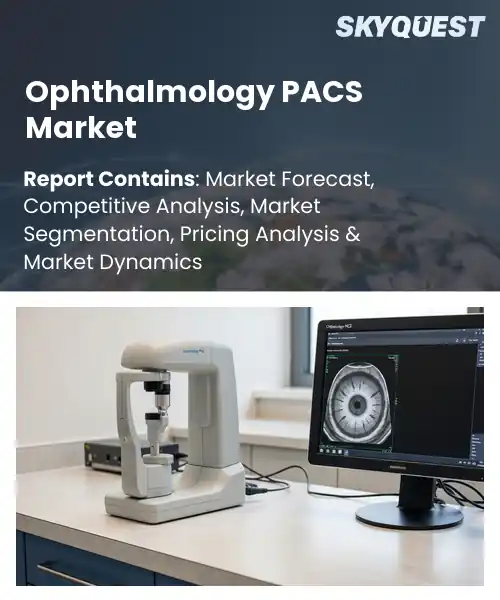
Ophthalmology PACS Market
Report ID: SQMIG35G2458
Report ID: SQMIG35G2458
[email protected]
USA +1 351-333-4748
Report ID:
SQMIG35G2458 |
Region:
Global |
Published Date: June, 2026
Pages:
157
|Tables:
143
|Figures:
78


Global Ophthalmology PACS Market size was valued at USD 282.5 Million in 2024 and is poised to grow from USD 306.29 Million in 2025 to USD 585.4 Million by 2033, growing at a CAGR of 8.42% during the forecast period (2026-2033).
The ophthalmology PACS market as a specialized segment of medical imaging IT that stores, retrieves and distributes ocular images such as OCT, fundus photography and fluorescein angiography, and it matters because visual data underpin diagnosis, treatment planning and longitudinal care. The primary driver is escalating imaging volumes driven by an aging population and growing incidence of diabetes and age related macular degeneration, which create sustained demand for scalable digital archives. The sector evolved from film based records to enterprise PACS then to cloud hosted interoperable platforms leading eye centers and teleophthalmology programs exemplify this transition globally today.
Similarly, integrated AI triage that flags urgent OCT findings shortens time to treatment and raises reimbursement potential, prompting hospitals to invest in PACS enhancements. As interoperability fosters multi center research and population health initiatives, vendors monetize services, expanding market penetration in mature and emerging healthcare systems across geographies.
How is AI enhancing diagnostic accuracy in the ophthalmology PACS market?
Automated image triaging, lesion identification, and longitudinal comparisons across multiple imaging modalities improve diagnostic accuracy in the ophthalmology PACS industry through the use of AI. AI enhances the quality of images, quantifies biomarkers, and identifies subtle changes that would be missed on a manual review of images. By providing decision support at the time of decision-making and reducing the variability between readers, PACS incorporating AI streamline the workflow for both the provider and patient. Vendors are also embedding validated AI models into their cloud solutions for optical coherence tomography and fundus images, allowing clinics to reduce the time spent on this process, support remote screening and monitoring, and have increased confidence in the accuracy of their diagnoses.
In May 2026, Heidelberg Engineering announced that it had established collaborations with AI analytic solution providers and marketplace integration to give users of SPECTRALIS access to route their optical coherence tomography volumes directly to AI tools to improve detection of lesions consistently and to reduce the time required to review the images by the clinician to increase efficiency for PACS/image archiving.
Market snapshot - (2026-2033)
Global Market Size
USD 282.5 Million
Largest Segment
Software
Fastest Growth
Software
Growth Rate
8.42% CAGR
To get more insights on this market click here to Request a Free Sample Report
Global ophthalmology PACS market is segmented by component, modality, deployment, end-user, distribution and region. Based on component, the market is segmented into Hardware, Software and Services. Based on modality, the market is segmented into Fundus Photography, OCT, Visual Field and Fluorescein Angiography. Based on deployment, the market is segmented into Cloud-Based and On-Premise. Based on end-user, the market is segmented into Eye Hospitals, Ophthalmology Clinics and Academic Medical Centers. Based on distribution, the market is segmented into Direct Sales and System Integrators. Based on region, the market is segmented into North America, Europe, Asia Pacific, Latin America and Middle East & Africa.
The software segment is currently growing the most with large ophthalmology PACS market share due to the ability of unified image management platforms to integrate multiple types of ophthalmic data, streamline clinical processes and provide a single window to view, compare and annotate an image. Clinicians perform fewer manual steps and ultimately have less time-consuming reporting because of interoperability with electronic health records (EHR) systems and with various diagnostic devices. Additionally, because EHR and diagnostic device integration offers analytics and AI-based tools, it will provide greater consistency in diagnostics and greater decision support.
As per ophthalmology PACS market analysis, services is currently the fastest growing segment within the ophthalmic PACS market. This growth is largely attributable to increased demand for managed services, implementation support and assistance with cloud migration. By providing outsourced management, training and integration services, vendors help to reduce the burden placed on clinic and hospital IT resources, speed up the deployment of applications, and provide ongoing optimization services for both new and existing applications. Through these services, vendors will also be able to continue adding new customers that have limited resources, thereby increasing the number of recurring revenue opportunities that vendors have.
As per ophthalmology PACS market outlook, on-premise segment dominates because many providers rely on direct control over data storage, system customization, and integration with existing enterprise IT infrastructures to ensure low-latency image access and meet stringent privacy requirements. For example, if someone wanted to ensure an organization would always have quick access to their imaging data and would have the ability to meet the strict privacy requirements mandated by state and federal regulations, an organization would be more likely to select an on-premise solution. Additionally, having local versions of these solutions allows organizations to customize how they are used to handle a very large amount of images and allows organizations to keep control and governance over their upgrade process and security processes; therefore, organizations who are focused on maintaining operational continuity and keeping tighter control over their systems are still preferring an on-premise architecture.
As per ophthalmology PACS market forecast, cloud-based segment is the fastest growing segment in the market as a result of the increase in demand for organizations to access images remotely, access a centralized repository of images, and use scalable computational resources for processing AI-generated data. Solutions that are hosted by the vendor will allow for reduced investment and ease of collaboration between multiple locations. As a result of these benefits, there will be more small clinics adopting PACS technology because it is easier to access and implement teleophthalmology and cross-institutional research initiatives.
To get detailed segments analysis, Request a Free Sample Report
As per ophthalmology PACS market regional outlook, North America dominates owing to established healthcare infrastructure with a strong focus on digital transformation throughout ophthalmic care pathways. Strong institutional adoption of corporate imaging techniques, tight connection with electronic health record systems, and the presence of top PACS suppliers generate a predictable environment for implementation and expansion. Existing referral pathways and funding models allow investment in teleophthalmology and enhanced imaging workflows. Clinical validation and product refinement are driven by academic and private specialist centers, and collaborative initiatives across providers, technology corporations, and regulators expedite interoperability and standardized data interchange.
As per ophthalmology PACS market regional forecast, United States highlights demand driven by big integrated health systems, specialist clinics, imaging facilities. High clinician adoption of sophisticated imaging modalities and close connection with hospital EHRs provide workflow automation and cross facility access. The vendors and competitive procurement environments stimulate innovation and service models that support teleophthalmology and remote consultation. Research hospitals are test beds for innovative functionality, leading clinical adaptation and uptake.
As per ophthalmology PACS industry analysis, Canada is impacted by public health systems and regional procurement strategies focused on interoperability and value. Academic ophthalmology centers and community eye clinics are the engines for clinical requirements and deployments. Cloud PACS models and teleophthalmology workflows are being adopted because of the emphasis on integrated care pathways and remote screening. Vendors working alongside provincial authorities and provider networks will focus on scalable support and training, which will help unify imaging protocols in fragmented environments.
The rise in Europe is credited to the collective growth of ophthalmic imaging services in public and private care sectors. Policy emphasis on cross border interoperability and data protection fosters standardized image management while national digital health programs boost integrated PACS implementation. The solutions are provided by a combination of proven vendors and creative regional suppliers, allowing for customized solutions that fit a range of procurement models and clinical procedures. Teleophthalmology and networked screening are driving demand for scalable, cloud enabled systems and secure sharing. Vendor interaction channels are predictable in many markets due to regulatory clarity and coordinated procurement. Professional societies and academic centers are working to standardize imaging procedures and clinician training, which validates clinical utility and supports broader adoption across diverse healthcare environments. Fragmented payer and procurement systems lead to modular, interoperable offers that may be adapted to national needs. Cross-border research collaborations and pilot programmes enhance the practical validation and diffusion of best practices.
Germany ophthalmology PACS market is driven by dense network of specialist eye hospitals and university clinics requiring enhanced imaging and interoperability. International vendor strength enables integrated enterprise solutions for hospital information system integration and analytics. Centralized procurement methods and clinician guided reviews prefer strong verified platforms. Providers, technology companies and research institutes working together on innovation speed up the development and rollout of features across care pathways and national standards.
United Kingdom is characterized by rapid uptake driven by national digital health programs, strong primary care referral networks, and interest from specialty providers. Emphasis on remote screening and community based eye care fosters demand for cloud enabled PACS and integrated workflows. Active clinician engagement, competitive vendor activity, and pilot programs between academic centers and health networks support validation and scaling of imaging solutions across care settings.
France is evolving through modernization of hospital imaging capabilities and regional eye clinic engagement. Interest in integrated workflows and secure cloud platforms is growing alongside teleophthalmology pilots that address screening and follow up pathways. Local vendors and international suppliers collaborate to adapt solutions to national regulatory and procurement frameworks. Clinical societies and academic centers support protocol standardization and practical validation, fostering steady expansion of imaging services.
Asia Pacific is solidifying its position with focused investments in digital health infrastructure and increasing focus on specialist ophthalmic services. In mature areas, hospitals are improving their imaging capabilities and linking PACS to larger electronic medical record systems. Regional vendors and multinational suppliers are teaming up to localize solutions. Government programs supporting telemedicine and community screening promote usage of cloud based infrastructures suitable to remote care. Academic centers and private specialist clinics are conducting clinical validation and training that builds clinician confidence with improved image management. These features breed a more receptive market climate where interoperability, scalable deployment strategies, and vendor alliances drive consistent growth across the region. The early adoption is driven by strong technology clusters in Japan and South Korea, while regional partnerships and competitive local suppliers boost the availability of bespoke, compliant PACS services.
Japan is driven by advanced hospital systems and a strong medical technology ecosystem that emphasizes integration with diagnostic devices. University clinics and specialist centers act as early adopters, validating sophisticated imaging workflows and analytics. Local and international vendors collaborate to deliver tailored, compliant solutions integrating with health IT initiatives. Focus on clinician training and demonstration projects supports broader acceptance of cloud enabled PACS across care settings.
South Korea reflects rapid technology adoption among large hospital groups and specialty clinics, supported by a robust electronics and software sector. Integration with electronic medical records and diagnostic devices is emphasized to streamline workflows. Local innovators and global suppliers work together to deliver cloud solutions suited to outpatient and tertiary care. Government support for telemedicine pilots and clinician engagement help validate solutions and encourage broader implementation.
To know more about the market opportunities by region and country, click here to
Buy The Complete Report
Integration With Electronic Records
Advances In Imaging Modalities
High Implementation and Maintenance Costs
Data Security and Privacy Concerns
Request Free Customization of this report to help us to meet your business objectives.
Competitive landscape shows accelerated consolidation and technical differentiation driven by AI enabled image analytics and cloud native PACS interoperability. Strategic activity is concrete and recent. Examples include targeted acquisitions to secure AI IP and clinical pipelines, device vendor partnerships to embed cloud PACS into imaging hardware, and product launches that combine AI biomarkers with image management to win clinical trial and screening contracts.
Recent Developments in the Global Ophthalmology PACS Market
SkyQuest’s ABIRAW (Advanced Business Intelligence, Research & Analysis Wing) is our Business Information Services team that Collects, Collates, Correlates, and Analyses the Data collected by means of Primary Exploratory Research backed by robust Secondary Desk research.
As per SkyQuest analysis, the global ophthalmology PACS market is propelled primarily by rising imaging volumes driven by an aging population and increasing prevalence of diabetes and age related macular degeneration, while high implementation and ongoing maintenance costs remain a key restraint that can slow adoption among smaller providers. Software led solutions dominate the market because unified image management, interoperability and embedded analytics deliver the most clinical value, and North America remains the largest regional market due to mature healthcare infrastructure and concentrated vendor presence. A secondary growth driver is deeper integration with electronic medical records that streamlines workflows and speeds clinical decision making. The global ophthalmology PACS market trend is driven by the increasing adoption of digital imaging solutions, rising prevalence of eye disorders, and growing demand for efficient data management systems that enhance diagnostic accuracy and streamline ophthalmic workflows across healthcare facilities.
| Report Metric | Details |
|---|---|
| Market size value in 2024 | USD 282.5 Million |
| Market size value in 2033 | USD 585.4 Million |
| Growth Rate | 8.42% |
| Base year | 2024 |
| Forecast period | (2026-2033) |
| Forecast Unit (Value) | USD Million |
| Segments covered |
|
| Regions covered | North America (US, Canada), Europe (Germany, France, United Kingdom, Italy, Spain, Rest of Europe), Asia Pacific (China, India, Japan, Rest of Asia-Pacific), Latin America (Brazil, Rest of Latin America), Middle East & Africa (South Africa, GCC Countries, Rest of MEA) |
| Companies covered |
|
| Customization scope | Free report customization with purchase. Customization includes:-
|
To get a free trial access to our platform which is a one stop solution for all your data requirements for quicker decision making. This platform allows you to compare markets, competitors who are prominent in the market, and mega trends that are influencing the dynamics in the market. Also, get access to detailed SkyQuest exclusive matrix.
Table Of Content
Executive Summary
Market overview
Parent Market Analysis
Market overview
Market size
KEY MARKET INSIGHTS
COVID IMPACT
MARKET DYNAMICS & OUTLOOK
Market Size by Region
KEY COMPANY PROFILES
Methodology
For the Ophthalmology PACS Market, our research methodology involved a mixture of primary and secondary data sources. Key steps involved in the research process are listed below:
1. Information Procurement: This stage involved the procurement of Market data or related information via primary and secondary sources. The various secondary sources used included various company websites, annual reports, trade databases, and paid databases such as Hoover's, Bloomberg Business, Factiva, and Avention. Our team did 45 primary interactions Globally which included several stakeholders such as manufacturers, customers, key opinion leaders, etc. Overall, information procurement was one of the most extensive stages in our research process.
2. Information Analysis: This step involved triangulation of data through bottom-up and top-down approaches to estimate and validate the total size and future estimate of the Ophthalmology PACS Market.
3. Report Formulation: The final step entailed the placement of data points in appropriate Market spaces in an attempt to deduce viable conclusions.
4. Validation & Publishing: Validation is the most important step in the process. Validation & re-validation via an intricately designed process helped us finalize data points to be used for final calculations. The final Market estimates and forecasts were then aligned and sent to our panel of industry experts for validation of data. Once the validation was done the report was sent to our Quality Assurance team to ensure adherence to style guides, consistency & design.
Analyst Support
Customization Options
With the given market data, our dedicated team of analysts can offer you the following customization options are available for the Ophthalmology PACS Market:
Product Analysis: Product matrix, which offers a detailed comparison of the product portfolio of companies.
Regional Analysis: Further analysis of the Ophthalmology PACS Market for additional countries.
Competitive Analysis: Detailed analysis and profiling of additional Market players & comparative analysis of competitive products.
Go to Market Strategy: Find the high-growth channels to invest your marketing efforts and increase your customer base.
Innovation Mapping: Identify racial solutions and innovation, connected to deep ecosystems of innovators, start-ups, academics, and strategic partners.
Category Intelligence: Customized intelligence that is relevant to their supply Markets will enable them to make smarter sourcing decisions and improve their category management.
Public Company Transcript Analysis: To improve the investment performance by generating new alpha and making better-informed decisions.
Social Media Listening: To analyze the conversations and trends happening not just around your brand, but around your industry as a whole, and use those insights to make better Marketing decisions.
REQUEST FOR SAMPLE
 REQUEST FREE CUSTOMIZATION
Global Ophthalmology Pacs Market size was valued at USD 282.5 Million in 2024 and is poised to grow from USD 306.29 Million in 2025 to USD 585.4 Million by 2033, growing at a CAGR of 8.42% during the forecast period (2026-2033).
Competitive landscape shows accelerated consolidation and technical differentiation driven by AI enabled image analytics and cloud native PACS interoperability. Strategic activity is concrete and recent. Examples include targeted acquisitions to secure AI IP and clinical pipelines, device vendor partnerships to embed cloud PACS into imaging hardware, and product launches that combine AI biomarkers with image management to win clinical trial and screening contracts. 'Topcon Corporation', 'Carl Zeiss Meditec', 'Heidelberg Engineering', 'Nidek Co. Ltd.', 'Canon Medical Systems', 'Optos (Nikon)', 'Veatchmed', 'Heyex (Heidelberg)', 'Mediware Information Systems', 'Vitreq BV', 'Digisonics', 'Sonomed Escalon', 'i-Solutions Health', 'OcuSoftware', 'Agfa HealthCare', 'Merge Healthcare', 'Visus Health IT', 'MedicsDocAssistant', 'Haag-Streit Group', 'FORUM (Zeiss)'
Integration of ophthalmology PACS platforms with electronic medical records and clinical information systems streamlines clinical workflows, reduces redundancy, and enhances the continuity of patient care. Seamless data exchange enables ophthalmologists and allied staff to access images and reports within a unified record, which improves diagnostic efficiency and lowers administrative burden. Improved interoperability increases perceived system value for hospitals and clinics, encouraging procurement and longer term adoption. Vendors that support strong integration capabilities are more likely to secure institutional contracts and foster broader implementation across care settings.
Ai Driven Diagnostic Integration: Advances in artificial intelligence increasingly augment ophthalmic image interpretation within PACS, enabling automated lesion detection, pattern recognition and prioritization of critical cases. Clinicians benefit from consolidated visualizations and decision support that reduce cognitive burden and help standardize reporting across modalities. Vendors are embedding trained models to streamline triage, guide measurements and flag progression trends, enhancing diagnostic confidence and workflow continuity. Continued validation, model explainability and integration with existing clinician workflows drive adoption and shape product roadmaps for enterprise imaging solutions.
Why does North America Dominate the Global Ophthalmology PACS Market? |@12


Want to customize this report? This report can be personalized according to your needs. Our analysts and industry experts will work directly with you to understand your requirements and provide you with customized data in a short amount of time. We offer $1000 worth of FREE customization at the time of purchase.
Feedback From Our Clients


 USA (+1) 351-333-4748

