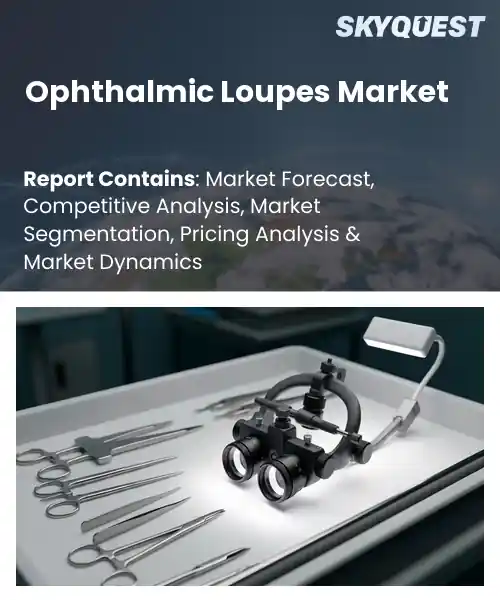
Ophthalmic Loupes Market
Report ID: SQMIG35A3563
Report ID: SQMIG35A3563
[email protected]
USA +1 351-333-4748
Report ID:
SQMIG35A3563 |
Region:
Global |
Published Date: May, 2026
Pages:
157
|Tables:
146
|Figures:
78


Global Ophthalmic Loupes Market size was valued at USD 615.20 Million in 2024 and is poised to grow from USD 652.73 Million in 2025 to USD 1048.23 Million by 2033, growing at a CAGR of 6.1% during the forecast period (2026-2033).
The ophthalmic loupes market trends includes specialized magnifying glasses and mounted optics on the head used by surgeons and ophthalmologists to improve visualization during delicate eye surgeries and examinations. The major driver is the growing demand for precision in microsurgical procedures as improved visual acuity reduces operative time and complication rates and improves patient outcomes . Historically, the market evolved from simple single lens magnifiers to variable magnification prism and flip up systems, and more recently to integrated loupe headlight and digital loupe combinations; leading hospitals adopted high magnification prismatic loupes for cataract and retinal microsurgery, prompting manufacturers to invest in ergonomic, lightweight designs globally deployed.
Technological convergence is one of the key drivers for the global ophthalmic loupes market growth. The integration of advanced optics with LED illumination, ergonomic frames, and digital imaging offers tangible clinical benefits and differentiation. Surgeons get better views with less fatigue, hospitals get shorter operating times and higher throughput, which drives procurement and encourages manufacturers to invest in R&D for lighter, adjustable magnification systems. Moreover, the rising demand for cataract and refractive surgeries from aging populations, as well as digital loupes that facilitate remote mentoring and documentation, creates openings for subscription services and training programs, further enhancing market penetration in developed and emerging systems.
How is AI Enhancing Diagnostic Accuracy in the Ophthalmic Loupes Market?
The ophthalmic loupes market share is seeing an increase in accuracy of diagnosis through the combination of better optics with real time image capture and intelligent image processing. Important features include image acquisition from the clinician’s perspective, automated enhancement to reveal subtle pathology, augmented overlays to direct attention, and seamless workflow integration to minimize observer variability. There is an increasing interest from traditional optics companies and agile software teams to incorporate cameras and on board analytics into loupe systems in the current market. Examples are camera modules placed near ocular, and adaptive illumination, which enhances contrast for faint lesions. These features make exams more reliable and allow earlier and more confident diagnosis.
In September 2025 ZEISS announced the CE mark for its AI clinical support tool CIRRUS PathFinder AI for validated AI diagnostics in ophthalmology. That development builds clinician trust in AI and assists market growth by making loupe integrated AI overlays and camera assisted workflows more attractive to practitioners and clinics.
Market snapshot - (2026-2033)
Global Market Size
USD 615.2 Million
Largest Segment
Through-the-Lens (TTL) Loupes
Fastest Growth
Through-the-Lens (TTL) Loupes
Growth Rate
6.1% CAGR
To get more insights on this market click here to Request a Free Sample Report
Global ophthalmic loupes market is segmented by product type, magnification power, lens type, material type, end user and region. Based on product type, the market is segmented into through-the-lens (TTL) loupes, flip-up loupes, clip-on loupes and others. Based on magnification power, the market is segmented into low magnification (Up to 2.5x), medium magnification (2.6x–4.0x) and high magnification (above 4.0x). Based on lens type, the market is segmented into galilean loupes and prismatic/keplerian loupes. Based on material type, the market is segmented into titanium, aluminum, carbon fiber and others. Based on end user, the market is segmented into hospitals, ophthalmology clinics, ambulatory surgical centers (ASCs) and academic & research institutes. Based on region, the market is segmented into North America, Europe, Asia Pacific, Latin America and Middle East & Africa.
Surgeons prefer the integrated optical alignment of the through-the-lens (TTL) loupes segment, which provides a natural sightline and constant focal plane for complex ophthalmic procedures. This design reduces head tilt and eye strain, allowing sustained precision in microsurgery and complex procedures. Manufacturers have focused on improving the ergonomics and custom optics of TTL, which have been widely adopted across surgical practices and teaching environments due to clinical preference and procedural outcomes.
However, flip-up Loupes is gaining strong momentum in growth thanks to its convertible design that allows for fast transition between magnified and unaided views, appealing to the multitasking clinicians and high throughput settings. Miniaturization continues and hinge mechanisms become more complex, thus enhancing comfort and portability. This will lead to greater adoption by ambulatory providers and clinics and opportunities for accessory innovations and expanded clinical use cases.
Segmentation of loupes prismatic/Keplerian dominates, since the folded optical path can have a higher effective magnification, with a wider usable field and less edge distortion, and therefore, better image fidelity for detailed ocular procedures. Increased depth of field and resolution enable better tissue differentiation and surgical precision encouraging specialists to adopt. Continued optical engineering and premium lens coatings have given clinicians confidence, making these optics the preferred choice for complex microsurgical workflows.
Meanwhile, galilean loupes are proving to be the fastest growing area as their simpler optics provide lighter, more affordable systems that are suitable for routine examinations, training and high volume clinics. The use of lightweight materials and anti reflective coatings has improved the comfort and clarity of imaging, thereby increasing adoption by new clinicians and expanding use outside of specialized operating rooms into general ophthalmic practice.
To get detailed segments analysis, Request a Free Sample Report
North America remains the leader, fueled by a combination of enabling structural and market dynamics. A sophisticated healthcare system that sets high standards for surgical results will drive the early adoption of precision optics and ergonomic solutions. The high-end loupes are in constant demand because of a dense network of specialized clinics and teaching hospitals, and close relationships between clinicians and manufacturers lead to iterative improvements of the products. Thanks to well developed distribution channels and procurement practices rapid market penetration can be achieved. Investment in clinical training and continuing education further entrenches loupes into surgical workflows. Quality and safety focused regulatory frameworks and enhanced intellectual property protection support innovative and commercialized products. Together, these elements create an ecosystem for both established and emerging loupe technologies to scale effectively, reinforcing North America leadership.
Ophthalmic loupes market forecast in United States is a cluster of ophthalmic specialists and surgical centers emphasizing on precision instruments. Established procurement practices and partnerships between clinicians and device makers speed adoption of advanced optics and ergonomic designs. Professional societies and academic institutions are critical in training and validating new loupe solutions, and a competitive supplier landscape is essential for ongoing product differentiation. Patient expectations of surgical quality further buttress the uptake of premium loupe offerings.
Ophthalmic loupes market outlook in Canada is a collaborative healthcare environment with a strong influence of specialty centers and regional hospitals in purchasing behavior. Interest in high performance loupe systems is fueled by a focus on clinical outcomes and clinician comfort. The distribution is largely concentrated through a core set of “medical suppliers” and professional networks facilitate knowledge transfer about ergonomic and optical advances. Public sector procurement dynamics allow for space for innovation when there are evident clinical benefits while encouraging value oriented selection.
Europe is witnessing a vibrant market growth driven by a combination of clinical priorities and industry dynamics. Growing emphasis on surgical precision in national health systems is boosting demand for optical aids that improve visual acuity and operator ergonomics. Rapid localization of advanced loupe solutions is possible thanks to strong traditions in medical device manufacturing and design expertise in the region. Cross border professional societies, training programs disseminate best practices accelerating clinician acceptance. Reimbursement and purchasing policies that acknowledge clinical value spur hospitals and clinics to invest in quality instruments. Joint research between academic centers and industry helps to promote product innovation to meet regional needs. The mix of clinical drivers, manufacturing capability and professional advocacy provides fertile ground for sustained market expansion.
Ophthalmic loupes market penetartion in Germany is supported by a strong medical technology industry and a dense network of specialist clinics which need high performance optical instruments. Local manufacturing expertise and an engineering heritage support the availability of sophisticated loupe options tailored to clinician preferences. New products gain credibility through clinical trials and professional organizations, while procurement practices emphasize durability and clinical benefit. The environment fuels premium loupe system adoption across surgical specialties.
Ophthalmic loupes market regional outlook in United Kingdom is fuelled by robust professional networks and increasing surgical training programs driving fast adoption of advanced loupe technologies. The desire to improve patient outcomes, and the ergonomics for the clinician, is the driver behind the purchase of sophisticated optics and lightweight solutions. Distribution channels are flexible and responsive to clinician feedback, allowing faster commercialization of innovative designs. Focus on policy to further increase surgical efficiency facilitates adoption in public and private care settings.
Ophthalmic loupes industry in France is developing as clinicians are focusing more on precision optics and ergonomic solutions in the hospital and ambulatory settings. Local medical device companies and specialist distributors are gaining momentum by customizing product features to suit regional clinical preferences. Training centers and professional forums promote knowledge exchange, which contributes to greater acceptance. Procurement trends balance cost sensitivity against a growing recognition of long term clinical value.
Asia Pacific is expanding its market share through a mix of manufacturing improvement, clinical capacity expansion, and strategic market involvement. Regional manufacturers are raising the ante on quality and design sophistication, closing the gap with established suppliers and allowing for competitive pricing without sacrificing performance. Ophthalmology is becoming more specialized, with more training programs and international collaboration, providing clinicians with greater access to the latest loupe systems. Targeted investments in research and product development in key markets drive innovations designed around local clinical workflows. Regional presence in international markets is boosted by export oriented strategies and partnerships with global distributors. All of these are pushing, slowly, from a manufacturing cost base to a value-oriented market participant with increasing influence in the world.
Ophthalmic loupes industry analysis in Japan is boosted by a deep-rooted culture of precision engineering and a healthcare sector that appreciates technological nuance. Local suppliers stress high optical quality and ergonomic customization to meet the demanding standards of clinicians. Close cooperation between research institutions and manufacturers is encouraged for continuous improvement in design of loupes, and clinician training and product evaluation are supported by professional societies. This combination further increases demand for sophisticated loupe systems.
Ophthalmic loupes market analysis in South Korea benefits from a rapidly advancing medical technology ecosystem and a vibrant network of clinical innovators. Manufacturers are increasingly focused on integrating lightweight materials and modular optics to address surgeon comfort and workflow needs. Strong ties between industry and clinical centers enable rapid iteration based on user feedback, while export orientation helps scale promising solutions beyond regional borders.
To know more about the market opportunities by region and country, click here to
Buy The Complete Report
Advancements In Optical Technology
Improved Ergonomics For Surgeons
High Cost of Advanced Loupes
Regulatory and Reimbursement Challenges
Request Free Customization of this report to help us to meet your business objectives.
Global ophthalmic loupes competition from commodity optics to integrated digital visualization and training ecosystems. Incumbents focus on consolidation and targeted acquisitions (e.g., Carl Zeiss Meditec’s April 2024 acquisition of D.O.R.C.) while partnerships increase access to training (e.g., Alcon and Aravind’s 2024 Global Centre of Excellence). Startups are disrupting tech innovation with head mounted, digital and robotic visualization platforms that rival traditional loupes.
Top Player’s Company Profile
Recent Developments in the Ophthalmic Loupes Market
SkyQuest’s ABIRAW (Advanced Business Intelligence, Research & Analysis Wing) is our Business Information Services team that Collects, Collates, Correlates, and Analyses the Data collected by means of Primary Exploratory Research backed by robust Secondary Desk research. As per SkyQuest analysis, the global ophthalmic loupes market is driven primarily by advancements in optical technology that improve surgical precision and reduce complications, while high costs of advanced loupes constrain adoption among smaller clinics. North America remains the dominating region due to mature healthcare infrastructure and strong clinician-manufacturer links, and the Through-the-Lens segment is the dominating product type because it delivers aligned optics and sustained accuracy in microsurgery. A second important driver is AI enhanced visualization, which integrates real time imaging and analytics to support diagnostics and teaching. Overall, manufacturers emphasizing ergonomics, modularity, and integrated digital features are best positioned to capture growth.
| Report Metric | Details |
|---|---|
| Market size value in 2024 | USD 615.2 Million |
| Market size value in 2033 | USD 1048.23 Million |
| Growth Rate | 6.1% |
| Base year | 2024 |
| Forecast period | (2026-2033) |
| Forecast Unit (Value) | USD Million |
| Segments covered |
|
| Regions covered | North America (US, Canada), Europe (Germany, France, United Kingdom, Italy, Spain, Rest of Europe), Asia Pacific (China, India, Japan, Rest of Asia-Pacific), Latin America (Brazil, Rest of Latin America), Middle East & Africa (South Africa, GCC Countries, Rest of MEA) |
| Companies covered |
|
| Customization scope | Free report customization with purchase. Customization includes:-
|
To get a free trial access to our platform which is a one stop solution for all your data requirements for quicker decision making. This platform allows you to compare markets, competitors who are prominent in the market, and mega trends that are influencing the dynamics in the market. Also, get access to detailed SkyQuest exclusive matrix.
Table Of Content
Executive Summary
Market overview
Parent Market Analysis
Market overview
Market size
KEY MARKET INSIGHTS
COVID IMPACT
MARKET DYNAMICS & OUTLOOK
Market Size by Region
KEY COMPANY PROFILES
Methodology
For the Ophthalmic Loupes Market, our research methodology involved a mixture of primary and secondary data sources. Key steps involved in the research process are listed below:
1. Information Procurement: This stage involved the procurement of Market data or related information via primary and secondary sources. The various secondary sources used included various company websites, annual reports, trade databases, and paid databases such as Hoover's, Bloomberg Business, Factiva, and Avention. Our team did 45 primary interactions Globally which included several stakeholders such as manufacturers, customers, key opinion leaders, etc. Overall, information procurement was one of the most extensive stages in our research process.
2. Information Analysis: This step involved triangulation of data through bottom-up and top-down approaches to estimate and validate the total size and future estimate of the Ophthalmic Loupes Market.
3. Report Formulation: The final step entailed the placement of data points in appropriate Market spaces in an attempt to deduce viable conclusions.
4. Validation & Publishing: Validation is the most important step in the process. Validation & re-validation via an intricately designed process helped us finalize data points to be used for final calculations. The final Market estimates and forecasts were then aligned and sent to our panel of industry experts for validation of data. Once the validation was done the report was sent to our Quality Assurance team to ensure adherence to style guides, consistency & design.
Analyst Support
Customization Options
With the given market data, our dedicated team of analysts can offer you the following customization options are available for the Ophthalmic Loupes Market:
Product Analysis: Product matrix, which offers a detailed comparison of the product portfolio of companies.
Regional Analysis: Further analysis of the Ophthalmic Loupes Market for additional countries.
Competitive Analysis: Detailed analysis and profiling of additional Market players & comparative analysis of competitive products.
Go to Market Strategy: Find the high-growth channels to invest your marketing efforts and increase your customer base.
Innovation Mapping: Identify racial solutions and innovation, connected to deep ecosystems of innovators, start-ups, academics, and strategic partners.
Category Intelligence: Customized intelligence that is relevant to their supply Markets will enable them to make smarter sourcing decisions and improve their category management.
Public Company Transcript Analysis: To improve the investment performance by generating new alpha and making better-informed decisions.
Social Media Listening: To analyze the conversations and trends happening not just around your brand, but around your industry as a whole, and use those insights to make better Marketing decisions.
REQUEST FOR SAMPLE
 REQUEST FREE CUSTOMIZATION
Global Ophthalmic Loupes Market size was valued at USD 615.2 Million in 2024 and is poised to grow from USD 652.73 Million in 2025 to USD 1048.23 Million by 2033, growing at a CAGR of 6.1% during the forecast period (2026-2033).
Global ophthalmic loupes competition is shifting from commodity optics toward integrated digital visualization and training ecosystems. Incumbents pursue consolidation and targeted acquisitions, for example Carl Zeiss Meditec’s April 2024 purchase of D.O.R.C., while partnerships expand training access, exemplified by Alcon and Aravind’s 2024 Global Centre of Excellence. Startups drive tech innovation with head mounted, digital and robotic visualization platforms that challenge traditional loupes. 'Carl Zeiss Meditec', 'Orascoptic', 'SurgiTel', 'Designs for Vision', 'Heine Optotechnik', 'Keeler', 'Enova Illumination', 'PeriOptix', 'Univet Optical Technologies', 'Rose Micro Solutions', 'SheerVision', 'Xenosys', 'Admetec', 'Q-Optics', 'Seiler Instrument', 'LumaDent', 'Kaps Optik', 'Ecleris', 'Neitz Instruments', 'Zumax Medical'
Ai Enhanced Visualization: Advanced image processing algorithms and machine learning overlays are increasingly integrated with ophthalmic loupes to enhance tissue contrast, provide real time guidance, and assist in fine decision making during microsurgeries. This trend shifts the loupe from a passive optical aid toward an interactive diagnostic and surgical support tool, improving precision and clinician confidence. Vendors and clinical teams collaborate to refine user interfaces and workflow compatibility, fostering adoption through enhanced situational awareness, reduced cognitive load, and improved procedural consistency and outcomes.
Why does North America Dominate the Global Ophthalmic Loupes Market? |@12


Want to customize this report? This report can be personalized according to your needs. Our analysts and industry experts will work directly with you to understand your requirements and provide you with customized data in a short amount of time. We offer $1000 worth of FREE customization at the time of purchase.
Feedback From Our Clients


 USA (+1) 351-333-4748

