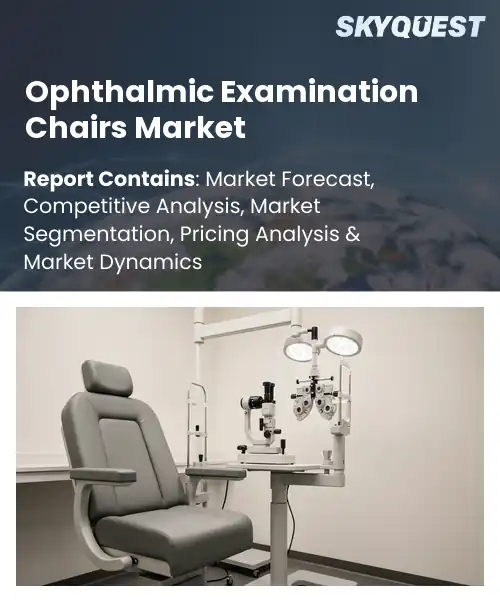
Ophthalmic Examination Chairs Market
Report ID: SQMIG35A3737
Report ID: SQMIG35A3737
[email protected]
USA +1 351-333-4748
Report ID:
SQMIG35A3737 |
Region:
Global |
Published Date: June, 2026
Pages:
157
|Tables:
173
|Figures:
81


Global Ophthalmic Examination Chairs Market size was valued at USD 93.4 Million in 2024 and is poised to grow from USD 98.63 Million in 2025 to USD 152.52 Million by 2033, growing at a CAGR of 5.6% during the forecast period (2026-2033).
Surge in prevalence of vision disorders, increasing geriatric population, rising demand for advanced eye care services, technological advancements in ophthalmic equipment, and expanding investments in healthcare infrastructure are driving sales of ophthalmic examination chairs.
The growing burden of eye diseases and vision-related disorders among aging populations is expected to primarily drive ophthalmic examination chairs market growth. Rising prevalence of eye disorders like cataract, glaucoma and diabetic retinopathy is motivating healthcare providers to increase their expenditure on sophisticated ophthalmic examination setup to enhance the efficiency of examination workflow and patients' comfortability. Besides technology intervention is becoming significant growth drivers in the market. The development of ophthalmic examination chairs with compatibility to various imaging machines, slit lamps, and digital diagnostic systems is contributing to enhanced efficiency and enhanced patient throughput. Demand of electric adjustable chairs is also gaining more importance as many eye care centers are extending their screening services and increasing the number of examinations with the increasing screening programs. Similarly, increased demand for portable eye examination setup in remote areas is fueling the manufacturing of lighter and foldable chairs for outreach and screening activities. These trends are opening up various new income streams for the manufacturers and are also contributing towards making eye care services more accessible for the people in developed as well as emerging economies.
On the contrary, high costs of advanced motorized examination chairs, maintenance and servicing requirements, limited healthcare budgets in developing regions, and challenges associated with equipment integration are anticipated to slow down ophthalmic examination chairs market penetration through 2033.
How is AI Enhancing Diagnostic Accuracy through Ophthalmic Examination Chairs?
AI is contributing towards enhanced accuracy of diagnosis in ophthalmic examination chair market by enabling incorporation of advanced software, sensors, and imaging techniques within the clinical workflow. Key application areas include AI-based analysis of data generated by OCT and fundus imaging equipment, automated patient positioning, and decision support system for enhancing uniformity of ophthalmic examinations. Increasing need for workflow-oriented solutions is facilitating manufacturing of integrated ophthalmic examination systems including chairs, instruments and AI components. Such systems offer pre-diagnostic inputs, automated notifications, and optimized examination protocols to ophthalmologists. It ultimately facilitates ophthalmologists to perform more standardized and time efficient ophthalmic examinations while benefiting the patients with better diagnosis.
Market snapshot - (2026-2033)
Global Market Size
USD 93.4 Million
Largest Segment
Motorized Ophthalmic Examination Chairs
Fastest Growth
Motorized Ophthalmic Examination Chairs
Growth Rate
5.6% CAGR
To get more insights on this market click here to Request a Free Sample Report
Global ophthalmic examination chairs market is segmented by product type, mobility type, application, end user, control mechanism, distribution channel, and region. Based on product type, the market is segmented into manual ophthalmic examination chairs, motorized ophthalmic examination chairs, and hydraulic ophthalmic examination chairs. Based on mobility type, the market is segmented into fixed chairs and mobile chairs. Based on application, the market is segmented into general eye examination, surgical & pre/post-operative examination, diagnostic & imaging procedures, and refraction & vision testing. Based on end user, the market is segmented into ophthalmology clinics, hospitals, ambulatory surgical centers (ASCs), optical & optometry centers, and academic & research institutes. Based on control mechanism, the market is segmented into electrically controlled chairs, foot-controlled chairs, and manual adjustment chairs. Based on distribution channel, the market is segmented into direct sales, medical equipment distributors, and online sales channels. Based on region, the market is segmented into North America, Europe, Asia Pacific, Latin America, and Middle East & Africa.
The motorized ophthalmic examination chairs segment is anticipated to hold the largest global ophthalmic examination chairs market share going forward. Automation of positioning, plus programmable presets, improve exam efficiency, staff touch time and turn time, and patient positioning for diagnostic accuracy. Excellent ergonomics and features, like integrated safety measures, improve practitioner workload and limit practitioner liability and therefore preferred for high volume providers. Continued development and support by manufacturers, with strong service and accessory infrastructure and programs, drives acquisition decisions and maintains market leadership due to documented gains in clinical efficiency and patient comfort.
However, hydraulic ophthalmic examination chairs are emerging as the fastest growing segment as per this ophthalmic examination chairs industry analysis. Owing to their robustness, intuitive manual-to-assisted operation, and overall lower total cost of ownership, these devices appeal in an outpatient environment. Increasing demand for reliable, low-maintenance systems and advances in hydraulic smoothness and safety controls increased market potential in a diverse range of care environments.
The electrically controlled chairs segment is slated to spearhead the global ophthalmic examination chairs market revenue generation over the coming years. Its precision calibration adjustments and computer modules control provide increased consistency, as well as improved operator ergonomic function. Automatic interfacing to the imaging unit and automated titling are beneficial in providing a stabilized patient and measurement consistency which leads to the design's acceptance in a setting focused on consistent procedure. Continued manufacturer investment in the system's reliability, warranties, and service support further strengthens institutional purchase decisions.
Meanwhile, foot-controlled chairs are witnessing strong growth since hands free actuation is more compatible with the flow of surgical procedures, maintaining sterility more effectively and adjusting chairs to ideal positions easily without disrupting the process. Enhanced performance of active pedals and adjustable resistance, combined with surgeon input on preference for tactile feedback, are accelerating usage of chair systems during eye surgery and increasing interest in ergonomic and safety guided chair configurations
To get detailed segments analysis, Request a Free Sample Report
Advanced clinical practice, concentrated purchasing by sophisticated hospital systems, and proximity to key manufacturers and design centers are helping this region hold sway over others. Additionally, North America continues to be benefitted by a highly specialized clinical marketplace that creates a demand for advanced chair products with extensive features that ergonomically optimize the user experience while being fully integrated with diagnostic equipment. The high emphasis placed on the patient experience and efficiency of the clinical workflow drives the adoption of premium products as well as post market services. A combination of established distribution networks, professional training programs, and active clinical research are utilized to enhance the speed at which new innovations are developed into the marketplace and stay relevant in early commercial use. Finally, the reimbursement systems and procurement guidelines used by the larger health systems further increase investment in durable and serviceable equipment thereby reinforcing the North American regional market leadership and providing for the continuance of supplier relationships.
Ophthalmic Examination Chairs Market in the United States is characterized by sustained demand for advanced, multifunctional products tailored to diverse care settings from tertiary centers to private practices. Clinical preference for integrated diagnostics and ergonomic design drives procurement of chairs with enhanced adjustability and modular options. Strong presence of domestic manufacturers and service networks supports rapid installation and maintenance. Emphasis on patient comfort, practitioner ergonomics, and compliance with clinical protocols informs purchasing decisions across urban and ambulatory environments.
Ophthalmic examination chair sales in Canada reflect procurement practices influenced by public healthcare frameworks and regional health authorities. Procurement professionals must consider clinical requirements against long term value and service life agreements. High patient throughput and infection control are paramount for specialized tertiary referral centers and clinics and increase the demand for reliable and low-maintenance systems. An important aspect of working with suppliers and health administrators involves training, warranty, and flexibility for a wide range of clinic footprints and encourages systematic and gradual modernization by province.
Coordinated investment in eye care infrastructure, modernization of outpatient services, and a strong culture of clinical innovation supports steady ophthalmic examination chairs adoption in Europe. Hospitals and specialty clinics are now focusing on the importance of chairs that facilitate integrated diagnostic workflow, improve patient comfort, and optimize clinician ergonomics in limited geographical spaces. With regional manufacturing capability and many suppliers operating in proximity, the design of chairs can accommodate the diverse needs of healthcare delivery across Europe. The government policies that emphasize ambulatory care coupled with cross-sector partnerships enhance the capability of providers to implement multifunctional patient care units. In addition, the emergence of professional societies and training programmes that establish standards favoring the purchase and use of multifunctional, durable chairs will further facilitate and encourage the utilization of these products within the European healthcare marketplace. The convergence of these factors will refocus the growth of the European patient care market by aligning clinicians' needs with suppliers' capabilities as well as institutional procurement activities.
Ophthalmic examination chairs market in Germany is anchored by a strong engineering and manufacturing base that emphasizes precision, reliability, and customization. Hospital procurement favors durable, serviceable chairs that integrate with advanced diagnostic platforms used in specialist centers. OEMs can partner with clinical facilities to further promote product development cycles and validation. Export orientation of the local manufacturers incentivizes more investment in innovation; with the consideration of the clinical ergonomics and workflow, the adoption is promoted among university hospitals and private practices.
Use of ophthalmic examination chairs in the United Kingdom’s private and public sectors is driven by policy shifts toward outpatient modernization and digital integration. Compact size, ease of operation and electronic health system interoperability drive clinical and ophthalmic hospital choice. Brisk private practice growth and renovation projects spur demand for versatile and supportive after-sales service. Provider relationships encompassing training and maintenance become an increasing driver for purchasing decisions across diverse care settings.
Targeted modernization of regional hospitals and private specialist clinics that seek efficient, patient centric solutions shape demand for ophthalmic examination chairs in France. Due to increased focus on ambulatory surgery and day care services, chair Manufacturers offering a mixture of comfort and efficiency to gain popularity. Dealers with sustainable design, easy maintenance and local service support prove valuable. Local clinical endorsements of ergonomic and infection control assist with a steady refresh of exam and procedure chairs in both public and private health settings.
Expanding healthcare infrastructure, growing clinical specialization, and increasing local manufacturing capability are supporting sales of ophthalmic examination chairs in the region. Regional markets succeed due to the partnerships formed between global OEMs and local manufacturers that adapt features to be in line with the local workflow and price sensitivity for each regional market. Regional markets are also transitioning to more compact, multi-purpose chairs that can be utilized by both telehealth enabled diagnostic systems and those used in high volume patient throughput care models. The establishment of specialist training centers for health professionals, as well as patients' higher expectations regarding their healthcare experiences, is driving the adoption of ergonomic advanced technology. Export-driven manufacturing and improved distribution systems are ensuring the availability and after-sales support of ergonomic advanced technology is being met, while the reform of procurement and regulatory processes in various markets is helping to accelerate the adoption of new chair designs.
Ophthalmic examination chair demand in Japan reflects a demand for precision engineered, high quality equipment that integrates seamlessly with advanced diagnostic instruments. In clinical settings, features such as space-saving ergonomics, minute adjustability, and robust function take center stage to meet rigorous practice requirements. Robust internal manufacturing, a commitment to improvement, and high-level features allow for lasting relationships with clients. Suppliers providing extensive technical support and integrated capabilities with imaging equipment are poised for widespread adoption by specialty clinics and sophisticated hospitals.
Rapid technological adoption and a focus on multifunctional, design conscious solutions suitable for high throughput clinics and aesthetic oriented practices help boost sales of ophthalmic examination chairs in South Korea. Local producers innovate with the small form factors, digital I/Os, and interconnectability to external diagnostic equipment. High attention to customer service and after-sales maintenance and firmware updates, together with the ability of customization meets with clinician’s requirements. The close co-working relationship between tech companies and the suppliers in the medical sector allows quickly optimizing and improving chair features for working process and patients’ comfort in any clinical situation.
To know more about the market opportunities by region and country, click here to
Buy The Complete Report
Increasing Demand For Advanced Equipment
Technological Integration With Imaging
High Equipment Acquisition Costs
Regulatory And Compliance Challenges
Request Free Customization of this report to help us to meet your business objectives.
Competitive dynamics in ophthalmic examination chairs now center on integration and workflow consolidation, not just seat ergonomics. Incumbents pursue targeted acquisitions and partnerships to embed AI imaging, connected diagnostics, and simulation into exam suites; examples include Topcon’s purchases of IRIS and RetInSight and Haag-Streit’s acquisition of VRmagic to add AI and VR capabilities and offer bundled diagnostic and training solutions.
SkyQuest’s ABIRAW (Advanced Business Intelligence, Research & Analysis Wing) is our Business Information Services team that Collects, Collates, Correlates, and Analyses the Data collected by means of Primary Exploratory Research backed by robust Secondary Desk research.
As per SkyQuest analysis, high prevalence of vision disorders, increasing geriatric population, rising demand for advanced eye care services, technological advancements in ophthalmic equipment, and expanding investments in healthcare infrastructure are anticipated to drive the demand for ophthalmic examination chairs going forward. However, high costs of advanced motorized examination chairs, maintenance and servicing requirements, limited healthcare budgets in developing regions, and challenges associated with equipment integration are slated to slow down the adoption of ophthalmic examination chairs in the future. North America is slated to spearhead the demand for ophthalmic examination chairs owing to its advanced healthcare infrastructure, high adoption of digital ophthalmic technologies, and growing prevalence of age-related eye disorders. Development of AI-powered diagnostic support systems, increasing integration of ophthalmic chairs with imaging and examination equipment, and rising demand for ergonomic and workflow-optimized examination solutions are anticipated to be key trends driving the ophthalmic examination chairs market in the long run.
| Report Metric | Details |
|---|---|
| Market size value in 2024 | USD 93.4 Million |
| Market size value in 2033 | USD 152.52 Million |
| Growth Rate | 5.6% |
| Base year | 2024 |
| Forecast period | (2026-2033) |
| Forecast Unit (Value) | USD Million |
| Segments covered |
|
| Regions covered | North America (US, Canada), Europe (Germany, France, United Kingdom, Italy, Spain, Rest of Europe), Asia Pacific (China, India, Japan, Rest of Asia-Pacific), Latin America (Brazil, Rest of Latin America), Middle East & Africa (South Africa, GCC Countries, Rest of MEA) |
| Companies covered |
|
| Customization scope | Free report customization with purchase. Customization includes:-
|
To get a free trial access to our platform which is a one stop solution for all your data requirements for quicker decision making. This platform allows you to compare markets, competitors who are prominent in the market, and mega trends that are influencing the dynamics in the market. Also, get access to detailed SkyQuest exclusive matrix.
Table Of Content
Executive Summary
Market overview
Parent Market Analysis
Market overview
Market size
KEY MARKET INSIGHTS
COVID IMPACT
MARKET DYNAMICS & OUTLOOK
Market Size by Region
KEY COMPANY PROFILES
Methodology
For the Ophthalmic Examination Chairs Market, our research methodology involved a mixture of primary and secondary data sources. Key steps involved in the research process are listed below:
1. Information Procurement: This stage involved the procurement of Market data or related information via primary and secondary sources. The various secondary sources used included various company websites, annual reports, trade databases, and paid databases such as Hoover's, Bloomberg Business, Factiva, and Avention. Our team did 45 primary interactions Globally which included several stakeholders such as manufacturers, customers, key opinion leaders, etc. Overall, information procurement was one of the most extensive stages in our research process.
2. Information Analysis: This step involved triangulation of data through bottom-up and top-down approaches to estimate and validate the total size and future estimate of the Ophthalmic Examination Chairs Market.
3. Report Formulation: The final step entailed the placement of data points in appropriate Market spaces in an attempt to deduce viable conclusions.
4. Validation & Publishing: Validation is the most important step in the process. Validation & re-validation via an intricately designed process helped us finalize data points to be used for final calculations. The final Market estimates and forecasts were then aligned and sent to our panel of industry experts for validation of data. Once the validation was done the report was sent to our Quality Assurance team to ensure adherence to style guides, consistency & design.
Analyst Support
Customization Options
With the given market data, our dedicated team of analysts can offer you the following customization options are available for the Ophthalmic Examination Chairs Market:
Product Analysis: Product matrix, which offers a detailed comparison of the product portfolio of companies.
Regional Analysis: Further analysis of the Ophthalmic Examination Chairs Market for additional countries.
Competitive Analysis: Detailed analysis and profiling of additional Market players & comparative analysis of competitive products.
Go to Market Strategy: Find the high-growth channels to invest your marketing efforts and increase your customer base.
Innovation Mapping: Identify racial solutions and innovation, connected to deep ecosystems of innovators, start-ups, academics, and strategic partners.
Category Intelligence: Customized intelligence that is relevant to their supply Markets will enable them to make smarter sourcing decisions and improve their category management.
Public Company Transcript Analysis: To improve the investment performance by generating new alpha and making better-informed decisions.
Social Media Listening: To analyze the conversations and trends happening not just around your brand, but around your industry as a whole, and use those insights to make better Marketing decisions.
REQUEST FOR SAMPLE
 REQUEST FREE CUSTOMIZATION
Global Ophthalmic Examination Chairs Market size was valued at USD 93.4 Million in 2024 and is poised to grow from USD 98.63 Million in 2025 to USD 152.52 Million by 2033, growing at a CAGR of 5.6% during the forecast period (2026-2033).
Competitive dynamics in ophthalmic examination chairs now center on integration and workflow consolidation, not just seat ergonomics. Incumbents pursue targeted acquisitions and partnerships to embed AI imaging, connected diagnostics, and simulation into exam suites; examples include Topcon’s purchases of IRIS and RetInSight and Haag-Streit’s acquisition of VRmagic to add AI and VR capabilities and offer bundled diagnostic and training solutions. 'ForSight Robotics: Established in 2020, their main objective is to develop robotic platforms for high precision ophthalmic microsurgery, reduce surgeon workload and extend access to sight saving procedures in underserved regions. Recent development: completed a $125 million Series B in June 2025 to accelerate the ORYOM and JASPER platforms toward first in human clinical trials, added strategic investors and advisory expertise, and signaled plans for regulatory submissions and clinical partnerships to integrate robotic assisted workflows into ophthalmic surgical suites.', 'Azalea Vision: Established in 2021, their main objective is to develop medical grade smart contact lenses and a connected vision platform to manage light sensitivity and other ocular disorders. Recent development: closed an initial Series A in July 2021 and raised further Series A extension funding in 2025 to advance on eye ALMA lens testing, expand R&D with imec infrastructure, and prepare clinical validation and commercialization pathways, and engage clinical partners in EU and US for pilot studies.', 'Topcon Corporation', 'Haag-Streit Group', 'Takagi Ophthalmic Instruments Europe Ltd.', 'Coburn Technologies, Inc.', 'S4OPTIK LLC', 'Luneau Technology Group', 'Frastema S.r.l.', 'bon Optic Vertriebsgesellschaft mbH', 'Reliance Medical Products, Inc.', 'Reichert, Inc.', 'CSO Costruzione Strumenti Oftalmici S.r.l.', 'US Ophthalmic LLC', 'AKRUS GmbH & Co. KG', 'Lemi Group', 'BTC S.r.l.', 'Vermund Larsen A/S', 'Medi-Plinth Equipment Ltd.', 'Appasamy Associates Pvt. Ltd.', 'Keeler Ltd.', 'RQL – Quality Ophthalmic Products Ltd.'
Increased demand for advanced diagnostic equipment motivates manufacturers to innovate and expand ophthalmic examination chair offerings. Clinics and specialty centers seek ergonomic, multifunctional chairs that improve patient comfort and support efficient workflows, prompting suppliers to enhance features and customization. This demand drives investment in research and product development, encourages broader distribution, and fosters collaborations between equipment makers and clinical institutions. As providers prioritize improved examination capabilities and patient experience, market participants respond by introducing solutions designed to meet these clinical and operational needs, reinforcing market growth.
Ergonomic Patient-Centered Design: Manufacturers are prioritizing ergonomic, patient-centered chair designs that enhance comfort, accessibility and clinical workflow. New models emphasize adjustable support, intuitive controls and smooth mobility to accommodate diverse patient heights and mobility limitations. Materials and forms aim to improve hygiene and durability while providing easy cleaning and infection control. Clinics value chairs that reduce clinician strain, streamline examinations and offer modular accessories for specialized ophthalmic procedures. This user-focused design trend supports improved patient experience, efficiency and equipment value in care settings.
Why does North America Dominate the Global Ophthalmic Examination Chairs Market? |@12


Want to customize this report? This report can be personalized according to your needs. Our analysts and industry experts will work directly with you to understand your requirements and provide you with customized data in a short amount of time. We offer $1000 worth of FREE customization at the time of purchase.
Feedback From Our Clients


 USA (+1) 351-333-4748

