Ophthalmic Drugs Market
Report ID: SQMIG35I2222
Report ID: SQMIG35I2222
[email protected]
USA +1 351-333-4748
Report ID:
SQMIG35I2222 |
Region:
Global |
Published Date: December, 2025
Pages:
157
|Tables:
64
|Figures:
75


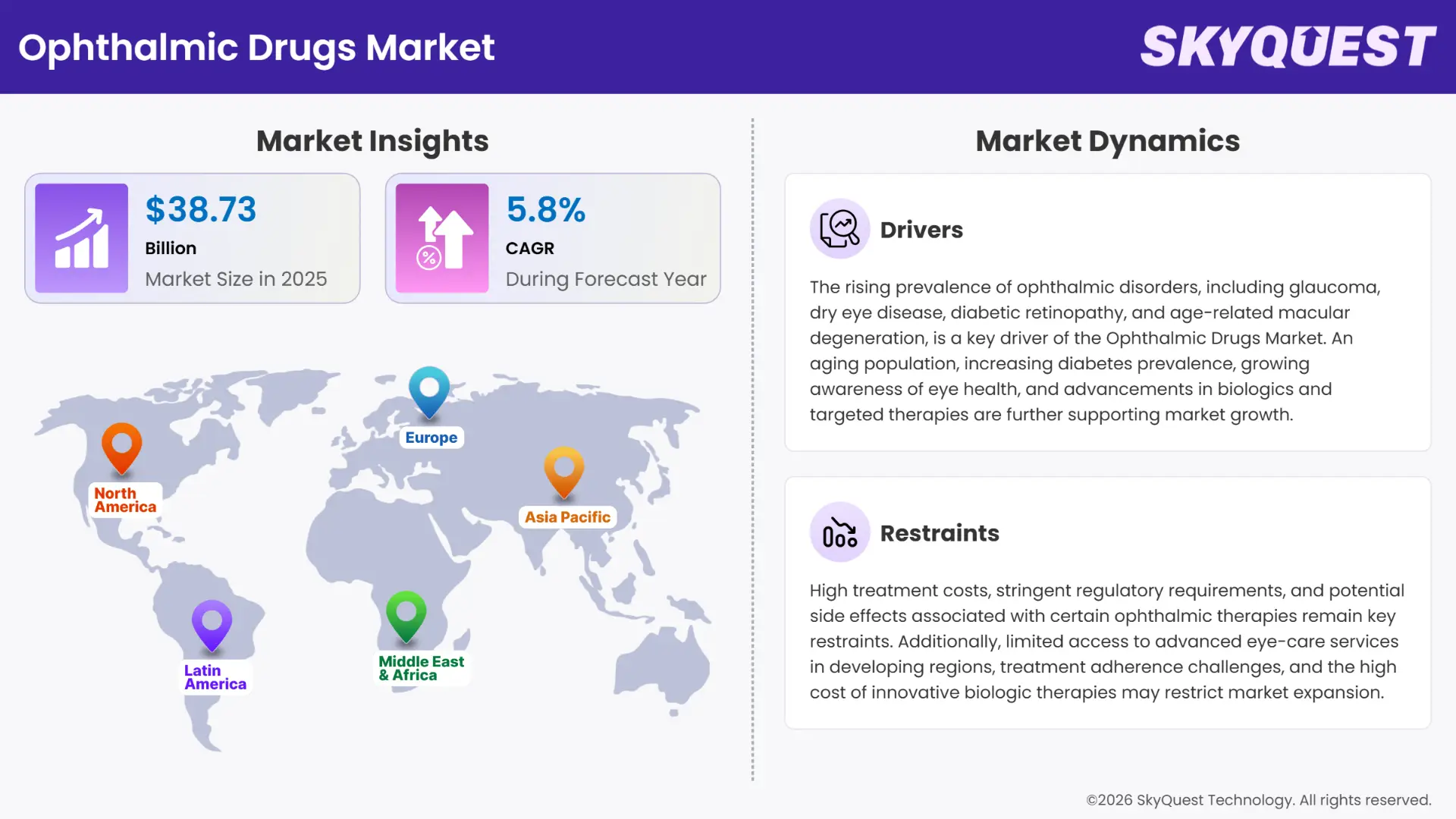
Global Ophthalmic Drugs Market size was valued at USD 36.61 Billion in 2024 and is poised to grow from USD 38.73 Billion in 2025 to USD 60.81 Billion by 2033, growing at a CAGR of 5.8% during the forecast period (2026–2033).
Key Takeaways: Market Trends & Insights
Increasing research and development efforts aimed at creating innovative ophthalmic drugs, coupled with strategic initiatives by key industry players, are expected to drive demand in the ophthalmic drugs market. Additionally, unmet medical needs in the field of ophthalmology are likely to contribute to market growth. According to a World Health Organization report from October 2021, approximately 2.2 billion people suffer from distance or near vision impairment disorders, with at least 1 billion of these cases being preventable through appropriate treatment. The primary cause of blindness and vision impairment is age-related, and this high prevalence places a significant financial burden on governments.
The COVID-19 pandemic hurt the ophthalmic drugs market. According to the Clinical Ophthalmology Journal in November 2021, an analysis of pre-pandemic and post-pandemic data revealed significant declines in visual field checkups (93.84%), clinical visits (92.52%), medication releases (19.63%), and surgical procedures (72.74%). This decline indicates a reduced treatment of glaucoma and other ophthalmic disorders. However, with the widespread availability of COVID-19 vaccines and decreasing COVID-19 cases, the market is expected to rebound.
The increase in research and development activities and investments by leading companies is projected to drive ophthalmic drugs market growth in the coming years. For example, Alcon, a leader in eye care, increased its R&D spending from USD 673 million in 2020 to USD 842 million in 2021. Alcon offers a wide range of products, including contact lenses, cataract treatments, and glaucoma products. Additionally, the presence of a robust pipeline of promising drug candidates is expected to support market growth. For instance, Nicox, a novel eye therapeutics company, is conducting phase III trials for its investigational candidate NCX 470, a novel NO-donating PG analog expected to be on the market by 2029.
To get more insights on this market click here to Request a Free Sample Report
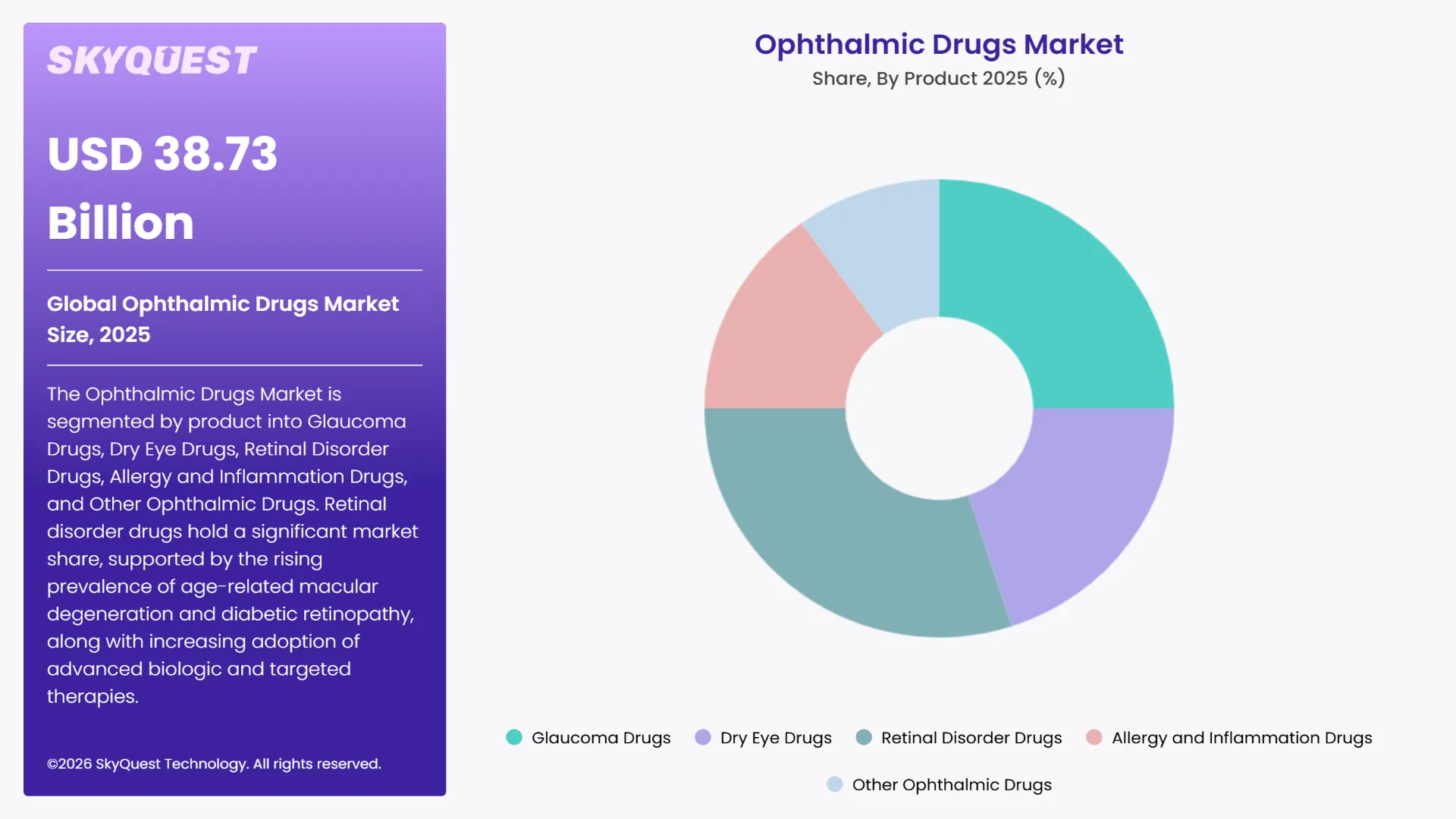
Global Ophthalmic Drugs Market is segmented by Disease, Drug Class, Dosage, Administration, Product and region. Based on Disease, the market is segmented into Eye Allergy, Eye Infection, Glaucoma, Retinal Disorders, Dry Eye and Others. Based on Drug Class, the market is segmented into Anti-Allergy, Anti-Inflammatory, Antiglaucoma and Anti-VEGF Agents. Based on Dosage, the market is segmented into Eye Solutions, Gels, Capsules, Eye Drops and Ointments. Based on Administration, the market is segmented into Systematic, Topical and Local Ocular. Based on Product, the market is segmented into Prescription Drugs and Over-the-Counter-Drugs. Based on region, the market is segmented into North America, Europe, Asia Pacific, Latin America and Middle East & Africa.
Prescription drugs segment accounted for 58.8% of all revenue in 2022, and it is anticipated that this sector would continue to dominate the market for the entire forecast period. This segment's growth can be attributed to the increasing prevalence of ophthalmic disorders such as age-related macular degeneration (AMD) and diabetic retinopathy. Prescription drugs offer improved efficacy and better safety, which are key factors driving the demand for this segment. Some notable prescription drugs in the market include Lotemax gel/ointment, Zylet, Durezol, Bepreve (bepotastine besilate ophthalmic solution), and prescription artificial tears. Bepreve, for example, is an antihistamine used to treat allergic conjunctivitis.
The OTC drugs segment is expected to grow steadily at a rate of 8.5%. This growth can be attributed to factors such as easy patient access, the rise of e-pharmacies, and an increase in product launches of OTC eye drops. For instance, in April 2022, Théa Pharma Inc announced the commercial availability of the iVIZIA line of OTC eye care products in the U.S. These products are available in various dosage forms, including gels, emulsions, capsules, ointments, and eye drops.
In 2022, The eye drops segment held the largest revenue share of 39.3%. This segment's growth is driven by factors such as the increasing availability of over-the-counter (OTC) eye drops, patient compliance considerations, and a high incidence of eye disorders. Additionally, the introduction of novel eye drop formulations is expected to further fuel the demand for this segment. For example, in January 2022, Alcon launched its systane complete preservative-free eye drops, offering a new option for consumers.
Ophthalmic gels are applied directly to the eyelids or the periphery of the eye. These gels, which are viscous liquids, are used to treat conditions such as uveitis, chronic inflammation, and cataracts. Aqueous gel formulations that utilize hydrophilic polymers and stimuli-responsive polymers are particularly attractive for investment in this market. Gels allow for the incorporation of pharmaceutical drugs to achieve the desired therapeutic effect and bioactivity at specific ocular sites. The increasing entry of OTC products in the ophthalmic gels segment has led to intense competitive rivalry among market players.
North America and Europe is expected to grow at a slower pace, primarily due to the economic slowdown and saturation in these markets. APAC is an unsaturated market, especially China and India, and these regions are expected to drive the growth of the overall ophthalmology market, mainly due to growing awareness of eye diseases and increasing disposable income.
To get detailed segments analysis, Request a Free Sample Report
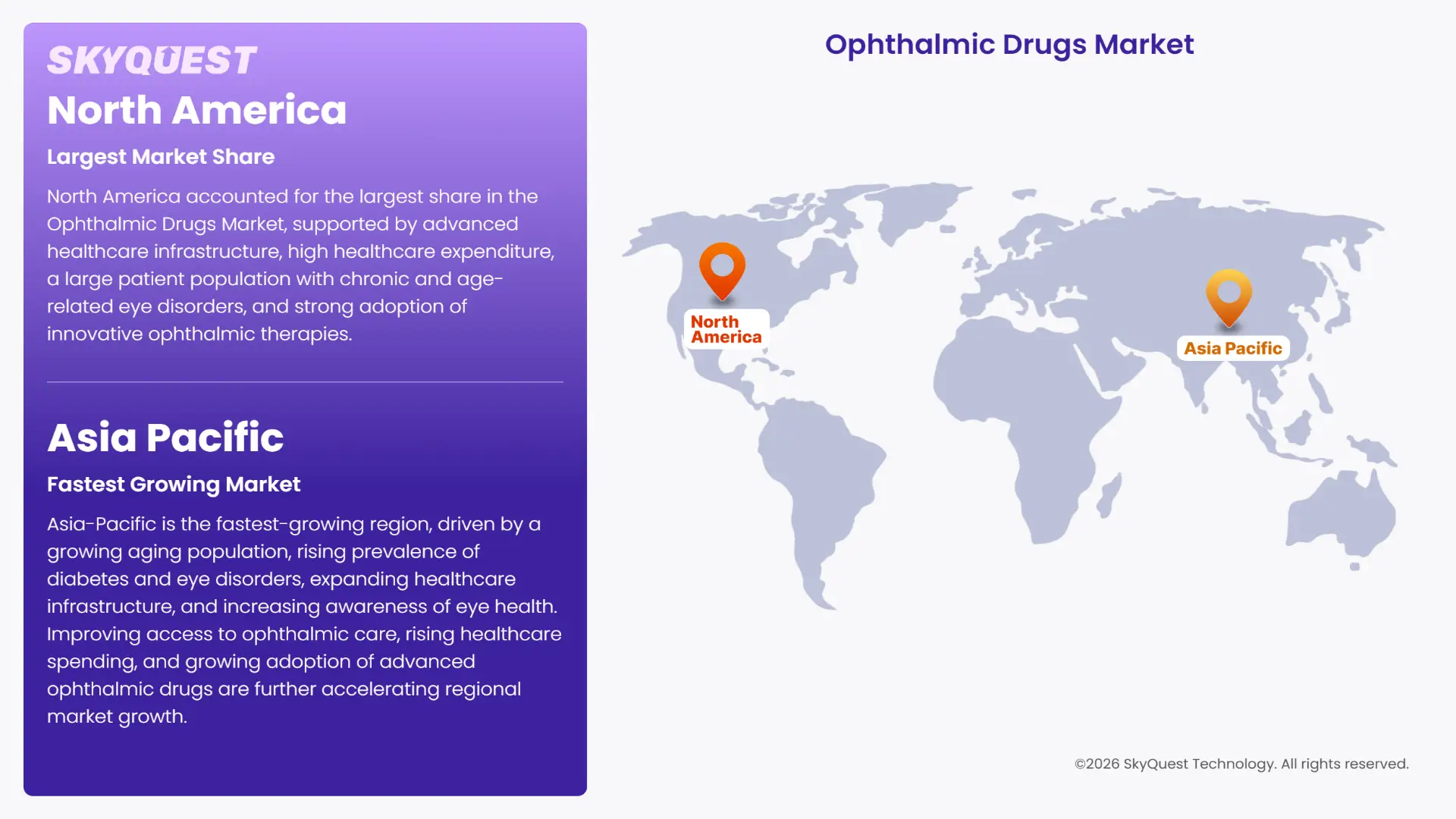
In 2022, North America emerged as the leading region in the ophthalmic drugs market share, capturing the largest revenue share of 39.3%. The growth of this region can be attributed to several factors, including a higher prevalence of eye diseases and increasing awareness about these conditions. The region has witnessed significant research and development activities by key market players, which have contributed to its growth. Additionally, the presence of leading companies like Alcon, Pfizer Inc, and Bausch and Lomb has further bolstered the market in North America. For instance, in June 2022, Harrow Health Inc announced the commercial availability of MAXITROL and IOPIDINE 1% in the United States.
The fastest growth is anticipated to occur in Asia Pacific, where a projected 9.6% CAGR is expected. The large patient pool, high disease prevalence, and rise of regional businesses are all responsible for this expansion. Although the Asia Pacific region has the highest patient base for eye diseases, the treatment rate remains relatively low. However, various strategic initiatives undertaken by market players are expected to drive growth in this region.
To know more about the market opportunities by region and country, click here to
Buy The Complete Report
Increasing Prevalence of Eye Disorders
Technological Advancements and Innovations
Stringent Regulatory Approval Processes
High Cost of Treatment
Request Free Customization of this report to help us to meet your business objectives.
The global ophthalmic drugs market is characterized by the presence of several key players, each striving to gain a significant market share. These companies focus on strategies such as new product launches, partnerships, mergers and acquisitions, and research and development activities to stay competitive and meet the evolving needs of patients and healthcare professionals. The competitive landscape also includes other major players such as Bayer AG, Johnson & Johnson, Merck & Co., Inc., and Bausch Health Companies Inc., among others.
These companies continuously invest in research and development activities to introduce new and improved ophthalmic drugs, strengthen their market presence, and address unmet medical needs. In addition to established pharmaceutical companies, the market also witnesses the presence of smaller and emerging companies that focus on niche segments and innovative approaches. This dynamic competitive landscape fosters innovation, enhances treatment options, and benefits patients in the global ophthalmic drugs market.
Increasing Emphasis on Personalized Medicine
Growing Adoption of Digital Health Technologies
SkyQuest's ABIRAW (Advanced Business Intelligence, Research & Analysis Wing) is our Business Information Services team that Collects, Collates, Correlates, and Analyzes the Data collected by means of Primary Exploratory Research backed by robust Secondary Desk research.
According to our global ophthalmic drugs market analysis, the market is driven by several factors. The increasing prevalence of eye diseases and disorders worldwide is a major driver. As the global population continues to age and the incidence of chronic diseases rises, the demand for effective ophthalmic drugs increases. The market also faces certain challenges and restraints. One of the key challenges is the high cost of ophthalmic drugs, which can limit their accessibility, particularly in developing regions. Moreover, stringent regulatory requirements and the lengthy approval process for new drugs pose challenges to market players. The global ophthalmic drugs market is driven by the increasing prevalence of eye disorders, advancements in drug formulations, and growing awareness about eye health. While there are challenges and restraints, the market offers opportunities for innovation and growth. The development of cost-effective drugs, expansion into untapped markets, and strategic collaborations can further propel the market in the coming years.
| Report Metric | Details |
|---|---|
| Market size value in 2024 | USD 36.61 Billion |
| Market size value in 2033 | USD 60.81 Billion |
| Growth Rate | 5.8% |
| Base year | 2024 |
| Forecast period | 2026–2033 |
| Forecast Unit (Value) | USD Billion |
| Segments covered |
|
| Regions covered | North America (US, Canada), Europe (Germany, France, United Kingdom, Italy, Spain, Rest of Europe), Asia Pacific (China, India, Japan, Rest of Asia-Pacific), Latin America (Brazil, Rest of Latin America), Middle East & Africa (South Africa, GCC Countries, Rest of MEA) |
| Companies covered |
|
| Customization scope | Free report customization with purchase. Customization includes:-
|
To get a free trial access to our platform which is a one stop solution for all your data requirements for quicker decision making. This platform allows you to compare markets, competitors who are prominent in the market, and mega trends that are influencing the dynamics in the market. Also, get access to detailed SkyQuest exclusive matrix.
Table Of Content
Executive Summary
Market overview
Parent Market Analysis
Market overview
Market size
KEY MARKET INSIGHTS
COVID IMPACT
MARKET DYNAMICS & OUTLOOK
Market Size by Region
KEY COMPANY PROFILES
Methodology
For the Ophthalmic Drugs Market, our research methodology involved a mixture of primary and secondary data sources. Key steps involved in the research process are listed below:
1. Information Procurement: This stage involved the procurement of Market data or related information via primary and secondary sources. The various secondary sources used included various company websites, annual reports, trade databases, and paid databases such as Hoover's, Bloomberg Business, Factiva, and Avention. Our team did 45 primary interactions Globally which included several stakeholders such as manufacturers, customers, key opinion leaders, etc. Overall, information procurement was one of the most extensive stages in our research process.
2. Information Analysis: This step involved triangulation of data through bottom-up and top-down approaches to estimate and validate the total size and future estimate of the Ophthalmic Drugs Market.
3. Report Formulation: The final step entailed the placement of data points in appropriate Market spaces in an attempt to deduce viable conclusions.
4. Validation & Publishing: Validation is the most important step in the process. Validation & re-validation via an intricately designed process helped us finalize data points to be used for final calculations. The final Market estimates and forecasts were then aligned and sent to our panel of industry experts for validation of data. Once the validation was done the report was sent to our Quality Assurance team to ensure adherence to style guides, consistency & design.
Analyst Support
Customization Options
With the given market data, our dedicated team of analysts can offer you the following customization options are available for the Ophthalmic Drugs Market:
Product Analysis: Product matrix, which offers a detailed comparison of the product portfolio of companies.
Regional Analysis: Further analysis of the Ophthalmic Drugs Market for additional countries.
Competitive Analysis: Detailed analysis and profiling of additional Market players & comparative analysis of competitive products.
Go to Market Strategy: Find the high-growth channels to invest your marketing efforts and increase your customer base.
Innovation Mapping: Identify racial solutions and innovation, connected to deep ecosystems of innovators, start-ups, academics, and strategic partners.
Category Intelligence: Customized intelligence that is relevant to their supply Markets will enable them to make smarter sourcing decisions and improve their category management.
Public Company Transcript Analysis: To improve the investment performance by generating new alpha and making better-informed decisions.
Social Media Listening: To analyze the conversations and trends happening not just around your brand, but around your industry as a whole, and use those insights to make better Marketing decisions.
REQUEST FOR SAMPLE
 REQUEST FREE CUSTOMIZATION
Ophthalmic Drugs Market size was valued at USD 36.61 Billion in 2024 and is poised to grow from USD 38.73 Billion in 2025 to USD 60.81 Billion by 2033, growing at a CAGR of 5.8% during the forecast period (2026–2033).
Key vendors in the Ophthalmic Drugs Market include Alcon Inc., Bausch + Lomb Corporation, AbbVie Inc., Novartis AG, Santen Pharmaceutical Co., Ltd., Regeneron Pharmaceuticals, Inc., Roche Holding AG, Pfizer Inc., Teva Pharmaceutical Industries Ltd., and Otsuka Pharmaceutical Co., Ltd. These companies focus on innovative therapies for glaucoma, dry eye, retinal disorders, ocular inflammation, and other eye diseases, while investing in biologics, drug delivery technologies, and next-generation ophthalmic treatments.
The key driver of the Ophthalmic Drugs Market is the rising prevalence of eye disorders, including glaucoma, dry eye disease, cataracts, diabetic retinopathy, and age-related macular degeneration. An aging population, increasing diabetes prevalence, growing awareness of eye health, and advancements in ophthalmic drug therapies are further accelerating market growth.
The key market trend in the Ophthalmic Drugs Market is the increasing adoption of biologics and targeted therapies for retinal and other ocular diseases. Advances in sustained-release drug delivery, gene therapies, and minimally invasive treatment approaches are also improving treatment efficacy, reducing dosing frequency, and supporting personalized ophthalmic care.
North America accounted for the largest share in the Ophthalmic Drugs Market, supported by advanced healthcare infrastructure, high healthcare expenditure, a large patient population with age-related and chronic eye disorders, and strong adoption of innovative ophthalmic therapies. The presence of leading pharmaceutical companies and significant investments in ophthalmic research and drug development further strengthen the region's market leadership.


Want to customize this report? This report can be personalized according to your needs. Our analysts and industry experts will work directly with you to understand your requirements and provide you with customized data in a short amount of time. We offer $1000 worth of FREE customization at the time of purchase.
Feedback From Our Clients


 USA (+1) 351-333-4748

