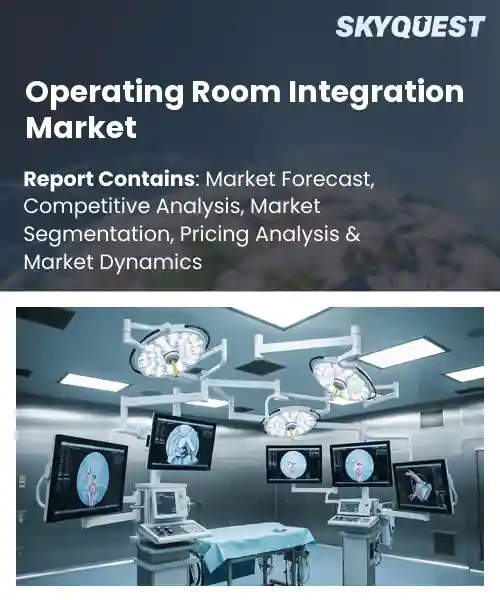
Operating Room Integration Market
Report ID: SQMIG35D2485
Report ID: SQMIG35D2485
[email protected]
USA +1 351-333-4748
Report ID:
SQMIG35D2485 |
Region:
Global |
Published Date: June, 2026
Pages:
157
|Tables:
148
|Figures:
78


Global Operating Room Integration Market size was valued at USD 2.5 Billion in 2024 and is poised to grow from USD 2.78 Billion in 2025 to USD 6.4 Billion by 2033, growing at a CAGR of 11.0% during the forecast period (2026-2033).
The primary driver of the operating room integration market is the demand for workflow efficiency and data continuity that reduces surgical errors and shortens procedure times. Operating room integration unifies imaging, monitoring, documentation and audiovisual systems into a centralized platform, enabling clinicians to access critical data and coordinate teams. This market matters because hospitals face pressure to improve outcomes while containing costs, and integrated ORs support standardized protocols and faster turnover. Over the past decade vendors such as Stryker and Philips evolved from point solutions to interoperable suites, and health systems increasingly deploy integrated operating rooms for minimally invasive procedures.
Building on the efficiency imperative, interoperability standards are a key factor shaping global OR integration growth because they lower integration costs and accelerate adoption across health systems. When hospitals adopt common protocols such as HL7 and DICOM, medical devices and electronic health records exchange data reliably, which reduces staff training burden and shortens implementation timelines. This creates opportunities for vendors to offer subscription models and cloud orchestration that expand into emerging markets. For example, a health network that implemented integration based on standards reported fewer documentation errors and higher operating room utilization, showing how technical harmonization produces measurable financial gains.
How is AI Optimizing Interoperability in the Operating Room Integration Market?
AI improves interoperability in the operating room integration market by creating a semantic layer that translates device protocols and normalizes data so systems speak the same language. AI also orchestrates real time workflows and routes video, imaging and sensor feeds to the right displays. The current market favors device agnostic platforms and cloud edge architectures that let hospitals adopt modular solutions. Vendors and integrators increasingly partner to bridge legacy equipment with modern orchestration services, making the OR more coordinated. Clinicians experience smoother handoffs, clearer situational awareness and fewer manual steps when systems automatically align around the surgical workflow.
In April 2026, Proximie work with NVIDIA to power a Smart OR platform shows how foundation models and accelerated compute can unify live video and device telemetry so AI can mediate interoperability and automate orchestration, boosting efficiency and faster scale up of integrated operating rooms.
Market snapshot - (2026-2033)
Global Market Size
USD 2.5 Billion
Largest Segment
Hardware
Fastest Growth
Software
Growth Rate
11.0% CAGR
To get more insights on this market click here to Request a Free Sample Report
Global operating room integration market is segmented by component, device type, application, deployment mode, end user and region. Based on component, the market is segmented into software, hardware and services. Based on device type, the market is segmented into audio-video management systems, display systems, documentation management systems and operating room communication systems. Based on application, the market is segmented into general surgery, orthopedic surgery, neurosurgery, cardiovascular surgery, gynecological surgery and others. Based on deployment mode, the market is segmented into on-premises and cloud-based. Based on end user, the market is segmented into hospitals, ambulatory surgical centers, specialty clinics and others. Based on region, the market is segmented into North America, Europe, Asia Pacific, Latin America and Middle East & Africa.
Based on the global operating room integration market growth, audio-video management systems segment dominates because it centralizes capture, routing and recording of surgical imagery and enables seamless distribution across interdisciplinary teams. Its comprehensive capability to unify endoscopic feeds, microscope outputs and external imaging reduces workflow friction, improves situational awareness, and supports multi-source synchronization. Vendors prioritize interoperability and real-time streaming, which drives hospital adoption and positions this offering as the core infrastructure for integrated operating room ecosystems.
However, display systems are emerging as the most rapidly expanding area due to advances in high-resolution panels, ergonomic mounting and multi-touch interaction. Their evolution supports augmented visualization, simplifies procedure-specific layouts and enhances team viewing. Rising clinician preference for crisp intraoperative visuals and vendor investment in modular displays accelerates adoption, creating opportunities for integrated visualization packages that broaden market reach.
Software segment leads because orchestration platforms and middleware enable centralized control of devices, scheduling, and data flows across the operating room. Intelligent software normalizes diverse device protocols, automates routine tasks, and embeds clinical decision support, which reduces setup time and cognitive load for surgical teams. Continuous software upgrades and analytics-driven insights improve procedural efficiency and postoperative documentation, making software the strategic enabler for scalable integrated operating room solutions.
Meanwhile, services are witnessing the strongest growth momentum as hospitals seek managed integration, installation, training and lifecycle maintenance to de-risk implementations. Growth is propelled by demand for turnkey deployments, remote monitoring and outcome-focused service models that extend vendor relationships. Expanded service offerings catalyze adoption by lowering operational barriers and unlocking recurring revenue streams for suppliers.
To get detailed segments analysis, Request a Free Sample Report
As per the global operating room integration market share, North America dominates due to a convergence of advanced hospital infrastructure, early adopter clinicians, and a concentrated base of vendors offering comprehensive integrated operating room solutions. Healthcare systems emphasize operational efficiency, clinician workflow optimization, and perioperative data continuity, which aligns with integration value propositions. Robust clinical research environments and active collaboration between medical centers and technology firms facilitate rigorous validation and refinement of systems. Favorable reimbursement frameworks, established procurement channels, and presence of specialized clinical engineering teams enable large scale implementations. Strong private investment and expertise in healthcare IT interoperability further support product development and complex deployments across both academic tertiary centers and community hospitals, reinforcing a leadership position in the global market. Emphasis on patient safety, comprehensive aftermarket services, and clinician training programs enhances long term adoption, while regulatory clarity and close engagement with payers and health systems smooth procurement and integration pathways.
Operating room integration market benefits from a concentration of academic medical centers, integrated health systems, and leading technology vendors. Providers prioritize workflow optimization, perioperative efficiency, and clinician collaboration, driving demand for interoperable audiovisual and data management solutions. IT integration expertise, structured procurement processes, and partnerships between device makers and software firms support complex deployments. Standards development and clinical validation programs further reinforce market maturity and adoption in advanced care settings.
Operating room integration market in Canada is shaped by publicly funded healthcare systems and centralized procurement approaches that emphasize standardization and value. Health authorities focus on interoperable platforms that support telehealth, remote collaboration, and efficient resource utilization across networks. Procurement tends to favor demonstrable clinical benefits and integration with existing IT infrastructure. Collaboration between clinical leaders, provincial agencies, and solution providers fosters adoption of scalable implementations aligned with health priorities.
Based on global operating room integration regional forecast, Europe is experiencing rapid expansion driven by coordinated efforts to modernize hospital infrastructure, harmonize interoperability standards, and leverage cross border expertise in surgical technology. Investment by both public health authorities and private hospital groups focuses on solutions that deliver procedural efficiency, enhanced imaging integration, and streamlined dataflows across care networks. Strong clinical leadership in several markets is fostering pilot deployments that demonstrate workflow improvements, while procurement frameworks and consortium purchasing models enable broader uptake. Active local industry participation, partnerships with global vendors, and emphasis on training and clinical validation support scalable implementations. Diverse healthcare systems encourage adaptable, standards compliant platforms that can be tailored to national priorities and institutional procurement practices across the region. Regulatory engagement, alignment with reimbursement pathways, and a focus on patient safety metrics further incentivize adoption, while centers of excellence and innovation clusters accelerate knowledge transfer and best practice dissemination across borders.
Operating room integration market in Germany benefits from concentrated medical technology manufacturing and advanced hospital networks. Providers value interoperable systems that integrate imaging, audiovisual feeds, and data streams to streamline surgical workflow and improve safety. Strong clinical engineering teams and partnerships with local vendors support tailored installations and rigorous validation. Procurement focuses on technical robustness and lifecycle support, encouraging stable installations within centers and surgical units across the healthcare landscape.
Operating room integration market in United Kingdom is propelled by health system modernization and a focus on digital hospitals. Clinical leaders champion interoperable operating room platforms that unify imaging, audiovisual feeds, and patient data to improve coordination. Public procurement frameworks and partnerships with technology vendors enable scalable pilots and subsequent wider adoption. Emphasis on staff training, workflow redesign, and adherence to interoperability standards fosters smoother implementations across diverse hospital settings.
Operating room integration market in France is marked by cautious adoption in regional hospitals and centers. Health authorities favor interoperable solutions that demonstrate clinical benefit and efficient resource use. Pilot programs led by academic centers and technology partners explore audiovisual integration, imaging workflows, and remote consultation. Budget constraints encourage modular deployments and strong vendor support. Emphasis on training and alignment with national health IT frameworks enables scaling across care settings.
As per global operating room integration regional outlook, Asia Pacific is strengthening its position through a blend of focused investments in advanced healthcare facilities, adaptable integration approaches tailored to local clinical workflows, and growing domestic medtech capabilities. Leading markets prioritize integration that supports minimally invasive and robot assisted procedures, telecollaboration, and centralized management of audiovisual and imaging streams to improve surgical throughput and patient outcomes. Strategic partnerships between local manufacturers and global solution providers accelerate technology transfer and localization. Governments and healthcare systems are promoting innovation, clinician training, and pilot projects, while improving regulatory and interoperability frameworks. These combined efforts create an environment where scalable, context sensitive operating room integration solutions can gain traction across varied hospital types and regional healthcare ecosystems. Attention to cost effective modular architectures, support services, and export oriented strategies by local vendors further strengthens market capabilities and encourages broader adoption across diverse economic contexts in the region.
Operating room integration market in Japan is influenced by a sophisticated medical technology ecosystem with culture of precision in surgery. Hospitals and specialty centers seek tightly integrated systems that combine high resolution imaging, robotic assistance, and integrated audiovisual management to support complex procedures. Strong collaboration between device manufacturers, software firms, and clinical teams drives tailored solutions. Emphasis on reliability, regulatory compliance, and clinical validation encourages thorough deployments within leading institutions.
Operating room integration market in South Korea is driven by proactive adoption in major hospitals and a dynamic domestic medtech industry. Providers seek compact integrated operating room platforms that combine advanced imaging, analytics, and collaboration tools to refine surgical workflows. Close collaboration between hospitals, manufacturers, and research institutions accelerates development and practical deployment. Public policy and investment in clinician training support interoperability and alignment of solutions with everyday clinical procedures.
To know more about the market opportunities by region and country, click here to
Buy The Complete Report
Integration Of Digital Imaging Systems
Demand For Workflow Efficiency
High Implementation and Maintenance Costs
Regulatory Complexity and Interoperability
Request Free Customization of this report to help us to meet your business objectives.
Competitive landscape in the global operating room integration market outlook is shaped by strategic M&A, technology partnerships and product innovation, as vendors seek end-to-end suites to win hospital procurement. Examples include Hillrom’s acquisition of Videomed and Helion launch, Barco and Getinge’s Tegris collaboration, and Fujifilm’s systems integration deal with caresyntax, all driving consolidation and platform differentiation.
Top Player’s Company Profile
Recent Developments
SkyQuest’s ABIRAW (Advanced Business Intelligence, Research & Analysis Wing) is our Business Information Services team that Collects, Collates, Correlates, and Analyses the Data collected by means of Primary Exploratory Research backed by robust Secondary Desk research.
As per SkyQuest analysis, a key driver behind global operating room integration industry is the demand for workflow efficiency and data continuity that reduces surgical errors and shortens procedure times, and a second driver is growing adoption of interoperability standards that lower integration costs and accelerate deployment. A major restraint is the high implementation and maintenance costs that constrain smaller providers and slow comprehensive rollouts. North America remains the dominating region due to advanced infrastructure, early adopters and concentrated vendor presence, while Audio-Video Management Systems are the dominating segment because they centralize capture, routing and recording of surgical imagery and enable seamless team collaboration. Overall market momentum favors software and cloud-native orchestration alongside managed services.
| Report Metric | Details |
|---|---|
| Market size value in 2024 | USD 2.5 Billion |
| Market size value in 2033 | USD 6.4 Billion |
| Growth Rate | 11.0% |
| Base year | 2024 |
| Forecast period | (2026-2033) |
| Forecast Unit (Value) | USD Billion |
| Segments covered |
|
| Regions covered | North America (US, Canada), Europe (Germany, France, United Kingdom, Italy, Spain, Rest of Europe), Asia Pacific (China, India, Japan, Rest of Asia-Pacific), Latin America (Brazil, Rest of Latin America), Middle East & Africa (South Africa, GCC Countries, Rest of MEA) |
| Companies covered |
|
| Customization scope | Free report customization with purchase. Customization includes:-
|
To get a free trial access to our platform which is a one stop solution for all your data requirements for quicker decision making. This platform allows you to compare markets, competitors who are prominent in the market, and mega trends that are influencing the dynamics in the market. Also, get access to detailed SkyQuest exclusive matrix.
Table Of Content
Executive Summary
Market overview
Parent Market Analysis
Market overview
Market size
KEY MARKET INSIGHTS
COVID IMPACT
MARKET DYNAMICS & OUTLOOK
Market Size by Region
KEY COMPANY PROFILES
Methodology
For the Operating Room Integration Market, our research methodology involved a mixture of primary and secondary data sources. Key steps involved in the research process are listed below:
1. Information Procurement: This stage involved the procurement of Market data or related information via primary and secondary sources. The various secondary sources used included various company websites, annual reports, trade databases, and paid databases such as Hoover's, Bloomberg Business, Factiva, and Avention. Our team did 45 primary interactions Globally which included several stakeholders such as manufacturers, customers, key opinion leaders, etc. Overall, information procurement was one of the most extensive stages in our research process.
2. Information Analysis: This step involved triangulation of data through bottom-up and top-down approaches to estimate and validate the total size and future estimate of the Operating Room Integration Market.
3. Report Formulation: The final step entailed the placement of data points in appropriate Market spaces in an attempt to deduce viable conclusions.
4. Validation & Publishing: Validation is the most important step in the process. Validation & re-validation via an intricately designed process helped us finalize data points to be used for final calculations. The final Market estimates and forecasts were then aligned and sent to our panel of industry experts for validation of data. Once the validation was done the report was sent to our Quality Assurance team to ensure adherence to style guides, consistency & design.
Analyst Support
Customization Options
With the given market data, our dedicated team of analysts can offer you the following customization options are available for the Operating Room Integration Market:
Product Analysis: Product matrix, which offers a detailed comparison of the product portfolio of companies.
Regional Analysis: Further analysis of the Operating Room Integration Market for additional countries.
Competitive Analysis: Detailed analysis and profiling of additional Market players & comparative analysis of competitive products.
Go to Market Strategy: Find the high-growth channels to invest your marketing efforts and increase your customer base.
Innovation Mapping: Identify racial solutions and innovation, connected to deep ecosystems of innovators, start-ups, academics, and strategic partners.
Category Intelligence: Customized intelligence that is relevant to their supply Markets will enable them to make smarter sourcing decisions and improve their category management.
Public Company Transcript Analysis: To improve the investment performance by generating new alpha and making better-informed decisions.
Social Media Listening: To analyze the conversations and trends happening not just around your brand, but around your industry as a whole, and use those insights to make better Marketing decisions.
REQUEST FOR SAMPLE
 REQUEST FREE CUSTOMIZATION
Global Operating Room Integration Market size was valued at USD 2.5 Billion in 2024 and is poised to grow from USD 2.78 Billion in 2025 to USD 6.4 Billion by 2033, growing at a CAGR of 11.0% during the forecast period (2026-2033).
Competitive landscape in the global operating room integration market is shaped by strategic M&A, technology partnerships and product innovation, as vendors seek end-to-end suites to win hospital procurement. Examples include Hillrom’s acquisition of Videomed and Helion launch, Barco and Getinge’s Tegris collaboration, and Fujifilm’s systems integration deal with caresyntax, all driving consolidation and platform differentiation. 'Stryker Corporation', 'STERIS plc', 'Getinge AB', 'Siemens Healthineers AG', 'Koninklijke Philips N.V.', 'Olympus Corporation', 'Karl Storz SE & Co. KG', 'Canon Inc.', 'Sony Group Corporation', 'Barco NV', 'Medtronic plc', 'Johnson & Johnson', 'B. Braun Melsungen AG', 'GE HealthCare Technologies Inc.', 'Cisco Systems, Inc.', 'Oracle Corporation', 'NDS Surgical Imaging LLC', 'Brainlab AG', 'Arthrex, Inc.', 'Ascom Holding AG'
Integration of digital imaging systems into operating room platforms enhances clinical decision making by providing surgeons and support staff with synchronized, high-quality visual data within a single environment. This unifies disparate imaging modalities and reduces delays associated with locating and accessing separate systems, thereby improving procedural flow and coordination. The improved access to real-time images and recorded procedures fosters greater clinician confidence in minimally invasive techniques and multidisciplinary collaboration, which encourages hospitals and surgical centers to invest in integrated solutions as a means to advance patient care and operational efficiency.
Ai Driven Workflow Orchestration: Clinical teams increasingly adopt integrated systems that use artificial intelligence to prioritize cases, automate instrument and device setup, and adapt imaging and monitoring displays in real time. These capabilities reduce cognitive load, standardize procedures, and enable adaptive scheduling across specialties. Vendors are focusing on contextual awareness, natural language interfaces, and predictive orchestration to deliver collaboration among surgeons, anesthesiologists, and nursing staff. As a result, value propositions center on improved workflow efficiency, consistency of care pathways, and enhanced intraoperative decision support.
Why does North America Dominate the Global Operating Room Integration Market? |@12


Want to customize this report? This report can be personalized according to your needs. Our analysts and industry experts will work directly with you to understand your requirements and provide you with customized data in a short amount of time. We offer $1000 worth of FREE customization at the time of purchase.
Feedback From Our Clients


 USA (+1) 351-333-4748

