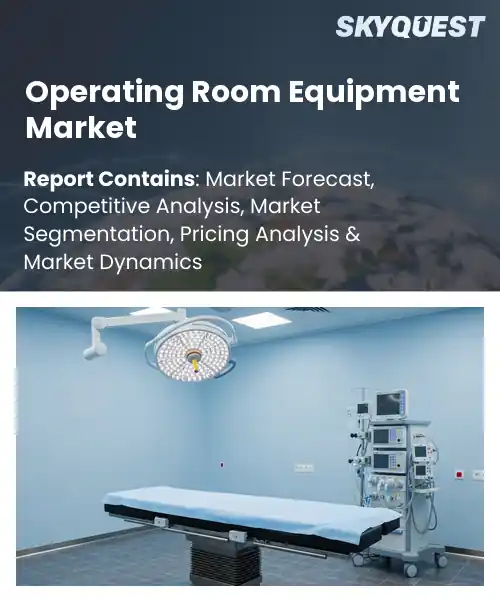
Operating Room Equipment Market
Report ID: SQMIG35A3571
Report ID: SQMIG35A3571
[email protected]
USA +1 351-333-4748
Report ID:
SQMIG35A3571 |
Region:
Global |
Published Date: May, 2026
Pages:
157
|Tables:
107
|Figures:
76


Global Operating Room Equipment Market size was valued at USD 17.9 Billion in 2024 and is poised to grow from USD 19.37 Billion in 2025 to USD 36.38 Billion by 2033, growing at a CAGR of 8.2% during the forecast period (2026-2033).
The operating room equipment market comprises capital devices, consumables and integrated systems used to perform surgical procedures. The key driver is the global burden of surgical disease coupled with technological innovation. While the demand for surgical interventions has increased due to the increased prevalence of chronic conditions and aging populations, advances such as robotic-assisted platforms and minimally invasive instruments have redefined standards of care. The market has evolved historically from basic sterilizers and lighting to advanced imaging, monitors and networked OR suites; for instance, the adoption of surgical robots in tertiary hospitals and digitized anesthesia workstations are examples of how clinical needs and supplier R&D influenced procurement patterns.
Healthcare infrastructure investment is a major contributor translating clinical need into market growth based on the interaction of patient demand and technology. Capital allocation enables hospitals to purchase advanced suites and train staff. As governments increase health budgets and private systems move toward value-based care, hospitals retrofit operating rooms with integrated imaging, OR automation and sterilization technologies, fueling vendor innovation and economies of scale. A metropolitan health system is buying hybrid ORs to enable complex cardiovascular interventions that shorten length of stay, justifying further investment and creating opportunities for modular, service-based business models.
How is AI improving surgical outcomes in the operating room equipment market?
AI is improving surgical outcomes by enabling smarter perception, guidance, and coordination in the operating room. These include computer vision for identification of anatomy and instruments, predictive models to anticipate need for equipment, real time decision support to highlight critical structures, and simulation tools to accelerate learning for surgeons. We are moving from stand-alone tools to connected OR platforms where cameras, robots and monitoring systems are talking to each other to reduce errors and speed things up. These developments lead to more uniform procedures across teams and institutions and thus better quality of care overall.
In March 2026, Stryker introduced its SmartHospital Platform, incorporating ambient intelligence and computer vision to connect devices and care teams. This development enhances efficiency and easier integration of intelligent OR equipment, which in turn aids the market growth by lowering the barriers of hospitals to adopt advanced AI-enabled solutions.
Market snapshot - (2026-2033)
Global Market Size
USD 17.9 Billion
Largest Segment
Patient Monitoring Systems
Fastest Growth
Surgical Navigation Systems
Growth Rate
8.2% CAGR
To get more insights on this market click here to Request a Free Sample Report
Global operating room equipment market is segmented by product type, application, end user and region. Based on product type, the market is segmented into Anesthesia Machines, Operating Tables, Surgical Lights, Electrosurgical Devices, Surgical Imaging Systems, Patient Monitoring Systems, Endoscopy Systems, Surgical Navigation Systems, Operating Room Integration Systems, Surgical Booms & Pendants, Sterilization Equipment and Others. Based on application, the market is segmented into General Surgery, Orthopedic Surgery, Cardiovascular Surgery, Neurosurgery, Gynecology Surgery, Urology Surgery, ENT Surgery, Gastrointestinal Surgery, Cosmetic & Reconstructive Surgery and Others. Based on end user, the market is segmented into Hospitals, Ambulatory Surgical Centers (ASCs), Specialty Clinics and Academic & Research Institutes. Based on region, the market is segmented into North America, Europe, Asia Pacific, Latin America and Middle East & Africa.
Anesthesia Machines segment is the dominant segment as anesthesia machines are central to every operative procedure and define perioperative patient safety and workflow. Controlled ventilation and anesthetic agent delivery, along with integration with monitoring systems and electronic records, impact clinical protocols and procurement priorities. But the institutional buy-in is driven by strong clinician familiarity and trusted reliability. And this encourages vendors to invest in incremental innovations that serve to reinforce their place as essential operating room equipment.
However, the fastest growing area is Patient Monitoring Systems as the need for continuous physiologic data and advances in sensor technology are driving the adoption of these systems in operating settings. Growing connectivity to surgical displays and analytics platforms, and regulatory scrutiny of perioperative safety are driving the adoption of advanced monitoring solutions that expand capabilities, create new integration possibilities, and deliver value-added services within the surgical care pathway.
The Surgical Navigation Systems segment is expected to lead the market as these systems provide real time guidance that reduces uncertainty during complex procedures and improves surgical accuracy. They merge pre-operative images with intra-operative tracking to enable accurate planning and execution of surgical trajectories, thus improving clinical confidence in high acuity specialties. Ongoing vendor investment in intuitive interfaces and algorithm improvements improves clinical outcomes and drives adoption by surgical teams and procurement committees.
On the other hand, Operating Room Integration Systems gain the most momentum as facilities are looking for unified control of devices and more streamlined data flows. Deployment is being driven by advances in interoperability standards and increasing demand for centralized audio-visual and device management to enable more efficient workflows, better documentation and new software driven services that expand recurring revenue potential in the surgical environment.
To get detailed segments analysis, Request a Free Sample Report
North America is the largest market for operating room equipment owing to a combination of developed healthcare infrastructure, concentrated purchasing power of large hospital systems, and a strong ecosystem of medical device manufacturers and service providers. Hospitals and ambulatory surgical centers in the area are early adopters of innovations in imaging, surgical navigation and integrated operating room solutions, driven by clinician demands for efficiency and patient safety. Strong reimbursement and established supply chain networks support procurement of high-value technologies, and rigorous regulatory standards encourage adoption of proven products. Industry-academic medical centers and clinical leadership collaboration accelerate the refinement of product and clinical validation. Continued investment in workforce training and maintenance services also helps ensure high utilization of sophisticated equipment across a wide range of surgical specialties.
Operating Room Equipment Market The United States is characterized by rapid adoption of advanced surgical technologies, led by pioneering academic hospitals and large integrated health systems. The procurement process is led by clinical outcomes, interoperability with hospital IT systems and availability of comprehensive service agreements. Clinical trials and evaluation are supported by close collaboration with device manufacturers, and demand for minimally invasive and robotic solutions continues to drive purchasing priorities across tertiary care settings.
Operating Room Equipment Market Canada is characterized by the presence of publicly funded health systems, and province level purchasing consortia with a focus on cost effective procurement. Hospitals want equipment that is reliable, easy to service and they want to have a long term service relationship with. Adoption trends foster innovation and budgetary prudence, favouring modular and interoperable solutions. Interest in versatile, low maintenance technologies is driven by the requirements of rural and remote healthcare. Collaboration with academic centers supports clinical evaluation and phased technology introduction.
The European operating room equipment market is set for rapid expansion, fueled by a combination of healthcare modernization efforts, a growing focus on clinical outcomes, and a rise in integrated digital solutions. Public and private hospital systems are upgrading operating rooms to improve throughput, reduce infection risk and allow advanced minimally invasive procedures. Harmonised regulatory pathways and regional standards enable access to innovative devices and health technology assessment frameworks guide procurement towards value for money solutions. Support for localized production, servicing and training comes from strong domestic manufacturing clusters and cross border partnerships. In addition, national funding programs and strategic hospital network planning are driving replacement cycles and the adoption of interoperable equipment in line with broader clinical informatics and patient safety goals.
OR Equipment Industry The concentration of the medical technology industry in Germany and a tradition of hospital specialization are. Clinical performance, local service networks and availability of high precision surgical systems influence purchase decisions. Local manufacturers closely cooperate with clinical centers to jointly develop solutions for complex surgical disciplines. Focus on long term service contracts, refurbishment capabilities and clinician training sustains the adoption of premium equipment in university hospitals.
UK Operating Theatre Equipment Industry Fast modernisation drives in national health services. Procurement reforms and investment initiatives are driving integrated operating room systems and digital imaging upgrades. University hospitals and specialist centres drive clinician uptake of minimally invasive and robotic platforms The need for electronic health record interoperability and bundled service models impacts vendor selection and maintenance agreements in all care settings.
Operating Room Equipment Market France is modernizing its hospitals and adopting innovative surgical technologies. Regional hospital systems look at new equipment in terms of operational efficiency, infection control and staff usability. Procurement often has to balance cost containment with clinical performance and therefore comes up with modular and scalable solutions. Teaching hospitals partner with medical device companies to provide clinical validation and a concentration on service provision and spare parts availability allows the equipment to be used for longer.
The Asia Pacific region is solidifying its position in the operating room equipment market through strategic investments in hospital infrastructure, building local manufacturing capabilities, and entering into strategic partnerships with global medical technology companies. Hospitals in the region are aiming to upgrade operating rooms to accommodate increased surgical volumes, and to integrate advanced minimally invasive and image guided systems. Government efforts to improve access to surgical care and to streamline regulatory processes make it easier to bring innovative products to market. Local suppliers are upgrading after sales service and clinical training programs to meet the diverse requirements of clinicians. At the same time, more emphasis is being placed on interoperable digital platforms to align the equipment procurement with the broader healthcare IT modernization goals. Regional centres of excellence are investing in research and development to adapt technologies to local clinical practice and public private collaborations are supporting supply chain resilience.
Operating Room Equipment Market Japan has a strong domestic medtech industry and precision surgical systems are widely used in clinical practice. Hospitals are looking to add advanced imaging and navigation and robotic assistance for complex procedures. Manufacturers also concentrate on quality, reliability and service support and work with clinical centers to improve device ergonomics and workflow. Procurement seeks a mixture of state of the art capability and proven performance. Hospitals worry about vendor response and maintenance networks
Operating Room Equipment South Korea is notable for the rapid integration of sophisticated electronics and digital imaging into the operating room. Homegrown companies use their deep electronics expertise to build high-performance devices and integrated operating room platforms. Hospitals focus on connectivity, real time data sharing and compatibility with national health IT systems. Regional adoption is supported by local service infrastructure and export production, and collaborative programs between manufacturers and clinical centers speed product validation.
To know more about the market opportunities by region and country, click here to
Buy The Complete Report
Rising Demand For Minimally Invasive Procedures
Technological Innovation And Integration
High Capital Investment Requirements
Regulatory Complexity And Compliance
Request Free Customization of this report to help us to meet your business objectives.
Consolidation and rapid technology differentiation are the name of the game in the global operating room equipment market. Big incumbents want to buy targeted companies and partner with OR systems while startups are pushing robotics and AI to replace legacy platforms. Examples include new robotics entrants accelerating clinical pilots and capital deployment, Stryker’s modular OR acquisitions and GE HealthCare’s OR integration moves.
SkyQuest’s ABIRAW (Advanced Business Intelligence, Research & Analysis Wing) is our Business Information Services team that Collects, Collates, Correlates, and Analyses the Data collected by means of Primary Exploratory Research backed by robust Secondary Desk research.
As per SkyQuest analysis, rising demand for minimally invasive procedures is a key driver of the global operating room equipment market, while high capital investment requirements represent a major restraint. North America remains the dominating region due to advanced infrastructure and early adoption, and anesthesia machines hold the dominant segment given their central role in perioperative care. A secondary driver is rapid technological innovation and deeper integration of digital systems that enable smart operating rooms and AI-enabled tools, which together with healthcare infrastructure investment underpin market expansion, although adoption will vary as hospitals balance clinical benefits against procurement and maintenance costs.
| Report Metric | Details |
|---|---|
| Market size value in 2024 | USD 17.9 Billion |
| Market size value in 2033 | USD 36.38 Billion |
| Growth Rate | 8.2% |
| Base year | 2024 |
| Forecast period | (2026-2033) |
| Forecast Unit (Value) | USD Billion |
| Segments covered |
|
| Regions covered | North America (US, Canada), Europe (Germany, France, United Kingdom, Italy, Spain, Rest of Europe), Asia Pacific (China, India, Japan, Rest of Asia-Pacific), Latin America (Brazil, Rest of Latin America), Middle East & Africa (South Africa, GCC Countries, Rest of MEA) |
| Companies covered |
|
| Customization scope | Free report customization with purchase. Customization includes:-
|
To get a free trial access to our platform which is a one stop solution for all your data requirements for quicker decision making. This platform allows you to compare markets, competitors who are prominent in the market, and mega trends that are influencing the dynamics in the market. Also, get access to detailed SkyQuest exclusive matrix.
Table Of Content
Executive Summary
Market overview
Parent Market Analysis
Market overview
Market size
KEY MARKET INSIGHTS
COVID IMPACT
MARKET DYNAMICS & OUTLOOK
Market Size by Region
KEY COMPANY PROFILES
Methodology
For the Operating Room Equipment Market, our research methodology involved a mixture of primary and secondary data sources. Key steps involved in the research process are listed below:
1. Information Procurement: This stage involved the procurement of Market data or related information via primary and secondary sources. The various secondary sources used included various company websites, annual reports, trade databases, and paid databases such as Hoover's, Bloomberg Business, Factiva, and Avention. Our team did 45 primary interactions Globally which included several stakeholders such as manufacturers, customers, key opinion leaders, etc. Overall, information procurement was one of the most extensive stages in our research process.
2. Information Analysis: This step involved triangulation of data through bottom-up and top-down approaches to estimate and validate the total size and future estimate of the Operating Room Equipment Market.
3. Report Formulation: The final step entailed the placement of data points in appropriate Market spaces in an attempt to deduce viable conclusions.
4. Validation & Publishing: Validation is the most important step in the process. Validation & re-validation via an intricately designed process helped us finalize data points to be used for final calculations. The final Market estimates and forecasts were then aligned and sent to our panel of industry experts for validation of data. Once the validation was done the report was sent to our Quality Assurance team to ensure adherence to style guides, consistency & design.
Analyst Support
Customization Options
With the given market data, our dedicated team of analysts can offer you the following customization options are available for the Operating Room Equipment Market:
Product Analysis: Product matrix, which offers a detailed comparison of the product portfolio of companies.
Regional Analysis: Further analysis of the Operating Room Equipment Market for additional countries.
Competitive Analysis: Detailed analysis and profiling of additional Market players & comparative analysis of competitive products.
Go to Market Strategy: Find the high-growth channels to invest your marketing efforts and increase your customer base.
Innovation Mapping: Identify racial solutions and innovation, connected to deep ecosystems of innovators, start-ups, academics, and strategic partners.
Category Intelligence: Customized intelligence that is relevant to their supply Markets will enable them to make smarter sourcing decisions and improve their category management.
Public Company Transcript Analysis: To improve the investment performance by generating new alpha and making better-informed decisions.
Social Media Listening: To analyze the conversations and trends happening not just around your brand, but around your industry as a whole, and use those insights to make better Marketing decisions.
REQUEST FOR SAMPLE
 REQUEST FREE CUSTOMIZATION
Global Operating Room Equipment Market size was valued at USD 17.9 Billion in 2024 and is poised to grow from USD 19.37 Billion in 2025 to USD 36.38 Billion by 2033, growing at a CAGR of 8.2% during the forecast period (2026-2033).
Competition in the global operating room equipment market centers on consolidation and rapid technology differentiation. Large incumbents pursue targeted acquisitions and OR system partnerships while startups push robotics and AI to displace legacy platforms. Examples include Stryker’s modular OR acquisitions and GE HealthCare’s OR integration moves, alongside new robotics entrants accelerating clinical pilots and capital deployment. 'Stryker Corporation', 'Getinge AB', 'STERIS plc', 'Hill-Rom Holdings, Inc.', 'Drägerwerk AG & Co. KGaA', 'Karl Storz SE & Co. KG', 'Olympus Corporation', 'Medtronic plc', 'GE HealthCare Technologies Inc.', 'Siemens Healthineers AG', 'Philips Healthcare', 'Canon Medical Systems Corporation', 'Trumpf Medical GmbH + Co. KG', 'Skytron LLC', 'Mizuho OSI', 'Merivaara Corp.', 'Alvo Medical', 'Bender GmbH & Co. KG', 'NDS Surgical Imaging', 'Simeon Medical GmbH & Co. KG'
Advances in and increasing preference for minimally invasive surgical techniques encourage healthcare providers to invest in sophisticated operating room equipment that enables precision, enhanced visualization, and ergonomic instrument control. Hospitals and surgical centers prioritize systems that integrate imaging, navigation, and robotic assistance to support complex procedures while improving workflow and safety. This demand motivates manufacturers to focus on interoperable solutions, training programs, and service models that facilitate adoption, thereby expanding procurement of advanced devices and related infrastructure across varied clinical settings.
Minimally Invasive Procedure Adoption: Surgeons' preference for less invasive techniques is reshaping demand for specialized instruments, visualization systems and ergonomic operating room layouts. Manufacturers focus on device miniaturization, improved imaging integration and workflow enhancements to support shorter recovery pathways and enhanced patient satisfaction. Hospitals prioritize equipment that enables predictable outcomes and efficient turnover, driving selection toward modular platforms and instruments compatible with multiple approaches. This trend fosters collaborative development between clinicians and suppliers to tailor solutions aligned with evolving surgical techniques and care models.
Why does North America Dominate the Global Operating Room Equipment Market? |@12


Want to customize this report? This report can be personalized according to your needs. Our analysts and industry experts will work directly with you to understand your requirements and provide you with customized data in a short amount of time. We offer $1000 worth of FREE customization at the time of purchase.
Feedback From Our Clients


 USA (+1) 351-333-4748

