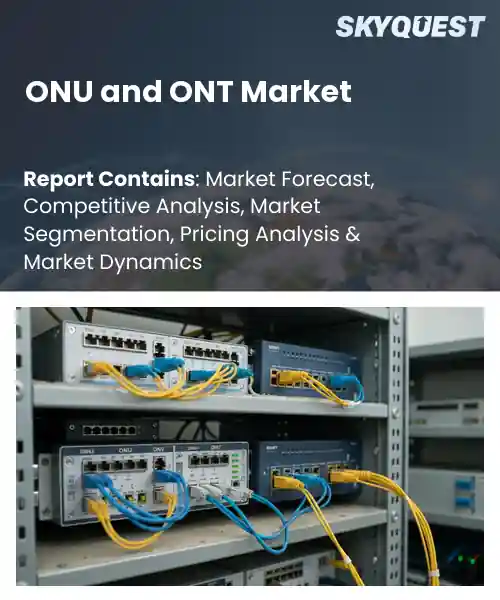
ONU and ONT Market
Report ID: SQMIG45H2266
Report ID: SQMIG45H2266
[email protected]
USA +1 351-333-4748
Report ID:
SQMIG45H2266 |
Region:
Global |
Published Date: July, 2026
Pages:
157
|Tables:
152
|Figures:
78


Global ONU And ONT Market size was valued at USD 8.4 Billion in 2024 and is poised to grow from USD 9.17 Billion in 2025 to USD 18.55 Billion by 2033, growing at a CAGR of 9.2% during the forecast period (2026-2033).
Building on that foundation, the principal catalyst driving the ONU and ONT market today is the convergence of broadband demand with fiber solutions, creating a feedback loop of network densification and equipment upgrades. As carriers expand access, they require ONUs that support bandwidth allocation and remote firmware updates, prompting manufacturers to embed AI‑based traffic management and programmable interfaces. Deployments such as Verizon’s 5G‑ready FT projects in United States and Deutsche Telekom’s hybrid‑fiber‑copper architecture in Germany show how ONTs unlock revenue through convergence and smart‑home services.
How is AI driving automation in the ONU and OTN market?
AI is reshaping the ONU and OTN landscape by embedding machine‑learning models directly into network units. These models continuously analyze traffic patterns, predict congestion and trigger self‑optimizing actions without human intervention. The result is faster provisioning, reduced manual configuration and higher reliability across fiber‑to‑the‑home and carrier backbones. Vendors are integrating AI‑driven fault detection, dynamic wavelength allocation and predictive maintenance into their hardware and software stacks. This convergence of intelligence and optics enables operators to scale capacity while keeping operational costs low, making the market more attractive for new entrants and legacy players alike. The trend is accelerating as data‑intensive services demand ever‑more agile transport solutions.
Ciena in April 2024, introduced an AI‑powered OTN orchestrator that automates wavelength provisioning and fault remediation, boosting network efficiency and supporting the sector’s rapid growth.
Market snapshot - (2026-2033)
Global Market Size
USD 8.4 Billion
Largest Segment
ONU
Fastest Growth
Business ONT
Growth Rate
9.2% CAGR
To get more insights on this market click here to Request a Free Sample Report
Global onu and ont market is segmented by product type, technology, application, end user, distribution channel and region. Based on product type, the market is segmented into ONU, SFU ONT, HGU ONT, Business ONT and Others. Based on technology, the market is segmented into GPON, EPON, XGS-PON, 10G EPON and Others. Based on application, the market is segmented into Residential, Commercial, Enterprise, Industrial and Others. Based on end user, the market is segmented into Telecom Operators, ISPs, Enterprises and Others. Based on distribution channel, the market is segmented into OEM, System Integrators, Distributors and Others. Based on region, the market is segmented into North America, Europe, Asia Pacific, Latin America and Middle East & Africa.
GPON segment dominates with large global ONU and ONT market share because it provides a mature, cost effective solution that meets the bandwidth requirements of most broadband deployments. Operators rely on its proven reliability, extensive ecosystem of vendors, and straightforward integration, which reduces deployment risk and operational expense. This entrenched position fuels continued preference across residential and commercial networks, reinforcing its market leadership. Additionally the widespread availability of legacy equipment and established training programs lower the barrier for new installations, ensuring that service providers can scale networks rapidly without extensive redesign.
However, XGS-PON segment is witnessing the strongest growth momentum because it delivers symmetrical multi gigabit speeds that enable emerging high bandwidth services such as 4K video, virtual reality, and cloud gaming. The push for future proof fiber networks drives operators to adopt this technology, creating new deployment opportunities and expanding overall market size.
Residential segment dominates because broadband providers prioritize mass deployment of ONUs and ONTs to meet the ever increasing demand for high speed internet in homes. The large subscriber base generates steady revenue streams, encouraging manufacturers to refine cost efficient designs and integrate user friendly features. Moreover ongoing digital lifestyle shifts such as remote work and streaming reinforce the need for reliable home connectivity, cementing this segment’s leadership.
On the other hand, enterprise segment emerges as the most rapidly expanding area because corporations are upgrading to fiber based networks to support data intensive applications, secure communications, and edge computing. This demand pushes providers to adopt advanced ONTs with higher capacity and management capabilities, stimulating innovation and opening lucrative avenues for vendors
To get detailed segments analysis, Request a Free Sample Report
Asia Pacific dominates due to high adoption of fiber broadband, strong telecom investments, advanced manufacturing ecosystems, and supportive regulatory frameworks. The region benefits from early rollout of next‑generation networks, extensive smart city initiatives, and a culture of rapid technology diffusion. Leading vendors collaborate closely with local operators, driving cost‑effective production of optical line terminals. Skilled engineering talent pools and competitive supply chains reduce component costs while maintaining quality. Moreover, government programs that prioritize digital infrastructure create a fertile environment for widespread ONU and ONT deployment across residential, enterprise, and industrial segments. This convergence of policy support, technical expertise, and market demand positions Asia Pacific as the preeminent hub for optical network equipment.
Japan is propelled by densely populated urban corridors where fiber penetration reaches saturation. Operators focus on upgrading legacy copper loops to fiber‑to‑the‑home, leveraging Japan’s precision manufacturing base to produce high‑performance optical devices. Strong consumer demand for high‑speed services and a regulatory emphasis on broadband accessibility further accelerate deployment. Collaborative R&D initiatives among telecoms, equipment makers, and academic institutions sustain innovation and ensure alignment with evolving network standards.
South Korea benefits from an aggressive rollout strategy that targets both metropolitan and suburban zones. The country’s telecom operators harness a robust domestic supply chain, enabling rapid scaling of optical hardware while maintaining cost efficiency. Government incentives that prioritize digital inclusion and smart infrastructure stimulate continual upgrades of last‑mile connectivity. High consumer expectations for seamless streaming and cloud‑based applications drive demand for advanced ONU and ONT solutions, reinforcing the market’s momentum.
Europe’s rapid expansion is driven by a combination of high broadband adoption targets, substantial public investment in fiber infrastructure, and a regulatory climate that encourages open access. National strategies emphasize closing the digital divide between urban centers and peripheral regions, prompting utilities to transition from copper to fiber. Manufacturers in the region benefit from a mature engineering talent pool and strong standards‑driven ecosystems that foster interoperability. Collaborative projects across borders accelerate technology diffusion, while sustainability goals push operators toward energy‑efficient optical solutions. The convergence of policy ambition, skilled supply chains, and consumer appetite for reliable high‑speed connectivity fuels a robust and accelerating ONU and ONT market across the continent.
Germany market is anchored by a well‑established fiber rollout program that integrates industrial precision with extensive network planning. Operators collaborate closely with domestic equipment manufacturers to ensure component reliability and compliance with stringent European standards. Federal initiatives promote broadband reach in both metropolitan hubs and rural zones, creating steady demand for advanced optical termination devices. The strong engineering culture and emphasis on quality reinforce Germany’s position as a dominant player within the European optical ecosystem.
United Kingdom market experiences the fastest growth within Europe as operators accelerate fiber‑to‑the‑premises projects across dense urban districts and emerging suburban corridors. Policy frameworks that prioritize universal broadband access stimulate sizable procurement cycles for optical line equipment. The country’s vibrant tech cluster encourages innovative integration of ONT functionality with emerging IoT services. Collaborative efforts between network providers and local manufacturers reduce time‑to‑market, supporting the rapid scaling of high‑capacity broadband connections.
France market is emerging steadily as national broadband initiatives target comprehensive fiber coverage in both historic city centers and peri‑urban areas. Operators benefit from a supportive regulatory environment that encourages competition and shared infrastructure, fostering demand for versatile ONU and ONT solutions. French engineering firms emphasize modular design and energy efficiency, aligning with broader sustainability objectives. The collaborative synergy between telecom operators and technology partners accelerates adoption of high‑speed optical access across the French market.
North America strengthens its position through a combination of large‑scale fiber deployments, leading‑edge research institutions, and a market that values rapid innovation cycles. Telecommunications carriers invest heavily in expanding ultra‑broadband footprints to meet the growing appetite for high‑definition media, cloud computing, and enterprise connectivity. Domestic manufacturers benefit from close proximity to these operators, enabling swift iteration of ONU and ONT designs that incorporate advanced diagnostics and energy‑saving features. Regulatory trends that support open‑access frameworks encourage competition and broaden the ecosystem of solution providers. Additionally, venture capital activity fuels startups developing next‑generation optical technologies, reinforcing the region’s reputation as a hub for cutting‑edge broadband infrastructure.
United States market is characterized by extensive fiber rollout initiatives that span coastal megacities and interior regional hubs. Operators leverage a deep supplier base to source high‑capacity optical devices that meet rigorous performance expectations. Federal broadband programs and private investment drive consistent demand for scalable ONU and ONT solutions, while industry alliances promote standardization and interoperability. The focus on innovation and cost‑effective production sustains the United States’ leadership in delivering widespread high‑speed connectivity.
Canada market advances through coordinated national fiber strategies that aim to reduce connectivity gaps across vast geographic regions. Service providers adopt modular ONU and ONT platforms designed for harsh climatic conditions, ensuring reliable performance in remote and northern communities. Government incentives encourage the deployment of energy‑efficient optical equipment, aligning with sustainability commitments. Partnerships between telecom operators and local technology firms promote knowledge transfer and accelerate the rollout of next‑generation broadband services throughout the Canadian landscape.
To know more about the market opportunities by region and country, click here to
Buy The Complete Report
Increasing Broadband Demand is Driving Adoption
Shift Toward Fiber‑to‑the‑Home is Accelerating
High Initial Capital Expenditure is Deterring
Regulatory Complexity and Standards Fragmentation are Hindering
Request Free Customization of this report to help us to meet your business objectives.
The competitive landscape in the global ONU and ONT market is shaped by intense rivalry among incumbents and emerging players, driving rapid innovation and consolidation. Recent M&A activity, such as Cisco’s acquisition of Acacia Communications, and strategic partnerships like Huawei’s alliance with China Mobile to co‑develop next‑generation ONTs, illustrate how firms are leveraging scale and expertise. Concurrently, technology innovation exemplified by Nokia’s launch of a 5G‑ready ONT platform continues to differentiate offerings and capture market share.
SkyQuest’s ABIRAW (Advanced Business Intelligence, Research & Analysis Wing) is our Business Information Services team that Collects, Collates, Correlates, and Analyses the Data collected by means of Primary Exploratory Research backed by robust Secondary Desk research.
As per SkyQuest analysis, the global ONU and ONT market growth is propelled primarily by soaring broadband demand as consumers and enterprises require higher speeds, driving extensive fiber deployments and equipment orders. A second catalyst is the rapid adoption of AI‑powered network optimization that embeds machine‑learning into ONUs and ONTs to auto‑tune firmware, predict congestion and cut operational costs. The market remains constrained by high initial capital outlay for fiber rollout, which can delay projects for smaller operators. Asia Pacific dominates the landscape due to aggressive fiber‑to‑the‑home programs, strong manufacturing bases and supportive policies, while the GPON technology segment continues to capture the largest share due to its proven cost‑effectiveness and broad ecosystem support. The global ONU and ONT market is witnessing strong growth due to increasing demand for high-speed internet connectivity, fiber-to-the-home (FTTH) deployments, and expansion of broadband infrastructure worldwide.
| Report Metric | Details |
|---|---|
| Market size value in 2024 | USD 8.4 Billion |
| Market size value in 2033 | USD 18.55 Billion |
| Growth Rate | 9.2% |
| Base year | 2024 |
| Forecast period | (2026-2033) |
| Forecast Unit (Value) | USD Billion |
| Segments covered |
|
| Regions covered | North America (US, Canada), Europe (Germany, France, United Kingdom, Italy, Spain, Rest of Europe), Asia Pacific (China, India, Japan, Rest of Asia-Pacific), Latin America (Brazil, Rest of Latin America), Middle East & Africa (South Africa, GCC Countries, Rest of MEA) |
| Companies covered |
|
| Customization scope | Free report customization with purchase. Customization includes:-
|
To get a free trial access to our platform which is a one stop solution for all your data requirements for quicker decision making. This platform allows you to compare markets, competitors who are prominent in the market, and mega trends that are influencing the dynamics in the market. Also, get access to detailed SkyQuest exclusive matrix.
Table Of Content
Executive Summary
Market overview
Parent Market Analysis
Market overview
Market size
KEY MARKET INSIGHTS
COVID IMPACT
MARKET DYNAMICS & OUTLOOK
Market Size by Region
KEY COMPANY PROFILES
Methodology
For the ONU and ONT Market, our research methodology involved a mixture of primary and secondary data sources. Key steps involved in the research process are listed below:
1. Information Procurement: This stage involved the procurement of Market data or related information via primary and secondary sources. The various secondary sources used included various company websites, annual reports, trade databases, and paid databases such as Hoover's, Bloomberg Business, Factiva, and Avention. Our team did 45 primary interactions Globally which included several stakeholders such as manufacturers, customers, key opinion leaders, etc. Overall, information procurement was one of the most extensive stages in our research process.
2. Information Analysis: This step involved triangulation of data through bottom-up and top-down approaches to estimate and validate the total size and future estimate of the ONU and ONT Market.
3. Report Formulation: The final step entailed the placement of data points in appropriate Market spaces in an attempt to deduce viable conclusions.
4. Validation & Publishing: Validation is the most important step in the process. Validation & re-validation via an intricately designed process helped us finalize data points to be used for final calculations. The final Market estimates and forecasts were then aligned and sent to our panel of industry experts for validation of data. Once the validation was done the report was sent to our Quality Assurance team to ensure adherence to style guides, consistency & design.
Analyst Support
Customization Options
With the given market data, our dedicated team of analysts can offer you the following customization options are available for the ONU and ONT Market:
Product Analysis: Product matrix, which offers a detailed comparison of the product portfolio of companies.
Regional Analysis: Further analysis of the ONU and ONT Market for additional countries.
Competitive Analysis: Detailed analysis and profiling of additional Market players & comparative analysis of competitive products.
Go to Market Strategy: Find the high-growth channels to invest your marketing efforts and increase your customer base.
Innovation Mapping: Identify racial solutions and innovation, connected to deep ecosystems of innovators, start-ups, academics, and strategic partners.
Category Intelligence: Customized intelligence that is relevant to their supply Markets will enable them to make smarter sourcing decisions and improve their category management.
Public Company Transcript Analysis: To improve the investment performance by generating new alpha and making better-informed decisions.
Social Media Listening: To analyze the conversations and trends happening not just around your brand, but around your industry as a whole, and use those insights to make better Marketing decisions.
REQUEST FOR SAMPLE
 REQUEST FREE CUSTOMIZATION
Global Onu And Ont Market size was valued at USD 8.4 Billion in 2024 and is poised to grow from USD 9.17 Billion in 2025 to USD 18.55 Billion by 2033, growing at a CAGR of 9.2% during the forecast period (2026-2033).
The competitive landscape in the global ONU and ONT market is shaped by intense rivalry among incumbents and emerging players, driving rapid innovation and consolidation. Recent M&A activity, such as Cisco’s acquisition of Acacia Communications, and strategic partnerships like Huawei’s alliance with China Mobile to co‑develop next‑generation ONTs, illustrate how firms are leveraging scale and expertise. Concurrently, technology innovation—exemplified by Nokia’s launch of a 5G‑ready ONT platform—continues to differentiate offerings and capture market share. 'Huawei Technologies Co., Ltd.', 'Nokia Corporation', 'ZTE Corporation', 'FiberHome Telecommunication Technologies Co., Ltd.', 'Dasan Networks, Inc.', 'Calix, Inc.', 'Adtran Holdings, Inc.', 'DZS Inc.', 'Iskratel d.o.o.', 'Alpha Networks Inc.', 'Sercomm Corporation', 'Mitsubishi Electric Corporation', 'Allied Telesis Holdings K.K.', 'UTStarcom Holdings Corp.', 'Raisecom Technology Co., Ltd.', 'Comtrend Corporation', 'Hitron Technologies Inc.', 'Genexis Group', 'NBG Technology Co., Ltd.', 'V-SOL (Guangzhou V-Solution Telecommunication Technology Co., Ltd.)'
Increasing broadband demand is driving adoption as service providers expand network capacity to meet consumer expectations for high‑speed connectivity, prompting operators to deploy more optical network units and terminals. Enhanced user experiences, remote work, and digital entertainment stimulate infrastructure investments, encouraging manufacturers to innovate and supply diversified ONU and ONT solutions. This heightened focus on delivering reliable, high‑bandwidth services fuels market expansion by creating sustained demand across residential, enterprise, and mobile backhaul segments and supporting the evolution of smart city applications worldwide.
Ai-Powered Network Optimization: The rapid adoption of artificial intelligence across telecom operators is reshaping ONU and ONT deployment strategies. Machine‑learning algorithms now predict traffic spikes, auto‑tune firmware, and streamline provisioning, reducing operational overhead. Operators leverage AI to anticipate customer demand, align capacity with real‑time usage patterns, and enhance fault detection. This intelligent approach accelerates service delivery, improves reliability, and supports scalable rollouts of high‑bandwidth services, positioning AI as a pivotal catalyst for next‑generation access network evolution in both residential and enterprise segments globally.
Why does Asia Pacific Dominate the Global ONU and ONT Market? |@12


Want to customize this report? This report can be personalized according to your needs. Our analysts and industry experts will work directly with you to understand your requirements and provide you with customized data in a short amount of time. We offer $1000 worth of FREE customization at the time of purchase.
Feedback From Our Clients


 USA (+1) 351-333-4748

