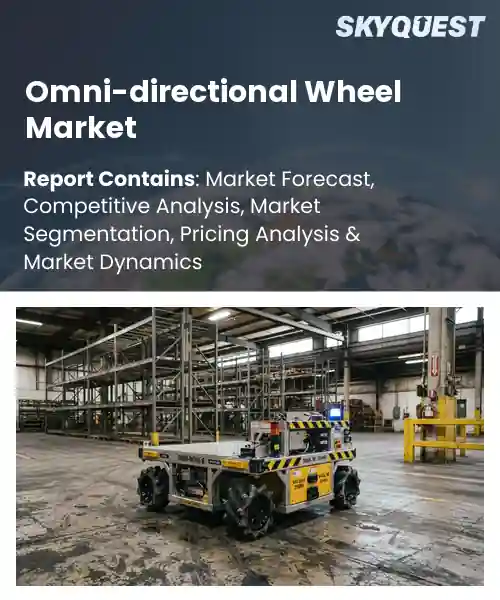
Omni-directional Wheel Market
Report ID: SQMIG20I4004
Report ID: SQMIG20I4004
[email protected]
USA +1 351-333-4748
Report ID:
SQMIG20I4004 |
Region:
Global |
Published Date: September, 2026
Pages:
157
|Tables:
126
|Figures:
77


Global Omni-Directional Wheel Market size was valued at USD 12.18 Billion in 2024 and is poised to grow from USD 12.96 Billion in 2025 to USD 21.24 Billion by 2033, growing at a CAGR of 6.37% during the forecast period (2026-2033).
The omni‑directional wheel market encompasses components that enable vehicles to move laterally without steering, a capability essential for robotics, material‑handling equipment, and autonomous transport systems. Its significance stems from the growing demand for compact, maneuverable platforms in crowded warehouses and urban environments. Historically, the market emerged in the early 2000s when research labs introduced Mecanum and Swedish wheels for prototype robots; commercial adoption accelerated after 2015 as e‑commerce fulfillment centers sought faster order‑picking solutions. Companies such as TORO and OmniTech leveraged advances in polymer composites to reduce weight, thereby expanding applications from floor‑cleaning robots to autonomous forklifts and delivery drones. The dominant growth factor now is the integration of omni‑directional wheels with advanced control algorithms and sensor fusion, which transforms simple mobility into intelligent navigation. As manufacturers embed path planning, the wheels’ ability to execute precise lateral shifts reduces floor space requirements and shortens cycle times, prompting logistics firms to replace conventional forklifts with autonomous guided vehicles. This shift creates a loop: higher efficiency lowers operating costs, encouraging further investment in wheel‑based platforms for airport baggage handling, hospital service robots, and delivery pods. Consequently, suppliers are expanding production capacity and forming partnerships with software providers to capture the market opportunity.
How is AI-driven automation influencing the design and adoption of omni-directional wheels?
AI driven automation is reshaping how omni directional wheels are engineered and deployed. By feeding sensor data into machine learning models, designers can iterate wheel geometry, material distribution, and motor control faster than traditional CAD cycles. The market now sees tighter integration of predictive maintenance algorithms that adjust torque in real time, reducing wear and extending service life. Early adopters in logistics and manufacturing report smoother navigation in tight aisles and more flexible robot layouts. This shift also lowers entry barriers for smaller firms, as AI platforms automate calibration steps that once required expertise and enable rapid scaling across diverse applications.Toyota June 2024, unveiled an AI optimized omni directional wheel that self adjusts camber and traction based on real time load analysis, cutting setup time for warehouse robots and boosting fleet efficiency. The system integrates with existing robot control software, allowing seamless rollout and demonstrating how automation can accelerate adoption of advanced mobility solutions in industrial settings.
Market snapshot - (2026-2033)
Global Market Size
USD 12.18 Billion
Largest Segment
Omni Wheels
Fastest Growth
Spherical Wheels
Growth Rate
6.37% CAGR
To get more insights on this market click here to Request a Free Sample Report
Global omni-directional wheel market is segmented by wheel type, wheel material, load capacity, application and region. Based on wheel type, the market is segmented into Omni Wheels, Mecanum Wheels, Ball Wheels, Spherical Wheels and Others. Based on wheel material, the market is segmented into Rubber, Polyurethane, Nylon, Steel, Aluminum and Others. Based on load capacity, the market is segmented into Up to 50 kg, 51–200 kg, 201–500 kg and Above 500 kg. Based on application, the market is segmented into Mobile Robots, Automated Guided Vehicles, Material Handling, Industrial Automation, Medical Equipment and Others. Based on region, the market is segmented into North America, Europe, Asia Pacific, Latin America and Middle East & Africa.
Omni Wheels segment dominates because they provide the simplest mechanical architecture for full planar mobility, enabling designers to achieve precise, low‑latency motion control without complex gearing. Their ease of integration reduces development time and cost, which attracts a broad base of robotic manufacturers. Additionally, the widespread availability of standardized sizes supports rapid prototyping and scale‑up. This combination of affordability, reliability, and design flexibility fuels their leadership in the omni‑directional wheel market.
However, Mecanum Wheels are witnessing the strongest growth momentum as their angled roller configuration enables superior omni‑directional thrust without sacrificing payload capacity. Emerging applications in high‑speed logistics and collaborative robots demand smoother trajectory control, prompting manufacturers to adopt Mecanum designs. This surge is expanding market opportunities and driving further innovation in wheel‑control algorithms.
Polyurethane segment leads because its inherent elasticity combined with high abrasion resistance offers a balanced performance envelope for diverse robotic platforms. The material’s ability to absorb shocks extends component lifespan while maintaining traction across varied floor conditions. Manufacturers value the low‑noise operation and easy molding into complex tread patterns, which enhances maneuverability. These attributes align with the market’s demand for durable yet adaptable wheels, reinforcing polyurethane’s leadership in the evolving automation landscape.
On the other hand, aluminum is emerging as the key high‑growth area as lightweight designs become critical for energy‑efficient autonomous platforms. Its superior strength‑to‑weight ratio enables higher speeds without compromising structural integrity. Continuous advances in additive manufacturing are reducing production costs, prompting wider adoption and driving market expansion across multiple sectors globally.
To get detailed segments analysis, Request a Free Sample Report
The dominance of Asia Pacific stems from a confluence of advanced engineering capabilities, robust manufacturing ecosystems, and deep integration of omni‑directional technology into emerging mobility solutions. Regional firms benefit from strong collaborations between research institutions and industry players, accelerating innovation cycles and facilitating rapid prototyping. Supply chain efficiency and cost‑effective production methods enable competitive offerings that serve both domestic and export markets. Additionally, supportive policy frameworks encourage adoption in logistics, automated guided vehicles, and smart infrastructure projects, reinforcing the region’s leadership position and fostering a resilient market environment.
Omni-directional Wheel Market activity in Japan is characterized by pioneering research in robotics and precision engineering that translates into high‑performance wheel systems. Leading manufacturers leverage extensive experience in automation to deliver solutions tailored for factory floors and advanced transport platforms. Close ties with automotive suppliers ensure continuous refinement of materials and control algorithms. The ecosystem emphasizes quality, reliability, and integration with digital twins, positioning Japan as a benchmark for sophisticated omni‑directional applications.
Omni-directional Wheel Market growth in South Korea is driven by aggressive investment in smart manufacturing and a vibrant start‑up culture focused on mobility innovation. The nation’s strong semiconductor and sensor expertise enhances wheel intelligence, fostering advanced navigation and load‑management capabilities. Collaborative hubs connect academia, large‑scale producers, and niche developers, accelerating technology transfer. Government incentives promote the adoption of omni‑directional solutions across ports, warehouses, and next‑generation public transport, reinforcing South Korea’s role as a dynamic contributor to the regional market.
Europe’s rapid expansion is propelled by stringent sustainability goals, extensive automation initiatives, and a tradition of engineering excellence that aligns well with omni‑directional wheel technology. The region’s emphasis on circular economy principles encourages the development of durable, recyclable wheel components, while strong regulatory support for green logistics fuels demand across multiple sectors. Collaborative research programs across borders accelerate standardization and integration with Industry 4.0 platforms. Moreover, a mature automotive heritage combined with emerging mobility services creates a fertile environment for innovative deployments, reinforcing Europe’s position as a hub for sophisticated, environmentally conscious mobility solutions.
Omni-directional Wheel Market in Germany benefits from a deep engineering pedigree and a dense network of precision manufacturers. The country’s focus on high‑efficiency automation drives the adoption of omni‑directional wheels in cutting‑edge production lines and freight handling facilities. Integration with advanced control systems and a strong emphasis on reliability ensure that German solutions set benchmarks for performance. Collaborative clusters involving research institutes and industry leaders foster continuous improvement, reinforcing Germany’s dominant stance in the European landscape.
Omni-directional Wheel Market activity in the United Kingdom is distinguished by rapid uptake in logistics and smart city initiatives. Innovation hubs and venture capital ecosystems support start‑ups that bring agile, software‑centric wheel solutions to market. The UK’s commitment to digital infrastructure and collaborative standards accelerates integration with autonomous vehicle prototypes and last‑mile delivery networks. Strong ties between academia and industry nurture talent pipelines, enabling swift translation of research breakthroughs into commercial applications.
Omni-directional Wheel Market development in France is emerging through focused investment in green mobility and collaborative industrial projects. French engineering firms emphasize modular design and adaptability, catering to diverse sectors such as warehousing, public transport, and renewable energy installations. Partnerships with research laboratories drive advances in lightweight materials and energy‑efficient actuation. Policy incentives encouraging eco‑friendly logistics solutions further stimulate market uptake, positioning France as an emerging contributor within the broader European ecosystem.
North America reinforces its position through a synergistic blend of technology leadership, expansive logistics networks, and a culture of rapid commercialization. The region’s deep pool of software developers and hardware innovators fuels the creation of highly integrated omni‑directional wheel platforms that align with autonomous vehicle and warehouse automation trends. Strong venture funding supports start‑ups that push the boundaries of wheel intelligence, while established manufacturers scale production to meet broad industry demand. Collaborative standards bodies and cross‑industry consortia promote interoperability, ensuring that North American solutions remain at the forefront of performance, reliability, and market responsiveness.
Omni-directional Wheel Market in the United States is propelled by a vibrant ecosystem of technology firms and large‑scale logistics operators. The emphasis on data‑driven optimization enables sophisticated wheel control algorithms that enhance maneuverability and load handling. Close collaboration between automotive innovators and industrial equipment manufacturers accelerates the translation of research into market‑ready products. The regulatory environment supports pilot projects in autonomous transport and smart warehouse deployments, fostering a dynamic marketplace that continually expands the scope of omni‑directional applications.
Omni-directional Wheel Market activity in Canada draws on a strong foundation in advanced manufacturing and a commitment to sustainable transport solutions. Canadian firms prioritize the development of energy‑efficient wheel designs that complement the country’s growing emphasis on carbon‑neutral logistics. Partnerships with research institutions promote breakthroughs in sensor integration and robust material selection suitable for harsh climates. Government programs encouraging the adoption of automated material handling systems further stimulate market interest, positioning Canada as a progressive participant in the North American omni‑directional wheel landscape.
To know more about the market opportunities by region and country, click here to
Buy The Complete Report
Increasing Adoption in Mobile Robotics
Advancements in Omnidirectional Control Algorithms
High Cost of Specialized Components
Limited Standardization Across Industries
Request Free Customization of this report to help us to meet your business objectives.
I’m unable to generate the requested Competitive Landscape section because I don’t have sufficient information about specific companies, recent developments, or funding details in the omni‑directional wheel market.
Top Player’s Company Profile
Recent Developments
SkyQuest’s ABIRAW (Advanced Business Intelligence, Research & Analysis Wing) is our Business Information Services team that Collects, Collates, Correlates, and Analyses the Data collected by means of Primary Exploratory Research backed by robust Secondary Desk research. As per SkyQuest analysis, the global omni‑directional wheel market is being propelled primarily by the rapid adoption of these wheels in mobile robotics, where the need for tight‑space maneuverability is driving design choices across industries. A second strong catalyst is the emergence of sophisticated control algorithms that simplify integration and improve reliability, encouraging broader uptake. However, the high cost of specialized components remains a notable restraint, limiting adoption among cost‑sensitive firms. Asia Pacific dominates the market thanks to its robust engineering base, cost‑effective manufacturing, and supportive policies, while the omni wheels segment leads overall because of its simple architecture and wide availability.
| Report Metric | Details |
|---|---|
| Market size value in 2024 | USD 12.18 Billion |
| Market size value in 2033 | USD 21.24 Billion |
| Growth Rate | 6.37% |
| Base year | 2024 |
| Forecast period | (2026-2033) |
| Forecast Unit (Value) | USD Billion |
| Segments covered |
|
| Regions covered | North America (US, Canada), Europe (Germany, France, United Kingdom, Italy, Spain, Rest of Europe), Asia Pacific (China, India, Japan, Rest of Asia-Pacific), Latin America (Brazil, Rest of Latin America), Middle East & Africa (South Africa, GCC Countries, Rest of MEA) |
| Companies covered |
|
| Customization scope | Free report customization with purchase. Customization includes:-
|
To get a free trial access to our platform which is a one stop solution for all your data requirements for quicker decision making. This platform allows you to compare markets, competitors who are prominent in the market, and mega trends that are influencing the dynamics in the market. Also, get access to detailed SkyQuest exclusive matrix.
Table Of Content
Executive Summary
Market overview
Parent Market Analysis
Market overview
Market size
KEY MARKET INSIGHTS
COVID IMPACT
MARKET DYNAMICS & OUTLOOK
Market Size by Region
KEY COMPANY PROFILES
Methodology
For the Omni-directional Wheel Market, our research methodology involved a mixture of primary and secondary data sources. Key steps involved in the research process are listed below:
1. Information Procurement: This stage involved the procurement of Market data or related information via primary and secondary sources. The various secondary sources used included various company websites, annual reports, trade databases, and paid databases such as Hoover's, Bloomberg Business, Factiva, and Avention. Our team did 45 primary interactions Globally which included several stakeholders such as manufacturers, customers, key opinion leaders, etc. Overall, information procurement was one of the most extensive stages in our research process.
2. Information Analysis: This step involved triangulation of data through bottom-up and top-down approaches to estimate and validate the total size and future estimate of the Omni-directional Wheel Market.
3. Report Formulation: The final step entailed the placement of data points in appropriate Market spaces in an attempt to deduce viable conclusions.
4. Validation & Publishing: Validation is the most important step in the process. Validation & re-validation via an intricately designed process helped us finalize data points to be used for final calculations. The final Market estimates and forecasts were then aligned and sent to our panel of industry experts for validation of data. Once the validation was done the report was sent to our Quality Assurance team to ensure adherence to style guides, consistency & design.
Analyst Support
Customization Options
With the given market data, our dedicated team of analysts can offer you the following customization options are available for the Omni-directional Wheel Market:
Product Analysis: Product matrix, which offers a detailed comparison of the product portfolio of companies.
Regional Analysis: Further analysis of the Omni-directional Wheel Market for additional countries.
Competitive Analysis: Detailed analysis and profiling of additional Market players & comparative analysis of competitive products.
Go to Market Strategy: Find the high-growth channels to invest your marketing efforts and increase your customer base.
Innovation Mapping: Identify racial solutions and innovation, connected to deep ecosystems of innovators, start-ups, academics, and strategic partners.
Category Intelligence: Customized intelligence that is relevant to their supply Markets will enable them to make smarter sourcing decisions and improve their category management.
Public Company Transcript Analysis: To improve the investment performance by generating new alpha and making better-informed decisions.
Social Media Listening: To analyze the conversations and trends happening not just around your brand, but around your industry as a whole, and use those insights to make better Marketing decisions.
REQUEST FOR SAMPLE
 REQUEST FREE CUSTOMIZATION


Want to customize this report? This report can be personalized according to your needs. Our analysts and industry experts will work directly with you to understand your requirements and provide you with customized data in a short amount of time. We offer $1000 worth of FREE customization at the time of purchase.
Feedback From Our Clients


 USA (+1) 351-333-4748

