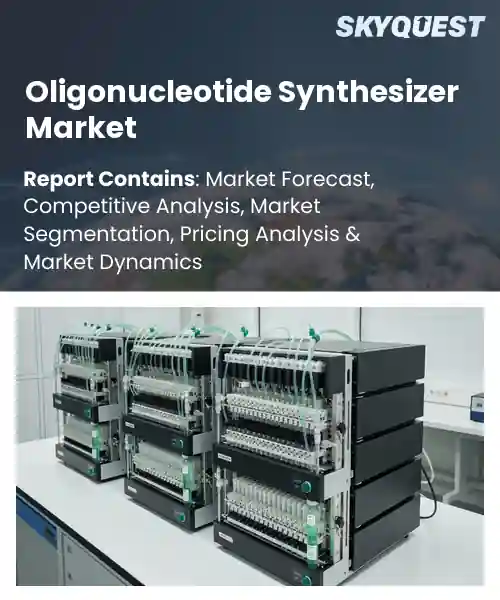
Oligonucleotide Synthesizer Market
Report ID: SQMIG35J2220
Report ID: SQMIG35J2220
[email protected]
USA +1 351-333-4748
Report ID:
SQMIG35J2220 |
Region:
Global |
Published Date: February, 2026
Pages:
157
|Tables:
149
|Figures:
78


Global Oligonucleotide Synthesizer Market size was valued at USD 3.17 Billion in 2024 and is poised to grow from USD 3.64 Billion in 2025 to USD 10.86 Billion by 2033, growing at a CAGR of 14.95% during the forecast period (2026-2033).
The oligonucleotide synthesizer market includes instruments that build DNA and RNA sequences for scientific and medical purposes together with the rising need for precision nucleic acid tools which drives its global oligonucleotide synthesizer market growth. The market holds significance since synthesized oligos serve as essential elements for gene editing and antisense therapies and mRNA vaccine production, which convert molecular sequences into workable items that enhance drug development and clinical diagnostic processes.
In addition, the global oligonucleotide synthesizer market outlook transformed its operational model because better automation and solid‑phase chemistry led academics and biotech startups to adopt benchtop synthesizers instead of centralized service providers. The evolution process decreased both turnaround times and operational costs, which resulted in more people gaining access to services and researchers obtaining permission to conduct more experiments. The global oligonucleotide synthesizer market experiences its most significant growth through rising access and enhanced synthesis speed as therapeutic and diagnostic pipelines create demand for advanced instruments that deliver increased output and dependable performance. The demand for greater library output with high purity requirements from companies developing antisense drugs siRNA therapies and personalized mRNA vaccines necessitates the creation of automated purification modules and inline quality monitoring by vendors. On-site synthesizers enable biotechs to decrease lead optimization cycle times during their medicinal chemistry screening process.
How is Automation Improving Throughput in the Oligonucleotide Synthesizer Market?
The oligonucleotide synthesizer industry uses automation to enhance production capacity through its automated process that connects different production stages which previously needed manual work. Automated reagent delivery systems work together with parallel synthesis systems and continuous flow technologies and integrated software systems that handle scheduling and error detection to form the system's core components. The current systems support laboratories to operate their production systems through automated processes while they switch between production modes at a faster rate. The market requires rapid therapeutic and diagnostic oligo production because customers need shorter therapeutic and diagnostic oligo production times. Automated processes through plate-based synthesizers and robotic sample handlers enable operations to run continuously while maintaining product quality and on-time delivery which reduces downtime.
Market snapshot - (2026-2033)
Global Market Size
USD 1.82 Billion
Largest Segment
Standard Synthesizers
Fastest Growth
High-Throughput Synthesizers
Growth Rate
10.09% CAGR
To get more insights on this market click here to Request a Free Sample Report
The global oligonucleotide synthesizer market is segmented into type, technology, form factor, application, end user, and region. Based on type, the market is segmented into Standard Synthesizers, High-Throughput Synthesizers, Custom Synthesizers, and Integrated Synthesizers. Based on technology, the market is segmented into Solid-Phase Synthesis, Liquid-Phase Synthesis, Microarray Technology, and Polymerase Chain Reaction (PCR)-Based Methods. Based on form factor, the market is segmented into Bench-top Synthesizers, Portable Synthesizers, Modular Synthesizers, and Automated Synthesizers. Based on application, the market is segmented into Research & Development, Diagnostic Applications, Therapeutic Applications, and Forensic Applications. Based on end user, the market is segmented into Academic Institutions, Pharmaceutical Companies, Biotechnology Firms, and Diagnostic Laboratories. Based on region, the market is segmented into North America, Europe, Asia Pacific, Latin America, and Middle East & Africa.
As per the global oligonucleotide synthesizer market analysis, standard synthesizers segment dominates because these platforms offer proven reliability, broad compatibility with established phosphoramidite chemistry, and user-friendly workflows that match routine research and development needs. The solution offers predictable performance which laboratories adopt because it reduces experimental errors and enhances reagent supply chains and compliance with regulatory requirements. The system provides organizations with a safe operational framework which allows them to concentrate on development work, thus creating a market preference for these systems.
High-Throughput Synthesizers have become the fastest growing segment because the rising requirement for extensive oligonucleotide libraries drives companies to invest in automated systems which can handle multiple tasks simultaneously. The market has been expanded through sample handling innovations and analytics integration and software development, which enable faster screening and scale-up operation, thus opening new contract synthesis opportunities and service models.
According to the global oligonucleotide synthesizer market forecast, solid-Phase Synthesis segment dominates the market because its established chemistry enables the production of precise oligonucleotides which can be automated and produced on a large scale. The method enables researchers to create reliable synthetic results across all sequence lengths and chemical compounds, which researchers need for their work in research and diagnostics and therapeutic applications. The market enables widespread instrument use because reliable resin and reagent supply chains and reliable coupling efficiency let users maximize throughput and product quality.
Whereas the microarray technology is anticipated to have the largest oligonucleotide synthesizer market share through its ability to produce multiple high-density oligonucleotides simultaneously, which supports the creation of diagnostic probes and the discovery process. Scientific innovations in surface chemistries combined with advanced printer technologies lead to higher yield production while reducing the cost to produce each target, which results in the creation of new assay formats and fast screening processes that generate demand for unique synthesizers and their associated analytical instruments.
To get detailed segments analysis, Request a Free Sample Report
As per the oligonucleotide synthesizer market regional forecast, North America leads because its ecosystem connects instrument manufacturers with research institutions and biotechnology companies to develop and sell oligonucleotide products. The system for translational research and clinical supply chain management enables hospitals to quickly try out new medical products. Academic institutions partner with contract research organizations and life science enterprises to create networks that speed up both method development and market entry. The combination of regulatory support with reimbursement systems and a trained workforce plus existing buying systems creates an environment that encourages adoption of new synthesizer technology. Instrument performance improves and service intervals lengthen because manufacturers provide both maintenance support and necessary reagents. The commercialization process receives additional support through strategic business partnerships and venture capital funding because companies need immediate synthesis solutions for their large clinical research projects. Market growth occurs because key opinion leaders in technology validation work at both academic institutions and commercial enterprises.
The United States Oligonucleotide Synthesizer sector develops because translational research centers and instrument manufacturers and major biopharma clients who need advanced synthesis capabilities create a dense business environment. The organization provides multiple service options that enable customers to quickly implement and adapt their system. The clinical program distribution together with buying behavior of procurement officers determines which platforms will be adopted by the market. The partnership between businesses and academic institutions accelerates the process of product validation and product development, which in turn creates a more mature market that favours solutions which can be integrated and expanded.
The Canadian Oligonucleotide Synthesizer industry operates through public research organizations and biotech clusters and infrastructure investments which support the use of advanced synthesizer platforms. The local area provides easy access to North American supply chains and shows partnerships with contract service providers for instrument and consumable access. The combination of research projects and technical workforce capabilities creates an environment that demands synthesis systems which are both trustworthy and flexible. Local service ecosystems and academic partnerships helptest platforms for clinical and commercial purposes.
Europe is experiencing rapid growth because its academic institutions have developed strong research programs which support the creation of new biotech companies and produce increased industrial investment in oligonucleotide therapeutics. The pan-regional research network enables research institutions and contract research organizations and manufacturers to share their technological knowledge and expand their operations in various markets. The innovation programs of each country work together with public-private partnerships to promote the development of local manufacturing capabilities and product commercialization. The established pharmaceutical industry needs precise therapeutic solutions which encourage hospitals to adopt advanced synthesizer systems because they have establishedclinical research networks. European countries create an environment for business growth through their unified regulatory processes and extensive service provider networks while their cost-effective supply chain systems and skilled technical teams create an environment for business expansion.
Germany benefits from a robust manufacturing industry and strong translational research networks and reliable contract service providers who assess and implement advanced synthesis technologies. The local industry together with academic institutions enables businesses to enhance their processes and expand their operations while pharmaceutical companies and biotechnology organizations continue to buy from them. The local area provides technical expertise with supply chains which enable businesses to efficiently implement their systems while providing ongoing support and system modifications for quality requirements.
The United Kingdom Oligonucleotide Synthesizer Market grows through its network of translational centers and contract research organizations which support fast development of innovative solutions. The availability of both flexible funding options and industry-academia connections enables organizations to assess emerging synthesis technologies while implementing them into their commercial operations. The local service industry together with clinical network connections supports both pilot program development and procurement activities while export partnerships help businesses reach new markets which increases their need for high-performance synthesizer solutions.
The French Oligonucleotide Synthesizer market grows through funding for both translational research institutes and industrial biotechnology modernization programs. Public research and private industry collaboration enables oligonucleotide production through process validation and manufacturing. Regional life science clusters together with a strengthening supplier base enable access to required materials through domestic service providers. The Oligonucleotide Synthesizer market penetration relies on policy support for industrial capacity and skilled workforce development which drives the increase in domestic market demand.
Asia Pacific is strengthening its position through domestic manufacturing expansion, public biotechnology support initiatives, and increased oligonucleotide research activities. Regional instrument and reagent suppliers are boosting their local presence, which includes better service support, thus decreasing their dependence on remote supply networks. The organization uses global technology partnerships and contract development networks to share knowledge with users who need to adopt new platforms. The growing industrial capacity, combined with technical talent development and regulatory pathway harmonization efforts, creates better conditions for business expansion. Investment in synthesis technologies receives a boost from cost-competitive production bases and localized clinical research activities, while domestic demand growth from government and business sectors drives development of advanced synthesis facilities and application capabilities. The local workforce development programs and academic training initiatives create local expertise through strategic incentives, which results in new indigenous platform innovators coming into existence.
The Oligonucleotide Synthesizer Market Japan depends on its advanced instrument manufacturing expertise and deep pharmaceutical research capabilities and precision medicine ecosystem, which requires reliability and quality for its operations. Domestic suppliers and service providers deliver maintenance and reagent support, enabling strong instrument performance. Research institutions work with industry partners to develop technology solutions through their close linkages with research institutions. The combination of technical talent and dedication to strict regulatory and quality standards creates an ongoing market requirement for advanced synthesis platforms, which can be customized according to user needs.
The Oligonucleotide Synthesizer Market South Korea is experiencing growth through its rapidly developing biotech industry, which receives government backing for life science research and its partnerships between instrument vendors and contract service providers. The domestic biopharma sector growth creates a need for high-performance synthesis platforms, which biopharma companies use to develop their therapeutic products. Global technology partnerships and technical training programs will enable rapid capability growth for the partner organization. Export markets benefit from the manufacturing base, which provides flexible support services that help businesses adopt and customize their products.
To know more about the market opportunities by region and country, click here to
Buy The Complete Report
Rising Demand for Therapeutic Applications
The manufacturers of synthesizer technologies have enhanced their production capabilities while developing superior products because of the increased demand for oligonucleotide-based therapeutics. The clinical and preclinical programs need synthesis platforms that can produce various sequences and chemistries through reliable and adaptable synthesis capabilities, which help them buy new systems and upgrade existing ones. The vendors who deliver better throughput with shorter turnaround times and higher reproducibility levels, create trust between researchers and biopharma companies. The market expands because companies investigate new technologies, which creates a cycle of increased technology adoption and subsequent technology development.
Advances in Automation and Integration
Oligonucleotide synthesis workflows have become more efficient through automation and system integration, which allows systems to operate without manual work while producing consistent results. The integrated platforms of laboratories enable them to run complex sequences through their complete system, which includes synthesis and purification and monitoring functions, to achieve superior performance while reducing operational demands. Suppliers design modular systems that customers can easily operate to manage their business expansion, which helps the market acquisition process because it enables suppliers to create systems that support this process. Organizations achieve synthesizer investment prioritization through improved workflow efficiency and easier technical adoption, which maintains demand while driving technological development.
High Initial Capital Investment
Advanced oligonucleotide synthesizers require high capital investment, which prevents small laboratories and new biotech companies from acquiring them because their financial resources need to cover multiple research needs. Organizations experience procurement delays because of cost perception, which leads them to maintain existing equipment instead of buying new systems. Customers require vendors to demonstrate long-term product value before they will purchase products, which vendors must prove through operational expense savings. The funding limits market growth potential because only financially strong organizations will buy new technologies during the introduction period.
Regulatory Complexity and Compliance
The existing rules for oligonucleotide production processes together with their evolving compliance requirements create a situation of uncertainty which leads companies to delay their adoption of new synthesizer technologies because different regions require different validation and document creation standards. Manufacturers together with end users need to spend large amounts of resources for achieving reproducible quality which creates delays in introducing new platforms because different certification standards must be fulfilled. Companies cannot allocate resources for new system investments because they need to navigate complex approval processes which leads to advanced equipment restrictions and market development delays until more regulatory guidance becomes available.
Request Free Customization of this report to help us to meet your business objectives.
The competitive environment now experiences three main changes which include market consolidation, establishment of platform partnerships and introduction of new instruments to satisfy the requirement of high-throughput oligonucleotide production which needs localized solutions for therapeutic and diagnostic applications. Major firms are executing acquisitions and licensing deals, for example GSK's acquisition of Elsie Biotechnologies in 2024, while vendors develop enzymatic flow-through synthesizers which include DNA Script's SYNTAX and Cambrex-Atinary automation partnerships to enhance their production capacity and operational efficiency.
Automation Driving Throughput Gains: The combination of advanced automation and robotics technologies in oligonucleotide synthesis enables manufacturers to produce items at high volumes while maintaining short production times. Companies are developing software-based platforms which enable standard operating procedures to be followed while guaranteeing product quality through reproducible results and flexible production volumes. The new system enables better process development through its adaptable supply chain system which helps manufacturers meet changing demands and work smoothly with contract developers. Automation reduces the need for specialized workers which helps organizations build more resilient operations while allowing scientists to focus their skills on research.
Collaborative Development Ecosystems: The market is moving towards a hybrid approach which combines multiple development partners who work with biopharmaceutical firms and contract manufacturing organizations to establish complete development systems that speed up scientific discoveries through production processes. The partnerships enable organizations to work together as they develop customized synthesis methods which combine hardware and software systems and share their knowledge to help customers meet their needs. The trend fosters service-oriented business models which create extra revenue through consumables and software subscriptions while providing businesses with complete solutions that help them develop their therapeutic methods and patient-specific treatment programs.
SkyQuest’s ABIRAW (Advanced Business Intelligence, Research & Analysis Wing) is our Business Information Services team that Collects, Collates, Correlates, and Analyses the Data collected by means ofPrimary Exploratory Research backed by robust Secondary Desk research.
As per SkyQuest analysis, the global demand for oligonucleotide-based therapeutics and diagnostics drives the growth of the oligonucleotide synthesizer market which also benefits from better automation and integration technologies that improve production efficiency. Standard synthesizers maintain their lead position because of their established reliability and their ability to work with various systems, and North America dominates the market because of its strong research and manufacturing centers and funding systems. The high costs to implement advanced systems hold back smaller laboratories and startups despite their strong product development capabilities and partnership networks. The demand in the market for research and clinical and commercial applications will benefit vendors who operatemodular automation systems and offer service-based business models and expand their manufacturing capabilities in local markets.
| Report Metric | Details |
|---|---|
| Market size value in 2024 | USD 1.82 Billion |
| Market size value in 2033 | USD 4.32 Billion |
| Growth Rate | 10.09% |
| Base year | 2024 |
| Forecast period | (2026-2033) |
| Forecast Unit (Value) | USD Billion |
| Segments covered |
|
| Regions covered | North America (US, Canada), Europe (Germany, France, United Kingdom, Italy, Spain, Rest of Europe), Asia Pacific (China, India, Japan, Rest of Asia-Pacific), Latin America (Brazil, Rest of Latin America), Middle East & Africa (South Africa, GCC Countries, Rest of MEA) |
| Companies covered |
|
| Customization scope | Free report customization with purchase. Customization includes:-
|
To get a free trial access to our platform which is a one stop solution for all your data requirements for quicker decision making. This platform allows you to compare markets, competitors who are prominent in the market, and mega trends that are influencing the dynamics in the market. Also, get access to detailed SkyQuest exclusive matrix.
Table Of Content
Executive Summary
Market overview
Parent Market Analysis
Market overview
Market size
KEY MARKET INSIGHTS
COVID IMPACT
MARKET DYNAMICS & OUTLOOK
Market Size by Region
KEY COMPANY PROFILES
Methodology
For the Oligonucleotide Synthesizer Market, our research methodology involved a mixture of primary and secondary data sources. Key steps involved in the research process are listed below:
1. Information Procurement: This stage involved the procurement of Market data or related information via primary and secondary sources. The various secondary sources used included various company websites, annual reports, trade databases, and paid databases such as Hoover's, Bloomberg Business, Factiva, and Avention. Our team did 45 primary interactions Globally which included several stakeholders such as manufacturers, customers, key opinion leaders, etc. Overall, information procurement was one of the most extensive stages in our research process.
2. Information Analysis: This step involved triangulation of data through bottom-up and top-down approaches to estimate and validate the total size and future estimate of the Oligonucleotide Synthesizer Market.
3. Report Formulation: The final step entailed the placement of data points in appropriate Market spaces in an attempt to deduce viable conclusions.
4. Validation & Publishing: Validation is the most important step in the process. Validation & re-validation via an intricately designed process helped us finalize data points to be used for final calculations. The final Market estimates and forecasts were then aligned and sent to our panel of industry experts for validation of data. Once the validation was done the report was sent to our Quality Assurance team to ensure adherence to style guides, consistency & design.
Analyst Support
Customization Options
With the given market data, our dedicated team of analysts can offer you the following customization options are available for the Oligonucleotide Synthesizer Market:
Product Analysis: Product matrix, which offers a detailed comparison of the product portfolio of companies.
Regional Analysis: Further analysis of the Oligonucleotide Synthesizer Market for additional countries.
Competitive Analysis: Detailed analysis and profiling of additional Market players & comparative analysis of competitive products.
Go to Market Strategy: Find the high-growth channels to invest your marketing efforts and increase your customer base.
Innovation Mapping: Identify racial solutions and innovation, connected to deep ecosystems of innovators, start-ups, academics, and strategic partners.
Category Intelligence: Customized intelligence that is relevant to their supply Markets will enable them to make smarter sourcing decisions and improve their category management.
Public Company Transcript Analysis: To improve the investment performance by generating new alpha and making better-informed decisions.
Social Media Listening: To analyze the conversations and trends happening not just around your brand, but around your industry as a whole, and use those insights to make better Marketing decisions.
REQUEST FOR SAMPLE
 REQUEST FREE CUSTOMIZATION
Global Oligonucleotide Synthesizer Market size was valued at USD 1.82 Billion in 2024 and is poised to grow from USD 2.0 Billion in 2025 to USD 4.32 Billion by 2033, growing at a CAGR of 10.09% during the forecast period (2026-2033).
Competitive landscape is marked by consolidation, platform partnerships and rapid instrument innovation driven by demand for localized, high-throughput oligonucleotide production for therapeutics and diagnostics. Major firms are executing acquisitions and licensing deals, for example GSK's acquisition of Elsie Biotechnologies in 2024, while vendors pursue enzymatic and flow-through synthesizers such as DNA Script's SYNTAX and automation collaborations like Cambrex-Atinary to boost capacity and speed. 'Thermo Fisher Scientific', 'Agilent Technologies', 'Integrated DNA Technologies', 'Eurofins Genomics', 'Sigma-Aldrich', 'Biolegio', 'GenScript', 'Fasmac', 'OligoSupply', 'Primedice', 'Twist Bioscience', 'Synthego', 'Bioneer', 'Nanjing GenScript', 'Vazyme', 'TriLink BioTechnologies', 'ChemGenes', 'LGC Biosearch Technologies', 'QIAGEN', 'Merck KGaA'
Rising demand for oligonucleotide-based therapeutics has encouraged investment in synthesizer technologies, enabling manufacturers to expand capacity and improve product offerings. Clinical and preclinical programs require reliable, flexible synthesis platforms that can support diverse sequences and chemistries, motivating purchases and upgrades. This demand drives vendors to optimize throughput, reduce turnaround, and enhance reproducibility, which in turn fosters confidence among researchers and biopharma companies. As a qualitative outcome, these dynamics create a virtuous cycle of adoption and technological refinement, reinforcing market expansion through sustained commercial and research engagement.
Automation Driving Throughput Gains: Adoption of advanced automation and robotics in oligonucleotide synthesis is enabling consistent high-throughput manufacturing and reduced cycle times. Firms are investing in modular software-driven platforms that standardize protocols, improve reproducibility, and allow scalable batch sizes while maintaining quality. This shift supports faster process development and flexible supply chains, allowing manufacturers to respond quickly to shifting demand and collaborate effectively with contract developers. Automation also lowers dependency on specialized manual labor, enhancing resilience and enabling redeployment of skilled scientists to innovation.
As per the oligonucleotide synthesizer market regional forecast, North America leads because its ecosystem connects instrument manufacturers with research institutions and biotechnology companies to develop and sell oligonucleotide products.


Want to customize this report? This report can be personalized according to your needs. Our analysts and industry experts will work directly with you to understand your requirements and provide you with customized data in a short amount of time. We offer $1000 worth of FREE customization at the time of purchase.
Feedback From Our Clients


 USA (+1) 351-333-4748

