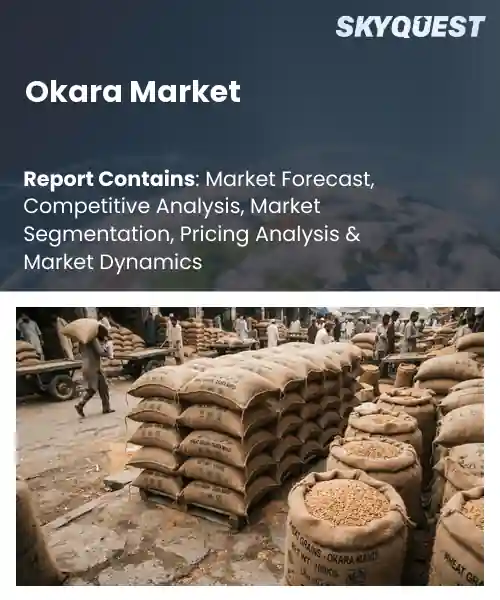
Okara Market
Okara Market

Report ID: SQMIG30I3196

[email protected]
USA +1 351-333-4748

Okara Market Size, Share, and Growth Analysis

Okara Market

Okara Market By Form (Fresh Okara, Dried Okara, Okara Powder), By Application (Food & Beverages, Animal Feed, Nutraceuticals, Cosmetics), By Source (Soybean Okara, Other Legume Okara), By Distribution Channel, By End User, By Region - Industry Forecast 2026-2033


Report ID: SQMIG30I3196 | Region: Global | Published Date: August, 2026
Pages: 157 |Tables: 144 |Figures: 78

Format - word format excel data power point presentation

Okara Market Insights

Global Okara Market size was valued at USD 3.58 Billion in 2024 and is poised to grow from USD 3.88 Billion in 2025 to USD 7.4 Billion by 2033, growing at a CAGR of 8.4% during the forecast period (2026-2033).

Okara, the soy pulp left after curdling soybeans for tofu or soy milk, has moved from a low‑value waste stream to a cornerstone of sustainable food sector. The primary driver of this transformation is rising consumer demand for plant‑based protein, which forces manufacturers to source affordable inputs that can be positioned as ingredients. Historically, producers discarded the pulp in landfills, yet cost pressures and regulatory incentives spurred a reassessment of its nutritional value. Today, Japanese snack firms blend okara into baked goods, while North American startups turn it into flour for gluten‑free breads, showing market’s evolution from waste to commodity. The global okara market is propelled by the convergence of food‑security initiatives and circular‑economy models, which together create a business case for upcycling soy by‑products. As governments impose waste‑reduction targets, manufacturers find that converting okara into protein‑rich powders reduces landfill fees while providing cost‑effective raw material for meat‑alternatives. This dynamic has led a European plant‑based brand to launch high‑fiber snack bars that cite okara’s digestible protein as a nutritional advantage, attracting health‑conscious consumers. Consequently, investment in processing technology accelerates, supply chains expand, and the globally recognized significant market’s valuation is projected to double rapidly by 2030 within five years globally.

How is AI-driven automation influencing the global Okra market?

AI-driven automation is reshaping the global okra landscape by integrating predictive analytics, precision farming tools and smart processing lines. Sensors collect real‑time soil moisture and temperature data, allowing algorithms to fine‑tune irrigation and fertiliser schedules, which improves crop consistency and reduces waste. Machine‑vision systems sort harvested pods, identifying size and quality faster than manual inspection, while robotic packagers streamline the frozen‑okra supply chain. These technologies also enable growers to respond swiftly to market signals, aligning production with demand spikes in retail and food‑service sectors. The result is a more resilient value chain that can scale efficiently while maintaining product standards.Sakata Seed Corporation launched the Niger F1 okra variety in 2025, leveraging AI‑enhanced breeding platforms that accelerate trait selection and seed yield forecasting, thereby supporting higher productivity and market growth.

Market snapshot - (2026-2033)

Global Market Size

USD 3.58 Billion

Largest Segment

Fresh Okara

Fastest Growth

Okara Powder

Growth Rate

8.4% CAGR

Okara Market ($ Bn)
Country Share for Asia Pacific Region (%)

To get more insights on this market click here to Request a Free Sample Report

Okara Market Segments Analysis

Global okara market is segmented by form, application, source, distribution channel, end user and region. Based on form, the market is segmented into Fresh Okara, Dried Okara and Okara Powder. Based on application, the market is segmented into Food & Beverages, Animal Feed, Nutraceuticals and Cosmetics. Based on source, the market is segmented into Soybean Okara and Other Legume Okara. Based on distribution channel, the market is segmented into Direct Sales, Retail and Online Retail. Based on end user, the market is segmented into Food Manufacturers, Feed Manufacturers and Consumers. Based on region, the market is segmented into North America, Europe, Asia Pacific, Latin America and Middle East & Africa.

What role does okara powder play in transforming the okara market?

Okara powder segment dominates because it offers a stable, shelf stable ingredient that meets the convenience demands of modern processors. Its low moisture content reduces spoilage risk, enabling manufacturers to integrate it into dry mixes and fortified products with minimal formulation adjustments. The ease of handling, consistent nutritional profile, and compatibility with large scale blending equipment drive its preferential adoption throughout production cycles and supply.

Meanwhile, dried okara segment emerges as the most rapidly expanding area because rising interest in plant based snack formulations fuels demand for processed moisture controlled material. Its texture supports crisp products while residual fiber aligns with health trends. This opens pathways for processing technologies and broadens market opportunity for okara utilization.

how does food & beverages application drive value creation in the okara market?

Food & beverages application dominates because it integrates okara as a functional ingredient that enhances nutritional density while meeting consumer demand for plant based options. Its versatility enables incorporation into bakery, dairy alternatives, and snack lines, providing texture and protein benefits without compromising taste. This alignment with mainstream product development cycles secures its leading position in the okara ecosystem as manufacturers seek cost effective sustainability solutions and label friendly fiber sources, okara becomes a preferred choice, reinforcing its market primacy.

Conversely, nutraceuticals application emerges as the fastest growing area because increasing focus on functional health products drives interest in okara’s bioactive compounds. Its high fiber, isoflavone, and antioxidant content makes it attractive for supplements, fortified drinks, and functional powders. This surge supports innovative product pipelines and expands the market’s health oriented revenue streams.

Okara Market By Form

To get detailed segments analysis, Request a Free Sample Report

Okara Market Regional Insights

Why does Asia Pacific Dominate the Global Okara Market?

Asia Pacific leads the global Okara market due to a confluence of agricultural abundance, sophisticated food‑processing infrastructure, and deep cultural familiarity with soy‑derived ingredients. The region benefits from extensive soybean cultivation, which supplies a steady stream of high‑quality okara as a by‑product. Advanced processing technologies enable efficient extraction and incorporation of okara into a wide range of food and feed applications. Consumer trends favor plant‑based nutrition and sustainability, reinforcing demand for functional ingredients like okara. Strong governmental support for circular economy initiatives further accelerates adoption, while collaborative research between universities and industry drives continuous product innovation. The region’s extensive distribution networks ensure rapid market penetration, and the presence of multinational food corporations facilitates scaling of okara‑based product lines across diverse consumer segments (subheading)

Okara Market in Japan thrives on a soy processing tradition and a consumer base that values nutrition. Industry players leverage milling and drying techniques to preserve the fiber and protein content of okara, enabling its integration into snack foods, fermented products, and beverages. Efforts between research institutes and manufacturers focus on enhancing sensory attributes, while frameworks support label claims, reinforcing market confidence and encouraging adoption across retail and foodservice channels

Okara Market in South Korea benefits from a strong culinary heritage that incorporates soy by‑products and a growing emphasis on sustainable food solutions. Producers apply extrusion and fermentation processes to improve texture and flavor, making okara suitable for meals, protein bars, and dairy alternatives. Partnerships with academic institutions drive research on health benefits, while consumer education campaigns highlight advantages, fostering acceptance among health‑conscious shoppers and expanding distribution through retail formats

What is Driving the Rapid Expansion of Okara Market in Europe?

The rapid expansion of the Okara market in Europe is propelled by a convergence of sustainability mandates, innovative food‑technology ecosystems, and heightened consumer demand for plant‑based nutrition. Regulatory frameworks encourage the reduction of food waste, positioning okara as a valuable ingredient for circular product development. Leading food manufacturers invest in processing capabilities that retain the nutritional profile of okara, enabling its use in bakery, dairy‑free, and functional snack categories. Collaborative research across universities and industry accelerates the creation of novel textures and flavor profiles, while branding strategies emphasize health and environmental benefits. This supportive environment, combined with strong distribution networks and a tradition of culinary experimentation, allows European markets to adopt okara at an accelerated pace, reinforcing the continent’s role as a hub for sustainable ingredient innovation (subheading)

Okara Market in Germany is characterized by a robust industrial food sector and a strong emphasis on eco‑efficiency. Manufacturers integrate okara into high‑protein breads, meat analogues, and dairy alternatives, leveraging advanced extrusion and fermentation technologies to meet stringent quality standards. Collaborative projects between research institutes and corporate partners focus on optimizing functional properties, while certification schemes highlight sustainability credentials, encouraging adoption by both European mainstream retailers and specialty health stores

Okara Market in United Kingdom is the fastest growing segment, driven by consumer enthusiasm for plant‑based alternatives and strong policy support for waste reduction. Food innovators employ processing methods such as treatment to enhance texture, enabling okara to be incorporated into protein‑rich snacks, fermented spreads, and dairy‑free yogurts. Partnerships with NGOs amplify messaging around environmental impact, while retail chains expand shelf space for okara‑enriched products, accelerating market penetration among shoppers

Okara Market in France is emerging as producers explore innovative applications to meet rising demand for sustainable ingredients. Culinary startups experiment with okara in bakery, confectionery, and plant‑based cheese, leveraging France’s tradition of gastronomy and food‑science research. Government incentives for circular economy projects encourage investment in processing facilities, while consumer awareness campaigns highlight the nutritional and environmental merits of okara, fostering gradual acceptance in both artisanal and mainstream retail channels

How is North America Strengthening its Position in Okara Market?

North America is strengthening its position in the Okara market through a combination of advanced processing capabilities, strategic partnerships, and a growing consumer shift toward plant‑based and waste‑reduction solutions. Food manufacturers invest in high‑throughput extraction and drying technologies that preserve okara’s nutritional integrity, enabling its use in protein bars, dairy alternatives, and functional beverages. Collaborative initiatives between research institutions and industry accelerate the development of novel textures and flavor profiles, while sustainability certifications provide credibility. Retail chains are expanding shelf space for okara‑enriched products, and culinary innovators are showcasing its versatility in mainstream and specialty foodservice settings. This integrated approach, supported by favorable regulatory environments and increasing awareness of environmental impact, positions North America as a dynamic hub for okara adoption and innovation (subheading)

Okara Market in United States benefits from a food processing infrastructure and a consumer base eager for plant‑based protein sources. Companies employ drying and fortification techniques to maintain okara’s fiber and protein content, facilitating its inclusion in snack bars, meat substitutes, and dairy‑free beverages. Partnerships with universities drive research on health benefits, while sustainability branding resonates with conscious shoppers, prompting broader distribution across supermarkets, health food stores, and online platforms

Okara Market in Canada is advancing through collaboration between agricultural producers and food innovators focused on ingredient development. Processing facilities apply gentle drying and extrusion methods to preserve okara’s nutritional profile, enabling its use in breads, plant‑based milks, and snack formulations. Government programs supporting economy initiatives provide funding for research, while consumer education highlights the health advantages of okara, encouraging retailers to allocate shelf space and driving significant market growth

Okara Market By Geography
  • Largest
  • Fastest

To know more about the market opportunities by region and country, click here to
Buy The Complete Report

Okara Market Dynamics

Drivers

Rising Consumer Interest in Fiber

  • Consumers are increasingly seeking functional foods that promote digestive health, and okara’s high dietary fiber content meets this preference. Manufacturers respond by incorporating okara into snack bars, baked goods, and plant‑based dairy alternatives, creating diversified product portfolios. This shift expands market reach beyond traditional soy‑based products and stimulates brand innovation. As health‑conscious purchasing decisions drive repeat buying, demand for okara‑enriched items grows, encouraging producers to scale processing capabilities and invest in supply chain integration, thereby reinforcing overall market expansion in the sector.

Expansion of Foodservice Applications

  • Restaurants and catering services are adopting okara as a sustainable ingredient to enhance menu diversity while reducing waste, and this practice aligns with corporate responsibility goals. Chefs integrate okara into sauces, doughs, and protein‑rich fillings, offering novel textures that attract environmentally aware diners. The visible commitment to circularity strengthens brand reputation and encourages repeat patronage. As foodservice operators prioritize cost‑effective, plant‑based components, demand for consistent okara supplies escalates, prompting suppliers to refine processing methods and broaden distribution networks across global markets.

Restraints

Limited Shelf Life Challenges

  • Okara’s high moisture content predisposes it to rapid microbial growth, and limited shelf life restricts its use in longer‑distance supply chains. Processors must employ immediate drying or preservation techniques, which increase operational complexity and cost. Retailers hesitant to stock perishable items may reduce shelf space allocation, limiting consumer exposure. Consequently, manufacturers often prioritize more stable ingredients, slowing the introduction of okara‑based products. This constraint hampers market momentum, as supply uncertainties deter investment in large‑scale production facilities and limit broader adoption across diverse distribution channels.

Supply Chain Volatility Issues

  • Global agricultural fluctuations and inconsistent soy‑bean processing outputs generate volatility in okara availability, and this irregular supply hampers reliable sourcing for manufacturers. Seasonal harvest variations, coupled with competing demands for soy products, can lead to sudden shortages or price spikes. Companies facing uncertain input streams may postpone product launches or revert to alternative fibers with more predictable deliveries. Such risk‑averse behavior limits long‑term planning and discourages investment in dedicated okara processing lines. Ultimately, supply chain instability curtails market expansion by creating hesitation among potential adopters and investors.

Request Free Customization of this report to help us to meet your business objectives.

Okara Market Competitive Landscape

The competitive landscape of the global okara market is shaped by a handful of niche innovators leveraging strategic M&A, targeted partnerships with soy processors, and technology‑driven product differentiation; recent examples include a merger between two mid‑size okara ingredient firms to expand geographic reach and a joint venture between a plant‑based protein startup and a major dairy alternative brand to co‑develop high‑fiber snack lines, underscoring the market’s emphasis on supply‑chain integration and value‑added processing.

  • Okara: Established in 2022, their main objective is to commercialize okara‑derived food ingredients for sustainable protein applications. Recent development: completed a seed funding round that attracted early‑stage venture capital, positioning the company to scale production and launch a line of fortified okara flour.
  • Okara AI: Established in 2021, their main objective is to provide AI‑powered analytics and market insights for okara producers and ingredient manufacturers. Recent development: released a suite of new AI tools on their platform, announced through a company blog, aimed at optimizing supply‑chain efficiency and forecasting demand for okara‑based products.

Top Player’s Company Profile

  • Pulmuone Co., Ltd.
  • House Foods Group Inc.
  • Fuji Oil Holdings Inc.
  • Vitasoy International Holdings Limited
  • Kikkoman Corporation
  • The Hain Celestial Group, Inc.
  • Otsuka Foods Co., Ltd.
  • SunOpta Inc.
  • Shandong Yuwang Ecological Food Industry Co., Ltd.
  • The Better Meat Co.
  • Marlow Ingredients
  • Soyaworld
  • Tofurky Company
  • Mori-Nu (Morinaga Nutritional Foods, Inc.)
  • ZenB
  • Earth's Own Food Company Inc.
  • Hodo Foods
  • SoyXpert
  • Jinluo Food Group
  • Yeo Hiap Seng Limited

Recent Developments

  • Tab Pulmuone Co., Ltd. introduced a premium okara‑infused tofu range in March 2025, emphasizing clean‑label sourcing and enhanced nutritional profiles, aiming to capture health‑conscious consumers seeking plant‑based protein alternatives while leveraging its extensive distribution network across Asia.
  • Tab House Foods Group Inc. launched a line of ready‑to‑eat okara‑based noodle soups in July 2025, integrating traditional Japanese flavors with modern convenience, positioning the products as sustainable, high‑fiber options for busy urban diners and reinforcing its commitment to innovative plant‑derived foods.
  • Tab Vitasoy International Holdings Limited rolled out a fortified okara beverage in November 2025, combining soy milk with okara fiber to deliver added texture and nutritional benefits, targeting the growing functional beverage segment and highlighting its sustainability agenda through upcycled ingredient utilization.

Okara Key Market Trends

Okara Market SkyQuest Analysis

SkyQuest’s ABIRAW (Advanced Business Intelligence, Research & Analysis Wing) is our Business Information Services team that Collects, Collates, Correlates, and Analyses the Data collected by means of Primary Exploratory Research backed by robust Secondary Desk research. As per SkyQuest analysis, the global okara market is being propelled primarily by rising consumer interest in fiber, which drives food manufacturers to embed this high‑fiber ingredient in snacks, baked goods and plant‑based dairy alternatives. A second catalyst is the rapid expansion of foodservice applications, where restaurants adopt okara to enhance menu sustainability and cut costs. The market’s leading segment is okara powder because its low moisture and shelf‑stable nature suit large‑scale processing, while Asia Pacific dominates overall due to abundant soy production, advanced processing and strong plant‑based trends. However, limited shelf life of fresh okara remains a restraint, adding complexity and cost to supply chains.

Report Metric Details
Market size value in 2024 USD 3.58 Billion
Market size value in 2033 USD 7.4 Billion
Growth Rate 8.4%
Base year 2024
Forecast period (2026-2033)
Forecast Unit (Value) USD Billion
Segments covered
  • Form
    • Fresh Okara
    • Dried Okara
    • Okara Powder
  • Application
    • Food & Beverages
    • Animal Feed
    • Nutraceuticals
    • Cosmetics
  • Source
    • Soybean Okara
    • Other Legume Okara
  • Distribution Channel
    • Direct Sales
    • Retail
    • Online Retail
  • End User
    • Food Manufacturers
    • Feed Manufacturers
    • Consumers
Regions covered North America (US, Canada), Europe (Germany, France, United Kingdom, Italy, Spain, Rest of Europe), Asia Pacific (China, India, Japan, Rest of Asia-Pacific), Latin America (Brazil, Rest of Latin America), Middle East & Africa (South Africa, GCC Countries, Rest of MEA)
Companies covered
  • Pulmuone Co., Ltd.
  • House Foods Group Inc.
  • Fuji Oil Holdings Inc.
  • Vitasoy International Holdings Limited
  • Kikkoman Corporation
  • The Hain Celestial Group, Inc.
  • Otsuka Foods Co., Ltd.
  • SunOpta Inc.
  • Shandong Yuwang Ecological Food Industry Co., Ltd.
  • The Better Meat Co.
  • Marlow Ingredients
  • Soyaworld
  • Tofurky Company
  • Mori-Nu (Morinaga Nutritional Foods, Inc.)
  • ZenB
  • Earth's Own Food Company Inc.
  • Hodo Foods
  • SoyXpert
  • Jinluo Food Group
  • Yeo Hiap Seng Limited
Customization scope

Free report customization with purchase. Customization includes:-

  • Segments by type, application, etc
  • Company profile
  • Market dynamics & outlook
  • Region

To get a free trial access to our platform which is a one stop solution for all your data requirements for quicker decision making. This platform allows you to compare markets, competitors who are prominent in the market, and mega trends that are influencing the dynamics in the market. Also, get access to detailed SkyQuest exclusive matrix.

Table Of Content

Executive Summary

Market overview

  • Exhibit: Executive Summary – Chart on Market Overview
  • Exhibit: Executive Summary – Data Table on Market Overview
  • Exhibit: Executive Summary – Chart on Okara Market Characteristics
  • Exhibit: Executive Summary – Chart on Market by Geography
  • Exhibit: Executive Summary – Chart on Market Segmentation
  • Exhibit: Executive Summary – Chart on Incremental Growth
  • Exhibit: Executive Summary – Data Table on Incremental Growth
  • Exhibit: Executive Summary – Chart on Vendor Market Positioning

Parent Market Analysis

Market overview

Market size

  • Market Dynamics
    • Exhibit: Impact analysis of DROC, 2021
      • Drivers
      • Opportunities
      • Restraints
      • Challenges
  • SWOT Analysis

KEY MARKET INSIGHTS

  • Technology Analysis
    • (Exhibit: Data Table: Name of technology and details)
  • Pricing Analysis
    • (Exhibit: Data Table: Name of technology and pricing details)
  • Supply Chain Analysis
    • (Exhibit: Detailed Supply Chain Presentation)
  • Value Chain Analysis
    • (Exhibit: Detailed Value Chain Presentation)
  • Ecosystem Of the Market
    • Exhibit: Parent Market Ecosystem Market Analysis
    • Exhibit: Market Characteristics of Parent Market
  • IP Analysis
    • (Exhibit: Data Table: Name of product/technology, patents filed, inventor/company name, acquiring firm)
  • Trade Analysis
    • (Exhibit: Data Table: Import and Export data details)
  • Startup Analysis
    • (Exhibit: Data Table: Emerging startups details)
  • Raw Material Analysis
    • (Exhibit: Data Table: Mapping of key raw materials)
  • Innovation Matrix
    • (Exhibit: Positioning Matrix: Mapping of new and existing technologies)
  • Pipeline product Analysis
    • (Exhibit: Data Table: Name of companies and pipeline products, regional mapping)
  • Macroeconomic Indicators

COVID IMPACT

  • Introduction
  • Impact On Economy—scenario Assessment
    • Exhibit: Data on GDP - Year-over-year growth 2016-2022 (%)
  • Revised Market Size
    • Exhibit: Data Table on Okara Market size and forecast 2021-2027 ($ million)
  • Impact Of COVID On Key Segments
    • Exhibit: Data Table on Segment Market size and forecast 2021-2027 ($ million)
  • COVID Strategies By Company
    • Exhibit: Analysis on key strategies adopted by companies

MARKET DYNAMICS & OUTLOOK

  • Market Dynamics
    • Exhibit: Impact analysis of DROC, 2021
      • Drivers
      • Opportunities
      • Restraints
      • Challenges
  • Regulatory Landscape
    • Exhibit: Data Table on regulation from different region
  • SWOT Analysis
  • Porters Analysis
    • Competitive rivalry
      • Exhibit: Competitive rivalry Impact of key factors, 2021
    • Threat of substitute products
      • Exhibit: Threat of Substitute Products Impact of key factors, 2021
    • Bargaining power of buyers
      • Exhibit: buyers bargaining power Impact of key factors, 2021
    • Threat of new entrants
      • Exhibit: Threat of new entrants Impact of key factors, 2021
    • Bargaining power of suppliers
      • Exhibit: Threat of suppliers bargaining power Impact of key factors, 2021
  • Skyquest special insights on future disruptions
    • Political Impact
    • Economic impact
    • Social Impact
    • Technical Impact
    • Environmental Impact
    • Legal Impact

Market Size by Region

  • Chart on Market share by geography 2021-2027 (%)
  • Data Table on Market share by geography 2021-2027(%)
  • North America
    • Chart on Market share by country 2021-2027 (%)
    • Data Table on Market share by country 2021-2027(%)
    • USA
      • Exhibit: Chart on Market share 2021-2027 (%)
      • Exhibit: Market size and forecast 2021-2027 ($ million)
    • Canada
      • Exhibit: Chart on Market share 2021-2027 (%)
      • Exhibit: Market size and forecast 2021-2027 ($ million)
  • Europe
    • Chart on Market share by country 2021-2027 (%)
    • Data Table on Market share by country 2021-2027(%)
    • Germany
      • Exhibit: Chart on Market share 2021-2027 (%)
      • Exhibit: Market size and forecast 2021-2027 ($ million)
    • Spain
      • Exhibit: Chart on Market share 2021-2027 (%)
      • Exhibit: Market size and forecast 2021-2027 ($ million)
    • France
      • Exhibit: Chart on Market share 2021-2027 (%)
      • Exhibit: Market size and forecast 2021-2027 ($ million)
    • UK
      • Exhibit: Chart on Market share 2021-2027 (%)
      • Exhibit: Market size and forecast 2021-2027 ($ million)
    • Rest of Europe
      • Exhibit: Chart on Market share 2021-2027 (%)
      • Exhibit: Market size and forecast 2021-2027 ($ million)
  • Asia Pacific
    • Chart on Market share by country 2021-2027 (%)
    • Data Table on Market share by country 2021-2027(%)
    • China
      • Exhibit: Chart on Market share 2021-2027 (%)
      • Exhibit: Market size and forecast 2021-2027 ($ million)
    • India
      • Exhibit: Chart on Market share 2021-2027 (%)
      • Exhibit: Market size and forecast 2021-2027 ($ million)
    • Japan
      • Exhibit: Chart on Market share 2021-2027 (%)
      • Exhibit: Market size and forecast 2021-2027 ($ million)
    • South Korea
      • Exhibit: Chart on Market share 2021-2027 (%)
      • Exhibit: Market size and forecast 2021-2027 ($ million)
    • Rest of Asia Pacific
      • Exhibit: Chart on Market share 2021-2027 (%)
      • Exhibit: Market size and forecast 2021-2027 ($ million)
  • Latin America
    • Chart on Market share by country 2021-2027 (%)
    • Data Table on Market share by country 2021-2027(%)
    • Brazil
      • Exhibit: Chart on Market share 2021-2027 (%)
      • Exhibit: Market size and forecast 2021-2027 ($ million)
    • Rest of South America
      • Exhibit: Chart on Market share 2021-2027 (%)
      • Exhibit: Market size and forecast 2021-2027 ($ million)
  • Middle East & Africa (MEA)
    • Chart on Market share by country 2021-2027 (%)
    • Data Table on Market share by country 2021-2027(%)
    • GCC Countries
      • Exhibit: Chart on Market share 2021-2027 (%)
      • Exhibit: Market size and forecast 2021-2027 ($ million)
    • South Africa
      • Exhibit: Chart on Market share 2021-2027 (%)
      • Exhibit: Market size and forecast 2021-2027 ($ million)
    • Rest of MEA
      • Exhibit: Chart on Market share 2021-2027 (%)
      • Exhibit: Market size and forecast 2021-2027 ($ million)

KEY COMPANY PROFILES

  • Competitive Landscape
    • Total number of companies covered
      • Exhibit: companies covered in the report, 2021
    • Top companies market positioning
      • Exhibit: company positioning matrix, 2021
    • Top companies market Share
      • Exhibit: Pie chart analysis on company market share, 2021(%)

Methodology

For the Okara Market, our research methodology involved a mixture of primary and secondary data sources. Key steps involved in the research process are listed below:

1. Information Procurement: This stage involved the procurement of Market data or related information via primary and secondary sources. The various secondary sources used included various company websites, annual reports, trade databases, and paid databases such as Hoover's, Bloomberg Business, Factiva, and Avention. Our team did 45 primary interactions Globally which included several stakeholders such as manufacturers, customers, key opinion leaders, etc. Overall, information procurement was one of the most extensive stages in our research process.

2. Information Analysis: This step involved triangulation of data through bottom-up and top-down approaches to estimate and validate the total size and future estimate of the Okara Market.

3. Report Formulation: The final step entailed the placement of data points in appropriate Market spaces in an attempt to deduce viable conclusions.

4. Validation & Publishing: Validation is the most important step in the process. Validation & re-validation via an intricately designed process helped us finalize data points to be used for final calculations. The final Market estimates and forecasts were then aligned and sent to our panel of industry experts for validation of data. Once the validation was done the report was sent to our Quality Assurance team to ensure adherence to style guides, consistency & design.

Analyst Support

Customization Options

With the given market data, our dedicated team of analysts can offer you the following customization options are available for the Okara Market:

Product Analysis: Product matrix, which offers a detailed comparison of the product portfolio of companies.

Regional Analysis: Further analysis of the Okara Market for additional countries.

Competitive Analysis: Detailed analysis and profiling of additional Market players & comparative analysis of competitive products.

Go to Market Strategy: Find the high-growth channels to invest your marketing efforts and increase your customer base.

Innovation Mapping: Identify racial solutions and innovation, connected to deep ecosystems of innovators, start-ups, academics, and strategic partners.

Category Intelligence: Customized intelligence that is relevant to their supply Markets will enable them to make smarter sourcing decisions and improve their category management.

Public Company Transcript Analysis: To improve the investment performance by generating new alpha and making better-informed decisions.

Social Media Listening: To analyze the conversations and trends happening not just around your brand, but around your industry as a whole, and use those insights to make better Marketing decisions.

$5,300

REQUEST FOR SAMPLE

Please verify that you're not a robot to proceed!
Want to customize this report? REQUEST FREE CUSTOMIZATION

FAQs

Global Okara Market size was valued at USD 3.58 Billion in 2024 and is poised to grow from USD 3.88 Billion in 2025 to USD 7.4 Billion by 2033, growing at a CAGR of 8.4% during the forecast period (2026-2033).

The competitive landscape of the global okara market is shaped by a handful of niche innovators leveraging strategic M&A, targeted partnerships with soy processors, and technology‑driven product differentiation; recent examples include a merger between two mid‑size okara ingredient firms to expand geographic reach and a joint venture between a plant‑based protein startup and a major dairy alternative brand to co‑develop high‑fiber snack lines, underscoring the market’s emphasis on supply‑chain integration and value‑added processing. 'Pulmuone Co., Ltd.', 'House Foods Group Inc.', 'Fuji Oil Holdings Inc.', 'Vitasoy International Holdings Limited', 'Kikkoman Corporation', 'The Hain Celestial Group, Inc.', 'Otsuka Foods Co., Ltd.', 'SunOpta Inc.', 'Shandong Yuwang Ecological Food Industry Co., Ltd.', 'The Better Meat Co.', 'Marlow Ingredients', 'Soyaworld', 'Tofurky Company', 'Mori-Nu (Morinaga Nutritional Foods, Inc.)', 'ZenB', 'Earth's Own Food Company Inc.', 'Hodo Foods', 'SoyXpert', 'Jinluo Food Group', 'Yeo Hiap Seng Limited'

Consumers are increasingly seeking functional foods that promote digestive health, and okara’s high dietary fiber content meets this preference. Manufacturers respond by incorporating okara into snack bars, baked goods, and plant‑based dairy alternatives, creating diversified product portfolios. This shift expands market reach beyond traditional soy‑based products and stimulates brand innovation. As health‑conscious purchasing decisions drive repeat buying, demand for okara‑enriched items grows, encouraging producers to scale processing capabilities and invest in supply chain integration, thereby reinforcing overall market expansion in the sector.

Plant-Based Protein Surge: Growing consumer interest in health-oriented, plant‑derived foods is driving manufacturers to incorporate okara as a high‑fiber, protein‑rich ingredient, enhancing product nutrition while reducing reliance on animal proteins. Food brands are reformulating snacks, baked goods, and dairy alternatives to meet demand for sustainable, functional nutrition, positioning okara as a cost‑effective solution that aligns with clean‑label trends and offers a natural texture enhancer, thereby expanding market reach across diverse demographic segments and strengthening brand loyalty among eco‑conscious shoppers globally.

Why does Asia Pacific Dominate the Global Okara Market? |@12
AGC3x.webp
Aisin3x.webp
ASKA P Co. LTD3x.webp
BD3x.webp
BILL & MELIDA3x.webp
BOSCH3x.webp
CHUNGHWA TELECOM3x.webp
DAIKIN3x.webp
DEPARTMENT OF SCIENCE & TECHNOLOGY3x.webp
ETRI3x.webp
Fiti Testing3x.webp
GERRESHEIMER3x.webp
HENKEL3x.webp
HITACHI3x.webp
HOLISTIC MEDICAL CENTRE3x.webp
Institute for information industry3x.webp
JAXA3x.webp
JTI3x.webp
Khidi3x.webp
METHOD.3x.webp
Missul E&S3x.webp
MITSUBISHI3x.webp
MIZUHO3x.webp
NEC3x.webp
Nippon steel3x.webp
NOVARTIS3x.webp
Nttdata3x.webp
OSSTEM3x.webp
PALL3x.webp
Panasonic3x.webp
RECKITT3x.webp
Rohm3x.webp
RR KABEL3x.webp
SAMSUNG ELECTRONICS3x.webp
SEKISUI3x.webp
Sensata3x.webp
SENSEAIR3x.webp
Soft Bank Group3x.webp
SYSMEX3x.webp
TERUMO3x.webp
TOYOTA3x.webp
UNDP3x.webp
Unilever3x.webp
YAMAHA3x.webp
Yokogawa3x.webp

Want to customize this report? This report can be personalized according to your needs. Our analysts and industry experts will work directly with you to understand your requirements and provide you with customized data in a short amount of time. We offer $1000 worth of FREE customization at the time of purchase.

Feedback From Our Clients


