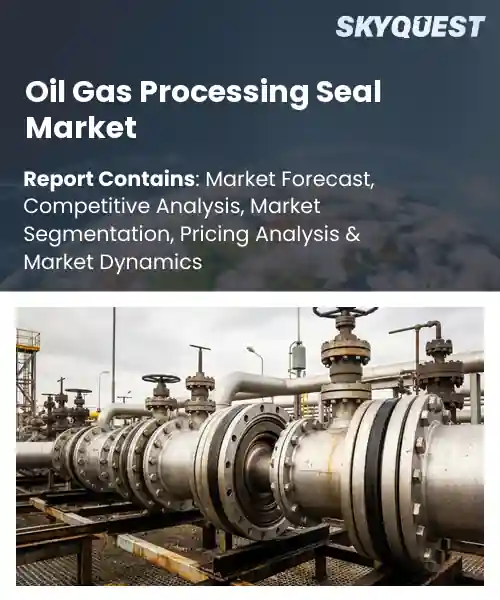
Oil Gas Processing Seal Market
Report ID: SQMIG20I2749
Report ID: SQMIG20I2749
[email protected]
USA +1 351-333-4748
Report ID:
SQMIG20I2749 |
Region:
Global |
Published Date: March, 2026
Pages:
157
|Tables:
125
|Figures:
77


Global Oil Gas Processing Seal Market size was valued at USD 6.0 Billion in 2024 and is poised to grow from USD 6.2 Billion in 2025 to USD 8.04 Billion by 2033, growing at a CAGR of 3.3% during the forecast period (2026-2033).
The primary driver of the global oil and gas processing seal market is the escalating demand for leak tight, reliable sealing solutions as operators pursue safer, more efficient hydrocarbon production. This market encompasses mechanical seals, elastomeric rings, metal to metal seals and subsea sealing systems used across upstream and midstream facilities, because sealing failures can halt production, pollute environments, and trigger regulatory penalties. Over decades industry evolved from rubber gaskets to engineered polymer composites and metallic seals certified to API standards, with examples such as subsea tree seals and high pressure compressor seals that enable deepwater and sour service operations.A central factor driving global oil and gas processing seal market growth is more complex operating environments that force operators to adopt advanced materials and integrated sealing designs to extend service life and cut unscheduled downtime. With fields moving to deeper water, higher pressures and sour chemistry, demand for corrosion resistant alloys, engineered elastomers and PTFE composites has risen and prompted manufacturers to intensify qualification testing and custom seal development. Consequently, aftermarket refurbishment, sensors for condition monitoring, and OEM partnerships to supply seals for LNG compressors, subsea trees and CO2 injection pumps have expanded, turning technical necessity into commercial opportunity.
How is IoT enhancing predictive maintenance for oil and gas processing seals?
IoT is enhancing predictive maintenance for oil and gas processing seals by turning seal condition into continuous actionable data. Key aspects include sensors that measure temperature pressure and vibration, edge analytics that flag anomalies, cloud platforms that store histories and machine learning that predicts failure modes. The current state is a move from calendar based maintenance to condition based strategies driven by digital services. Market demand favors aftermarket reliability solutions and pilots in pipelines and refineries make the case practical. Examples include EagleBurgmanns Smart Seal kit and John Crane Sense for remote monitoring which show how data driven upkeep reduces unplanned stops and targets service.John Crane September 2025, showcased John Crane Sense and remote seal monitoring which embeds IoT into service offerings and enables earlier detection of seal degradation. That development supports market growth by improving uptime reducing emergency interventions and making performance based service models more attractive.
Market snapshot - (2026-2033)
Global Market Size
USD 6.0 Billion
Largest Segment
Mechanical Seals
Fastest Growth
Magnetic Seals
Growth Rate
3.3% CAGR
To get more insights on this market click here to Request a Free Sample Report
Global oil gas processing seal market is segmented by seal type, material, application, processing segment and region. Based on seal type, the market is segmented into Mechanical Seals, Gaskets, Packing Seals, Magnetic Seals and Diaphragm Seals. Based on material, the market is segmented into Elastomers, Metals, Polymers, Ceramics, Seal Face Materials and Others. Based on application, the market is segmented into Oil and Gas Pipelines, Gas Compressors, Oil and Gas Storage Tanks, Heat Exchangers, Pumps and Others. Based on processing segment, the market is segmented into Upstream, Midstream and Downstream. Based on region, the market is segmented into North America, Europe, Asia Pacific, Latin America and Middle East & Africa.
Elastomers segment dominates because elastomeric materials deliver the flexibility and conformability required to seal irregular surfaces and compensate for dynamic movement in oil and gas processing equipment. Their chemical compatibility with hydrocarbons, resilience to compression set, and ability to maintain sealing force under thermal and pressure fluctuations reduce leak risk and equipment downtime. Ease of customization and cost effective manufacturing further drives widespread OEM and aftermarket adoption across diverse process applications.
However, polymers are emerging as the most rapidly expanding material class due to engineered polymer chemistries and reinforced composites that offer improved temperature stability, lower friction, and tailored chemical resistance for aggressive process streams. Adoption in lightweight retrofits and ongoing formulation innovation accelerates new applications and supplier investment.
Mechanical Seals segment dominates because they provide the robust face-to-face contact and pressure containment required in rotating equipment across oil and gas processing. Proven materials and configurable seal arrangements enable reliable operation under high shaft speeds, abrasive fluids, and variable pressures, which minimizes unplanned shutdowns. Established maintenance protocols, extensive supplier support, and compatibility with existing pump and compressor fleets further entrench their use as the default sealing choice in critical process equipment.
Meanwhile, magnetic seals are witnessing the strongest growth momentum as contactless solutions that reduce wear and eliminate lubricant leakage in compressor and pump applications. Advances in magnetic coupling and compatible materials, plus demand for zero-leakage systems, drive adoption. These innovations create retrofit opportunities and support tightening emissions and reliability requirements.
To get detailed segments analysis, Request a Free Sample Report
Asia Pacific dominates the global Oil Gas Processing Seal Market due to a concentrated nexus of upstream production, midstream processing and downstream refining and petrochemical activity that generates sustained demand for advanced sealing solutions. A strong regional manufacturing base produces specialized seal technologies, while close proximity to large equipment makers and service providers enables rapid application and iteration. Operational complexity in offshore platforms and LNG facilities drives demand for high performance materials and engineered sealing systems, and robust aftermarket ecosystems support maintenance and retrofitting. Regional suppliers combine material science capabilities with application engineering and export orientation, creating integrated supply chains that reduce time to market and enhance responsiveness. Policy focus on energy security and ongoing infrastructure investment further strengthen the role of Asia Pacific as the market leader for critical sealing technologies.
Oil Gas Processing Seal Market in Japan benefits from advanced manufacturing and precision engineering coupled with close collaboration between seal suppliers and major equipment makers. Focus on material science, stringent quality regimes and established maintenance practices supports demand for high integrity sealing solutions. Integration with petrochemical and LNG operations, emphasis on lifecycle service offerings and export orientation reinforce a resilient market defined by reliability and technical specialization and supplier expertise.
Oil Gas Processing Seal Market in South Korea is supported by strong shipbuilding and petrochemical sectors, prominent offshore activity and a network of specialized component manufacturers. Emphasis on compact, high performance sealing designs, rigorous testing protocols and close ties with industrial OEMs drive technical adoption. Robust aftermarket support, focus on material innovation and export orientation of suppliers enhance competitiveness, while integrated service offerings and collaborative R&D support depth and reliability.
North America has experienced rapid expansion in the Oil Gas Processing Seal Market driven by a combination of mature infrastructure renewal, extensive midstream networks and strong demand for reliability in complex processing environments. Operators prioritize asset integrity and uptime, prompting investments in advanced sealing technologies, condition monitoring integration and lifecycle service models. A dense ecosystem of equipment manufacturers, independent service companies and specialist seal suppliers accelerates technology adoption and custom engineering. Regulatory emphasis on safety and environmental performance increases scrutiny of sealing reliability, while active aftermarket and maintenance programs sustain demand for replacement components and retrofits. Local manufacturing capability and resilient supplier networks support quick turnarounds and tailored solutions, while strategic partnerships between operators and seal specialists foster continuous improvement and knowledge transfer.
Oil Gas Processing Seal Market in United States reflects mature processing and midstream sectors with strong focus on asset integrity and engineered sealing systems. Emphasis on uptime through maintenance increases demand for durable materials and condition monitoring integration. A supplier ecosystem of manufacturers and specialty seal firms enables customization and aftermarket support. Collaborative relationships between operators and seal providers drive material innovation, testing and comprehensive lifecycle services for complex operations.
Oil Gas Processing Seal Market in Canada is shaped by heavy hydrocarbon processing and offshore platforms, requiring seals engineered for durability and contamination resistance. Emphasis on environmental compliance and asset longevity increases demand for robust sealing materials and validated field solutions. Local service networks and specialty manufacturers deliver tailored designs, testing and aftermarket support. Collaboration with operators and focus on cold climate performance strengthen supply chain responsiveness and technical refinement.
Europe is strengthening its position in the Oil Gas Processing Seal Market through a combination of advanced engineering, stringent regulatory standards and a strong focus on lifecycle performance. Investment in material development, specialized sealing architectures and rigorous qualification practices enhances product reliability in demanding processing and offshore environments. European suppliers emphasize integrated service offerings, condition based maintenance and retrofit solutions for aging assets, creating sustained aftermarket demand. Collaboration among industrial conglomerates, specialist seal manufacturers and testing institutions accelerates technology transfer, while emphasis on environmental containment and operational safety positions Europe as a center for high integrity sealing solutions and best practice adoption. Growing adoption of digital condition monitoring and predictive maintenance tools complements material advances, enabling longer service intervals and targeted interventions. Harmonized certification frameworks and cross border supply chain collaboration support wider market penetration and facilitate export of European sealing expertise.
Oil Gas Processing Seal Market in Germany draws on precision manufacturing, materials science and tight integration with equipment makers. Commitment to engineering excellence, rigorous testing and certification supports demand for dependable sealing solutions. Suppliers pair metallurgical capability with advanced machining and quality control to address complex processing and offshore needs. Focus on clustered innovation and service oriented models enables customization and aftermarket support, reinforcing leadership in high integrity sealing applications.
Oil Gas Processing Seal Market in United Kingdom benefits from a strong engineering sector, legacy offshore activity and focus on retrofit and lifecycle projects. Specialist seal manufacturers and service providers deliver tailored solutions, rigorous qualification testing and condition monitoring integration. Emphasis on environmental containment and safety drives demand for certified sealing systems and comprehensive maintenance strategies. Collaborative industry networks and testing facilities support innovation, supplier capabilities and sustained aftermarket engagement.
Oil Gas Processing Seal Market in France is driven by a substantial petrochemical and industrial processing base, coupled with materials research and manufacturing. Suppliers emphasize validated sealing designs, contamination control and compliance with stringent environmental standards. Integrated service offerings, field testing capabilities and engineering consultancy support retrofits and ongoing optimizations. Close cooperation between manufacturers, operators and research institutions fosters innovation, export readiness and sustained demand for high performance sealing solutions.
To know more about the market opportunities by region and country, click here to
Buy The Complete Report
Increasing Demand For Enhanced Reliability
Stringent Environmental and Safety Regulations
Volatility In Raw Material Supply
High Costs Of Advanced Seals
Request Free Customization of this report to help us to meet your business objectives.
Competitive landscape in the global oil gas processing seal market is driven by incumbent consolidation, aftermarket channel control and product differentiation through low emission and digital solutions. Market leaders deploy acquisitions and exclusive distribution deals to secure spares and service revenue while investing in diagnostic-enabled seals and material innovation, for example John Crane’s expanded diagnostic offerings and sector distribution and service acquisitions.
Top Player’s Company Profile
Recent Developments
SkyQuest’s ABIRAW (Advanced Business Intelligence, Research & Analysis Wing) is our Business Information Services team that Collects, Collates, Correlates, and Analyses the Data collected by means of Primary Exploratory Research backed by robust Secondary Desk research. As per SkyQuest analysis, the global oil and gas processing seal market is driven primarily by escalating demand for leak-tight, reliable sealing solutions that reduce unplanned shutdowns and environmental risk and is further supported by rapid digitalization and adoption of predictive maintenance which enables condition-based servicing. Growth is restrained by volatility in raw material supply that disrupts manufacturing, increases lead times and limits availability of high-performance components. Asia Pacific dominates the market given its integrated upstream-to-downstream activity and strong manufacturing base, while elastomers remain the leading segment because of their flexibility, chemical compatibility and cost effectiveness. Together these dynamics favor aftermarket and engineering service expansion.
| Report Metric | Details |
|---|---|
| Market size value in 2024 | USD 6.0 Billion |
| Market size value in 2033 | USD 8.04 Billion |
| Growth Rate | 3.3% |
| Base year | 2024 |
| Forecast period | (2026-2033) |
| Forecast Unit (Value) | USD Billion |
| Segments covered |
|
| Regions covered | North America (US, Canada), Europe (Germany, France, United Kingdom, Italy, Spain, Rest of Europe), Asia Pacific (China, India, Japan, Rest of Asia-Pacific), Latin America (Brazil, Rest of Latin America), Middle East & Africa (South Africa, GCC Countries, Rest of MEA) |
| Companies covered |
|
| Customization scope | Free report customization with purchase. Customization includes:-
|
To get a free trial access to our platform which is a one stop solution for all your data requirements for quicker decision making. This platform allows you to compare markets, competitors who are prominent in the market, and mega trends that are influencing the dynamics in the market. Also, get access to detailed SkyQuest exclusive matrix.
Table Of Content
Executive Summary
Market overview
Parent Market Analysis
Market overview
Market size
KEY MARKET INSIGHTS
COVID IMPACT
MARKET DYNAMICS & OUTLOOK
Market Size by Region
KEY COMPANY PROFILES
Methodology
For the Oil Gas Processing Seal Market, our research methodology involved a mixture of primary and secondary data sources. Key steps involved in the research process are listed below:
1. Information Procurement: This stage involved the procurement of Market data or related information via primary and secondary sources. The various secondary sources used included various company websites, annual reports, trade databases, and paid databases such as Hoover's, Bloomberg Business, Factiva, and Avention. Our team did 45 primary interactions Globally which included several stakeholders such as manufacturers, customers, key opinion leaders, etc. Overall, information procurement was one of the most extensive stages in our research process.
2. Information Analysis: This step involved triangulation of data through bottom-up and top-down approaches to estimate and validate the total size and future estimate of the Oil Gas Processing Seal Market.
3. Report Formulation: The final step entailed the placement of data points in appropriate Market spaces in an attempt to deduce viable conclusions.
4. Validation & Publishing: Validation is the most important step in the process. Validation & re-validation via an intricately designed process helped us finalize data points to be used for final calculations. The final Market estimates and forecasts were then aligned and sent to our panel of industry experts for validation of data. Once the validation was done the report was sent to our Quality Assurance team to ensure adherence to style guides, consistency & design.
Analyst Support
Customization Options
With the given market data, our dedicated team of analysts can offer you the following customization options are available for the Oil Gas Processing Seal Market:
Product Analysis: Product matrix, which offers a detailed comparison of the product portfolio of companies.
Regional Analysis: Further analysis of the Oil Gas Processing Seal Market for additional countries.
Competitive Analysis: Detailed analysis and profiling of additional Market players & comparative analysis of competitive products.
Go to Market Strategy: Find the high-growth channels to invest your marketing efforts and increase your customer base.
Innovation Mapping: Identify racial solutions and innovation, connected to deep ecosystems of innovators, start-ups, academics, and strategic partners.
Category Intelligence: Customized intelligence that is relevant to their supply Markets will enable them to make smarter sourcing decisions and improve their category management.
Public Company Transcript Analysis: To improve the investment performance by generating new alpha and making better-informed decisions.
Social Media Listening: To analyze the conversations and trends happening not just around your brand, but around your industry as a whole, and use those insights to make better Marketing decisions.
REQUEST FOR SAMPLE
 REQUEST FREE CUSTOMIZATION


Want to customize this report? This report can be personalized according to your needs. Our analysts and industry experts will work directly with you to understand your requirements and provide you with customized data in a short amount of time. We offer $1000 worth of FREE customization at the time of purchase.
Feedback From Our Clients


 USA (+1) 351-333-4748

