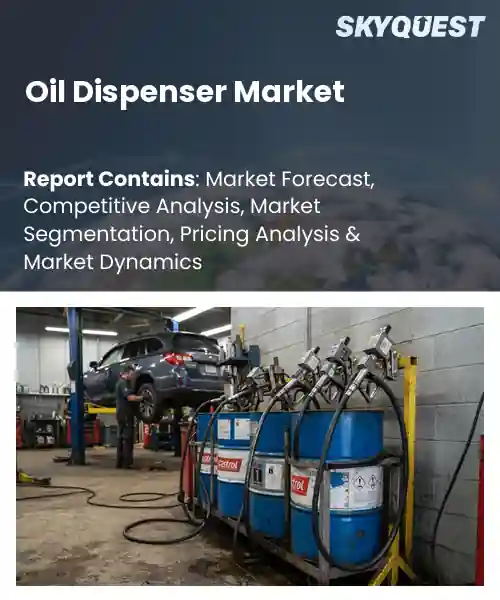
Oil Dispenser Market
Report ID: SQMIG20I3758
Report ID: SQMIG20I3758
[email protected]
USA +1 351-333-4748
Report ID:
SQMIG20I3758 |
Region:
Global |
Published Date: August, 2026
Pages:
157
|Tables:
90
|Figures:
76


Global Oil Dispenser Market size was valued at USD 487.3 Million in 2024 and is poised to grow from USD 513.61 Million in 2025 to USD 782.28 Million by 2033, growing at a CAGR of 5.4% during the forecast period (2026-2033).
The global oil dispenser market comprises devices that store, meter, and deliver lubricants, fuels, or edible oils to industrial, automotive, and retail customers. Its relevance stems from the need for volume control, safety compliance, and cost efficiency in sectors ranging from automotive service centers to food processing plants. Historically, the market emerged in the 1970s with mechanical pumps, evolved through the 1990s as electronic metering improved accuracy, and accelerated after 2010 as IoT connectivity enabled monitoring and maintenance. This evolution reflects the primary driver: demand for efficiency, which pushes manufacturers to embed sensors and analytics that reduce waste and labor. Beyond efficiency, smart connectivity drives the global oil dispenser market because it creates revenue from data services and predictive upkeep. When dispensers send real‑time flow data to cloud platforms, operators anticipate refill cycles, avoid stockouts, and adjust pricing based on usage, directly boosting margins for fuel stations and restaurant chains. Companies such as Gilbarco and Tokheim now offer subscription analytics dashboards, showing how data monetization fuels a feedback loop: deeper insights prompt equipment upgrades, which generate richer data. This cause‑and‑effect chain encourages expansion into emerging economies where logistics gaps make automated oil management especially valuable for local distributors and consumers.
How is IoT integration improving efficiency and data analytics in the oil dispenser market?
IoT integration is reshaping oil dispensers by linking each unit to a cloud platform that gathers usage data in real time. Sensors monitor flow rates, temperature, and inventory levels, enabling automatic alerts when refills are needed and reducing manual checks. This continuous data stream feeds analytics tools that identify patterns such as peak dispensing times and maintenance needs, allowing operators to fine‑tune schedules and cut downtime. The market is responding to these capabilities with smarter, connected dispensers that support remote management and predictive servicing, making the overall supply chain more responsive and cost‑effective.In March 2024, a leading oil dispenser manufacturer announced a new IoT‑enabled dispenser line, highlighting how real‑time monitoring and analytics improve operational efficiency and drive market growth.
Market snapshot - (2026-2033)
Global Market Size
USD 487.3 Million
Largest Segment
Single Compartment Sinks
Fastest Growth
Others
Growth Rate
5.4% CAGR
To get more insights on this market click here to Request a Free Sample Report
Global oil dispenser market is segmented by product type, capacity, application and region. Based on product type, the market is segmented into Manual Oil Dispensers and Automatic Oil Dispensers. Based on capacity, the market is segmented into Small Capacity, Medium Capacity and Large Capacity. Based on application, the market is segmented into Automotive, Industrial, Foodservice and Household. Based on region, the market is segmented into North America, Europe, Asia Pacific, Latin America and Middle East & Africa.
Manual Oil Dispensers segment dominates because its straightforward design aligns with cost‑sensitive buyers who prioritize reliability over sophistication. The absence of complex electronics reduces maintenance requirements, which appeals to small workshops and home users alike. Simplicity also shortens training time, encouraging widespread adoption across diverse settings. This ease of use builds trust, driving repeat purchases and sustaining the segment’s leading position within the oil dispenser market.
However, Automatic Oil Dispensers segment is witnessing the strongest growth momentum as integrated sensors and dispensing precision meet rising expectations for hygiene and consistency. Advances in battery technology enable portable units, while connectivity features support data analytics for inventory control. This innovation fuels demand expansion and opens opportunities across commercial environments.
Automotive application segment leads because vehicle owners and service centers require regular lubrication for engine performance and longevity. The high frequency of oil changes creates a steady consumption pattern, prompting manufacturers to prioritize dispensers tailored for quick, precise delivery in garages and dealerships. Compatibility with commonly used engine oils and rugged design further cement its appeal, ensuring that automotive needs continuously drive core market volume and product development focus.
Meanwhile, Industrial application segment emerges as the key high growth area as factories adopt preventive maintenance regimes to minimize equipment downtime. The need for bulk capacity dispensers that can handle diverse lubricants drives innovation in robust, high throughput designs. This shift expands market reach into heavy machinery environments, creating fresh revenue streams and accelerating overall market expansion.
To get detailed segments analysis, Request a Free Sample Report
North America dominates due to a mature fuel retail infrastructure, strong investment in automation, and leading technology providers that set global standards. The region benefits from high consumer demand for convenient self‑service fueling and a regulatory environment that encourages safety and efficiency. Robust supply chains ensure reliable component availability, while extensive refinery capacity supports stable product flow to dispensers. Industry collaborations foster continuous innovation in metering accuracy and digital integration, reinforcing North American leadership. Additionally, the presence of major oil companies and large‑scale service stations creates economies of scale that lower cost and accelerate adoption across the market.
Oil Dispenser Market in United States reflects a sophisticated network of high‑traffic stations that prioritize precision and speed. Advanced telemetry solutions enable real‑time monitoring, while widespread adoption of contactless payment aligns with consumer expectations. Strong support from leading equipment manufacturers drives ongoing enhancements in safety features. The market also benefits from extensive training programs that ensure operational excellence and compliance with stringent environmental guidelines.
Oil Dispenser Market in Canada is characterized by a focus on reliability in remote and northern locations where fuel access is critical. Emphasis on rugged design and low‑temperature performance ensures functionality under harsh conditions. Integration of renewable fuel options supports national sustainability goals, while collaborative efforts with provincial regulators promote standards that balance safety and environmental stewardship. Market participants leverage cross‑border expertise to introduce innovative dispensing technologies.
Europe’s oil dispenser landscape is propelled by stringent environmental legislation and a consumer shift toward cleaner fueling options. Governments encourage adoption of low‑emission fuels, prompting stations to upgrade dispensing systems for higher accuracy and reduced leakage. Digitalization initiatives foster connectivity, allowing operators to optimize inventory and enhance user experiences through smart interfaces. Strong engineering heritage across the continent supports the development of high‑precision metering devices, while collaborative research programs accelerate integration of alternative fuel dispensers. The combined effect of regulatory push and technological readiness fuels the rapid expansion observed throughout European markets.
Oil Dispenser Market in Germany benefits from a deep engineering base that produces highly accurate metering equipment. The market emphasizes compliance with rigorous safety standards, driving continuous refinement of nozzle designs and leak‑prevention mechanisms. Integration of advanced data analytics enables operators to manage fuel quality and inventory efficiently. Collaboration between automotive manufacturers and dispenser suppliers fosters innovative solutions tailored to emerging fuel types, reinforcing Germany’s dominant position in the European sector.
Oil Dispenser Market in United Kingdom experiences accelerated growth through widespread adoption of smart fueling technologies. Consumer demand for seamless payment experiences encourages deployment of contactless and mobile‑app interfaces. Regulatory focus on emissions reduction drives stations to incorporate multi‑fuel dispensers capable of handling low‑carbon options. Industry alliances promote rapid rollout of standardized safety protocols, while investment in digital infrastructure supports real‑time monitoring and predictive maintenance, positioning the United Kingdom as a fast‑growing market within Europe.
Oil Dispenser Market in France is emerging alongside national initiatives promoting alternative fuels and energy efficiency. Early‑stage projects test hybrid dispenser systems that accommodate bio‑fuels alongside conventional petroleum. Emphasis on user‑friendly interfaces aligns with French consumer expectations for convenience. Collaborative efforts between government agencies and technology firms aim to standardize safety and environmental criteria, fostering a supportive environment for market entrants. This emerging focus lays the groundwork for sustained expansion in the French dispensing sector.
Asia Pacific advances its role by leveraging rapid urbanization and a burgeoning network of modern fuel stations that prioritize automation. Regional manufacturers invest heavily in research to produce compact, high‑efficiency dispensers suited to dense market environments. Adoption of digital payment platforms and mobile integration responds to tech‑savvy consumer preferences, while government incentives for cleaner fuel distribution encourage diversification of dispensing capabilities. Cross‑border collaboration among leading Asian firms accelerates technology transfer, ensuring that innovations in metering accuracy and safety quickly reach the market. Together, these dynamics reinforce Asia Pacific’s growing significance in the global oil dispenser arena.
Oil Dispenser Market in Japan emphasizes precision engineering and compact design to fit limited station footprints. Integration of advanced sensor technology enhances accuracy and reduces emissions, aligning with strict environmental standards. Widespread use of electronic payment solutions reflects consumer expectation for seamless transactions. Collaborative research between automotive and dispenser manufacturers drives development of systems compatible with emerging fuel types, supporting Japan’s leadership in high‑quality dispensing solutions.
Oil Dispenser Market in South Korea focuses on rapid adoption of smart fueling infrastructure that blends connectivity with user convenience. High penetration of mobile payment platforms encourages stations to implement touchless dispensers. Domestic manufacturers prioritize innovation in leak‑detection and energy‑efficient operation, meeting rigorous regulatory expectations. Partnerships with technology firms accelerate the rollout of integrated monitoring systems, positioning South Korea as a dynamic contributor to the broader Asia Pacific oil dispenser landscape.
To know more about the market opportunities by region and country, click here to
Buy The Complete Report
Increasing Demand for Automated Fueling
Adoption of Contactless Payment Systems
Stringent Environmental Regulations
High Capital Expenditure for Upgrades
Request Free Customization of this report to help us to meet your business objectives.
I don’t have enough information to generate the requested Competitive Landscape section.
Top Player’s Company Profile
Recent Developments
SkyQuest’s ABIRAW (Advanced Business Intelligence, Research & Analysis Wing) is our Business Information Services team that Collects, Collates, Correlates, and Analyses the Data collected by means of Primary Exploratory Research backed by robust Secondary Desk research. As per SkyQuest analysis the global oil dispenser market is projected to reach $782.3 million by 2033, driven primarily by the rising demand for automated fueling that leverages IoT sensors and remote monitoring to cut wait times and improve safety. A second catalyst is the rapid adoption of contactless payment systems, which streamline transactions and boost station throughput. The market’s main restraint comes from increasingly stringent environmental regulations that raise compliance costs and slow equipment upgrades. North America remains the dominant region thanks to its mature fuel‑retail infrastructure and strong technology providers, while manual oil dispensers continue to hold the largest share due to their cost‑effective, reliable design.
| Report Metric | Details |
|---|---|
| Market size value in 2024 | USD 487.3 Million |
| Market size value in 2033 | USD 782.28 Million |
| Growth Rate | 5.4% |
| Base year | 2024 |
| Forecast period | (2026-2033) |
| Forecast Unit (Value) | USD Million |
| Segments covered |
|
| Regions covered | North America (US, Canada), Europe (Germany, France, United Kingdom, Italy, Spain, Rest of Europe), Asia Pacific (China, India, Japan, Rest of Asia-Pacific), Latin America (Brazil, Rest of Latin America), Middle East & Africa (South Africa, GCC Countries, Rest of MEA) |
| Companies covered |
|
| Customization scope | Free report customization with purchase. Customization includes:-
|
To get a free trial access to our platform which is a one stop solution for all your data requirements for quicker decision making. This platform allows you to compare markets, competitors who are prominent in the market, and mega trends that are influencing the dynamics in the market. Also, get access to detailed SkyQuest exclusive matrix.
Table Of Content
Executive Summary
Market overview
Parent Market Analysis
Market overview
Market size
KEY MARKET INSIGHTS
COVID IMPACT
MARKET DYNAMICS & OUTLOOK
Market Size by Region
KEY COMPANY PROFILES
Methodology
For the Oil Dispenser Market, our research methodology involved a mixture of primary and secondary data sources. Key steps involved in the research process are listed below:
1. Information Procurement: This stage involved the procurement of Market data or related information via primary and secondary sources. The various secondary sources used included various company websites, annual reports, trade databases, and paid databases such as Hoover's, Bloomberg Business, Factiva, and Avention. Our team did 45 primary interactions Globally which included several stakeholders such as manufacturers, customers, key opinion leaders, etc. Overall, information procurement was one of the most extensive stages in our research process.
2. Information Analysis: This step involved triangulation of data through bottom-up and top-down approaches to estimate and validate the total size and future estimate of the Oil Dispenser Market.
3. Report Formulation: The final step entailed the placement of data points in appropriate Market spaces in an attempt to deduce viable conclusions.
4. Validation & Publishing: Validation is the most important step in the process. Validation & re-validation via an intricately designed process helped us finalize data points to be used for final calculations. The final Market estimates and forecasts were then aligned and sent to our panel of industry experts for validation of data. Once the validation was done the report was sent to our Quality Assurance team to ensure adherence to style guides, consistency & design.
Analyst Support
Customization Options
With the given market data, our dedicated team of analysts can offer you the following customization options are available for the Oil Dispenser Market:
Product Analysis: Product matrix, which offers a detailed comparison of the product portfolio of companies.
Regional Analysis: Further analysis of the Oil Dispenser Market for additional countries.
Competitive Analysis: Detailed analysis and profiling of additional Market players & comparative analysis of competitive products.
Go to Market Strategy: Find the high-growth channels to invest your marketing efforts and increase your customer base.
Innovation Mapping: Identify racial solutions and innovation, connected to deep ecosystems of innovators, start-ups, academics, and strategic partners.
Category Intelligence: Customized intelligence that is relevant to their supply Markets will enable them to make smarter sourcing decisions and improve their category management.
Public Company Transcript Analysis: To improve the investment performance by generating new alpha and making better-informed decisions.
Social Media Listening: To analyze the conversations and trends happening not just around your brand, but around your industry as a whole, and use those insights to make better Marketing decisions.
REQUEST FOR SAMPLE
 REQUEST FREE CUSTOMIZATION


Want to customize this report? This report can be personalized according to your needs. Our analysts and industry experts will work directly with you to understand your requirements and provide you with customized data in a short amount of time. We offer $1000 worth of FREE customization at the time of purchase.
Feedback From Our Clients


 USA (+1) 351-333-4748

