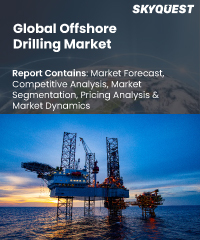
Offshore Drilling Market
Report ID: SQMIG10D2055
Report ID: SQMIG10D2055
[email protected]
USA +1 351-333-4748
Report ID:
SQMIG10D2055 |
Region:
Global |
Published Date: August, 2025
Pages:
189
|Tables:
63
|Figures:
74


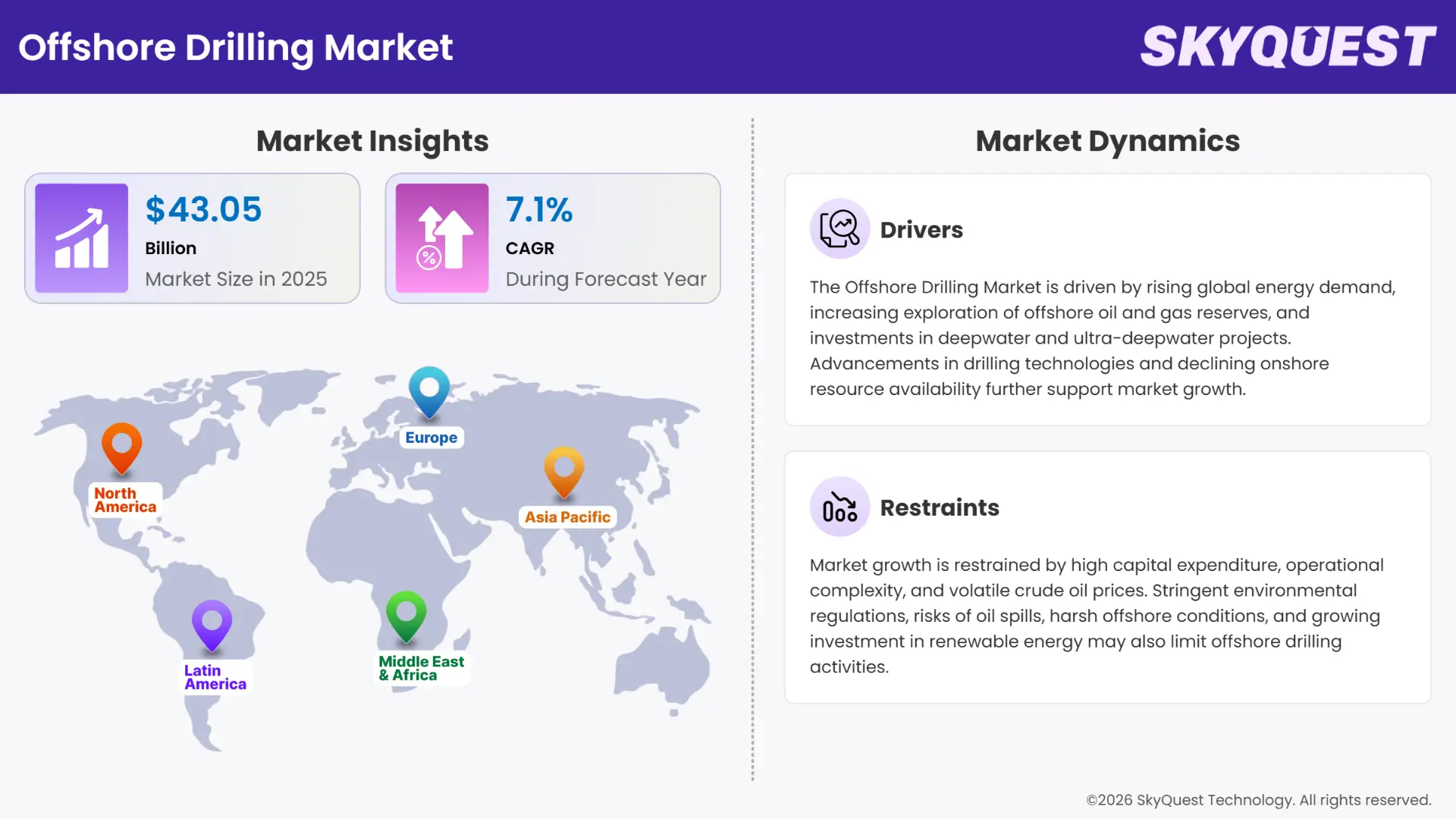
Global Offshore Drilling Market size was valued at USD 40.2 Billion in 2024 and is poised to grow from USD 43.05 Billion in 2025 to USD 74.53 Billion by 2033, growing at a CAGR of 7.1% during the forecast period (2026–2033).
Key Takeaways: Market Trends & Insights
Surge in demand for energy around the world, maturing onshore reserves, innovations in drilling technologies, launch of new deepwater projects, and launch of new licensing rounds by governments to promote offshore exploration are driving up the demand for offshore drilling in the future. With rising global population and rapid industrialization, energy demand continues to surge, which in turn is expected to bolster the adoption of offshore drilling going forward. As onshore oil and gas reserves face depletion or declining output, energy companies are increasingly turning to offshore fields to maintain production levels. Modern rigs now operate in ultra-deepwater and high-pressure environments once deemed too risky or costly.
Technologies like managed pressure drilling (MPD) and digital twins allow real-time decision-making and predictive maintenance. Countries like Brazil, India, Norway, and Mexico offer favorable licensing rounds, tax benefits, and reduced regulatory barriers. Growing demand and geological limitations of shallow water sites are pushing the offshore industry toward deepwater and ultra-deepwater exploration thereby furthering offshore drilling market growth. On the contrary, high operational costs, stringent environmental regulations, volatility in oil and gas prices, and rising adoption of renewable energy resources are slated to slow down the global offshore drilling market penetration across the forecast period and beyond.
What is the Impact of Automation and Digitization Technologies on Offshore Drilling?
Offshore drilling is undergoing rapid digital transformation through technologies like AI, IoT, predictive analytics, and real-time data monitoring. Operators are deploying automated drilling systems, digital twins, and cloud-based platforms to improve operational efficiency, reduce downtime, and enhance safety. Remote rig management and robotics help reduce human error and lower manpower costs. Predictive maintenance minimizes equipment failures and non-productive time (NPT). Major oilfield service companies are investing in smart rigs with integrated sensors and AI-driven controls. This digital shift supports cost reduction and decision-making, enabling real-time optimization of drilling operations, especially in complex and high-risk offshore environments like deepwater and Arctic zones.
To get more insights on this market click here to Request a Free Sample Report
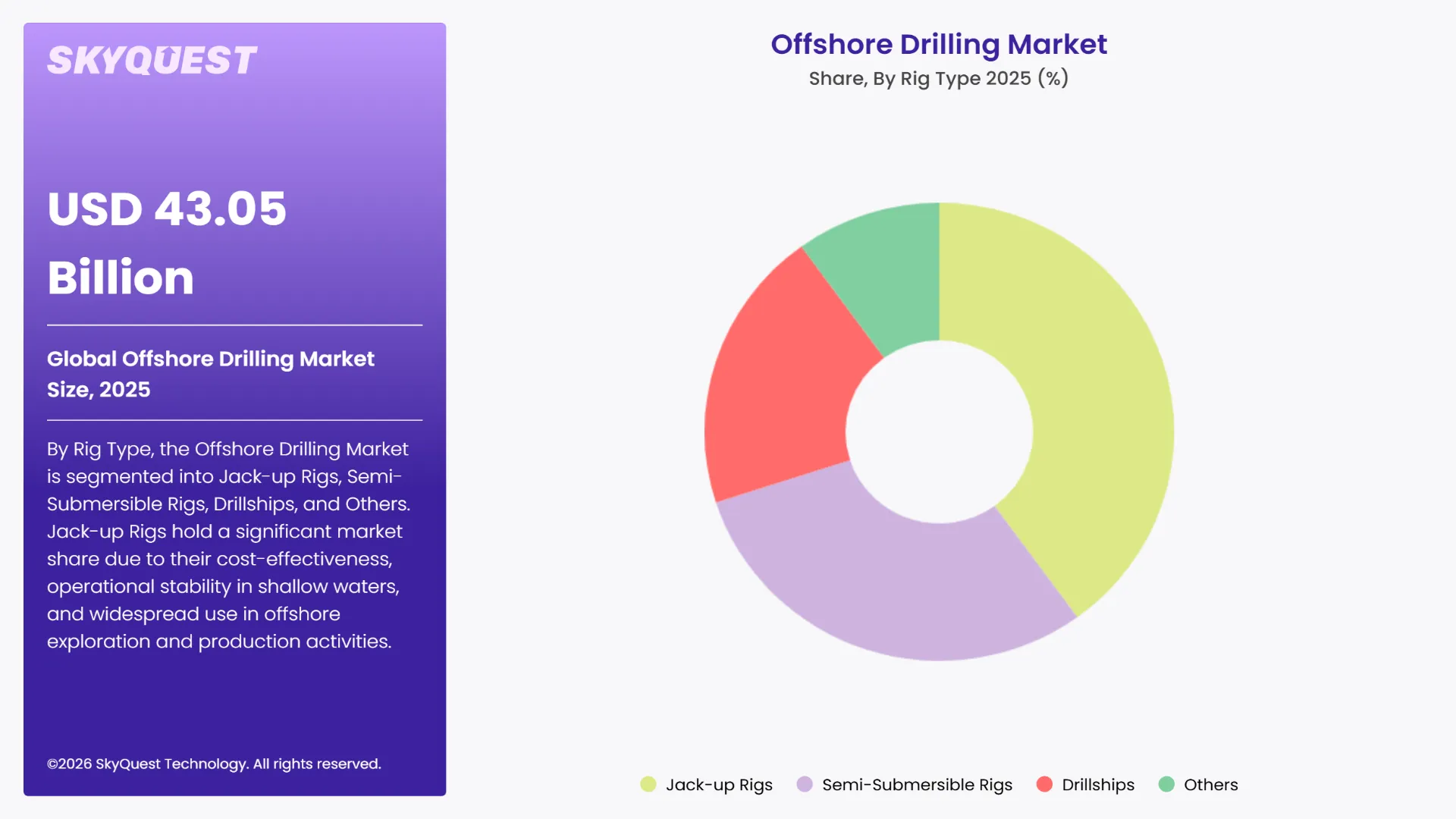
The global offshore drilling market is segmented by rig type, water depth, and region. Based on rig type, the market is segmented into drillships, semisubmersibles, and jackups. Based on water depth, the market is segmented into shallow water, deepwater, and ultra-deepwater. Based on region, the market is segmented into North America, Europe, Asia Pacific, Latin America, and Middle East & Africa.
The shallow water segment is forecasted to spearhead the global offshore drilling market revenue generation in the future. Low operational costs and reduced technical complexity of shallow water drilling is expected to help bolster the dominance of this segment. Operators prefer shallow water projects for their faster returns and lower risk, making them a staple for national oil companies and independent producers. Meanwhile, the ultra-deepwater segment is slated to rise at a robust pace in the global offshore drilling industry through 2032. Rising investments in exploring previously unreachable hydrocarbon reserves in areas is helping create new business scope via this segment. As conventional reserves decline, global energy players are increasingly targeting ultra-deepwater fields to meet future demand.
The jackups segment is forecasted to hold the highest global offshore drilling market share going forward. Ease of mobility and suitability for exploration and development drilling offered by jackup rigs is helping them hold sway over other segments. Their consistent demand across mature offshore fields has helped maintain their leading position in the global offshore drilling landscape. On the other hand, the demand for drillships is slated to rise at an impressive CAGR over the coming years. Growing investments in deepwater and ultra-deepwater explorations in regions such as Brazil, the Gulf of Mexico, and West Africa are driving up the sales of drillships.
To get detailed segments analysis, Request a Free Sample Report
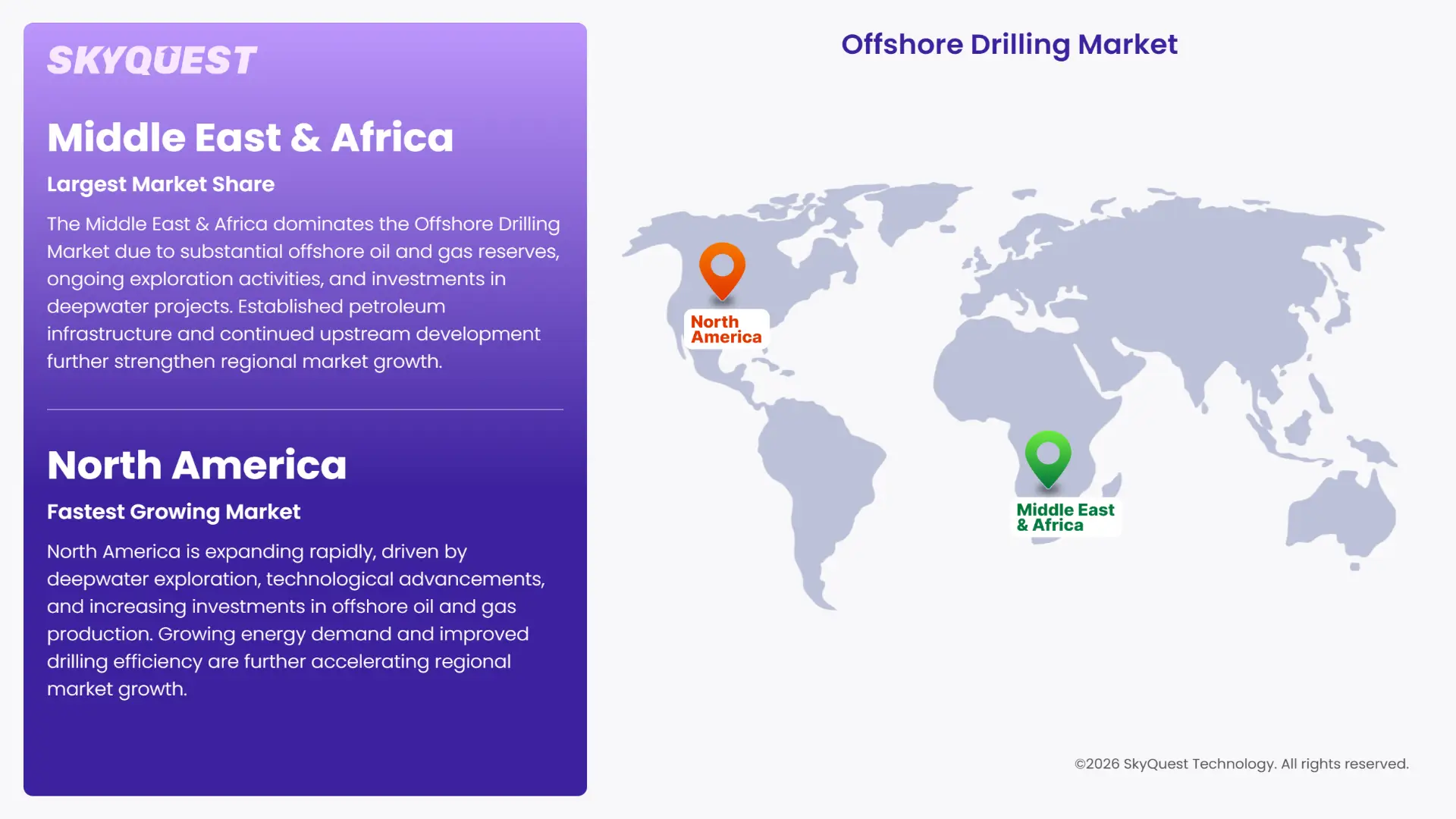
The presence of a developed oil & gas industry and prolific offshore reserves in the Gulf of Mexico are helping this region lead global offshore drilling adoption. High investments from major oil & gas companies in new offshore projects and stable regulatory frameworks are helping bolster the dominance of this region. Surge in demand for energy and emphasis on improving energy independence is also slated to boost the sales of offshore drilling solutions in North America through 2032 and beyond.
Offshore Drilling Market in United States
The United States has emerged as a leader in offshore drilling adoption owing to the presence of the Gulf of Mexico, which hosts major deepwater and ultra-deepwater operations by Chevron, Shell, and ExxonMobil. Political backing for leasing rounds under the Outer Continental Shelf program sustains exploration momentum. Despite environmental opposition, the country’s offshore sector remains robust, supported by innovation, established supply chains, and a skilled workforce.
Offshore Drilling Market in Canada
The majority of offshore drilling activity in the country is focused in Jeanne d’Arc and Flemish Pass basins. The presence of robust deepwater reserves in the country is attracting offshore drilling companies such as Equinor, ExxonMobil, and Suncor to invest in this region. The government supports development of winter resilient offshore drilling rigs through tax incentives and exploration licenses to boost energy security. Canada's offshore prospects remain promising due to significant untapped potential, especially in frontier regions through 2032 and beyond.
Growing energy consumption, boom in industrialization, and high investments in exploration of offshore reserves are making Asia Pacific the fastest-expanding region for offshore drilling companies. Development of Exclusive Economic Zones (EEZs) to boost energy self-sufficiency in countries such as India, China, Indonesia, and Malaysia is also slated to drive up the adoption of offshore drilling in the future. As demand for oil and gas surges across Southeast Asia, offshore drilling becomes a crucial pillar of regional energy security and economic resilience.
Offshore Drilling Market in Japan
Japan is home to a limited offshore drilling industry which has the potential for steady growth in the future. Regional resource exploration ambitions and government emphasis on reducing energy import dependency are driving up the demand for offshore drilling solutions in the country. The Japan Oil, Gas and Metals National Corporation (JOGMEC) leads initiatives to develop marine energy technologies and partner with international firms. Environmental sensitivities and seismic risks are major bottlenecks for widespread offshore drilling adoption in Japan.
Offshore Drilling Market in South Korea
Majority of offshore drilling activity in South Korea is focused on natural gas exploration in the East Sea State-run Korea National Oil Corporation (KNOC) spearheads exploration projects and collaborates with foreign firms for technical expertise. High reliance of the country on energy imports is prompting investments in developing domestic offshore energy sources to reduce dependency. Accelerated investments in unexplored offshore blocks and adjacent maritime zones are also slated to bolster the adoption of offshore drilling in the country.
High emphasis on improving energy security and availability of existing drilling infrastructure is steadily influencing the demand for offshore drilling in Europe. The EU’s push for sustainable energy balances traditional drilling with environmental standards. The region’s strategic reserves, stable policies, and hybrid energy approach are also helping it create new business scope for offshore drilling companies across the study period and beyond.
Offshore Drilling Market in United Kingdom
The country’s energy transition plan balances oil and gas extraction with renewable energy development, ensuring sustained demand for offshore drilling going forward. Government initiatives like the North Sea Transition Deal promote decarbonization while retaining offshore capability. While production is declining, the United Kingdom still ranks among Europe's top offshore producers, which is expected to help boost offshore drilling demand in the future.
Offshore Drilling Market in Germany
Germany’s expertise in offshore oilfield services and subsea equipment through engineering firms makes it a key name in offshore drilling equipment supply chain despite not being a major offshore oil producer. Environmental regulations and a strong renewable energy agenda limit hydrocarbon exploration. The country’s offshore energy focus is on wind farms rather than fossil fuels. Domestic offshore drilling potential is limited due to politically sensitive nature and stringent environmental controls.
Offshore Drilling Market in France
Offshore drilling in France is mostly limited to overseas territories such as French Guiana and offshore Africa. Environmental policies and EU regulations discourage fossil fuel exploration on mainland France, which has hampered the adoption of offshore drilling solutions in the country. France’s expertise in engineering services, subsea technologies, and maritime logistics is expected to play a crucial role in shaping up the adoption of offshore drilling in the European region in the future.
To know more about the market opportunities by region and country, click here to
Buy The Complete Report
Maturing of Onshore Oilfields and Reserves
Surge in Crude Oil Prices
Growing Momentum of Renewable Energy Transition
Stringent Environmental and Safety Regulations
Request Free Customization of this report to help us to meet your business objectives.
Offshore drilling providers should focus on targeting countries launching new licensing rounds to expand their business scope in the long run. Collaborating with government-backed oil and gas organizations can also be highly rewarding for offshore drilling companies going forward. Developing economies are slated to emerge as highly opportune markets as per this offshore drilling market analysis in the future.
High Investments in Deepwater and Ultra-Deepwater Exploration
Integration of Carbon Reduction and Sustainability Measures
SkyQuest’s ABIRAW (Advanced Business Intelligence, Research & Analysis Wing) is our Business Information Services team that Collects, Collates, Correlates, and Analyses the Data collected by means of Primary Exploratory Research backed by robust Secondary Desk research.
As per SkyQuest analysis, growing oil and gas exploration activity and launch of new licensing rounds are slated to primarily drive the demand for offshore drilling going forward. However, high initial investment requirements and environmental regulations are anticipated to slow down the adoption of offshore drilling operations in the future. North America is slated to emerge as the dominant region owing to extensive offshore activities, especially in the Gulf of Mexico, United States. Integration of carbon reduction measures and high investments in deepwater exploration is slated to create new business scope for offshore drilling companies in the long run.
| Report Metric | Details |
|---|---|
| Market size value in 2024 | USD 40.2 Billion |
| Market size value in 2033 | USD 74.53 Billion |
| Growth Rate | 7.1% |
| Base year | 2024 |
| Forecast period | 2026–2033 |
| Forecast Unit (Value) | USD Billion |
| Segments covered |
|
| Regions covered | North America (US, Canada), Europe (Germany, France, United Kingdom, Italy, Spain, Rest of Europe), Asia Pacific (China, India, Japan, Rest of Asia-Pacific), Latin America (Brazil, Rest of Latin America), Middle East & Africa (South Africa, GCC Countries, Rest of MEA) |
| Companies covered |
|
| Customization scope | Free report customization with purchase. Customization includes:-
|
To get a free trial access to our platform which is a one stop solution for all your data requirements for quicker decision making. This platform allows you to compare markets, competitors who are prominent in the market, and mega trends that are influencing the dynamics in the market. Also, get access to detailed SkyQuest exclusive matrix.
Table Of Content
Executive Summary
Market overview
Parent Market Analysis
Market overview
Market size
KEY MARKET INSIGHTS
COVID IMPACT
MARKET DYNAMICS & OUTLOOK
Market Size by Region
KEY COMPANY PROFILES
Methodology
For the Offshore Drilling Market, our research methodology involved a mixture of primary and secondary data sources. Key steps involved in the research process are listed below:
1. Information Procurement: This stage involved the procurement of Market data or related information via primary and secondary sources. The various secondary sources used included various company websites, annual reports, trade databases, and paid databases such as Hoover's, Bloomberg Business, Factiva, and Avention. Our team did 45 primary interactions Globally which included several stakeholders such as manufacturers, customers, key opinion leaders, etc. Overall, information procurement was one of the most extensive stages in our research process.
2. Information Analysis: This step involved triangulation of data through bottom-up and top-down approaches to estimate and validate the total size and future estimate of the Offshore Drilling Market.
3. Report Formulation: The final step entailed the placement of data points in appropriate Market spaces in an attempt to deduce viable conclusions.
4. Validation & Publishing: Validation is the most important step in the process. Validation & re-validation via an intricately designed process helped us finalize data points to be used for final calculations. The final Market estimates and forecasts were then aligned and sent to our panel of industry experts for validation of data. Once the validation was done the report was sent to our Quality Assurance team to ensure adherence to style guides, consistency & design.
Analyst Support
Customization Options
With the given market data, our dedicated team of analysts can offer you the following customization options are available for the Offshore Drilling Market:
Product Analysis: Product matrix, which offers a detailed comparison of the product portfolio of companies.
Regional Analysis: Further analysis of the Offshore Drilling Market for additional countries.
Competitive Analysis: Detailed analysis and profiling of additional Market players & comparative analysis of competitive products.
Go to Market Strategy: Find the high-growth channels to invest your marketing efforts and increase your customer base.
Innovation Mapping: Identify racial solutions and innovation, connected to deep ecosystems of innovators, start-ups, academics, and strategic partners.
Category Intelligence: Customized intelligence that is relevant to their supply Markets will enable them to make smarter sourcing decisions and improve their category management.
Public Company Transcript Analysis: To improve the investment performance by generating new alpha and making better-informed decisions.
Social Media Listening: To analyze the conversations and trends happening not just around your brand, but around your industry as a whole, and use those insights to make better Marketing decisions.
REQUEST FOR SAMPLE
 REQUEST FREE CUSTOMIZATION
Global Offshore Drilling Market size was valued at USD 40.2 Billion in 2024 and is poised to grow from USD 43.05 Billion in 2025 to USD 74.53 Billion by 2033, growing at a CAGR of 7.1% during the forecast period (2026–2033).
The key vendors in the Offshore Drilling Market include Transocean Ltd., Valaris Limited, Noble Corporation plc, Seadrill Limited, China Oilfield Services Limited, Borr Drilling Limited, Shelf Drilling Ltd., Saipem S.p.A., Diamond Offshore Drilling, Inc., and COSL. These companies provide offshore drilling rigs, deepwater drilling services, and specialized solutions for oil and gas exploration and production.
The key driver of the Offshore Drilling Market is rising global energy demand and the need to access untapped offshore oil and gas reserves. Increasing investments in deepwater and ultra-deepwater exploration, alongside declining onshore resource availability, further support market growth.
The key market trend in the Offshore Drilling Market is the growing adoption of advanced drilling technologies, automation, and digital monitoring systems. Operators are investing in high-efficiency rigs, real-time data analytics, and deepwater exploration capabilities to improve operational safety, reduce costs, and enhance drilling performance.
Middle East & Africa accounted for the largest share of the Offshore Drilling Market, supported by substantial offshore oil and gas reserves, ongoing exploration activities, and investments in deepwater projects. Strong energy demand, established petroleum infrastructure, and continued upstream development further strengthen the region’s market position.


Want to customize this report? This report can be personalized according to your needs. Our analysts and industry experts will work directly with you to understand your requirements and provide you with customized data in a short amount of time. We offer $1000 worth of FREE customization at the time of purchase.
Feedback From Our Clients


 USA (+1) 351-333-4748

