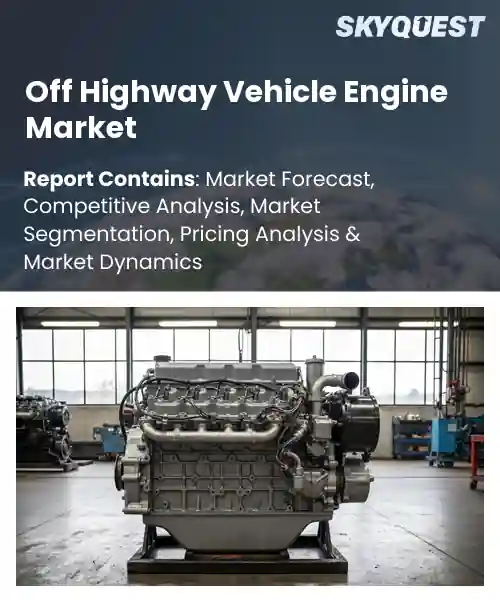
Off Highway Vehicle Engine Market
Report ID: SQMIG20I3067
Report ID: SQMIG20I3067
[email protected]
USA +1 351-333-4748
Report ID:
SQMIG20I3067 |
Region:
Global |
Published Date: June, 2026
Pages:
157
|Tables:
116
|Figures:
77


Global Off Highway Vehicle Engine Market size was valued at USD 0.171 Billion in 2024 and is poised to grow from USD 0.18 Billion in 2025 to USD 0.29 Billion by 2033, growing at a CAGR of 6.2% during the forecast period (2026-2033).
Off highway vehicle engines power machinery used in construction, agriculture, mining and forestry, the market encompasses manufacturers, component suppliers and aftermarket services for diesel, gas and increasingly hybrid powertrains. The primary driver has been global infrastructure and mechanization demand which created predictable replacement cycles and fleet expansion in emerging economies such as China and India while mature markets focus on productivity upgrades. Over decades the industry evolved from low emission diesel units to electronically managed common rail systems and turbocharged engine architectures, with firms as Caterpillar, John Deere and Komatsu driving innovation and integrating emissions aftertreatment to meet tightening standards. Tightening emissions standards are a catalyst that forces original equipment manufacturers and suppliers to adopt cleaner combustion, aftertreatment and alternative powertrains, which in turn raises spending and opens opportunities for providers. As a result, demand for selective catalytic reduction systems, diesel particulate filters and common rail control modules has surged and fleet operators face higher acquisition costs and lower operating emissions and fuel consumption. This dynamic creates growth in retrofits and maintenance services and growth in electrified and dual fuel use cases, for example Stage V compliant excavators in Europe and LNG powered haul trucks in large mining operations worldwide.
How is AI optimizing emissions and efficiency in the off-highway vehicle engine market?
AI is optimizing the emissions and efficiency in the off highway vehicle engine industry by linking sensor data, machine learning and edge computing to smarter engine control and fleet management. Key aspects include predictive maintenance that keeps engines in optimal condition, adaptive control of fuel and aftertreatment systems, and operator assistance that reduces idle time and misuse. The market is seeing wider integration of telematics and AI into engine calibration and service workflows as manufacturers respond to stricter emissions expectations and pressure to lower operating costs. Real world instances include AI guided calibration, real time aftertreatment management and workload aware power delivery that match engine output to actual job needs.
Caterpillar in January 2026, unveiled Cat AI Assistant which connects Helios platform data to in cab and off board workflows to enable predictive maintenance and smarter engine control, supporting lower emissions and improved fuel efficiency across jobsites and speeding adoption of AI driven engine solutions.
Market snapshot - (2026-2033)
Global Market Size
USD 0.171 Billion
Largest Segment
100 HP to 500 HP
Fastest Growth
Under 100 HP
Growth Rate
6.2% CAGR
To get more insights on this market click here to Request a Free Sample Report
Global off highway vehicle engine market is segmented by power output capacity, fuel technology platform, target machinery application, distribution channel and region. Based on power output capacity, the market is segmented into Under 100 HP, 100 HP to 500 HP and Above 500 HP. Based on fuel technology platform, the market is segmented into Conventional Diesel Engines, Alternately Fueled Engines and Electric & Hybrid Powertrains. Based on target machinery application, the market is segmented into Agricultural Equipment, Construction & Earthmoving Equipment and Mining & Heavy Extraction Machinery. Based on distribution channel, the market is segmented into Direct OEM Supply and Indirect Aftermarket Networks. Based on region, the market is segmented into North America, Europe, Asia Pacific, Latin America and Middle East & Africa.
Conventional diesel engines segment dominates with large off highway vehicle engine market share because established reliability, high energy density, and broad compatibility with heavy duty applications anchor OEM and operator preferences in the off highway engine market. Proven service networks and familiar maintenance practices lower operational risk and total lifecycle cost, encouraging design in by machine builders. Mature development and infrastructure also deliver torque and durability suited to continuous heavy load cycles, reinforcing incumbent leadership.
As per off highway vehicle engine market outlook, electric & hybrid powertrains are the fastest growing area driven by advances in battery integration, stricter emissions expectations, and operator interest in lower operating costs. Electrification enables quieter operation and duty cycle optimization, expanding eligible applications and catalyzing new service and retrofit opportunities that accelerate market transformation across off highway engines.
As per off highway vehicle engine market forecast, direct OEM supply segment is the largest because OEM's like to buy their Powertrains from one source in order to ensure that the designs work together, that the performance of each component can be validated, and that the warranty will match those of other components found on machines used in off road applications. Having a single company that supplies all powertrain components can also assist individual OEM's by decreasing engineering costs and thereby decreasing the amount of time it takes to develop a product and get it to market, while providing long term agreements for purchasing will help OEM's stabilize their production plans.
As per off highway vehicle engine market analysis, the fastest growing channel is through indirect aftermarket suppliers since vehicle owners require flexibility when it comes to repairing, retrofitting or purchasing replacement parts for their machines after their OEM warranty period has expired. In addition, increasing remanufacturing programs, offers of performance enhancements, and online ordering of replacement parts are allowing specialist distributors and service agencies to support a wider range of engine life cycles, larger numbers of customers, and new business models that will allow aftermarket suppliers to create markets more quickly.
To get detailed segments analysis, Request a Free Sample Report
As per off highway vehicle engine market regional outlook, Asia Pacific dominates the market buoyed by a mix of industrial depth, localized manufacturing ecosystems and policy focus on infrastructure and mechanization that underpins demand for off highway powertrains. Strong local supply chains and developed sourcing of components minimize development times and production costs, and regional cooperation between OEMs and suppliers accelerates technological integration. The companies in the market are served by diverse end sectors including construction, agricultural and mining, backed by strong maintenance and aftermarket networks. Innovation clusters in the region’s advanced economies generate efficiency gains and pollution control technologies that appeal globally. Strategic investment and flexible engineering skills to reinforce regional leadership and set global product roadmaps through localized production. The close proximity of supply networks and a talented engineering personnel allows for fast prototyping and product customization for various terrains and applications.
As per off highway vehicle engine market regional forecast, Japan has a concentration of superior engineering capabilities and established powertrain manufacturers that focus on small, high efficiency designs suited to different applications. Close collaboration between OEMs and component suppliers enables iterative development and quality control. Precision manufacturing, emissions management technologies and export oriented production define competitive positioning, while domestic maintenance networks and specialist service providers maintain product longevity across industries.
As per off highway vehicle engine industry analysis, South Korea employs robust manufacturing ecosystems and collaborative R&D between industrial organizations and academia to speed up technological adoption. Focus on modular engine architectures and integration of emission control technologies for demanding industrial applications. Local vendors provide responsive parts sourcing and aftermarket service. Strategic ties with multinational OEMs enable transfer of best practices. The dynamics of the markets focus on improving performance and durability in various operating circumstances.
North America is growing rapidly, driven by strong demand from the infrastructure and resource extraction industries, a developed supply chain network and a proactive deployment of modern engine technology. OEMs and specialist suppliers are focusing on adaptability and serviceability to fulfill the demands of operators in different climates and terrains. Investments in aftermarket capabilities and fleet services increase the overall lifecycle value for end users, and collaboration between manufacturers and technology providers accelerates the incorporation of advancements in emissions control and fuel efficiency. Equipment fleet modernization is being driven by policy alignment and industry incentives. Strong relationships between academic institutions and commercial sector actors are promoting tool development and testing, establishing the region as a key market for both legacy and next generation off highway power solutions.
United States is characterized by broad demand across construction, agriculture, and energy sectors, driving a focus on durable, serviceable designs suited to field use. Strong aftermarket networks support uptime and lifecycle management and maintenance. Manufacturers emphasize integration of emissions mitigation and performance optimization tailored to operator needs. Collaboration among OEMs, suppliers, and research entities fosters practical innovation and deployment across diverse operating environments.
Canada reflects a balance between resource sector requirements and agricultural needs, prompting focus on engines that combine durability with simplicity. Remoteness of operations increases emphasis on reliability, spare parts availability, and robust service networks. Domestic suppliers and partners align to deliver adaptable powertrains suited to harsh conditions. Industry stakeholders prioritize ease of maintenance, fuel flexibility, and support models that reduce downtime in dispersed locations.
The investment is focussed on technology for reducing emissions, joint research programs and a solid network of specialist manufacturers who put precise engineering first. This is how Europe is reinforcing its position. Regional OEMs and suppliers are emphasizing modular architectures and innovative aftertreatment systems which meet tough environmental expectations without compromising operating efficiency. Cross border cooperation and knowledge sharing within industry clusters increases supply chain resilience and adoption of efficient designs. Service ecosystem development comprising maintenance, diagnosis and training for long term equipment reliability. The ability to tailor solutions for a range of agricultural and construction needs, as well as access to skilled engineering talent, enables European players to shape global standards and deliver differentiated solutions in the off highway engine space. Supportive regulatory frameworks and test infrastructure allow innovative concepts to be validated at scale, while excellent aftermarket and training services build operator trust.
Germany benefits from deep engineering expertise and a dense network of precision component suppliers focused on performance. Manufacturers emphasize robust design, efficient combustion management, and integration with aftertreatment systems to meet demanding operational requirements. Collaborative research between industry and institutes supports continuous improvement. Strong vocational training and service networks enable reliable field support, reinforcing Germany as a center for quality off highway power solutions.
United Kingdom focuses on compact engine formats and service solutions for varied terrain applications. Collaboration between engineering firms and research centers supports development of efficient combustion systems and aftertreatment integration. Emphasis on fleet support and diagnostics enhances uptime. Domestic suppliers and workshops provide responsive maintenance and parts supply. The market prioritizes adaptability, training, and alignment with end user requirements across construction and agriculture.
France emphasizes environmental compliance alongside operational performance, supported by a strong engineering base. Manufacturers develop adaptable engine platforms and aftertreatment systems to meet varied field demands. Robust service networks and dealer support facilitate maintenance in regional operations. Collaboration with agricultural and construction equipment makers informs tailored powertrain solutions. The market prioritizes durability, ease of servicing, and alignment with end user efficiency and operational requirements.
To know more about the market opportunities by region and country, click here to
Buy The Complete Report
Stricter Emission Regulations Fuel Growth
Adoption Of Hybrid and Electric Systems
High Compliance and Development Costs
Limited Alternative Fuel Infrastructure
Request Free Customization of this report to help us to meet your business objectives.
Competitive dynamics in the global off highway vehicle engine industry are driven by rapid electrification and cleaner fuel technology, prompting targeted M&A, supplier acquisitions and strategic partnerships. OEMs and suppliers pursue acquisitions such as BorgWarner’s powertrain and battery buys, form alliances like Hypercraft with Geiser Brothers and Upfit UTV with OMI, and advance engine innovation exemplified by ClearFlame’s plant based fuel demonstrations to secure retrofit and niche fleet contracts.
SkyQuest’s ABIRAW (Advanced Business Intelligence, Research & Analysis Wing) is our Business Information Services team that Collects, Collates, Correlates, and Analyses the Data collected by means of Primary Exploratory Research backed by robust Secondary Desk research.
As per SkyQuest analysis, the global off highway vehicle engine market growth is being driven primarily by tightening emission regulations that push OEMs toward cleaner combustion and aftertreatment investments, while a secondary driver is the growing adoption of hybrid and electric powertrains which broaden application scope and retrofit opportunities. High compliance and development costs constrain smaller manufacturers and can slow new product introductions. Asia Pacific dominates the market due to deep manufacturing ecosystems and strong demand, and conventional diesel engines remain the dominant segment due to proven reliability and extensive service networks. These global off highway vehicle engine market trends are accelerating demand for aftertreatment, telematics and electrification services.
| Report Metric | Details |
|---|---|
| Market size value in 2024 | USD 0.171 Billion |
| Market size value in 2033 | USD 0.29 Billion |
| Growth Rate | 6.2% |
| Base year | 2024 |
| Forecast period | (2026-2033) |
| Forecast Unit (Value) | USD Billion |
| Segments covered |
|
| Regions covered | North America (US, Canada), Europe (Germany, France, United Kingdom, Italy, Spain, Rest of Europe), Asia Pacific (China, India, Japan, Rest of Asia-Pacific), Latin America (Brazil, Rest of Latin America), Middle East & Africa (South Africa, GCC Countries, Rest of MEA) |
| Companies covered |
|
| Customization scope | Free report customization with purchase. Customization includes:-
|
To get a free trial access to our platform which is a one stop solution for all your data requirements for quicker decision making. This platform allows you to compare markets, competitors who are prominent in the market, and mega trends that are influencing the dynamics in the market. Also, get access to detailed SkyQuest exclusive matrix.
Table Of Content
Executive Summary
Market overview
Parent Market Analysis
Market overview
Market size
KEY MARKET INSIGHTS
COVID IMPACT
MARKET DYNAMICS & OUTLOOK
Market Size by Region
KEY COMPANY PROFILES
Methodology
For the Off Highway Vehicle Engine Market, our research methodology involved a mixture of primary and secondary data sources. Key steps involved in the research process are listed below:
1. Information Procurement: This stage involved the procurement of Market data or related information via primary and secondary sources. The various secondary sources used included various company websites, annual reports, trade databases, and paid databases such as Hoover's, Bloomberg Business, Factiva, and Avention. Our team did 45 primary interactions Globally which included several stakeholders such as manufacturers, customers, key opinion leaders, etc. Overall, information procurement was one of the most extensive stages in our research process.
2. Information Analysis: This step involved triangulation of data through bottom-up and top-down approaches to estimate and validate the total size and future estimate of the Off Highway Vehicle Engine Market.
3. Report Formulation: The final step entailed the placement of data points in appropriate Market spaces in an attempt to deduce viable conclusions.
4. Validation & Publishing: Validation is the most important step in the process. Validation & re-validation via an intricately designed process helped us finalize data points to be used for final calculations. The final Market estimates and forecasts were then aligned and sent to our panel of industry experts for validation of data. Once the validation was done the report was sent to our Quality Assurance team to ensure adherence to style guides, consistency & design.
Analyst Support
Customization Options
With the given market data, our dedicated team of analysts can offer you the following customization options are available for the Off Highway Vehicle Engine Market:
Product Analysis: Product matrix, which offers a detailed comparison of the product portfolio of companies.
Regional Analysis: Further analysis of the Off Highway Vehicle Engine Market for additional countries.
Competitive Analysis: Detailed analysis and profiling of additional Market players & comparative analysis of competitive products.
Go to Market Strategy: Find the high-growth channels to invest your marketing efforts and increase your customer base.
Innovation Mapping: Identify racial solutions and innovation, connected to deep ecosystems of innovators, start-ups, academics, and strategic partners.
Category Intelligence: Customized intelligence that is relevant to their supply Markets will enable them to make smarter sourcing decisions and improve their category management.
Public Company Transcript Analysis: To improve the investment performance by generating new alpha and making better-informed decisions.
Social Media Listening: To analyze the conversations and trends happening not just around your brand, but around your industry as a whole, and use those insights to make better Marketing decisions.
REQUEST FOR SAMPLE
 REQUEST FREE CUSTOMIZATION
Global Off Highway Vehicle Engine Market size was valued at USD 0.171 Billion in 2024 and is poised to grow from USD 0.18 Billion in 2025 to USD 0.29 Billion by 2033, growing at a CAGR of 6.2% during the forecast period (2026-2033).
Competitive dynamics in the global Off Highway Vehicle Engine market are driven by rapid electrification and cleaner fuel technology, prompting targeted M&A, supplier acquisitions and strategic partnerships. OEMs and suppliers pursue acquisitions such as BorgWarner’s powertrain and battery buys, form alliances like Hypercraft with Geiser Brothers and Upfit UTV with OMI, and advance engine innovation exemplified by ClearFlame’s plant based fuel demonstrations to secure retrofit and niche fleet contracts. 'Caterpillar', 'Cummins', 'Deere & Company', 'Volvo Group', 'Komatsu', 'Kubota Corporation', 'Yanmar Holdings', 'Isuzu Motors', 'Hino Motors', 'Mitsubishi Heavy Industries', 'Kawasaki Heavy Industries', 'Doosan Enerbility', 'Hyundai Genuine', 'Kohler Co', 'Briggs & Stratton', 'Honda Motor Company', 'Toyota Motor Corporation', 'Deutz AG', 'Perkins Engines', 'Scania AB'
Stringent emission regulations compel manufacturers to redesign engines to meet tighter standards, prompting investments in cleaner combustion, aftertreatment systems, and alternative powertrains. This regulatory push accelerates adoption of advanced engines by creating market demand for compliant products and incentivizing OEMs to prioritize research and development. As a result, suppliers scale capabilities and introduce differentiated solutions to satisfy regulatory requirements across regions. The cumulative effect is expanded product portfolios, increased innovation focus, and a stronger market environment that directly supports growth in off highway vehicle engine demand.
Electrification And Hybridization: Industry participants are accelerating adoption of electric and hybrid powertrains for off highway engines, responding to operator demand for lower emissions and quieter operation in sensitive environments. Collaborative ecosystems among OEMs, battery and control suppliers are forming to deliver modular, scalable platforms that preserve reliability under heavy duty cycles. Service paradigms are shifting to energy management, thermal resilience, and predictive maintenance. Retrofit and aftermarket electrification create new revenue while extending asset life and operational flexibility across agricultural, construction and mining.
Why does Asia Pacific Dominate the Global Off Highway Vehicle Engine Market? |@12


Want to customize this report? This report can be personalized according to your needs. Our analysts and industry experts will work directly with you to understand your requirements and provide you with customized data in a short amount of time. We offer $1000 worth of FREE customization at the time of purchase.
Feedback From Our Clients


 USA (+1) 351-333-4748

