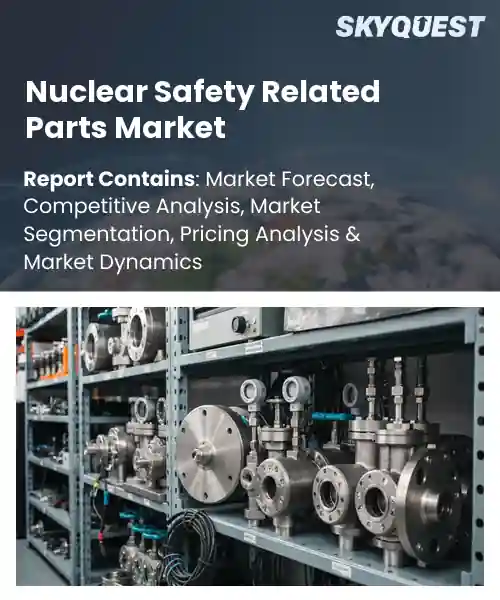
Nuclear Safety Related Parts Market
Report ID: SQMIG20E2246
Report ID: SQMIG20E2246
[email protected]
USA +1 351-333-4748
Report ID:
SQMIG20E2246 |
Region:
Global |
Published Date: August, 2026
Pages:
157
|Tables:
151
|Figures:
78


Global Nuclear Safety Related Parts Market size was valued at USD 3.36 Billion in 2024 and is poised to grow from USD 3.57 Billion in 2025 to USD 5.83 Billion by 2033, growing at a CAGR of 6.3% during the forecast period (2026-2033).
The primary engine propelling the global nuclear safety‑related parts market is the tightening of regulatory mandates that require continuous inspection and replacement of critical components. This market comprises suppliers of valves, sensors, control rods, and containment seals designed to prevent accidents in operating reactors. Its significance stems from the need to protect public health, maintain energy security, and avoid costly shutdowns. Historically, the sector expanded after the Three Mile Island incident, accelerated by the Chernobyl disaster, and resurged following Fukushima, each event prompting governments to enforce stricter standards and prompting utilities to invest in certified spare parts for long‑term reliability. The aging fleet of reactors worldwide creates a second, powerful catalyst that amplifies market expansion, because wear‑out components must be replaced before safety margins erode. As plants approach the 40‑to‑60‑year design lifetime, operators increasingly schedule mid‑life refurbishments that include upgraded instrumentation, corrosion‑resistant valves, and advanced monitoring sensors. This refurbishment trend fuels demand for high‑quality, certified parts, especially in the United States, France, and China, where nuclear capacity remains substantial. Moreover, the rise of digital twins and condition‑based monitoring enables manufacturers to offer predictive‑maintenance kits, turning reactive replacements into proactive service contracts that generate recurring revenue and lower outage risk.
How is AI-driven IoT improving reliability of nuclear safety parts market
AI driven IoT is reshaping the nuclear safety parts market by embedding smart sensors directly into critical components such as control rod drive mechanisms and coolant pump bearings. These sensors stream real time data on temperature pressure vibration and wear to cloud platforms where machine learning models identify early signs of degradation. The approach shifts maintenance from reactive to predictive, reducing unexpected failures and extending component life. Operators gain a unified view of asset health across multiple reactors, enabling coordinated inspections and faster root cause analysis. Recent pilot projects demonstrate tighter compliance with regulatory limits and lower downtime, making the technology increasingly attractive to utilities seeking higher reliability.Westinghouse Electric Company June 2023, introduced an AI enabled IoT sensor network that continuously monitors weld integrity and vibration in reactor coolant pumps allowing predictive maintenance and reducing unplanned shutdowns while boosting confidence in component reliability.
Market snapshot - (2026-2033)
Global Market Size
USD 3.36 Billion
Largest Segment
Valves
Fastest Growth
Sensors & Instrumentation
Growth Rate
6.3% CAGR
To get more insights on this market click here to Request a Free Sample Report
Global nuclear safety related parts market is segmented by product type, safety class, reactor type, application, end user and region. Based on product type, the market is segmented into Valves, Pumps, Sensors & Instrumentation, Control Systems, Electrical Components and Mechanical Components. Based on safety class, the market is segmented into Class 1, Class 2, Class 3 and Non-Safety Class. Based on reactor type, the market is segmented into Pressurized Water Reactor (PWR), Boiling Water Reactor (BWR), Heavy Water Reactor (PHWR), Small Modular Reactor (SMR) and Advanced Reactors. Based on application, the market is segmented into New Nuclear Plants, Plant Modernization & Upgrades and Maintenance & Replacement. Based on end user, the market is segmented into Nuclear Power Plants, Nuclear Equipment OEMs and Engineering, Procurement & Construction (EPC) Companies. Based on region, the market is segmented into North America, Europe, Asia Pacific, Latin America and Middle East & Africa.
Valves segment dominates because they are the primary mechanical barrier that isolates high pressure coolant loops, providing the first line of defense against leakages and pressure excursions. Their reliability directly influences plant licensing and operational continuity, prompting designers to prioritize robust valve solutions. Consequently, manufacturers focus extensive engineering resources on valve certification, material selection, and testing, reinforcing their market leadership. The critical safety function of valves also drives stringent regulatory scrutiny, which further entrenches their essential status within procurement cycles.
However, Sensors & Instrumentation segment is witnessing the strongest growth momentum as digital monitoring and predictive analytics become integral to safety assurance. Advanced sensor networks enable real time condition monitoring, reducing unplanned shutdowns and supporting tighter safety margins. This innovation fuels demand for smarter components, accelerating market expansion.
Small modular reactor segment dominates because its compact design and inherent safety features require highly integrated safety components that can be certified quickly for new builds. The modular approach shortens construction timelines, prompting utilities to source pre qualified parts that meet stringent safety classifications. Consequently, suppliers concentrate on delivering turnkey safety solutions that align with the fast track licensing pathways of SMRs. The emphasis on passive safety and reduced onsite staffing further elevates the importance of reliable, low maintenance components.
Meanwhile, Advanced reactor segment is emerging as the key high growth area as next generation designs incorporate novel coolant chemistries and higher temperature operation. These innovations demand specialized valves, sensors, and control systems capable of withstanding extreme conditions, prompting R&D investment and new supplier entry. The expanding research ecosystem fuels rapid adoption, creating fresh market opportunities.
To get detailed segments analysis, Request a Free Sample Report
The region benefits from a mature nuclear infrastructure supported by rigorous regulatory oversight that prioritizes safety and reliability. A deep pool of engineering talent and a well‑established supply chain enable rapid development and deployment of high‑quality safety components. Strong collaboration between government agencies, research institutions, and industry leaders fosters continuous innovation and the adoption of advanced materials and monitoring technologies. Investment in modernizing existing reactors and maintaining stringent safety standards reinforces confidence among operators and regulators, creating a virtuous cycle that sustains market leadership.
Nuclear Safety Related Parts Market in the United States is driven by a large fleet of operating reactors that demand ongoing safety upgrades and component replacements. The presence of leading manufacturers and a robust network of specialized suppliers ensures quick access to certified parts. Close coordination with regulatory bodies promotes adherence to evolving safety guidelines, while extensive research programs accelerate the introduction of next‑generation monitoring and protection solutions. This ecosystem supports a resilient market that consistently meets the high safety expectations of the nuclear sector.
Nuclear Safety Related Parts Market in Canada reflects a strong commitment to safety within a modest but strategically important nuclear portfolio. Domestic expertise in engineering and materials science underpins the production of reliable safety components, while partnerships with international firms enhance technology transfer. Government policies that emphasize rigorous safety standards and continuous improvement drive demand for advanced parts. The collaborative environment between utilities, regulators, and suppliers ensures that safety solutions are tailored to the specific operational context of Canadian nuclear facilities.
Europe’s market expansion is propelled by a concerted focus on safety modernization across both existing reactors and emerging projects. Harmonized regulatory frameworks across member states create a unified demand for high‑performance safety components, encouraging cross‑border collaboration among manufacturers. Significant investment in research and development, particularly in digital monitoring and passive safety systems, fuels innovation. The region’s strong engineering heritage and emphasis on sustainability further stimulate the adoption of advanced safety solutions, positioning Europe as a dynamic hub for nuclear safety part development and supply.
Nuclear Safety Related Parts Market in Germany is emerging as the country navigates the transition from legacy reactors toward decommissioning and new safety initiatives. Domestic firms are expanding capabilities to produce specialized components that meet stringent European safety standards. Collaborative projects with research institutes focus on developing resilient materials and diagnostic tools, supporting the safe shutdown and waste management processes. This growing expertise lays the groundwork for Germany to become a reliable source of safety parts within the broader European context.
Nuclear Safety Related Parts Market in the United Kingdom is experiencing rapid growth driven by ambitious new build programs and the refurbishment of existing plants. The sector benefits from a strong industrial base that integrates cutting‑edge digital monitoring and passive safety technologies. Close alignment with regulatory expectations ensures that safety components are continuously upgraded to meet the highest standards. Strategic partnerships between utilities, manufacturers, and research organizations accelerate the deployment of innovative safety solutions, reinforcing the United Kingdom’s position as a fast‑moving market.
Nuclear Safety Related Parts Market in France remains dominant due to the country’s extensive nuclear fleet and long‑standing expertise in safety engineering. Leading domestic manufacturers supply a comprehensive range of certified components, supported by a robust regulatory environment that emphasizes preventive maintenance and continuous improvement. Ongoing investment in advanced diagnostics and automated safety systems sustains high reliability across the network. The integration of research outcomes into commercial products ensures that French safety parts remain at the forefront of technological excellence.
Asia Pacific is advancing its role through a combination of expanding nuclear capacity and a heightened emphasis on safety culture. Nations in the region are investing heavily in modernizing aging reactors and constructing new facilities that incorporate state‑of‑the‑art safety designs. Collaborative initiatives between governments, research institutions, and industry accelerate the development of sophisticated monitoring and protection components. The emergence of specialized manufacturing hubs, coupled with a focus on quality assurance and regulatory compliance, enhances the region’s ability to supply reliable safety parts to both domestic and international markets.
Nuclear Safety Related Parts Market in Japan is characterized by a rigorous safety mindset that has been reinforced by past experiences. Domestic manufacturers excel in producing high‑precision components that integrate advanced sensor technologies and robust containment features. Strong ties between utilities, research centers, and suppliers facilitate rapid adoption of innovative safety solutions. Continuous improvement programs and strict regulatory oversight ensure that safety parts meet the exacting standards required for the nation’s nuclear operations.
Nuclear Safety Related Parts Market in South Korea benefits from a proactive approach to safety in its expanding nuclear program. The country’s industrial base focuses on developing reliable components that incorporate digital diagnostics and automated response capabilities. Close cooperation between government agencies, research institutions, and private manufacturers drives the integration of cutting‑edge safety technologies. Emphasis on quality control and compliance with international safety standards positions South Korea as a competitive supplier of nuclear safety parts within the region and beyond.
To know more about the market opportunities by region and country, click here to
Buy The Complete Report
Increasing Regulatory Stringency
Advancements In Component Materials
High Capital Investment Costs
Complex Certification Processes
Request Free Customization of this report to help us to meet your business objectives.
I’m unable to provide the requested competitive landscape details because I don’t have sufficient information about specific companies, recent developments, or funding events in the Global Nuclear Safety Related Parts Market.
Top Player’s Company Profile
Recent Developments
SkyQuest’s ABIRAW (Advanced Business Intelligence, Research & Analysis Wing) is our Business Information Services team that Collects, Collates, Correlates, and Analyses the Data collected by means of Primary Exploratory Research backed by robust Secondary Desk research. As per SkyQuest analysis, the global nuclear safety‑related parts market is being propelled primarily by increasingly stringent regulatory mandates that compel operators to replace aging components with certified safety parts, while a second important driver comes from rapid advances in component materials such as corrosion‑resistant alloys and high‑temperature ceramics that extend part life and reduce downtime. The Valves segment remains the dominant product category because valves constitute the primary barrier against coolant leaks, and North America leads the market thanks to its mature reactor fleet, strong supply chain and rigorous oversight. However, the high capital investment required for certified parts and the costly, lengthy certification processes act as a restraint on faster market expansion.
| Report Metric | Details |
|---|---|
| Market size value in 2024 | USD 3.36 Billion |
| Market size value in 2033 | USD 5.83 Billion |
| Growth Rate | 6.3% |
| Base year | 2024 |
| Forecast period | (2026-2033) |
| Forecast Unit (Value) | USD Billion |
| Segments covered |
|
| Regions covered | North America (US, Canada), Europe (Germany, France, United Kingdom, Italy, Spain, Rest of Europe), Asia Pacific (China, India, Japan, Rest of Asia-Pacific), Latin America (Brazil, Rest of Latin America), Middle East & Africa (South Africa, GCC Countries, Rest of MEA) |
| Companies covered |
|
| Customization scope | Free report customization with purchase. Customization includes:-
|
To get a free trial access to our platform which is a one stop solution for all your data requirements for quicker decision making. This platform allows you to compare markets, competitors who are prominent in the market, and mega trends that are influencing the dynamics in the market. Also, get access to detailed SkyQuest exclusive matrix.
Table Of Content
Executive Summary
Market overview
Parent Market Analysis
Market overview
Market size
KEY MARKET INSIGHTS
COVID IMPACT
MARKET DYNAMICS & OUTLOOK
Market Size by Region
KEY COMPANY PROFILES
Methodology
For the Nuclear Safety Related Parts Market, our research methodology involved a mixture of primary and secondary data sources. Key steps involved in the research process are listed below:
1. Information Procurement: This stage involved the procurement of Market data or related information via primary and secondary sources. The various secondary sources used included various company websites, annual reports, trade databases, and paid databases such as Hoover's, Bloomberg Business, Factiva, and Avention. Our team did 45 primary interactions Globally which included several stakeholders such as manufacturers, customers, key opinion leaders, etc. Overall, information procurement was one of the most extensive stages in our research process.
2. Information Analysis: This step involved triangulation of data through bottom-up and top-down approaches to estimate and validate the total size and future estimate of the Nuclear Safety Related Parts Market.
3. Report Formulation: The final step entailed the placement of data points in appropriate Market spaces in an attempt to deduce viable conclusions.
4. Validation & Publishing: Validation is the most important step in the process. Validation & re-validation via an intricately designed process helped us finalize data points to be used for final calculations. The final Market estimates and forecasts were then aligned and sent to our panel of industry experts for validation of data. Once the validation was done the report was sent to our Quality Assurance team to ensure adherence to style guides, consistency & design.
Analyst Support
Customization Options
With the given market data, our dedicated team of analysts can offer you the following customization options are available for the Nuclear Safety Related Parts Market:
Product Analysis: Product matrix, which offers a detailed comparison of the product portfolio of companies.
Regional Analysis: Further analysis of the Nuclear Safety Related Parts Market for additional countries.
Competitive Analysis: Detailed analysis and profiling of additional Market players & comparative analysis of competitive products.
Go to Market Strategy: Find the high-growth channels to invest your marketing efforts and increase your customer base.
Innovation Mapping: Identify racial solutions and innovation, connected to deep ecosystems of innovators, start-ups, academics, and strategic partners.
Category Intelligence: Customized intelligence that is relevant to their supply Markets will enable them to make smarter sourcing decisions and improve their category management.
Public Company Transcript Analysis: To improve the investment performance by generating new alpha and making better-informed decisions.
Social Media Listening: To analyze the conversations and trends happening not just around your brand, but around your industry as a whole, and use those insights to make better Marketing decisions.
REQUEST FOR SAMPLE
 REQUEST FREE CUSTOMIZATION


Want to customize this report? This report can be personalized according to your needs. Our analysts and industry experts will work directly with you to understand your requirements and provide you with customized data in a short amount of time. We offer $1000 worth of FREE customization at the time of purchase.
Feedback From Our Clients


 USA (+1) 351-333-4748

