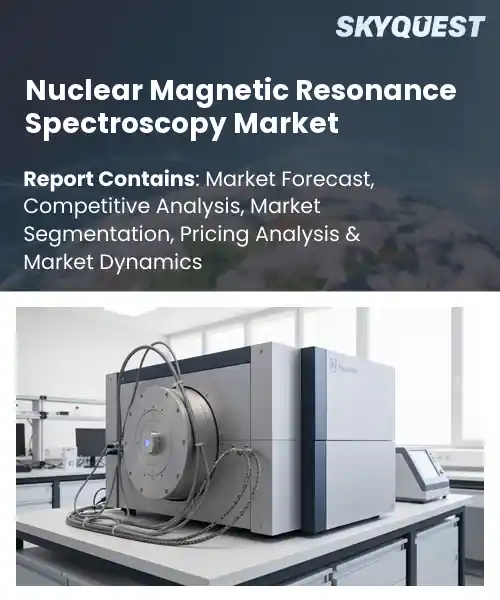
Nuclear Magnetic Resonance Spectroscopy Market
Report ID: SQMIG35J2265
Report ID: SQMIG35J2265
[email protected]
USA +1 351-333-4748
Report ID:
SQMIG35J2265 |
Region:
Global |
Published Date: May, 2026
Pages:
157
|Tables:
92
|Figures:
71


Global Nuclear Magnetic Resonance Spectroscopy Market size was valued at USD 1.52 Billion in 2024 and is poised to grow from USD 1.63 Billion in 2025 to USD 2.85 Billion by 2033, growing at a CAGR of 7.22% during the forecast period (2026-2033).
Nuclear Magnetic Resonance Spectroscopy market is mainly focused on equipment and services that utilize magnetic properties of atoms in order to study molecular structure and dynamics and has been used extensively by pharmaceutical companies and academic research organizations. The main driving factor for the growth of the market was technological progress that allowed more sensitive and detailed analysis to be conducted in shorter periods of time, thus expanding NMR spectroscopy beyond purely biological purposes and making it widely used for quality control in pharmaceutical industry. For example, due to faster analysis of small molecules and metabolomics research in academic laboratories could be performed.
With advancements in instrumentation and applications being more diverse than ever, the main driver in the global NMR spectroscopy market is the use of automation and analytics, enabling higher efficiency and better interpretation capabilities for end-users. Thanks to advances such as automation of sample preparation and the use of spectral analysis software, time savings are realized and even complex mixtures can be analyzed, which has resulted in a growth of services provided by contract research organizations in drug discovery as well as in environmental testing. The greater importance of structural analysis in regulations also encourages investments, prompting the development of tabletop devices for QC, as well as cryogen-free devices from manufacturers of high field systems.
How is AI Improving Data Analysis in the Nuclear Magnetic Resonance Spectroscopy Market?
The role of artificial intelligence in the data analysis in nuclear magnetic resonance spectroscopy entails automation of data processing and spectrum interpretation through algorithms that eliminate noise and correct the baseline, peak picking, deconvoluted overlapped peaks, and pattern recognition for matching spectra to chemical structure patterns. Presently, AI techniques are used in combination with machine learning and chemometrics in instruments for faster processing of results and enhancing the reproducibility of the outcomes. AI technologies have been embraced by various vendors and researchers who are interested in improving the efficiency of material identification processes and the drug discovery process using spectroscopic techniques. These technologies involve using transformers for automated structure identification and multimodal generators that combine NMR data with other spectrometric measurements. As an example of these developments, Bruker revealed the latest AI-enabled NMR solutions at ENC 2026 in April 2026.
Market snapshot - (2026-2033)
Global Market Size
USD 1.52 Billion
Largest Segment
Instruments
Fastest Growth
Software
Growth Rate
7.22% CAGR
To get more insights on this market click here to Request a Free Sample Report
Global nuclear magnetic resonance spectroscopy market is segmented by product, application, end-user and region. Based on product, the market is segmented into Instruments, Reagents & Accessories and Software. Based on application, the market is segmented into Drug Discovery, Structural Biology, Food & Beverage Testing and Environmental Analysis. Based on end-user, the market is segmented into Pharma & Biotech, Academic & Research, Food Testing Labs and Chemical Industry. Based on region, the market is segmented into North America, Europe, Asia Pacific, Latin America and Middle East & Africa.
Instrument Segment Leads due to high performance spectrometers being an integral part of NMR processes, facilitating sophisticated chemical analysis. Improvement in performance metrics like sensitivity and resolution through innovation in the instruments drives further applications of NMR technologies and the need to invest in them. Innovation in modular systems and software integration by the instrument manufacturers boosts productivity in NMR processes, making instruments the key driver of value creation in this industry.
However, the Reagents & Accessories segment is witnessing the highest growth owing to demand for unique reagents, isotopes and other accessories for conducting experiments. Development in kit-based services and their acceptance in high throughput labs is driving growth in this space.
The Drug Discovery segment earns the largest share since the use of NMR for its particular structural characterization and dynamic behavior has become key in the hit identification, fragment screening, and lead optimization phases of drug discovery. In addition, the capability of NMR to provide insight into binding mechanism, kinetics, and metabolism directly impacts medicinal chemistry and the drug candidate selection process, hence driving continuous funding from the pharma development team. Its combination with automation and computational chemistry only makes NMR more vital in drug development.
Nevertheless, Structural Biology emerges as the rapidly growing category owing to innovations in NMR such as isotope labeling in cell NMR and solid-state NMR to obtain the protein structure and interactions not easily obtained before. There has been an increase in interest in studying biologics and membrane proteins leading to a need for special services in this regard.
To get detailed segments analysis, Request a Free Sample Report
Nuclear magnetic resonance spectroscopy instruments have been experiencing significant growth in North America owing to the presence of several research institutes equipped with latest technologies, an extensive pharmaceutical industry, and a widespread clinical and academic adoption of NMR spectroscopy. Strong infrastructure, healthy supply chains, and the close involvement of manufacturers and end-users facilitate the continuous innovation in the technology. The culture of early technology adoption within analytical laboratories facilitates complex applications in fields like drug discovery, metabolomics, and material sciences. The comprehensive support and maintenance of instruments minimize downtime and instill trust in the instruments. Favorable regulatory systems that promote the creation of high-quality data and competent labor force contribute to the dominance of North America in NMR Spectroscopy Market.
The US Nuclear Magnetic Resonance Spectroscopy market is distinguished by a focused research approach, robust industrial requirement, and close interaction between developers and end users. State-of-the-art lab facilities, along with wide usage in clinical and business settings, encourages the use of sophisticated instruments. Availability of nearby technical assistance services and competent technicians helps ensure efficient uptime and development of methods. Industry alliances play a key role in translating new NMR technologies into practical analytical protocols.
The Nuclear Magnetic Resonance Spectroscopy Market in Canada is driven by collaboration amongst researchers, research institutes, and the application of NMR spectroscopy by industries in pharmaceuticals and advanced material. This includes investment in lab networks as well as training to build capabilities for advanced analysis. Good connections between universities, hospitals, and service providers help in maintaining standards as well as applying the techniques for different purposes. A concentration on services helps increase confidence in the product.
Rapid growth in the NMR spectroscopy market can be seen in Europe due to a blend of favorable factors such as heavy investment in research by the government, presence of many biotech and pharmaceutical companies, and cross-border collaboration networks aiding technology transfers. Investments in analytical instrumentation through universities and research institutes along with centers of excellence fostermethodological development and applications. Strong regulatory focus on analytical characterization in the pharmaceutical and chemical industry drives the requirement for precision tools like NMR spectroscopy. Translational research initiatives along with cooperation between academia and industry help fast track innovative solutions using NMR spectroscopy. Fragmentation of the market in Europe also aids specialty providers offering services.
Germany Nuclear Magnetic Resonance Spectroscopy Market is driven by highly advanced industrial chemical and pharmaceutical industry, well established research facilities, and abundance of analytical labs. There are also dedicated service organizations to ensure extensive application of NMR in material science, chemistry, and life sciences fields. Cooperation between NMR instrument suppliers and universities facilitates development of customized techniques. Excellent technical support systems and client-oriented services ensure efficient use of modern NMR systems.
The UK NMR Spectroscopy Market is one where there exists a robust academic research presence, an active biotechnology industry, and entrepreneurship that leads to the development of methods for use in commercial applications. The interaction of universities, startups, and CROs plays an important role in the development of new applications and services. The involvement of regulations and targeted skill sets has contributed significantly to the emergence of many skilled end users.
Market for Nuclear Magnetic Resonance Spectroscopy in France is developing with the help of selective investments in scientific infrastructure, smart academic-industry collaboration, and the formation of clusters of analytical service providers. Translational research and program collaboration drive the use of this technology within the fields of pharmaceutical and materials research. Training programs and shared instrumentation centers ease access and facilitate the growth of advanced applications and skilled personnel within the region.
Players have been working towards improving its brand in the Asian market owing to a series of strategic investments in research infrastructure, enhanced capabilities within the local production of instruments, as well as increased demand for applications within the pharmaceutical, chemical, and material industry segments. A greater number of facilities with the necessary infrastructure and services ensures wider clinical and industrial adoption. The process of collaborating on research and development projects, as well as technology transfer, contributes towards the localization of advanced nuclear magnetic resonance technology in the region. The development of talent, industry academia collaborations and other activities contribute towards developing the requisite technical capability. Improved supply chains and expanded services facilitate the ease of procurement as well as operations.
The Nuclear Magnetic Resonance Spectroscopy Market in Japan enjoys advantages related to manufacturing expertise, advanced industrial research, and the ability to perform studies on various materials and medicines. Well-established suppliers and expert services ensure efficient instrument functionality and high-level method developments. Cooperation between corporations, institutions, and universities speeds up implementation of customized NMR instruments. Training and maintenance services ensure proper operation of the equipment, which increases trust both among national and foreign users.
The Nuclear Magnetic Resonance Spectroscopy Market in South Korea is driven by the country’s interest in highly technological fields of production, advancements in pharmaceuticals and materials, and an increased research potential. Growing local expertise in technical and analytical activities ensures further growth of the market. Universities' cooperation with companies encourages NMR applications and method development.
To know more about the market opportunities by region and country, click here to
Buy The Complete Report
Technological Advancements in Instrumentation
Progress in magnet engineering, probe sensitivity, and pulse sequences has enhanced spectral resolution and shortened experiment duration, making it easier to gain better insight about molecules in a more efficient manner, thus encouraging wider usage of the technology within scientific institutions. The enhanced capabilities of the instruments make more applications possible, which include those involving biology and materials science that were once difficult to achieve, leading to a higher demand for better performing instruments.
Expansion in Pharmaceutical Research Use
Expanding usage in drug research and biotech applications in structural characterization and metabolomics research, as well as analysis of compound quality, have increased the need for advanced NMR equipment as an indispensable technique for research work. Involvement of such techniques in drug development processes and product formulations will result in continued demands for equipment as well as innovative developments from manufacturers of NMR products due to cooperation between equipment makers and R&D institutions.
High Operational and Maintenance Costs
Large capital investments needed for installing highly sophisticated NMR equipment along with associated costs related to maintenance, servicing and supply of necessary consumable items like cryogens lead to heavy economic burden on most of the labs. Specialized infrastructure needs as well as trained manpower for handling and analysis of complex data make the cost of operation higher and may hinder even small research organizations or industries from purchasing or upgrading their existing equipment. This way, market expansion is limited due to economic constraints of the potential customers.
Regulatory and Standardization Challenges
The complex nature of regulations, along with the lack of internationally agreed upon standards for collecting, processing, and analyzing data, may affect the ability of various industries to utilize NMR technologies in their operations. The different criteria for validating systems in each region and application area lead to additional time needed to comply with the regulations, causing companies to avoid the purchase of new systems or utilization of NMR in their regulatory processes.
Request Free Customization of this report to help us to meet your business objectives.
Competition involves differentiation of the product and platform, which is achieved through strategic acquisitions, collaboration with universities, and hardware advancements favoring benchtop, micro, and quantum-enabled NMR systems; these can be seen in Nanalysis’s efforts to advance benchtop technology and its acquisition of RS2D, Bruker’s development of benchtop systems for chemical research, and Quantum Brilliance’s progress in room temperature NV diamond technology.
𝐀𝐈-e𝐧𝐚𝐛𝐥𝐞𝐝 𝐒𝐩𝐞𝐜𝐭𝐫𝐚𝐥 𝐈𝐧𝐭𝐞𝐫𝐩𝐫𝐞𝐭𝐚𝐭𝐢𝐨𝐧: The application of machine learning and pattern recognition allows for automated analysis of difficult NMR spectra. By embedding intelligent deconvolution and assignment algorithms as well as automatic detection of anomalies, the process can be made faster and less dependent on highly trained professionals. In cooperation between suppliers and laboratories, machine learning methods may be implemented that allow continuous learning based on datasets from institutions. This will make the technology accessible in routine processes such as quality control and early discovery by requiring less knowledge and expertise.
𝐏𝐨𝐫𝐭𝐚𝐛𝐥𝐞 𝐁𝐞𝐧𝐜𝐡𝐭𝐨𝐩 𝐍𝐌𝐑 𝐀𝐝𝐨𝐩𝐭𝐢𝐨𝐧: Benchtop and portable NMR systems create opportunities to perform analyses not only in central facilities but also at remote locations. Ease of operation, flexibility in software and reduced size enable the assessment of compositions, formulations and troubleshooting. Companies develop instruments and application packages that cater to the specific needs of the customer and are easy enough to use for non-specialists, which promotes adoption for quality control, environment testing and process optimization.
SkyQuest’s ABIRAW (Advanced Business Intelligence, Research & Analysis Wing) is our Business Information Services team that Collects, Collates, Correlates, and Analyses the Data collected by means ofPrimary Exploratory Research backed by robust Secondary Desk research.
According to SkyQuest analysis, the primary driving force behind the growth of the nuclear magnetic resonance spectroscopy market globally includes constant innovation in terms of instrumentation along with automation and analytics that increase speed and capacity, and the secondary factor is the increasing usage in pharmaceutical industry for structural elucidation and quality control purposes. The major barrier to this market growth is the cost involved in terms of purchasing and maintenance of equipment, along with high costs related to the use of these products. North America is the dominant player in the market because of its research facilities and academic-industry partnership, and instruments are the dominant segment within the market.
| Report Metric | Details |
|---|---|
| Market size value in 2024 | USD 1.52 Billion |
| Market size value in 2033 | USD 2.85 Billion |
| Growth Rate | 7.22% |
| Base year | 2024 |
| Forecast period | (2026-2033) |
| Forecast Unit (Value) | USD Billion |
| Segments covered |
|
| Regions covered | North America (US, Canada), Europe (Germany, France, United Kingdom, Italy, Spain, Rest of Europe), Asia Pacific (China, India, Japan, Rest of Asia-Pacific), Latin America (Brazil, Rest of Latin America), Middle East & Africa (South Africa, GCC Countries, Rest of MEA) |
| Companies covered |
|
| Customization scope | Free report customization with purchase. Customization includes:-
|
To get a free trial access to our platform which is a one stop solution for all your data requirements for quicker decision making. This platform allows you to compare markets, competitors who are prominent in the market, and mega trends that are influencing the dynamics in the market. Also, get access to detailed SkyQuest exclusive matrix.
Table Of Content
Executive Summary
Market overview
Parent Market Analysis
Market overview
Market size
KEY MARKET INSIGHTS
COVID IMPACT
MARKET DYNAMICS & OUTLOOK
Market Size by Region
KEY COMPANY PROFILES
Methodology
For the Nuclear Magnetic Resonance Spectroscopy Market, our research methodology involved a mixture of primary and secondary data sources. Key steps involved in the research process are listed below:
1. Information Procurement: This stage involved the procurement of Market data or related information via primary and secondary sources. The various secondary sources used included various company websites, annual reports, trade databases, and paid databases such as Hoover's, Bloomberg Business, Factiva, and Avention. Our team did 45 primary interactions Globally which included several stakeholders such as manufacturers, customers, key opinion leaders, etc. Overall, information procurement was one of the most extensive stages in our research process.
2. Information Analysis: This step involved triangulation of data through bottom-up and top-down approaches to estimate and validate the total size and future estimate of the Nuclear Magnetic Resonance Spectroscopy Market.
3. Report Formulation: The final step entailed the placement of data points in appropriate Market spaces in an attempt to deduce viable conclusions.
4. Validation & Publishing: Validation is the most important step in the process. Validation & re-validation via an intricately designed process helped us finalize data points to be used for final calculations. The final Market estimates and forecasts were then aligned and sent to our panel of industry experts for validation of data. Once the validation was done the report was sent to our Quality Assurance team to ensure adherence to style guides, consistency & design.
Analyst Support
Customization Options
With the given market data, our dedicated team of analysts can offer you the following customization options are available for the Nuclear Magnetic Resonance Spectroscopy Market:
Product Analysis: Product matrix, which offers a detailed comparison of the product portfolio of companies.
Regional Analysis: Further analysis of the Nuclear Magnetic Resonance Spectroscopy Market for additional countries.
Competitive Analysis: Detailed analysis and profiling of additional Market players & comparative analysis of competitive products.
Go to Market Strategy: Find the high-growth channels to invest your marketing efforts and increase your customer base.
Innovation Mapping: Identify racial solutions and innovation, connected to deep ecosystems of innovators, start-ups, academics, and strategic partners.
Category Intelligence: Customized intelligence that is relevant to their supply Markets will enable them to make smarter sourcing decisions and improve their category management.
Public Company Transcript Analysis: To improve the investment performance by generating new alpha and making better-informed decisions.
Social Media Listening: To analyze the conversations and trends happening not just around your brand, but around your industry as a whole, and use those insights to make better Marketing decisions.
REQUEST FOR SAMPLE
 REQUEST FREE CUSTOMIZATION
Global Nuclear Magnetic Resonance Spectroscopy Market size was valued at USD 1.52 Billion in 2024 and is poised to grow from USD 1.63 Billion in 2025 to USD 2.85 Billion by 2033, growing at a CAGR of 7.22% during the forecast period (2026-2033).
Competition centers on product and platform differentiation, accelerated by targeted M&A, university partnerships, and hardware innovation that shift competitive advantage toward benchtop, micro-scale, and quantum-enhanced NMR offerings; examples include Nanalysis expanding benchtop capabilities and acquiring RS2D, Bruker adding benchtop chemistry solutions, and Quantum Brilliance advancing room-temperature NV diamond devices through academic and HPC partnerships. 'Bruker Corporation', 'Agilent Technologies', 'Thermo Fisher Scientific', 'JEOL Ltd.', 'Magritek', 'Oxford Instruments', 'Varian Medical Systems', 'Nanalysis Scientific', 'Spinlock SRL', 'Anasazi Instruments', 'Wiley-VCH (NMR databases)', 'Mestrelab Research', 'ACD/Labs', 'Spectral Data Services', 'Resonance Instruments'
𝐀𝐈-𝐄𝐧𝐚𝐛𝐥𝐞𝐝 𝐒𝐩𝐞𝐜𝐭𝐫𝐚𝐥 𝐈𝐧𝐭𝐞𝐫𝐩𝐫𝐞𝐭𝐚𝐭𝐢𝐨𝐧: Machine learning and pattern recognition enable automated interpretation of complex NMR spectra, accelerating workflows and reducing reliance on specialized analysts. Integration of AI-driven deconvolution, assignment and anomaly detection improves throughput and consistency across diverse sample types. Vendors and laboratories collaborate to embed adaptive algorithms within instrumentation and software ecosystems, fostering continuous learning from institutional datasets. The trend expands applicability into routine quality control and early discovery by lowering the expertise barrier and enabling more rapid decision making across global industries.
North America Dominate the Global Nuclear Magnetic Resonance Spectroscopy Market


Want to customize this report? This report can be personalized according to your needs. Our analysts and industry experts will work directly with you to understand your requirements and provide you with customized data in a short amount of time. We offer $1000 worth of FREE customization at the time of purchase.
Feedback From Our Clients


 USA (+1) 351-333-4748

