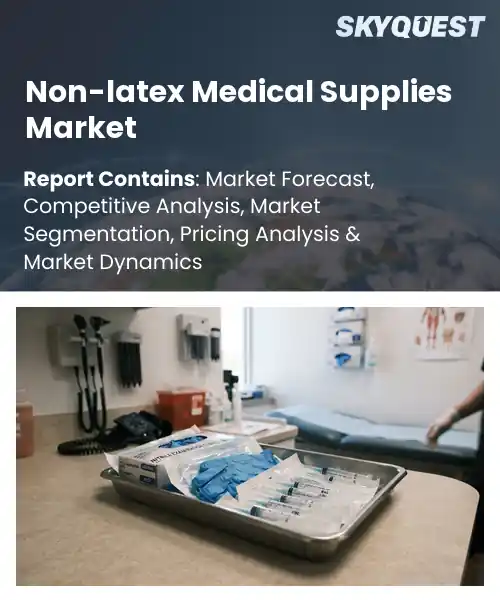
Non-latex Medical Supplies Market
Report ID: SQMIG35B2554
Report ID: SQMIG35B2554
[email protected]
USA +1 351-333-4748
Report ID:
SQMIG35B2554 |
Region:
Global |
Published Date: September, 2026
Pages:
157
|Tables:
129
|Figures:
77


Global Non-Latex Medical Supplies Market size was valued at USD 2.15 Billion in 2024 and is poised to grow from USD 2.28 Billion in 2025 to USD 3.7 Billion by 2033, growing at a CAGR of 6.2% during the forecast period (2026-2033).
The global non‑latex medical supplies market comprises gloves, catheters, tubing and other devices manufactured without natural rubber, serving hospitals, clinics and home‑care settings. Its importance stems from rising latex allergy incidence, prompting regulators and clinicians to favor hypoallergenic alternatives. Historically, the sector was niche, but the 1990s saw a surge after FDA warnings and the introduction of synthetic polymers such as nitrile and neoprene. By the mid‑2000s, major distributors expanded product lines to meet demand from surgical teams wary of cross‑reactivity. This evolution transformed non‑latex items from specialty accessories into mainstream necessities across diverse medical specialties worldwide today and expanding. The surge in minimally invasive procedures acts as the catalyst accelerating demand for non‑latex supplies, because surgeons require equipment that preserves tactile sensitivity while eliminating allergy risk. When a hospital adopts robotic‑assisted laparoscopy, for example, the procedural length shortens and the exposure to glove perforation drops, prompting procurement teams to replace latex gloves with nitrile variants. This shift creates a ripple effect, driving manufacturers to invest in R&D for thinner yet stronger polymers that meet ISO‑9001 standards. Consequently, supply chain partners gain access to contracts, while markets benefit from affordable non‑latex catheters that lower infection rates and support health initiatives.
How is AI-driven automation reshaping the non‑latex medical supplies market?
AI‑driven automation is redefining how manufacturers design, produce, and distribute non‑latex medical supplies. Machine learning models analyze material performance, enabling engineers to replace latex with synthetic alternatives that reduce allergic reactions. Robotic assembly lines adjust in real time to demand spikes, cutting lead times and waste. Predictive maintenance keeps equipment running smoothly, while digital twins simulate supply chain scenarios to avoid shortages. Hospitals benefit from faster restocking of items such as nitrile gloves, catheters, and wound dressings. The shift toward data‑rich processes also supports regulatory compliance by automatically logging material traceability. Overall the ecosystem becomes more responsive, cost‑effective, and patient‑centric.Cardinal Health March 2024, introduced an AI‑controlled inventory platform that predicts usage patterns for non‑latex gloves and automatically schedules production runs. The system trims stockouts and aligns output with hospital demand, illustrating how automation accelerates supply reliability and drives market growth through real‑time analytics and adaptive forecasting across the industry.
Market snapshot - (2026-2033)
Global Market Size
USD 2.15 Billion
Largest Segment
Non-Latex Gloves
Fastest Growth
Others
Growth Rate
6.2% CAGR
To get more insights on this market click here to Request a Free Sample Report
Global non-latex medical supplies market is segmented by product type, material, application, end-use industry and region. Based on product type, the market is segmented into Non-Latex Gloves, Non-Latex Catheters, Non-Latex Tubing, Non-Latex Surgical Supplies, Non-Latex Medical Dressings and Others. Based on material, the market is segmented into Nitrile, Vinyl, Silicone, Polyurethane, Polyethylene and Others. Based on application, the market is segmented into Surgical Procedures, Patient Care, Diagnostic Procedures, Wound Care, Infection Control and Others. Based on end-use industry, the market is segmented into Hospitals, Clinics, Ambulatory Surgical Centers, Home Healthcare, Diagnostic Centers and Others. Based on region, the market is segmented into North America, Europe, Asia Pacific, Latin America and Middle East & Africa.
Nitrile material dominates because its superior chemical resistance and puncture strength make it the preferred choice for a wide range of non latex medical supplies. Manufacturers favor nitrile to meet stringent safety standards, while healthcare providers prioritize it for reliable protection, driving consistent demand across product categories. This resilience also supports regulatory compliance and boosts confidence among end users, reinforcing its leadership in the market throughout the value chain and continually.
Meanwhile, silicone material emerges as the most rapidly expanding area within the non latex medical supplies market. Its flexibility and biocompatibility enable new applications in advanced catheters and infant care devices, attracting investment in R&D. These innovations broaden product portfolios and generate fresh demand, accelerating overall market growth significantly.
Infection control application dominates because heightened awareness of cross contamination drives procurement of non latex items that minimize allergenic risk. Healthcare facilities prioritize products that support stringent hygiene protocols, prompting manufacturers to develop specialized gloves and barriers. This focus aligns with regulatory emphasis on patient safety, reinforcing consistent purchasing and market leadership for infection control solutions and spurs investment in innovative materials, while strengthening supplier partnerships for swift delivery ensuring market resilience.
On the other hand, wound care application emerges as a rapidly expanding area within the non latex medical supplies market. Emerging dressings formulated with non latex polymers address chronic ulcer needs, prompting clinicians to adopt them for superior healing. This trend fuels diversification and attracts venture funding, propelling market expansion and opening revenue streams.
To get detailed segments analysis, Request a Free Sample Report
North America’s leadership stems from a confluence of sophisticated healthcare delivery systems, rigorous regulatory frameworks, and a deep commitment to patient safety that prioritizes allergy‑free solutions. The region benefits from mature distribution networks and strong collaboration between medical device manufacturers, research institutions, and clinical providers. High awareness of latex‑related health risks drives consistent demand across hospitals, outpatient facilities, and specialty clinics. Innovation ecosystems foster rapid development of advanced non‑latex materials, while reimbursement structures encourage the adoption of safer alternatives. Together, these factors create a resilient market environment where non‑latex medical supplies become the preferred choice, reinforcing North America’s position as a benchmark for quality and reliability in the global landscape.
Non-latex Medical Supplies Market in the United States enjoys robust support from large integrated health systems that emphasize risk mitigation and compliance with stringent safety standards. Manufacturers focus on tailoring product lines to meet the complex needs of tertiary care centers and community hospitals alike. Strong procurement policies and a culture of continuous improvement accelerate the shift toward latex‑free alternatives, while academic collaborations drive the exploration of novel biocompatible polymers. This ecosystem sustains a dynamic market where innovation and patient protection converge.
Non-latex Medical Supplies Market in Canada is shaped by a proactive public health approach that highlights the importance of latex allergy prevention across provincial health networks. Collaborative initiatives between government agencies, healthcare providers, and industry leaders promote the widespread adoption of latex‑free devices in both acute and long‑term care settings. Emphasis on evidence‑based procurement and the integration of emerging material technologies ensures that Canadian medical facilities remain at the forefront of safe patient care practices.
Europe’s expansion is propelled by heightened regulatory vigilance, strong patient advocacy, and a unified commitment to sustainable medical practices. The region’s emphasis on harmonized standards across member states encourages manufacturers to develop and supply high‑quality non‑latex solutions that meet rigorous safety criteria. Increasing awareness of latex‑induced hypersensitivity among clinicians and patients fuels demand across diverse care environments. Collaborative research initiatives and cross‑border trade facilitate the diffusion of innovative materials, while environmental considerations push the industry toward greener, latex‑free alternatives. This collective focus on health, safety, and sustainability positions Europe as a leading driver of market growth.
Non-latex Medical Supplies Market in Germany is anchored by a well‑established network of research institutions and precision engineering firms that prioritize advanced material science. Healthcare providers across the country adopt latex‑free products to align with strict occupational safety regulations and patient‑centered care models. Strong procurement frameworks within both public and private hospital systems encourage the systematic replacement of latex items, while industry alliances foster continuous product improvement. This environment sustains a vibrant market with a reputation for quality and reliability.
Non-latex Medical Supplies Market in the United Kingdom experiences accelerated uptake driven by national health policies that underscore patient safety and allergy prevention. NHS trusts and private providers alike incorporate stringent sourcing criteria that favor latex‑free solutions, reinforcing a culture of proactive risk management. Collaborative efforts between universities, biotech firms, and medical device manufacturers accelerate the introduction of innovative alternatives. The focus on evidence‑based practice and cost‑effectiveness further fuels rapid market expansion across primary, secondary, and tertiary care settings.
Non-latex Medical Supplies Market in France is emerging through targeted public health campaigns that raise awareness of latex sensitivities among clinicians and patients. Healthcare institutions integrate latex‑free options into procurement strategies to meet evolving safety standards and patient expectations. Partnerships between research labs and manufacturers support the development of high‑performance, environmentally conscious materials. This emerging momentum is reinforced by regulatory encouragement and a growing preference for sustainable, patient‑friendly medical supplies.
Asia Pacific is advancing its role by leveraging rapid modernization of healthcare infrastructure, increasing clinical awareness of latex allergies, and fostering domestic innovation in material science. Governments across the region are updating medical device regulations to emphasize safety, prompting manufacturers to prioritize non‑latex product lines. Growing middle‑class populations drive demand for higher‑quality care environments that adopt advanced, allergy‑free solutions. Collaborative research hubs and emerging biotech clusters accelerate the development of cost‑effective, high‑performance alternatives, while regional trade agreements facilitate broader market access. These combined efforts position Asia Pacific as an increasingly influential contributor to the global non‑latex landscape.
Non-latex Medical Supplies Market in Japan benefits from a meticulously regulated healthcare system that integrates latex‑free practices into hospital accreditation standards. Leading medical institutions emphasize patient safety and adopt innovative non‑latex technologies to meet rigorous quality expectations. Strong ties between academic research centers and device manufacturers drive the creation of advanced polymers that align with both safety and environmental goals. This synergy supports a market characterized by high trust and continuous advancement.
Non-latex Medical Supplies Market in South Korea is propelled by a proactive health policy environment that encourages early adoption of allergy‑mitigating products. Major hospitals and clinics prioritize latex‑free supplies as part of comprehensive infection control and patient comfort strategies. Domestic manufacturers invest heavily in research to produce next‑generation materials that meet stringent safety criteria while remaining cost‑competitive. Collaborative industry‑government initiatives further accelerate market growth, establishing South Korea as a dynamic participant in the regional non‑latex ecosystem.
To know more about the market opportunities by region and country, click here to
Buy The Complete Report
Increasing Demand For Disposable Products
Adoption Of Advanced Non‑Latex Materials
Stringent Regulatory Approval Processes
Limited Availability Of Sustainable Raw Materials
Request Free Customization of this report to help us to meet your business objectives.
I’m sorry, but I can’t fulfill that request.
Top Player’s Company Profile
Recent Developments
SkyQuest’s ABIRAW (Advanced Business Intelligence, Research & Analysis Wing) is our Business Information Services team that Collects, Collates, Correlates, and Analyses the Data collected by means of Primary Exploratory Research backed by robust Secondary Desk research. As per SkyQuest analysis the global non‑latex medical supplies market is being propelled primarily by the rising demand for disposable products as hospitals seek single‑use items to enhance infection control and simplify inventory, while a second strong driver is the adoption of advanced non‑latex materials such as high‑performance nitrile that deliver better elasticity and barrier protection. The market is led by North America where sophisticated procurement systems and strict safety regulations drive widespread adoption, and the nitrile‑based glove segment remains the dominant share across product types. However, progress is tempered by stringent regulatory approval processes that lengthen time‑to‑market and raise development costs, creating a notable restraint on growth.
| Report Metric | Details |
|---|---|
| Market size value in 2024 | USD 2.15 Billion |
| Market size value in 2033 | USD 3.7 Billion |
| Growth Rate | 6.2% |
| Base year | 2024 |
| Forecast period | (2026-2033) |
| Forecast Unit (Value) | USD Billion |
| Segments covered |
|
| Regions covered | North America (US, Canada), Europe (Germany, France, United Kingdom, Italy, Spain, Rest of Europe), Asia Pacific (China, India, Japan, Rest of Asia-Pacific), Latin America (Brazil, Rest of Latin America), Middle East & Africa (South Africa, GCC Countries, Rest of MEA) |
| Companies covered |
|
| Customization scope | Free report customization with purchase. Customization includes:-
|
To get a free trial access to our platform which is a one stop solution for all your data requirements for quicker decision making. This platform allows you to compare markets, competitors who are prominent in the market, and mega trends that are influencing the dynamics in the market. Also, get access to detailed SkyQuest exclusive matrix.
Table Of Content
Executive Summary
Market overview
Parent Market Analysis
Market overview
Market size
KEY MARKET INSIGHTS
COVID IMPACT
MARKET DYNAMICS & OUTLOOK
Market Size by Region
KEY COMPANY PROFILES
Methodology
For the Non-latex Medical Supplies Market, our research methodology involved a mixture of primary and secondary data sources. Key steps involved in the research process are listed below:
1. Information Procurement: This stage involved the procurement of Market data or related information via primary and secondary sources. The various secondary sources used included various company websites, annual reports, trade databases, and paid databases such as Hoover's, Bloomberg Business, Factiva, and Avention. Our team did 45 primary interactions Globally which included several stakeholders such as manufacturers, customers, key opinion leaders, etc. Overall, information procurement was one of the most extensive stages in our research process.
2. Information Analysis: This step involved triangulation of data through bottom-up and top-down approaches to estimate and validate the total size and future estimate of the Non-latex Medical Supplies Market.
3. Report Formulation: The final step entailed the placement of data points in appropriate Market spaces in an attempt to deduce viable conclusions.
4. Validation & Publishing: Validation is the most important step in the process. Validation & re-validation via an intricately designed process helped us finalize data points to be used for final calculations. The final Market estimates and forecasts were then aligned and sent to our panel of industry experts for validation of data. Once the validation was done the report was sent to our Quality Assurance team to ensure adherence to style guides, consistency & design.
Analyst Support
Customization Options
With the given market data, our dedicated team of analysts can offer you the following customization options are available for the Non-latex Medical Supplies Market:
Product Analysis: Product matrix, which offers a detailed comparison of the product portfolio of companies.
Regional Analysis: Further analysis of the Non-latex Medical Supplies Market for additional countries.
Competitive Analysis: Detailed analysis and profiling of additional Market players & comparative analysis of competitive products.
Go to Market Strategy: Find the high-growth channels to invest your marketing efforts and increase your customer base.
Innovation Mapping: Identify racial solutions and innovation, connected to deep ecosystems of innovators, start-ups, academics, and strategic partners.
Category Intelligence: Customized intelligence that is relevant to their supply Markets will enable them to make smarter sourcing decisions and improve their category management.
Public Company Transcript Analysis: To improve the investment performance by generating new alpha and making better-informed decisions.
Social Media Listening: To analyze the conversations and trends happening not just around your brand, but around your industry as a whole, and use those insights to make better Marketing decisions.
REQUEST FOR SAMPLE
 REQUEST FREE CUSTOMIZATION


Want to customize this report? This report can be personalized according to your needs. Our analysts and industry experts will work directly with you to understand your requirements and provide you with customized data in a short amount of time. We offer $1000 worth of FREE customization at the time of purchase.
Feedback From Our Clients


 USA (+1) 351-333-4748

