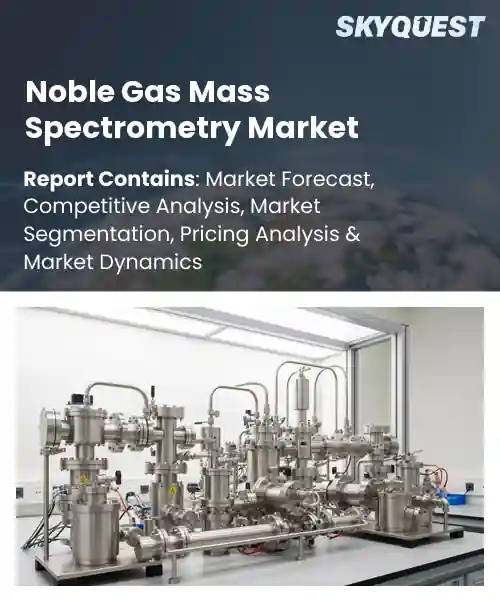
Noble Gas Mass Spectrometry Market
Report ID: SQMIG20I2715
Report ID: SQMIG20I2715
[email protected]
USA +1 351-333-4748
Report ID:
SQMIG20I2715 |
Region:
Global |
Published Date: February, 2026
Pages:
157
|Tables:
121
|Figures:
77


Global Noble Gas Mass Spectrometry Market size was valued at USD 345.7 Million in 2024 and is poised to grow from USD 366.44 Million in 2025 to USD 584.05 Million by 2033, growing at a CAGR of 6.0% during the forecast period (2026-2033).
The primary use of noble gas mass spectrometers is to provide accurate and precise measurements of noble gas composition and isotopic ratios and therefore they are used extensively in geochronology/geochemistry, environmental monitoring, nuclear safety, and atmospheric research.
A noble gas mass spectrometry market trends of steady growth is expected in this market segment, as the total number of advanced analytical technologies used by research organizations and government laboratories.
Some of the recent technological advancements to noble gas mass spectrometers such as improved sensitivity, automated systems, and integrated software for data analysis have continued to improve instrument performance. Also growing investment in scientific research, climate change investigations, and earth science exploration has led to increased demand globally for systems capable of performing noble gas mass spectrometry.
How is AI Improving Detection Accuracy in the Noble Gas Mass Spectrometry Market?
The application of AI has led to greater accuracy in detection of noble gases via mass spectrometry through automated signal processing and improved identification of peaks and baselines. Key processes such as the reduction of noise through peak deconvolution, refinement of isotope ratios, correction for drift, and identification of anomalies are improving analytical techniques.
Vendors and laboratories are now integrating machine learning in their data workflows which will provide higher reproducibility and decreased need for manual curation. Market demand for increased throughput and consistent determination of trace isotopes in geoscience, environmental monitoring and sourcing of helium has led to the adoption of AI by laboratories.
Market snapshot - (2026-2033)
Global Market Size
USD 345.7 Million
Largest Segment
Mass Spectrometers
Fastest Growth
Bench-top Mass Spectrometers
Growth Rate
6.0% CAGR
To get more insights on this market click here to Request a Free Sample Report
Global noble gas mass spectrometry market is segmented into product type, technology, application, end-user and region. Based on product type, the market is segmented into mass spectrometers and bench-top mass spectrometers. Based on technology, the market is segmented into quadrupole mass spectrometry, time-of-flight (ToF) mass spectrometry, Ion trap mass spectrometry, and magnetic sector mass spectrometry. Based on application, the market is segmented into environmental monitoring, geochronology, industrial applications, research & academia and medical applications. Based on end-user, the market is segmented into academic & research institutions, government agencies, industrial laboratories, pharmaceutical companies and environmental agencies. Based on region, the market is segmented into North America, Europe, Asia Pacific, Latin America and Middle East & Africa.
As per global noble gas mass spectrometry market analysis, the geochronology segment has a strong emphasis on obtaining ultra-precise measurements of noble gas isotopes. The resulting demand drives the development of high-performance instruments and specialized workflows. Further, the major importance of isotopic dating to the Earth Sciences and resource exploration creates constant, or ongoing mission-critical budgets, as well as long project timeframes, leading to manufacturers optimizing their systems in terms of sensitivity, stability, and calibration processes. As a result, suppliers are emphasizing the use of highly developed systems and service support networks that help to support their market leadership position in the noble gas mass spectrometry market.
As per global noble gas mass spectrometry market outlook, the environmental monitoring segment is experiencing the highest growth as regulatory interests, and the demand for atmospheric noble gas analysis is driving the use of dedicated instruments and field processes to perform noble gas-related work. Additionally, through the development of portable interfaces and simplifying sample handling procedures, new users are entering into this market, significantly increasing the opportunities for both services and consumables for noble gas mass spectrometry.
As per global noble gas mass spectrometry market forecast, the bench top mass spectrometer segment dominates because compact designs remove many of the barriers associated with acquiring and operating these analytical instruments for laboratories that perform noble gas isotope analysis. Their smaller footprint, simplified processes, and faster turnaround times enable a much larger number of laboratories to obtain and deploy them versus other configurations, leading most laboratory users to prefer to procure accessible platforms. Such a broad base of options creates an incentive for vendors to invest in modular design and service support, helping to cement bench top mass spectrometers as the primary purchase choice in the market.
In contrast, mass spectrometers segment is also experiencing significant growth due to an increasing demand for high-resolution, multiple collector analyses in the research and industrial laboratory fields. Improvements in detector and interface automation technology as well as integration with systems used for noble gas purification are also expanding the utility of these instrumentation technologies.
To get detailed segments analysis, Request a Free Sample Report
North American market has a major noble gas mass spectrometry market share due to its concentration of advanced research institutions, established industrial laboratories, and collaborative networks that link academia and instrument manufacturers. High technology adoption rates can be attributed to an available pool of application expertise in geochemistry, environmental monitoring, and quality control within the semiconductor industry, driving demand for both highly precise instrumentation and customized analytical services.
As per noble gas mass spectrometry market regional forecast, U.S. market benefits from a large amount of laboratory infrastructure, its proximity to leading instrument manufacturers, and a strong end-user base in the energy, environmental science, and semiconductor or industries. Highly skilled technical expertise and established service ecosystems allow for both the execution of complex applications and the rapid development of methods.
As per noble gas mass spectrometry industry analysis, Canada market is supported by a distributed network of research labs as well as an increasing number of end users involved in the areas of environmental monitoring, energy exploration, and academic research. In addition, both collaborative programs and access to specialized analytical services foster the widespread use of advanced instruments. The availability of skilled technical staff, coupled with close relationships between universities and service companies, supports the development of new methods and niche applications, allowing service providers to offer tailored and local support to users.
As per noble gas mass spectrometry market regional forecast, the expansion in Europe is a result of the existence of many well-founded sciences, the large demand from different industries for these services, and intergovernmental policies that emphasize the need for good environmental impact assessments. Major research institutions are converting academic advances into real-world workflows and using them to support a broad range of applications across geosciences, environmental remediation, and industrial quality assurance, among other fields. Collaboration across borders and vendors gives users access to sophisticated systems and methods for the analysis of noble gases, while the federal government focuses on traceability.
The noble gas mass spectrometry market in Germany is benefitting from the presence of world-class research institutes and the existence of an advanced industry analytical needs requiring high-quality measurements of environmental constituents and materials being researched. A number of instrument manufacturers and specialists in laboratory services are available to assist with the development and customization of methods and the requirements of regulatory bodies. The implementation of established accreditation standards and collaborative efforts between universities and commercial laboratories has enabled the growth of the industry's acceptance to the market. A skilled workforce of analysts and service engineers is available to ensure proper operation of instruments and to provide specialized analytical services for complex analytical challenges.
The United Kingdom's noble gas mass spectrometry industry is fueled by growing applied research, and a developing commercial services sector geared toward environmental, forensic, and industrial testing markets. There is an increased level of collaboration between universities, national laboratories, and private providers that facilitate the transfer of analytical methods between these categories of stakeholders; as a result, a quicker approach to method transfer and commercialization can be established through these partnerships. Contract laboratories provide their clients with specialized testing services and consulting solutions based on client specifications.
The noble gas mass spectrometry market in France continues to grow due to a continual increase in application possibilities, including but not limited to applications for environmental assessments and energy exploration, as well as for academic research. Increased specialization among service providers in addition to increased collaboration between research institutions and the private sector supports the development and commercialization of analytical methods. Providing specific training programs for target populations and making equipment available through manufacturers' distribution channels also improves the technical capacity of the laboratory staff. The combination of academic history, service providers, and strategic alliances allows service providers to meet the analytically complex needs of their customers in all industries today.
Asia Pacific continues an ongoing commitment in developing its role in the noble gas mass spectrometry laboratory through its investment into laboratory infrastructure, localized manufacturing capabilities, and increasing technical proficiency in scientific knowledge. The establishment of centres of excellence and national research programmes encourages application driven innovation in geosciences, environmental sciences, and materials testing. Increased global vendor networks of instruments and the growth of domestic suppliers improve access to advanced analytical mass spectrometry equipment, their subsequent repair and maintenance, as well as staff training.
Japan noble gas mass spectrometry laboratory is highly developed due significantly to much of its strong academic research and instrument manufacturing base, both of which have developed application-based demands for the use of noble gas mass spectrometry within geology and semiconductor quality control. Engineering expertise and collaboration between universities and industries greatly assist in advancing instrumental performance and developing efficient procedures. Provider support and service provider networks supply the necessary environment for maintenance and customization of instruments used in analytical mass spectrometry.
Although South Korea's noble gas mass spectrometry laboratory cannot compare directly with the existing capacity established by Japan's laboratories. They have a considerable internal business incentive to continue expanding their existing laboratory capabilities through the continued investment of both government and private sectors. Increasing application demands from energy and environment testing, coupled with growing awareness among private-sector companies, are driving the collaboration required between laboratories and universities to further optimize technical application procedures. Continued expansion of local vendors and domestic service providers to meet the varied needs of analytical mass spectrometry laboratories provides access to a diverse breadth of analytical testing services from leading edge laboratories.
To know more about the market opportunities by region and country, click here to
Buy The Complete Report
Advancements In Analytical Instrumentation
Growing Environmental Monitoring Requirements
High Instrumentation Acquisition Cost
Lack of Trained Workforce to Operate Instruments
Request Free Customization of this report to help us to meet your business objectives.
The landscape of competition is formed by the large established companies that produce instruments for the industry and differentiate themselves through new product development and strategic partnerships, while the new smaller 'niche' companies are entering into the marketplace primarily by bringing out compact and ion-mobility based instruments. Specifically, Nu Instruments and Isotopx are bringing to market advanced multicollector and NGX designs; while MOBILion is integrating SLIM Ion mobility technology into the Agilent platform, and BioFlyte is partnering with Los Alamos National Lab (LANL) to provide field portable mass spectrometers. The current competitive landscape is defined by several forms of partnering including mergers, OEMs, and targeted R&D.
SkyQuest’s ABIRAW (Advanced Business Intelligence, Research & Analysis Wing) is our Business Information Services team that Collects, Collates, Correlates, and Analyses the Data collected by means of Primary Exploratory Research backed by robust Secondary Desk research.
As per SkyQuest analysis, the global noble gas mass spectrometry market is propelled by advancements in analytical instrumentation that raise sensitivity and automation, while rising environmental monitoring needs further expand applications for isotope tracing. High acquisition and operating costs remain a restraint, limiting adoption among smaller laboratories despite growing demand. Geochronology stands out as the dominating segment because demand for ultra-precise isotope dating drives procurement of high-performance systems and specialized workflows. Continued miniaturization and AI-driven data processing are enabling broader deployment and faster, more reproducible results across sectors.
| Report Metric | Details |
|---|---|
| Market size value in 2024 | USD 345.7 Million |
| Market size value in 2033 | USD 584.05 Million |
| Growth Rate | 6.0% |
| Base year | 2024 |
| Forecast period | (2026-2033) |
| Forecast Unit (Value) | USD Million |
| Segments covered |
|
| Regions covered | North America (US, Canada), Europe (Germany, France, United Kingdom, Italy, Spain, Rest of Europe), Asia Pacific (China, India, Japan, Rest of Asia-Pacific), Latin America (Brazil, Rest of Latin America), Middle East & Africa (South Africa, GCC Countries, Rest of MEA) |
| Companies covered |
|
| Customization scope | Free report customization with purchase. Customization includes:-
|
To get a free trial access to our platform which is a one stop solution for all your data requirements for quicker decision making. This platform allows you to compare markets, competitors who are prominent in the market, and mega trends that are influencing the dynamics in the market. Also, get access to detailed SkyQuest exclusive matrix.
Table Of Content
Executive Summary
Market overview
Parent Market Analysis
Market overview
Market size
KEY MARKET INSIGHTS
COVID IMPACT
MARKET DYNAMICS & OUTLOOK
Market Size by Region
KEY COMPANY PROFILES
Methodology
For the Noble Gas Mass Spectrometry Market, our research methodology involved a mixture of primary and secondary data sources. Key steps involved in the research process are listed below:
1. Information Procurement: This stage involved the procurement of Market data or related information via primary and secondary sources. The various secondary sources used included various company websites, annual reports, trade databases, and paid databases such as Hoover's, Bloomberg Business, Factiva, and Avention. Our team did 45 primary interactions Globally which included several stakeholders such as manufacturers, customers, key opinion leaders, etc. Overall, information procurement was one of the most extensive stages in our research process.
2. Information Analysis: This step involved triangulation of data through bottom-up and top-down approaches to estimate and validate the total size and future estimate of the Noble Gas Mass Spectrometry Market.
3. Report Formulation: The final step entailed the placement of data points in appropriate Market spaces in an attempt to deduce viable conclusions.
4. Validation & Publishing: Validation is the most important step in the process. Validation & re-validation via an intricately designed process helped us finalize data points to be used for final calculations. The final Market estimates and forecasts were then aligned and sent to our panel of industry experts for validation of data. Once the validation was done the report was sent to our Quality Assurance team to ensure adherence to style guides, consistency & design.
Analyst Support
Customization Options
With the given market data, our dedicated team of analysts can offer you the following customization options are available for the Noble Gas Mass Spectrometry Market:
Product Analysis: Product matrix, which offers a detailed comparison of the product portfolio of companies.
Regional Analysis: Further analysis of the Noble Gas Mass Spectrometry Market for additional countries.
Competitive Analysis: Detailed analysis and profiling of additional Market players & comparative analysis of competitive products.
Go to Market Strategy: Find the high-growth channels to invest your marketing efforts and increase your customer base.
Innovation Mapping: Identify racial solutions and innovation, connected to deep ecosystems of innovators, start-ups, academics, and strategic partners.
Category Intelligence: Customized intelligence that is relevant to their supply Markets will enable them to make smarter sourcing decisions and improve their category management.
Public Company Transcript Analysis: To improve the investment performance by generating new alpha and making better-informed decisions.
Social Media Listening: To analyze the conversations and trends happening not just around your brand, but around your industry as a whole, and use those insights to make better Marketing decisions.
REQUEST FOR SAMPLE
 REQUEST FREE CUSTOMIZATION
Global Noble Gas Mass Spectrometry Market size was valued at USD 345.7 Million in 2024 and is poised to grow from USD 366.44 Million in 2025 to USD 584.05 Million by 2033, growing at a CAGR of 6.0% during the forecast period (2026-2033).
Competitive landscape is shaped by incumbent instrument makers differentiating through product innovation and strategic alliances while specialist entrants commercialize compact and ion mobility platforms. Examples include Nu Instruments and Isotopx advancing multicollector and NGX designs, MOBILion integrating SLIM ion mobility with Agilent, and BioFlyte partnering with Los Alamos to field portable mass spectrometers. Mergers, OEM partnerships, and targeted R&D define current rivalry. 'Thermo Fisher Scientific', 'Agilent Technologies', 'PerkinElmer', 'Shimadzu Corporation', 'Waters Corporation', 'Bruker Corporation', 'Elementar Analysensysteme GmbH', 'Hiden Analytical', 'SPECTRO Analytical Instruments', 'PGC Scientific', 'Aerodyne Research', 'Nu Instruments', 'Leco Corporation', 'Sciex', 'Emission Solutions', 'Lake Shore Cryotronics', 'TSI Incorporated', 'Advion, Inc.', 'Sematech', 'Rigaku Corporation'
Improved instrument sensitivity, resolution, and automation have expanded the practical applications of noble gas mass spectrometry, enabling laboratories to detect trace isotopic signatures with greater confidence and to streamline complex workflows. These technological enhancements reduce the expertise and time required for routine analyses, encourage adoption across diverse sectors such as environmental monitoring, nuclear safeguards, and medical research, and support development of novel methodologies. As a result, demand for advanced systems and complementary services increases, because organizations seek reliable, efficient tools that broaden analytical capability and improve operational throughput.
Environmental Monitoring Integration: Growing regulatory focus on air quality and greenhouse gas inventories is driving adoption of noble gas mass spectrometry within environmental monitoring programs. Laboratories and field agencies value its selectivity for tracing atmospheric processes, leak detection, and isotope fingerprinting. Integration with broader sensor networks and data platforms enhances real-time interpretation and supports policy decision-making. Collaboration between instrument manufacturers and environmental consultants is expanding customized sampling workflows, enabling reliable long-term monitoring campaigns and facilitating multi-disciplinary studies addressing climate and contamination challenges objectives.
North American market has a major noble gas mass spectrometry market share due to its concentration of advanced research institutions, established industrial laboratories, and collaborative networks that link academia and instrument manufacturers.


Want to customize this report? This report can be personalized according to your needs. Our analysts and industry experts will work directly with you to understand your requirements and provide you with customized data in a short amount of time. We offer $1000 worth of FREE customization at the time of purchase.
Feedback From Our Clients


 USA (+1) 351-333-4748

