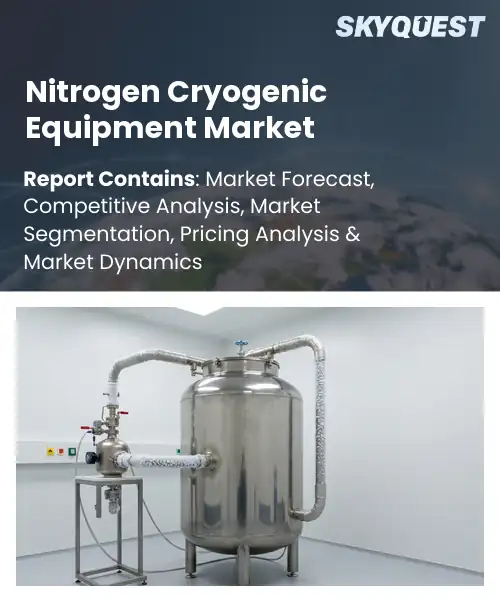
Nitrogen Cryogenic Equipment Market
Report ID: SQMIG20F2065
Report ID: SQMIG20F2065
[email protected]
USA +1 351-333-4748
Report ID:
SQMIG20F2065 |
Region:
Global |
Published Date: May, 2026
Pages:
157
|Tables:
241
|Figures:
81


Global Nitrogen Cryogenic Equipment Market size was valued at USD 3.6 Billion in 2024 and is poised to grow from USD 3.82 Billion in 2025 to USD 6.19 Billion by 2033, growing at a CAGR of 6.2% during the forecast period (2026-2033).
The main driver for the nitrogen cryogenic equipment market growth is rising demand for dependable low-temperature gas delivery across energy, healthcare, and manufacturing circles. This market is a a set of tools used to liquefy, store, move and finally vaporize nitrogen in cryogenic ranges, and it matters because cryogenics makes LNG processing possible, supports semiconductor production, keeps vaccine cold chains stable, and also assists biological preservation. Over the last twenty years the landscape moved from big centralized air separation plants toward more varied choices like on-site liquefiers and portable dewars , and can see it in examples such as LNG terminals pushing regasification, and pharma groups investing in cold storage for mRNA vaccines, which sped up adoption around the globe.Those shifts basically set up a key market lever: technological progress in energy-sparing liquefaction and modular storage, which directly pulls adoption forward by trimming operating costs and unlocking new uses. As cryogenic liquefiers get smaller, more automated, industrial gas buyers in semiconductor fabs and pharmaceutical cold chains can justify on-site systems. That pushes suppliers to deliver scalable packages and service agreements. In plain terms, LNG trucking companies buy cryogenic tanks to spread fuel distribution wider, biobanks use vapor-phase holding for cell lines, and some emerging markets lean into rental arrangements—so the lower total cost of ownership starts the whole “cycle” effect where growth speeds up even more.
IoT is improving operational efficiency in this nitrogen cryogenic equipment space by tying sensors, controllers, and analytics together so the systems behave more proactively. Some key pieces are real time condition watching, predictive upkeep, remote adjustment of set points , and inventory tracking. Right now, the picture shows broader use of connected dewars, valves, and compressors, because customers in pharmaceuticals, semiconductors, and research want higher reliability plus better traceability. Real-world examples include boil off monitoring, used to schedule refill timing more accurately, and networked valve control that cuts leakage risks while keeping purity stable. Collectively, these upgrades reduce the need for constant hands-on work and increase uptime, while also giving operators clearer visibility plus stronger control.
Market snapshot - (2026-2033)
Global Market Size
USD 3.6 Billion
Largest Segment
Cryogenic Tanks
Fastest Growth
Cryogenic Freezers
Growth Rate
6.2% CAGR
To get more insights on this market click here to Request a Free Sample Report
The global nitrogen cryogenic equipment market is segmented by product type, equipment mobility, storage type, temperature range, application, end-use industry, capacity, distribution channel and region. Based on product type, the market is segmented into Cryogenic Tanks, Cryogenic Vaporizers, Cryogenic Pumps, Cryogenic Valves, Cryogenic Piping Systems, Cryogenic Freezers, Cryogenic Dewars, Cryogenic Pressure Vessels and Others. Based on equipment mobility, the market is segmented into Stationary Systems and Portable Systems. Based on storage type, the market is segmented into Bulk Storage Systems, Microbulk Storage Systems and Cylinder-Based Storage Systems. Based on temperature range, the market is segmented into Below -150°C, -150°C to -100°C and Above -100°C. Based on application, the market is segmented into Nitrogen Storage, Nitrogen Transportation, Nitrogen Distribution, Cryopreservation, Industrial Freezing, Inerting & Purging, Cooling Applications and Others. Based on end-use industry, the market is segmented into Healthcare & Biotechnology, Food & Beverage, Electronics & Semiconductor, Chemical & Petrochemical, Metal Processing & Manufacturing, Energy & Power, Aerospace & Defense, Research Laboratories and Others. Based on capacity, the market is segmented into Small Capacity Systems, Medium Capacity Systems and Large Capacity Systems. Based on distribution channel, the market is segmented into Direct Sales, Distributors & Channel Partners and EPC & Industrial System Integrators. Based on region, the market is segmented into North America, Europe, Asia Pacific, Latin America and Middle East & Africa.
As per the nitrogen cryogenic equipment market analysis, the Cryogenic Tanks segment dominates ,because tanks basically form the main storage and handling spine for liquid nitrogen across most end use industries, acting like the core touchpoint between upstream supply and what happens downstream. Their proven designs keep thermal behavior steady ,with low losses during holding, and they work well with bulk distribution setups , which in turn reduces day to day operational fuss and helps meet regulatory expectations. Manufacturers tend to standardize these tanks for safety along with system fit, so adoption keeps spreading ,and it also anchors both procurement plans and the related infrastructure investments through out the whole market.
Still ,Cryogenic Vaporizers are picking up the strongest growth momentum, since on site gasification needs are getting bigger across different industries. Recent improvements in compact vaporizer effectiveness, plus modular installation options, mean deployments get done quicker and fewer operational bottlenecks show up. As manufacturers and processors increasingly want consistent gaseous nitrogen feedstocks, they start spending more on vaporizer solutions ,which opens up fresh retrofit, and aftermarket, paths.
According to the nitrogen cryogenic equipment market forecast, the Nitrogen Storage segment dominates because storage is the foundational requirement that largely defines scale, equipment choices, and logistics across the nitrogen cryogenic equipment market. Having dependable storage capacity supports steady supply for medical uses, industrial operations, and research programs , so investment flows into durable tanks, pressure vessels, and the associated safety controls. That ongoing need for compatible storage options shapes supplier lineups, helps sustain long term service ties , and also steadies demand for complementary cryogenic equipment along with maintenance programs.
On the other hand, Cryopreservation is becoming the fastest rising application area. This is pushed by growth in biobanking, cell therapies, and research groups that require ultra low temperature governance. New portable dewar designs and automated retrieval systems help protect sample integrity while improving operational efficiency. At the same time, more regulatory attention on biological sample traceability is accelerating demand, which unlocks sales of specialized equipment and the related service opportunities.
To get detailed segments analysis, Request a Free Sample Report
As per the nitrogen cryogenic equipment market regional forecast, Asia Pacific ends up leading, not just because of big demand but it’s also because the industrial base is concentrated, plus the manufacturing ecosystem is mature , and cryogenic technologies are well tied into several key end use areas. There is persistent needs coming from semiconductor fabrication, pharmaceutical processing, and chemical production, so buyers keep asking for nitrogen cryogenic equipment that actually works the same way every time , and local suppliers have built specialized know how so they can adjust to different process specs. Research groups and industrial partners also keep pushing collaborative innovation , which helps refine product details and customize faster. And the supply chain looks more settled, with precision engineering clusters that help keep production cost competitive and make deployment quicker. Regulatory settings that back advanced manufacturing and infrastructure investment are doing more heavy lifting too , while cross border strategic partnerships support technology transfer and scaling. On top of that, regional firms tend to stress service networks and aftermarket support so customer relationships don’t just fade after installation.
Japan Nitrogen Cryogenic Equipment Market
Japan Nitrogen Cryogenic Equipment Market looks strong because there’s a long tradition of precision engineering, and manufacturers tend to stay close to the actual process end users. With high technical standards in play, plus demand from semiconductors, materials development, and other advanced manufacturing fields, specialized equipment keeps getting developed. Domestic suppliers try to be strict on quality control , plus they offer customization and bundled service options that keep operations stable. Research institutions and industrial alliances then tune system reliability and efficiency, so buyers lean toward cryogenic solutions that are more tailored.
South Korea Nitrogen Cryogenic Equipment Market
Nitrogen Cryogenic Equipment Market South Korea benefits from having a concentrated electronics and semiconductor environment that pushes for high performance cryogenic solutions. The equipment makers keep strong connections with end users, so customization and incremental improvement happen more smoothly. Manufacturers often highlight compact layouts, energy efficient operation and solid service networks to handle production pressure. Joint efforts with research centers, and some global partners, also help upgrade materials handling methods and process control , which makes locally built cryogenic systems more attractive even for domestic customers.
North America is growing fast, mainly from clustered demand in advanced manufacturing, life sciences, and even energy, all backed by a lively innovation ecosystem. Equipment manufacturers, service providers, and major end users collaborate closely, so adoption of nitrogen cryogenic systems that fit high precision processes can move quickly. Reliability and safety remain core, but there’s also extra focus on integrated maintenance, so aftermarket services become extra important for many buyers. When technical expertise is accessible, and industrial capital is easier to deploy, product innovation and scale up also get supported. Regional regulatory structures that prioritize industrial safety and environmental factors are steering development toward cryogenic solutions that are more efficient, more controllable. Market players are also trying to stand out through system integration, digital monitoring capabilities, and localized support networks.
United States Nitrogen Cryogenic Equipment Market
Nitrogen Cryogenic Equipment Market United States is supported by a strong industrial base that expects dependable cryogenic systems. With pharmaceutical, semiconductor, and aerospace players present at scale, manufacturers see clearer reasons to push advanced equipment adoption and offer custom configurations. Companies, including service providers, tend to prioritize integrated maintenance, remote monitoring, and quick response networks, mainly to reduce unplanned downtime. Partnerships with research laboratories also encourage innovation in materials handling and automation. In addition, regulatory focus on safety and environmental management shapes design decisions and operating practices.
Canada Nitrogen Cryogenic Equipment Market
Nitrogen Cryogenic Equipment Market Canada blends advanced research capacity with an emphasis on life sciences and clean technology use cases. Manufacturers work with universities, plus process operators, to shape nitrogen cryogenic solutions for delicate materials and cold chain requirements. Buyers often look for dependable local service, flexible equipment performance, and procurement guided by environmental compliance. Regional engineering hubs and cooperative programs support improvements in system efficiency and also operator training , which makes the market steadier and strengthens ongoing supplier relationships.
Europe is tightening its grip in the market by mixing technological innovation, a heavy regulatory emphasis on safety and sustainability, and very specific industrial demand that keeps showing up in a steady way. There is also that strong engineering background in a few key countries which helps enable development of resilient, high precision nitrogen cryogenic systems, aimed at complicated processing needs in pharmaceuticals, chemicals, and research environments. Most manufacturers care a lot about system reliability, modular setups , and service integration so they can stay aligned with tough operating requirements. At the same time, cross country collaboration is happening between industry consortia and research centers, it speeds up uptake of more advanced materials handling methods and energy efficient solutions.
Procurement people tend to lean toward suppliers that can prove compliance, offer full aftersales support, and still deliver adaptable configurations. That lets European players compete with more confidence on overall quality and technical sophistication while also responding to shifting priorities from end users. Continuous improvements are supported by investment in research and development, plus a fairly dense web of specialized suppliers. And there’s more focus on digital monitoring , predictive maintenance, and compatibility with wider process control systems which boosts the value for customers who need complex industrial performance.
Germany Nitrogen Cryogenic Equipment Market
The Nitrogen Cryogenic Equipment Market in Germany relies on a long, practical engineering tradition and active chemical processing sectors, which pushes demand toward high quality cryogenic solutions. Local manufacturers usually stress precision engineering, sturdy construction, and service packages that match strict operational standards. The close connections between equipment makers, research institutes and industrial users helps drive innovation, plus it supports customization that fits real workflows. There is also a strong push for export readiness and modular design, so suppliers can handle different international needs while keeping performance integrity steady.
United Kingdom Nitrogen Cryogenic Equipment Market
In the United Kingdom, the Nitrogen Cryogenic Equipment Market benefits from a solid research foundation and from varied demand, spanning pharmaceuticals, precision engineering, and energy related activities. Suppliers focus on dependable system performance, flexible configurations ,and strong aftermarket services, since process requirements can get complex. Collaborative programs between universities and industry help speed up development of thermally efficient, and more digitally enabled solutions. A clear emphasis on operational compliance and targeted support networks strengthens customer trust in tailored cryogenic equipment.
France Nitrogen Cryogenic Equipment Market
In France, the Nitrogen Cryogenic Equipment Market connects chemical and pharmaceutical sectors with research communities to stimulate demand for cryogenic solutions. Manufacturers generally prioritize modular design, safety compliance , and integration with process automation to satisfy practical operational requirements. Strong regional supplier ecosystems and service capabilities support both maintenance cycles and deployment. Ongoing cooperation between industrial groups and technology centers encourages innovation in materials handling and energy efficiency, which improves the competitiveness of French cryogenic systems in both local and international markets.
To know more about the market opportunities by region and country, click here to
Buy The Complete Report
Drivers
Rising Industrial Demand For Nitrogen
Expansion Of Healthcare and Electronics
Restraints
High Capital Expenditure Requirements
Stringent Regulatory Compliance and Safety
Request Free Customization of this report to help us to meet your business objectives.
The competitive landscape for the global nitrogen cryogenic equipment market gets shaped by consolidation, strategic engineering alliances, and, well, more concentrated product innovation. A bunch of that is pulled in by demand from biobanking, semiconductor cooling, space launch, and quantum research. Most players tend to chase M&A, mainly to bolt on gas handling and compressor capabilities, like Chart Industries did when it acquired Howden. Then there are major gas suppliers doubling down with engineering alliances plus onsite nitrogen solutions, to lock in those high value contracts, and keep it all sticky.
Top Player’s Company Profile
Recent Developments in the Nitrogen Cryogenic Equipment Market
SkyQuest’s ABIRAW (Advanced Business Intelligence, Research & Analysis Wing) is our Business Information Services team that Collects, Collates, Correlates, and Analyses the Data collected by means of Primary Exploratory Research backed by robust Secondary Desk research.
As per SkyQuest analysis, the global nitrogen cryogenic equipment market is being propelled mostly by the rising need for dependable low-temperature gas supply across energy , healthcare and manufacturing sectors , and this is being supported by technological improvements in energy-efficient liquefaction and modular storage . those improvements lower operating costs and help make on-site systems more feasible. overall growth is anchored by the dominance of cryogenic tanks as the main storage backbone while Asia Pacific leads regionally, largely because industrial demand is concentrated there and the manufacturing ecosystems are strong. even so , high capital expenditure requirements still constrain adoption among smaller operators , and they can delay onsite deployments. suppliers that focus on scalable modular offerings connected monitoring and service-oriented models are likely the best placed to capture recurring revenue as the market keeps expanding.
| Report Metric | Details |
|---|---|
| Market size value in 2024 | USD 3.6 Billion |
| Market size value in 2033 | USD 6.19 Billion |
| Growth Rate | 6.2% |
| Base year | 2024 |
| Forecast period | (2026-2033) |
| Forecast Unit (Value) | USD Billion |
| Segments covered |
|
| Regions covered | North America (US, Canada), Europe (Germany, France, United Kingdom, Italy, Spain, Rest of Europe), Asia Pacific (China, India, Japan, Rest of Asia-Pacific), Latin America (Brazil, Rest of Latin America), Middle East & Africa (South Africa, GCC Countries, Rest of MEA) |
| Companies covered |
|
| Customization scope | Free report customization with purchase. Customization includes:-
|
To get a free trial access to our platform which is a one stop solution for all your data requirements for quicker decision making. This platform allows you to compare markets, competitors who are prominent in the market, and mega trends that are influencing the dynamics in the market. Also, get access to detailed SkyQuest exclusive matrix.
Table Of Content
Executive Summary
Market overview
Parent Market Analysis
Market overview
Market size
KEY MARKET INSIGHTS
COVID IMPACT
MARKET DYNAMICS & OUTLOOK
Market Size by Region
KEY COMPANY PROFILES
Methodology
For the Nitrogen Cryogenic Equipment Market, our research methodology involved a mixture of primary and secondary data sources. Key steps involved in the research process are listed below:
1. Information Procurement: This stage involved the procurement of Market data or related information via primary and secondary sources. The various secondary sources used included various company websites, annual reports, trade databases, and paid databases such as Hoover's, Bloomberg Business, Factiva, and Avention. Our team did 45 primary interactions Globally which included several stakeholders such as manufacturers, customers, key opinion leaders, etc. Overall, information procurement was one of the most extensive stages in our research process.
2. Information Analysis: This step involved triangulation of data through bottom-up and top-down approaches to estimate and validate the total size and future estimate of the Nitrogen Cryogenic Equipment Market.
3. Report Formulation: The final step entailed the placement of data points in appropriate Market spaces in an attempt to deduce viable conclusions.
4. Validation & Publishing: Validation is the most important step in the process. Validation & re-validation via an intricately designed process helped us finalize data points to be used for final calculations. The final Market estimates and forecasts were then aligned and sent to our panel of industry experts for validation of data. Once the validation was done the report was sent to our Quality Assurance team to ensure adherence to style guides, consistency & design.
Analyst Support
Customization Options
With the given market data, our dedicated team of analysts can offer you the following customization options are available for the Nitrogen Cryogenic Equipment Market:
Product Analysis: Product matrix, which offers a detailed comparison of the product portfolio of companies.
Regional Analysis: Further analysis of the Nitrogen Cryogenic Equipment Market for additional countries.
Competitive Analysis: Detailed analysis and profiling of additional Market players & comparative analysis of competitive products.
Go to Market Strategy: Find the high-growth channels to invest your marketing efforts and increase your customer base.
Innovation Mapping: Identify racial solutions and innovation, connected to deep ecosystems of innovators, start-ups, academics, and strategic partners.
Category Intelligence: Customized intelligence that is relevant to their supply Markets will enable them to make smarter sourcing decisions and improve their category management.
Public Company Transcript Analysis: To improve the investment performance by generating new alpha and making better-informed decisions.
Social Media Listening: To analyze the conversations and trends happening not just around your brand, but around your industry as a whole, and use those insights to make better Marketing decisions.
REQUEST FOR SAMPLE
 REQUEST FREE CUSTOMIZATION
Global Nitrogen Cryogenic Equipment Market size was valued at USD 3.6 Billion in 2024 and is poised to grow from USD 3.82 Billion in 2025 to USD 6.19 Billion by 2033, growing at a CAGR of 6.2% during the forecast period (2026-2033).
The competitive landscape for the global nitrogen cryogenic equipment market is defined by consolidation, strategic engineering alliances, and focused product innovation driven by demand from biobanking, semiconductor cooling, space launch and quantum research. Companies pursue M&A to add gas handling and compressor capabilities, as seen in Chart Industries acquisition of Howden. Major gas suppliers deepen engineering alliances and onsite nitrogen solutions to secure high value contracts. 'Air Liquide', 'Linde plc', 'Air Products and Chemicals, Inc.', 'Chart Industries, Inc.', 'Cryogenic Industries, Inc.', 'INOXCVA', 'Nikkiso Co., Ltd.', 'Parker Hannifin Corporation', 'Taylor-Wharton International LLC', 'Herose GmbH', 'Wessington Cryogenics Ltd', 'FIBA Technologies, Inc.', 'Acme Cryogenics, Inc.', 'Cryofab, Inc.', 'Demaco Holland B.V.', 'VRV S.p.A.', 'Eden Cryogenics LLC', 'Super Cryogenic Systems Pvt. Ltd.', 'Cryogas Equipment Pvt. Ltd.', 'Auguste Cryogenics'
The broadening use of high-purity nitrogen across petrochemical, pharmaceutical, and food processing industries drives demand for reliable cryogenic equipment capable of continuous, large-scale supply. Manufacturers and end users prioritize systems that ensure purity, consistency, and low contamination risk, prompting investment in advanced storage and distribution technology. This persistent industrial need encourages suppliers to expand production capacity and service networks, stimulate innovation in cryogenic design, and foster partnerships that improve accessibility, thereby supporting sustained market growth through increased adoption and longer-term procurement commitments.
Hydrogen Ecosystem Integration: Growing emphasis on decarbonization is driving adoption of nitrogen cryogenic equipment within broader hydrogen supply networks. Manufacturers are positioning systems to interface with hydrogen production purification and storage workflows, enhancing compatibility and facilitating joint project development. This trend promotes collaborative procurement models and longer term service agreements between equipment suppliers and hydrogen developers, reducing installation complexity and improving operational resilience. Vendors are prioritizing modular interfaces materials compatibility and documentation to simplify integration and support faster deployment across industrial mobility applications.
Why does Asia Pacific Dominate the Global Nitrogen Cryogenic Equipment Market? |@12


Want to customize this report? This report can be personalized according to your needs. Our analysts and industry experts will work directly with you to understand your requirements and provide you with customized data in a short amount of time. We offer $1000 worth of FREE customization at the time of purchase.
Feedback From Our Clients


 USA (+1) 351-333-4748

