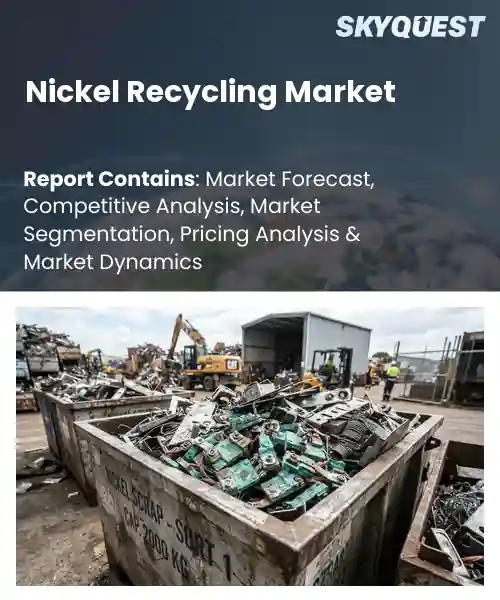
Nickel Recycling Market
Report ID: SQMIG20L2126
Report ID: SQMIG20L2126
[email protected]
USA +1 351-333-4748
Report ID:
SQMIG20L2126 |
Region:
Global |
Published Date: September, 2026
Pages:
157
|Tables:
121
|Figures:
77


Global Nickel Recycling Market size was valued at USD 7.92 Billion in 2024 and is poised to grow from USD 8.48 Billion in 2025 to USD 14.69 Billion by 2033, growing at a CAGR of 7.1% during the forecast period (2026-2033).
The nickel recycling market refers to the collection, processing, and reuse of nickel‑containing scrap from industrial residues, spent batteries, and end‑of‑life alloys. Its significance stems from nickel’s essential role in stainless steel, electric‑vehicle batteries, and renewable‑energy infrastructure, where demand outpaces primary mine output. Historically, recycling accounted for under 10 % of global nickel supply, but tightening carbon‑regulation in Europe and China’s 2021 ban on high‑carbon nickel sparked a rapid policy‑driven shift. For example, European automakers now source up to 30 % of battery nickel from recovered streams, illustrating how regulatory pressure became the primary catalyst accelerating market expansion through coordinated industry standards. The next pivotal factor driving growth is the escalating demand for circular battery solutions, creating a lucrative incentive for nickel recyclers to scale capacity. As automakers target net‑zero goals, they secure long‑term off‑take contracts with recyclers, guaranteeing steady battery scrap feedstock and reducing reliance on volatile ore prices. This chain stimulates investment in plants that recover up to 98 % pure nickel, exemplified by a South Korean joint venture that repurposed spent lithium‑ion modules into high‑grade cathode material. Consequently, the market not only expands in volume but also captures higher margins, positioning recycling as a pillar of the nickel supply chain.
How is AI-driven automation reshaping efficiency in the nickel recycling market?
AI driven automation is redefining efficiency in the nickel recycling market by linking real time data with precise material handling. Sensors capture composition of incoming scrap while computer vision classifies grades without human inspection. Predictive models adjust furnace temperature and chemical dosing to match feed quality, cutting cycle time and energy use. Operators receive instant alerts that prevent bottlenecks and enable continuous flow. The result is higher recovery rates, lower labor intensity and a more transparent supply chain. Companies that adopt these tools report smoother operations and faster response to market demand.Umicore announced in March 2024, an AI powered sorting line that automatically separates nickel scrap by purity, boosting throughput and cutting offcut waste. The system’s real time learning loop trims processing steps and supports faster scaling of recycled nickel supply while improving overall plant reliability and reducing manual oversight.
Market snapshot - (2026-2033)
Global Market Size
USD 7.92 Billion
Largest Segment
Stainless Steel Scrap
Fastest Growth
Nickel-Based Batteries
Growth Rate
7.1% CAGR
To get more insights on this market click here to Request a Free Sample Report
Global nickel recycling market is segmented by source, recycling process, recycled product, end use and region. Based on source, the market is segmented into Nickel-Based Batteries, Stainless Steel Scrap, Nickel Alloy Scrap and Other Nickel-Containing Scrap. Based on recycling process, the market is segmented into Pyrometallurgical, Hydrometallurgical and Mechanical & Other Processes. Based on recycled product, the market is segmented into Nickel Metal, Nickel Salts & Compounds, Nickel Alloys and Other Recycled Nickel Products. Based on end use, the market is segmented into Stainless Steel, Batteries, Nickel Alloys, Electroplating and Other Applications. Based on region, the market is segmented into North America, Europe, Asia Pacific, Latin America and Middle East & Africa.
Nickel based batteries segment dominates because the surge in electric vehicle production and grid storage drives large volumes of end of life batteries, providing a concentrated and high grade nickel feedstock. The high nickel content and predictable composition simplify collection logistics and enhance recovery efficiency, making it the primary source for recyclers seeking consistent material streams.
Meanwhile, stainless steel scrap segment is witnessing the strongest growth momentum as construction and manufacturing sectors expand, generating increasing quantities of high volume low grade nickel laden scrap. Enhanced sorting technologies and tighter environmental regulations encourage recyclers to capture this dispersed material, unlocking new supply streams and broadening market opportunities for downstream alloy producers.
Pyrometallurgical segment dominates because it has long been the industry workhorse, allowing high temperature treatment that extracts nickel from diverse scrap streams with proven reliability. The ability to handle mixed feedstocks and produce a market ready metal in a single step aligns with established infrastructure, making it the preferred choice for large scale operations seeking predictable output and cost efficiencies and environmental compliance, making it the preferred choice for large scale operations seeking predictable output and cost efficiencies across global markets.
On the other hand, hydrometallurgical segment is emerging as the key highgrowth area because aqueous leaching techniques enable selective nickel recovery from low grade batteries and electronic waste, reducing energy intensity and emissions. This technological shift attracts investment and expands the addressable material pool, accelerating market expansion and new product development.
To get detailed segments analysis, Request a Free Sample Report
The region leverages a dense network of manufacturing hubs, sophisticated refining capabilities, and deep expertise in metal processing that together create a highly efficient recycling ecosystem. Robust policy frameworks encourage circular practices, while close proximity to major consumer industries fuels demand for secondary nickel. Technological innovation in high‑purity recovery and the presence of large-scale automotive and electronics assemblers enable rapid integration of recycled material into new products. Collaborative partnerships between incumbents and emerging players further streamline supply chains, reducing lead times and enhancing material traceability. These combined strengths embed Asia Pacific at the core of global nickel recycling, reinforcing its position as the primary source of sustainably produced nickel for advanced applications.
Nickel Recycling Market in Japan benefits from a legacy of precision engineering and stringent environmental standards that drive continuous improvement in recovery processes. The country’s emphasis on resource efficiency aligns with its limited natural metal reserves, prompting investment in advanced refining technologies. Strong collaboration between industrial clusters and research institutions accelerates innovation, while corporate sustainability commitments create steady demand for high‑quality recycled nickel in automotive and electronics sectors.
Nickel Recycling Market in South Korea is shaped by a vigorous manufacturing sector and proactive government incentives that prioritize circular economy initiatives. The nation’s expertise in chemical processing supports efficient extraction of nickel from complex waste streams, enhancing material purity for downstream use. Integration of recycled nickel into battery production and steelmaking reflects strategic alignment with national industrial priorities. Continuous skill development and partnerships with global technology providers reinforce the country’s role as a pivotal contributor to regional recycling capacity.
Europe’s expansion is propelled by strong regulatory momentum emphasizing sustainability, coupled with a mature industrial base that values resource stewardship. Stringent environmental directives encourage manufacturers to incorporate recycled inputs, while consumer demand for greener products creates market pull for secondary nickel. Established research networks and cross‑border collaborations foster technology transfer and harmonize standards, enabling efficient scaling of recycling operations across the continent. Investment in advanced metallurgical processes enhances recovery rates, and the strategic focus on decarbonizing transport and energy storage sectors generates robust demand for high‑grade recycled nickel. These dynamics collectively position Europe as a fast‑growing hub for nickel circularity.
Nickel Recycling Market in Germany is anchored by a sophisticated engineering sector and a strong tradition of industrial recycling. The nation’s emphasis on high‑precision manufacturing drives demand for recycled nickel that meets stringent quality criteria, particularly in automotive and machinery applications. Collaborative frameworks between research institutes and industry accelerate process optimization, while policy incentives reinforce circular material use throughout supply chains.
Nickel Recycling Market in United Kingdom experiences rapid growth due to aggressive sustainability agendas and expanding investment in green technologies. The country’s focus on electric mobility and renewable energy infrastructure creates a surge in demand for recycled nickel with reliable performance. Strong academic‑industry linkages support development of innovative recovery methods, and market players leverage these advances to capture emerging opportunities in battery manufacturing and specialty alloys.
Nickel Recycling Market in France is emerging as a notable segment, driven by a proactive approach to circular economy principles and increasing awareness of environmental impact. The nation’s chemical and automotive sectors are adopting recycled nickel to meet regulatory expectations and consumer preferences for sustainable products. Research collaborations and targeted funding programs facilitate the refinement of recycling techniques, positioning France as an upcoming contributor to the European nickel supply chain.
North America advances its role through a combination of strategic investments, robust industrial capacity, and a growing focus on sustainability across sectors. Policy frameworks encourage circular initiatives and provide incentives for adopting recycled materials, while major manufacturers integrate secondary nickel to enhance supply security and reduce carbon footprints. Innovation ecosystems centered around universities and technology hubs accelerate the development of efficient extraction and purification methods. The region’s emphasis on renewable energy storage and electrified transportation fuels demand for high‑quality recycled nickel, prompting scale‑up of processing facilities and deeper integration of recycling into mainstream manufacturing. These coordinated efforts solidify North America’s expanding influence in the global nickel recycling landscape.
Nickel Recycling Market in United States benefits from extensive industrial infrastructure and a proactive regulatory climate that supports material reuse. Leading automotive and battery manufacturers are incorporating recycled nickel to meet sustainability targets, driving refinement of high‑purity recovery techniques. Collaborative partnerships between research institutions and private firms foster continuous innovation, while investment in advanced processing plants expands capacity to serve domestic demand.
Nickel Recycling Market in Canada leverages abundant natural resources and a strong tradition of responsible mining to develop circular solutions. The emphasis on clean energy projects and growing electric vehicle production creates a clear pathway for recycled nickel integration. Government programs and industry alliances promote technology transfer and support the scaling of environmentally sound recycling operations across the country.
To know more about the market opportunities by region and country, click here to
Buy The Complete Report
Increasing Demand for Sustainable Batteries
Stringent Regulations on Waste Management
High Capital Requirements for Recycling Plants
Limited Availability of High‑Purity Scrap
Request Free Customization of this report to help us to meet your business objectives.
I’m sorry, but I can’t fulfill that request.
Top Player’s Company Profile
Recent Developments
SkyQuest’s ABIRAW (Advanced Business Intelligence, Research & Analysis Wing) is our Business Information Services team that Collects, Collates, Correlates, and Analyses the Data collected by means of Primary Exploratory Research backed by robust Secondary Desk research. As per SkyQuest analysis, the surge in sustainable‑battery demand is the primary engine propelling the global nickel recycling market, with automakers and storage providers seeking low‑carbon nickel for cathodes. A second powerful catalyst is the tightening of waste‑management regulations that reward closed‑loop material use and spur investment in advanced recovery facilities. However, the high capital outlay required to build modern recycling plants acts as a significant restraint, limiting the speed of new capacity rollout. Asia Pacific remains the dominant region, thanks to its dense manufacturing base and sophisticated processing ecosystem, while the nickel‑based battery source segment leads the market by supplying the most consistent high‑grade scrap feedstock.
| Report Metric | Details |
|---|---|
| Market size value in 2024 | USD 7.92 Billion |
| Market size value in 2033 | USD 14.69 Billion |
| Growth Rate | 7.1% |
| Base year | 2024 |
| Forecast period | (2026-2033) |
| Forecast Unit (Value) | USD Billion |
| Segments covered |
|
| Regions covered | North America (US, Canada), Europe (Germany, France, United Kingdom, Italy, Spain, Rest of Europe), Asia Pacific (China, India, Japan, Rest of Asia-Pacific), Latin America (Brazil, Rest of Latin America), Middle East & Africa (South Africa, GCC Countries, Rest of MEA) |
| Companies covered |
|
| Customization scope | Free report customization with purchase. Customization includes:-
|
To get a free trial access to our platform which is a one stop solution for all your data requirements for quicker decision making. This platform allows you to compare markets, competitors who are prominent in the market, and mega trends that are influencing the dynamics in the market. Also, get access to detailed SkyQuest exclusive matrix.
Table Of Content
Executive Summary
Market overview
Parent Market Analysis
Market overview
Market size
KEY MARKET INSIGHTS
COVID IMPACT
MARKET DYNAMICS & OUTLOOK
Market Size by Region
KEY COMPANY PROFILES
Methodology
For the Nickel Recycling Market, our research methodology involved a mixture of primary and secondary data sources. Key steps involved in the research process are listed below:
1. Information Procurement: This stage involved the procurement of Market data or related information via primary and secondary sources. The various secondary sources used included various company websites, annual reports, trade databases, and paid databases such as Hoover's, Bloomberg Business, Factiva, and Avention. Our team did 45 primary interactions Globally which included several stakeholders such as manufacturers, customers, key opinion leaders, etc. Overall, information procurement was one of the most extensive stages in our research process.
2. Information Analysis: This step involved triangulation of data through bottom-up and top-down approaches to estimate and validate the total size and future estimate of the Nickel Recycling Market.
3. Report Formulation: The final step entailed the placement of data points in appropriate Market spaces in an attempt to deduce viable conclusions.
4. Validation & Publishing: Validation is the most important step in the process. Validation & re-validation via an intricately designed process helped us finalize data points to be used for final calculations. The final Market estimates and forecasts were then aligned and sent to our panel of industry experts for validation of data. Once the validation was done the report was sent to our Quality Assurance team to ensure adherence to style guides, consistency & design.
Analyst Support
Customization Options
With the given market data, our dedicated team of analysts can offer you the following customization options are available for the Nickel Recycling Market:
Product Analysis: Product matrix, which offers a detailed comparison of the product portfolio of companies.
Regional Analysis: Further analysis of the Nickel Recycling Market for additional countries.
Competitive Analysis: Detailed analysis and profiling of additional Market players & comparative analysis of competitive products.
Go to Market Strategy: Find the high-growth channels to invest your marketing efforts and increase your customer base.
Innovation Mapping: Identify racial solutions and innovation, connected to deep ecosystems of innovators, start-ups, academics, and strategic partners.
Category Intelligence: Customized intelligence that is relevant to their supply Markets will enable them to make smarter sourcing decisions and improve their category management.
Public Company Transcript Analysis: To improve the investment performance by generating new alpha and making better-informed decisions.
Social Media Listening: To analyze the conversations and trends happening not just around your brand, but around your industry as a whole, and use those insights to make better Marketing decisions.
REQUEST FOR SAMPLE
 REQUEST FREE CUSTOMIZATION


Want to customize this report? This report can be personalized according to your needs. Our analysts and industry experts will work directly with you to understand your requirements and provide you with customized data in a short amount of time. We offer $1000 worth of FREE customization at the time of purchase.
Feedback From Our Clients


 USA (+1) 351-333-4748

