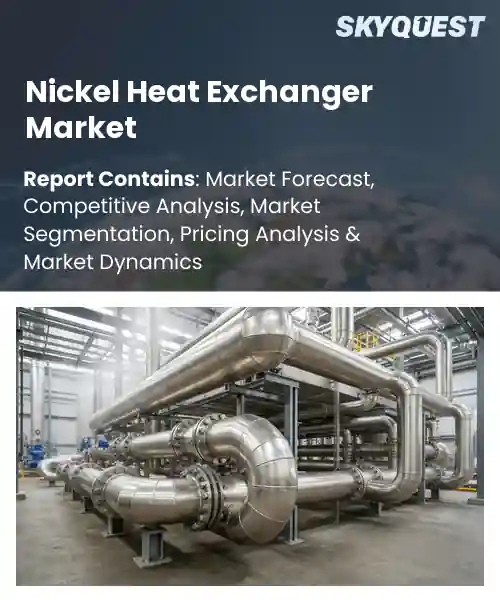
Nickel Heat Exchanger Market
Report ID: SQMIG20I2657
Report ID: SQMIG20I2657
[email protected]
USA +1 351-333-4748
Report ID:
SQMIG20I2657 |
Region:
Global |
Published Date: February, 2026
Pages:
157
|Tables:
229
|Figures:
81


Global Nickel Heat Exchanger Market size was valued at USD 81.3 Million in 2024 and is poised to grow from USD 86.02 Million in 2025 to USD 135.04 Million by 2033, growing at a CAGR of 5.8% during the forecast period (2026-2033).
Corrosion resistance and high temperature performance are the primary drivers of the nickel heat exchanger market because industries demand durable materials that preserve thermal efficiency under aggressive conditions. This market covers production and supply of heat exchangers made from nickel and nickel alloys for chemical plants, oil and gas facilities, power and marine systems and matters due to the high cost of failures and downtime. Historically the sector moved from carbon steel to stainless steel and then to high nickel alloys when regulators tightened standards and processing streams grew more corrosive, as in LNG regasification and offshore processing, enhancing longevity.Building on the longevity imperative, a central market driver is the energy transition with tighter environmental regulation, prompting operators to choose alloys that tolerate novel chemistries and higher efficiencies. Consequently plants invest in nickel heat exchangers for sour gas processing, hydrogen production and waste heat recovery, which increases demand for specialized fabrication and alloy supply. Examples include LNG liquefaction trains and carbon capture modules that require compact, corrosion resistant exchangers, creating opportunities for premium design, aftermarket services and recycling. Concurrent nickel supply constraints further elevate prices and push manufacturers toward alloy innovation and fabrication optimization and improving lifecycle economic returns.
How is AI transforming the nickel heat exchanger market?
AI is reshaping the nickel heat exchanger market by improving design, reliability, and service models. Key aspects include AI enabled design optimization that adapts flow geometry to nickel alloy performance, predictive maintenance that spots fouling and corrosion early, and process control that stabilizes manufacturing steps for brazed and welded assemblies. The current market favors compact and high integrity designs where digital twin and machine learning tools speed development and lower lifetime costs. Operators now combine sensor streams and analytics to tune operation and extend service intervals, making nickel based exchangers more attractive for harsh chemical and energy applications.Alfa Laval March 2025, showcased performance monitoring and predictive maintenance for plate and Packinox heat exchangers, illustrating how AI driven analytics and digital twin tools cut unplanned downtime and improve thermal efficiency and operating economics for nickel alloy exchanger applications.
Market snapshot - (2026-2033)
Global Market Size
USD 81.3 Million
Largest Segment
Shell and Tube
Fastest Growth
Plate Heat Exchanger
Growth Rate
5.8% CAGR
To get more insights on this market click here to Request a Free Sample Report
Global nickel heat exchanger market is segmented by product type, material composition, design configuration, pressure range, temperature range, installation type, application industry, end-user and region. Based on product type, the market is segmented into Shell and Tube, Plate Heat Exchanger, Air Cooled Heat Exchanger and Other Types. Based on material composition, the market is segmented into Pure Nickel, Nickel-Copper Alloys, Nickel-Chromium Alloys, Nickel-Molybdenum Alloys and Other Nickel-Based Alloys. Based on design configuration, the market is segmented into Compact Design and Modular Design. Based on pressure range, the market is segmented into Low Pressure, Medium Pressure and High Pressure. Based on temperature range, the market is segmented into Low Temperature, Medium Temperature and High Temperature. Based on installation type, the market is segmented into New Installation and Replacement / Retrofit. Based on application industry, the market is segmented into Chemical Processing, Oil & Gas, Power Generation, HVAC, Food & Beverage and Others. Based on end-user, the market is segmented into Industrial Users, Commercial Users and Residential Users. Based on region, the market is segmented into North America, Europe, Asia Pacific, Latin America and Middle East & Africa.
Shell and Tube segment dominates because its robust cylindrical construction and straightforward flow paths enable reliable handling of high pressures and temperatures common in demanding process environments. Compatibility with nickel materials allows long service life under corrosive and fouling conditions, and modular bundle designs facilitate maintenance and customization, which causes broad adoption by industries requiring durable, easily serviced heat transfer solutions. This proven performance reduces downtime risks and supports predictable lifecycle costs for operators.
However, Plate Heat Exchanger is witnessing the strongest growth momentum as its thin plate channels deliver exceptional thermal performance and compact footprints that address space and energy efficiency pressures. Advances in nickel based fabrication and gasketless brazed designs are increasing adoption across retrofit and new installations, unlocking opportunities in sectors prioritizing efficiency and reduced material use.
Nickel-Copper Alloys segment leads because the alloy combination balances excellent corrosion resistance in seawater and chloride bearing environments with favorable thermal conductivity and manufacturability, making it widely specified in industrial heat exchangers. Its adaptability to diverse exchanger geometries and compatibility with standard welding and fabrication practices reduces installation complexity, which increases preference among designers and operators of corrosive process systems. This translates into lower total cost of ownership and more predictable maintenance cycles for asset managers.
On the other hand, Nickel-Molybdenum Alloys are emerging as the fastest growing composition due to superior resistance to pitting and crevice corrosion in aggressive acid environments and at elevated temperatures. Innovations in alloy processing and rising demand from harsh chemical applications are accelerating adoption and unlocking new market opportunities.
To get detailed segments analysis, Request a Free Sample Report
Asia Pacific dominates the global nickel heat exchanger market due to a combination of concentrated industrial demand and established materials expertise. Major manufacturing hubs support integrated supply chains that connect alloy producers, fabricators, and end users in petrochemicals, power generation, and marine sectors. Regional firms emphasize corrosion resistant designs and high alloy procurement, enabling rapid customization for aggressive process environments. Proximity to large process plants and shipyards reduces lead times and supports extensive aftermarket services and maintenance networks. Public and private investments in specialized fabrication capacity and technical training further strengthen capabilities. Collaborative relationships between suppliers and industrial operators promote tailored solutions, while export oriented producers leverage scale to serve global projects, reinforcing Asia Pacific leadership in both advanced products and cost effective delivery.
Nickel Heat Exchanger Market in Japan benefits from advanced metallurgy and precise fabrication that deliver highly engineered corrosion resistant solutions. Domestic manufacturers emphasize rigorous quality standards and close collaboration with process OEMs across chemical, power and electronics sectors. Deep materials expertise and disciplined production practices enable reliable performance in demanding environments while extensive service networks support maintenance and long term operational stability while extending export reach and industry collaboration globally.
Nickel Heat Exchanger Market in South Korea leverages heavy industry demand and advanced shipbuilding capability to sustain extensive alloy use and precision fabrication. Suppliers work closely with process operators to deliver tailored designs for corrosive service and accelerate project timelines. Focused welding expertise and factory assembly enable complex exchanger configurations while export orientation and supplier networks position South Korea as a reliable source of high performance nickel heat exchanger solutions.
Europe is experiencing rapid expansion in nickel heat exchanger demand as industrial operators undertake material upgrades and process retrofits to meet stricter corrosion and durability requirements across refining, chemical and power segments. Emphasis on long term asset resilience and compliance with rigorous engineering standards drives adoption of nickel alloys for hostile service conditions. Regional growth is further supported by concentrated engineering expertise, a robust aftermarket for maintenance and replacement, and collaborative projects that integrate advanced materials with system level designs. National strategies prioritizing infrastructure modernization and energy transition related projects encourage investment in high performance heat exchangers. Strong supplier networks and engineering consultancies translate technical requirements into tailored solutions, reinforcing Europe as a dynamic market for nickel based thermal equipment.
Nickel Heat Exchanger Market in Germany is anchored by deep engineering capacity with a strong industrial base that emphasizes reliability and standards. Local fabricators and materials specialists collaborate with end users in chemical and heavy industries to deliver robust heat exchanger solutions. Integration of design methods and quality practices supports complex integrity applications while established supplier networks and exports consolidate Germany as a dominant market for nickel based thermal equipment.
Nickel Heat Exchanger Market in United Kingdom reflects refurbishment and adaptation of assets, driving demand for corrosion resistant replacements. Energy sector initiatives, offshore activity and a strong services ecosystem focused on retrofit underpin market momentum. Engineering consultancies and fabricators work together to develop modular exchanger designs that simplify maintenance and installation. A flexible supplier base and aftermarket capability position United Kingdom as a growing market for nickel based heat exchangers.
Nickel Heat Exchanger Market in France is an emerging segment supported by an industrial mix and engineering capability. Interest from chemical, refining and energy sectors in durable corrosion resistant solutions drives adoption of nickel alloys. Fabricators combine materials expertise with collaborative development to pilot exchanger concepts. Emphasis on lifecycle performance and system integration promotes market maturation while local service networks enable maintenance and support and drive innovation and exports broadly.
North America is strengthening its role in the nickel heat exchanger market through a combination of localized production enhancements, materials research and closer integration between suppliers and end users. Industry participants prioritize retrofit and replacement programs to improve asset longevity in aggressive service conditions, while fabricators refine welding and joining capabilities for high alloy assemblies. Strategic sourcing and supply chain coordination reduce lead times for specialized alloys, and engineering firms translate process needs into tailored exchanger designs. An expanding aftermarket ecosystem provides maintenance and life extension services, encouraging operator confidence in nickel based solutions. Collaborative initiatives among manufacturers, utilities and industrial operators further embed advanced exchanger technologies across power, petrochemical and industrial segments. Investment in workforce training and certification, combined with pilot projects that validate performance in demanding environments, accelerates market acceptance and fosters supplier competitiveness in domestic and export markets.
Nickel Heat Exchanger Market in United States is driven by industrial infrastructure requiring durable corrosion resistant equipment across refining, petrochemical and power sectors. Domestic fabricators and engineering houses develop exchanger solutions to meet site specific process demands, emphasizing welding integrity and material traceability. Aftermarket services and consulting support installation and lifecycle management. Cooperation between suppliers and major operators facilitates adoption of nickel alloys for critical applications and enhances production capability.
Nickel Heat Exchanger Market in Canada is influenced by proximity to resource supply chains and industrial activity in energy and mining sectors. Canadian fabricators focus on durable corrosion resistant designs suited to cold climates and operating conditions. Collaboration with engineering consultancies and aftermarket service providers ensures reliable performance. Trade and partnerships with suppliers extend capability while technical expertise supports adoption of nickel alloy solutions in demanding applications and export opportunities.
To know more about the market opportunities by region and country, click here to
Buy The Complete Report
Increasing Demand From Chemical Industry
The chemical industry's requirement for reliable heat transfer and corrosion resistance in processing environments drives demand for nickel based heat exchangers, as their material properties enhance longevity and reduce downtime; manufacturers seeking stable operations and lower maintenance favor nickel alloys for handling aggressive fluids and high temperatures, which supports wider adoption across process industries. This preference encourages suppliers to expand production capacity and offer tailored designs, fostering market growth through increased specification of nickel exchangers in new projects and replacement applications.
Rising Energy Efficiency Requirements
Stricter energy efficiency standards and industry emphasis on reducing operational costs prompt process and power plants to prefer heat exchangers that deliver superior thermal performance, positioning nickel heat exchangers as an attractive option due to their ability to maintain efficient heat transfer under demanding conditions; this preference for higher performing equipment spurs procurement decisions that favor nickel alloys, motivating manufacturers to innovate designs and promote these products, thereby supporting market expansion through specification changes and replacement of less efficient units with nickel based solutions.
High Raw Material Costs
Volatility and elevated prices of nickel feedstock increase production costs for heat exchanger manufacturers, which can deter adoption by cost sensitive end users and slow procurement cycles; purchasers facing constrained budgets may opt for alternative materials or delay upgrades, reducing immediate demand growth. Additionally, higher input costs compress manufacturer margins, limiting investments in capacity expansion and innovation, which in turn constrains the market's ability to respond to rising specification needs and dampens momentum for broader adoption of nickel based heat exchangers across various industries.
Corrosion And Fouling Challenges
Persistent corrosion and fouling issues in certain process fluids and operational conditions raise lifecycle maintenance requirements for nickel heat exchangers, increasing operational interruptions and service complexity; end users may perceive heightened maintenance burdens and associated downtime risks, which can reduce willingness to adopt nickel solutions for specific applications. The need for specialized cleaning procedures and qualified maintenance resources can further elevate ownership costs and procedural hurdles, thereby restraining broader market uptake where operators prioritize low maintenance or simpler system solutions overall.
Request Free Customization of this report to help us to meet your business objectives.
The competitive landscape for the global nickel heat exchanger market is defined by consolidation, cross sector partnerships, and rapid adoption of additive manufacturing. Incumbents pursue bolt on acquisitions to secure fabrication capacity and alloy supply, while engineering firms partner with AM vendors to print nickel alloy cores. Venture-backed specialists and PCHE focused startups push niche product innovation, forcing legacy suppliers to pursue licensing, strategic JV and targeted M&A to defend contracts.
Top Player’s Company Profile
Recent Developments
SkyQuest’s ABIRAW (Advanced Business Intelligence, Research & Analysis Wing) is our Business Information Services team that Collects, Collates, Correlates, and Analyses the Data collected by means of Primary Exploratory Research backed by robust Secondary Desk research. As per SkyQuest analysis, the global nickel heat exchanger market is driven primarily by the need for corrosion resistance and high temperature performance that extend asset life in aggressive process environments and secondly by the energy transition and rising energy efficiency requirements pushing operators toward higher performance alloys. Growth is restrained by high raw material and feedstock costs that pressure supplier margins and slow procurement. Asia Pacific emerges as the dominating region thanks to integrated supply chains, fabrication capacity and concentrated industrial demand, while shell and tube exchangers remain the dominating segment due to their robustness for high pressure and temperature service. The market favors modular, compact and digitally enabled solutions.
| Report Metric | Details |
|---|---|
| Market size value in 2024 | USD 81.3 Million |
| Market size value in 2033 | USD 135.04 Million |
| Growth Rate | 5.8% |
| Base year | 2024 |
| Forecast period | (2026-2033) |
| Forecast Unit (Value) | USD Million |
| Segments covered |
|
| Regions covered | North America (US, Canada), Europe (Germany, France, United Kingdom, Italy, Spain, Rest of Europe), Asia Pacific (China, India, Japan, Rest of Asia-Pacific), Latin America (Brazil, Rest of Latin America), Middle East & Africa (South Africa, GCC Countries, Rest of MEA) |
| Companies covered |
|
| Customization scope | Free report customization with purchase. Customization includes:-
|
To get a free trial access to our platform which is a one stop solution for all your data requirements for quicker decision making. This platform allows you to compare markets, competitors who are prominent in the market, and mega trends that are influencing the dynamics in the market. Also, get access to detailed SkyQuest exclusive matrix.
Table Of Content
Executive Summary
Market overview
Parent Market Analysis
Market overview
Market size
KEY MARKET INSIGHTS
COVID IMPACT
MARKET DYNAMICS & OUTLOOK
Market Size by Region
KEY COMPANY PROFILES
Methodology
For the Nickel Heat Exchanger Market, our research methodology involved a mixture of primary and secondary data sources. Key steps involved in the research process are listed below:
1. Information Procurement: This stage involved the procurement of Market data or related information via primary and secondary sources. The various secondary sources used included various company websites, annual reports, trade databases, and paid databases such as Hoover's, Bloomberg Business, Factiva, and Avention. Our team did 45 primary interactions Globally which included several stakeholders such as manufacturers, customers, key opinion leaders, etc. Overall, information procurement was one of the most extensive stages in our research process.
2. Information Analysis: This step involved triangulation of data through bottom-up and top-down approaches to estimate and validate the total size and future estimate of the Nickel Heat Exchanger Market.
3. Report Formulation: The final step entailed the placement of data points in appropriate Market spaces in an attempt to deduce viable conclusions.
4. Validation & Publishing: Validation is the most important step in the process. Validation & re-validation via an intricately designed process helped us finalize data points to be used for final calculations. The final Market estimates and forecasts were then aligned and sent to our panel of industry experts for validation of data. Once the validation was done the report was sent to our Quality Assurance team to ensure adherence to style guides, consistency & design.
Analyst Support
Customization Options
With the given market data, our dedicated team of analysts can offer you the following customization options are available for the Nickel Heat Exchanger Market:
Product Analysis: Product matrix, which offers a detailed comparison of the product portfolio of companies.
Regional Analysis: Further analysis of the Nickel Heat Exchanger Market for additional countries.
Competitive Analysis: Detailed analysis and profiling of additional Market players & comparative analysis of competitive products.
Go to Market Strategy: Find the high-growth channels to invest your marketing efforts and increase your customer base.
Innovation Mapping: Identify racial solutions and innovation, connected to deep ecosystems of innovators, start-ups, academics, and strategic partners.
Category Intelligence: Customized intelligence that is relevant to their supply Markets will enable them to make smarter sourcing decisions and improve their category management.
Public Company Transcript Analysis: To improve the investment performance by generating new alpha and making better-informed decisions.
Social Media Listening: To analyze the conversations and trends happening not just around your brand, but around your industry as a whole, and use those insights to make better Marketing decisions.
REQUEST FOR SAMPLE
 REQUEST FREE CUSTOMIZATION


Want to customize this report? This report can be personalized according to your needs. Our analysts and industry experts will work directly with you to understand your requirements and provide you with customized data in a short amount of time. We offer $1000 worth of FREE customization at the time of purchase.
Feedback From Our Clients


 USA (+1) 351-333-4748

