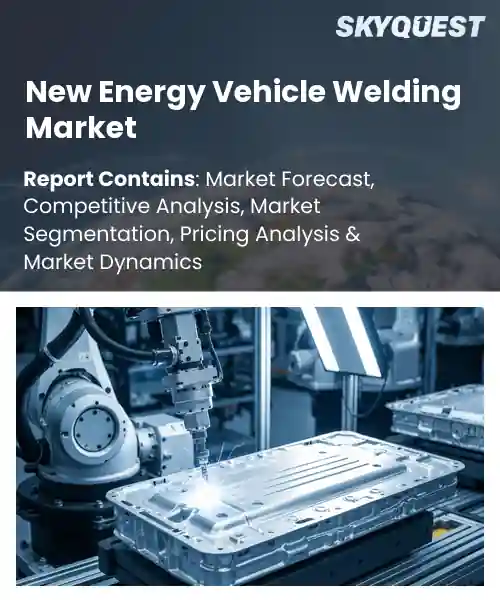
New Energy Vehicle Welding Market
Report ID: SQMIG20I3403
Report ID: SQMIG20I3403
[email protected]
USA +1 351-333-4748
Report ID:
SQMIG20I3403 |
Region:
Global |
Published Date: July, 2026
Pages:
157
|Tables:
118
|Figures:
77


Global New Energy Vehicle Welding Market size was valued at USD 2.14 Billion in 2024 and is poised to grow from USD 2.24 Billion in 2025 to USD 3.26 Billion by 2033, growing at a CAGR of 4.8% during the forecast period (2026-2033).
The global new energy vehicle welding industry has become a pivotal part of the automotive supply chain, driven mainly by the surge in electric and hybrid car production. Stricter emissions regulations push manufacturers to increase NEV output, which raises demand for welding capable of joining lightweight aluminum and steel while preserving structural integrity. Early adopters such as Tesla and BYD demonstrate the shift; Tesla’s Model 3 uses laser‑bow joint welding to cut panel count, and BYD’s e6 relies on resistance spot welding for battery enclosures.
During decade market grew from niche vendors to multinational firms investing in robotics, mirroring sustainability goals. The most influential factor shaping the NEV welding market is the shift toward automation in vehicle assembly lines, which accelerates production speed and reduces human error. As manufacturers scale output to meet rising demand, they adopt laser and friction stir welding robots that operate, lowering cycle times and enabling panel designs that improve range. For instance, Volkswagen’s Chattanooga plant installed laser welding cells to assemble its ID.4 battery pack frames, cutting assembly time by 30 percent. This trend creates opportunities for suppliers of AI vision systems and IoT‑linked monitoring, because defect detection becomes to maintain safety standards and keep costs competitive.
How is AI-driven automation reshaping the new energy vehicle welding market?
AI-driven automation is transforming the welding processes that build new energy vehicle frames. Machine learning models optimize laser parameters, reducing defects and cycle time. Robotic arms equipped with vision systems adapt to different battery pack designs, allowing flexible production lines. The market now favors suppliers that integrate AI with traditional welding equipment, and manufacturers report smoother assembly and higher consistency. AI also predicts tool wear, allowing maintenance before breakdowns. Robots fire only when needed, cutting energy use and supporting the sustainability goals of electric vehicle makers.
General Motors in June 2025, introduced AI‑controlled welding robots on its Berlin plant, demonstrating how intelligent automation can shorten assembly cycles and improve joint quality. The rollout showcases the technology’s role in boosting production efficiency and reinforcing the market’s shift toward smarter, greener manufacturing and sets a benchmark for other OEMs.
Market snapshot - (2026-2033)
Global Market Size
USD 2.14 Billion
Largest Segment
Laser Welding
Fastest Growth
Friction Stir
Growth Rate
4.8% CAGR
To get more insights on this market click here to Request a Free Sample Report
Global new energy vehicle welding market is segmented by technology type, components welded, automation level, end use industry and region. Based on technology type, the market is segmented into Laser Welding, Resistance Welding, Friction Stir, Ultrasonic Welding and Others. Based on components welded, the market is segmented into Battery Packs, Drive Motors, Body Chassis and Power Electronics. Based on automation level, the market is segmented into Fully Automated and Semi Automated. Based on end use industry, the market is segmented into Electric Vehicle OEMs and Tier 1 Component Suppliers. Based on region, the market is segmented into North America, Europe, Asia Pacific, Latin America and Middle East & Africa.
Laser welding segment dominates with large new energy vehicle welding market share because its precision and high energy density enable seamless joining of thin metal sheets and complex geometries essential for electric vehicle structures. The process minimizes heat‑affected zones, preserving material strength, which matches manufacturers’ demand for lightweight yet robust frames. Compatibility with automated production lines further reinforces adoption, creating a virtuous cycle of efficiency and quality that places laser welding at the forefront of the market.
As per new energy vehicle welding market outlook, friction stir welding emerges as the fastest growing technology because its solid‑state process eliminates melting, reducing distortion and enabling strong joints in high‑strength alloys used for chassis and battery enclosures. Rising adoption of lightweight designs and regulatory pressure for safety drive its expansion, opening new opportunities for advanced vehicle architectures.
Battery packs segment dominates because welding is critical to achieving the electrical integrity and mechanical resilience required for high‑energy density modules. The need for reliable interconnects and sealed enclosures drives the adoption of specialized welding techniques that ensure low resistance and robust thermal management. As vehicle ranges extend, manufacturers prioritize pack durability, reinforcing the central role of battery‑pack welding in the New Energy Vehicle Welding Market.
Conversely, power electronics welding witnesses the strongest growth momentum because expanding inverter and charger architectures demand precise, high‑speed joins for copper and aluminum pathways. The shift toward higher voltage systems and silicon‑carbide devices intensifies the need for reliable, low‑inductance connections, spurring rapid adoption of advanced welding that unlocks greater efficiency and performance in electric drivetrains.
To get detailed segments analysis, Request a Free Sample Report
Asia Pacific leads the global landscape through a confluence of deep automotive engineering expertise, extensive supply chain integration, and aggressive policy encouragement for clean‑energy mobility. The region benefits from a mature component ecosystem that accelerates technology transfer and supports high‑volume production with precision welding techniques. Strong collaboration between original equipment manufacturers and specialty welding firms fuels continuous innovation in lightweight structures and high‑strength joint solutions. Government initiatives that prioritize low‑emission vehicle adoption create a robust demand pipeline, while the presence of world‑class research institutions ensures a steady flow of advanced materials knowledge. Together these factors cement Asia Pacific’s position as the primary driver of new energy vehicle welding capabilities worldwide.
As per new energy vehicle welding market regional outlook, Japan thrives on a legacy of precision engineering and a culture of continuous improvement. Domestic manufacturers leverage sophisticated laser and resistance welding technologies to meet exacting quality standards for battery housings and chassis components. Collaborative research programmes between industry and academia accelerate the development of ultra‑thin, high‑strength joints that support lightweight vehicle architectures. Robust supplier networks ensure rapid material sourcing, while policy frameworks reinforce investment in next‑generation welding equipment and workforce training.
As per new energy vehicle welding market regional forecast, South Korea is propelled by a strong focus on high‑tech manufacturing and a proactive stance on electromobility. Leading automotive groups integrate advanced spot and friction welding processes to achieve rapid cycle times and superior joint integrity for electric drivetrains. Strategic government incentives foster the establishment of specialized welding hubs that concentrate expertise and promote technology sharing. The country’s emphasis on skilled labor development and automation enhances production efficiency, positioning South Korea as a pivotal contributor to the regional welding ecosystem.
Europe’s expansion is driven by ambitious decarbonization goals, rigorous safety standards, and a vibrant ecosystem of automotive innovators committed to electrification. The continent’s strong emphasis on sustainability pushes manufacturers to adopt advanced welding solutions that enable lighter, more efficient vehicle structures. Collaborative clusters of research institutes and specialized welding firms accelerate the rollout of high‑performance, low‑energy joining techniques, particularly for battery modules and structural components. Regulatory frameworks that mandate stringent emissions performance inspire continuous investment in welding automation and material science. Moreover, a well‑established supply base, coupled with a skilled engineering workforce, supports rapid adaptation to evolving design requirements, propelling Europe’s welding sector to the forefront of the new energy vehicle transition.
Germany benefits from a deep engineering heritage and a concentration of premium automotive manufacturers. The sector emphasizes precision laser welding and high‑strength adhesive hybrid solutions to meet demanding performance criteria for electric vehicle frames and battery enclosures. Integrated research networks foster the development of novel welding processes that address lightweighting and durability concerns. Strong industrial policy and a commitment to vocational excellence ensure a steady pipeline of skilled technicians, reinforcing Germany’s dominant role in the European welding landscape.
United Kingdom is emerging through a blend of innovative startups and established automotive suppliers. Focus on flexible welding technologies, such as ultrasonic and resistance spot welding, supports rapid prototyping and low‑volume production of electric vehicle components. Government initiatives that encourage green manufacturing stimulate investment in advanced welding equipment and digitalization. Collaborative hubs linking universities with industry accelerate knowledge transfer, positioning the United Kingdom as an increasingly influential player in the European welding arena.
France is experiencing the fastest growth as manufacturers pursue aggressive electrification strategies. Emphasis on high‑efficiency welding processes, particularly for battery pack assembly, drives the adoption of state‑of‑the‑art equipment that reduces cycle time while maintaining joint quality. Strong public‑private partnerships fund research into innovative joining methods that support lightweight vehicle architectures. A skilled labor force combined with a supportive regulatory environment fuels rapid expansion, making France a key catalyst for Europe’s welding advancement.
North America reinforces its position through a combination of robust innovation ecosystems, sizable investment in advanced manufacturing, and a strategic focus on electrified powertrains. The region’s leading automotive firms prioritize the integration of high‑speed resistance and laser welding technologies to meet the demanding specifications of electric vehicle chassis and battery systems. Strong collaboration between research universities, technology providers, and OEMs accelerates the development of next‑generation joint designs that enhance structural integrity and reduce vehicle weight. Government incentives that encourage clean‑energy vehicle adoption, together with a mature supply chain for high‑performance steels and alloys, create a fertile environment for welding technology adoption. Additionally, a commitment to workforce upskilling and digital manufacturing ensures that North America remains at the cutting edge of new energy vehicle welding capabilities.
United States is anchored by leading OEMs that champion large‑scale adoption of advanced welding solutions for electric vehicle platforms. Investment in high‑precision laser welding and automated spot welding lines accelerates production throughput while preserving stringent quality standards. Partnerships with research institutions drive breakthroughs in welding of novel battery materials and lightweight composites. Federal programs that promote clean transportation underpin continued capital allocation toward sophisticated welding equipment and skilled technician development, reinforcing the United States’ leadership in the sector.
Canada benefits from a strong emphasis on sustainable manufacturing and a collaborative network of welding specialists. Focus on low‑energy resistance welding and hybrid adhesive‑welding techniques supports the assembly of battery modules and structural frames optimized for cold‑climate performance. Government support for green technology adoption encourages the deployment of cutting‑edge welding equipment across the supply chain. Close ties between academic research centers and industry accelerate innovation in joint design, positioning Canada as an emerging hub for advanced welding solutions in the North American market.
To know more about the market opportunities by region and country, click here to
Buy The Complete Report
Increasing Government Incentives
Advancements In Laser Welding
High Equipment Capital Costs
Limited Skilled Workforce Availability
Request Free Customization of this report to help us to meet your business objectives.
The competitive landscape is shaped by major automakers such as General Motors, Ford and Volkswagen intensifying in‑house battery and welding capabilities to secure supply chains, while well‑funded startups are entering the market with advanced welding automation and virtual‑power‑plant integration, prompting a wave of strategic partnerships and large‑scale funding rounds.
SkyQuest’s ABIRAW (Advanced Business Intelligence, Research & Analysis Wing) is our Business Information Services team that Collects, Collates, Correlates, and Analyses the Data collected by means of Primary Exploratory Research backed by robust Secondary Desk research.
As per SkyQuest analysis, the global new energy vehicle welding market growth propelled primarily by increasing government incentives that lower development costs and accelerate adoption of advanced welding technologies, while a second strong catalyst is the rapid advancement of laser welding which delivers higher precision, lighter structures and faster production lines. The market’s growth is tempered by the high equipment capital costs that deter smaller suppliers from upgrading to modern systems. Asia Pacific currently dominates the landscape due to its deep supply‑chain integration and supportive policies, and laser welding leads as the prevailing segment, driving the majority of volume and innovation. The global new energy vehicle welding market trend due to the expansion of electric vehicle (EV) production, increasing demand for lightweight vehicle structures, and the need for advanced manufacturing technologies.
| Report Metric | Details |
|---|---|
| Market size value in 2024 | USD 2.14 Billion |
| Market size value in 2033 | USD 3.26 Billion |
| Growth Rate | 4.8% |
| Base year | 2024 |
| Forecast period | (2026-2033) |
| Forecast Unit (Value) | USD Billion |
| Segments covered |
|
| Regions covered | North America (US, Canada), Europe (Germany, France, United Kingdom, Italy, Spain, Rest of Europe), Asia Pacific (China, India, Japan, Rest of Asia-Pacific), Latin America (Brazil, Rest of Latin America), Middle East & Africa (South Africa, GCC Countries, Rest of MEA) |
| Companies covered |
|
| Customization scope | Free report customization with purchase. Customization includes:-
|
To get a free trial access to our platform which is a one stop solution for all your data requirements for quicker decision making. This platform allows you to compare markets, competitors who are prominent in the market, and mega trends that are influencing the dynamics in the market. Also, get access to detailed SkyQuest exclusive matrix.
Table Of Content
Executive Summary
Market overview
Parent Market Analysis
Market overview
Market size
KEY MARKET INSIGHTS
COVID IMPACT
MARKET DYNAMICS & OUTLOOK
Market Size by Region
KEY COMPANY PROFILES
Methodology
For the New Energy Vehicle Welding Market, our research methodology involved a mixture of primary and secondary data sources. Key steps involved in the research process are listed below:
1. Information Procurement: This stage involved the procurement of Market data or related information via primary and secondary sources. The various secondary sources used included various company websites, annual reports, trade databases, and paid databases such as Hoover's, Bloomberg Business, Factiva, and Avention. Our team did 45 primary interactions Globally which included several stakeholders such as manufacturers, customers, key opinion leaders, etc. Overall, information procurement was one of the most extensive stages in our research process.
2. Information Analysis: This step involved triangulation of data through bottom-up and top-down approaches to estimate and validate the total size and future estimate of the New Energy Vehicle Welding Market.
3. Report Formulation: The final step entailed the placement of data points in appropriate Market spaces in an attempt to deduce viable conclusions.
4. Validation & Publishing: Validation is the most important step in the process. Validation & re-validation via an intricately designed process helped us finalize data points to be used for final calculations. The final Market estimates and forecasts were then aligned and sent to our panel of industry experts for validation of data. Once the validation was done the report was sent to our Quality Assurance team to ensure adherence to style guides, consistency & design.
Analyst Support
Customization Options
With the given market data, our dedicated team of analysts can offer you the following customization options are available for the New Energy Vehicle Welding Market:
Product Analysis: Product matrix, which offers a detailed comparison of the product portfolio of companies.
Regional Analysis: Further analysis of the New Energy Vehicle Welding Market for additional countries.
Competitive Analysis: Detailed analysis and profiling of additional Market players & comparative analysis of competitive products.
Go to Market Strategy: Find the high-growth channels to invest your marketing efforts and increase your customer base.
Innovation Mapping: Identify racial solutions and innovation, connected to deep ecosystems of innovators, start-ups, academics, and strategic partners.
Category Intelligence: Customized intelligence that is relevant to their supply Markets will enable them to make smarter sourcing decisions and improve their category management.
Public Company Transcript Analysis: To improve the investment performance by generating new alpha and making better-informed decisions.
Social Media Listening: To analyze the conversations and trends happening not just around your brand, but around your industry as a whole, and use those insights to make better Marketing decisions.
REQUEST FOR SAMPLE
 REQUEST FREE CUSTOMIZATION
Global New Energy Vehicle Welding Market size was valued at USD 2.14 Billion in 2024 and is poised to grow from USD 2.24 Billion in 2025 to USD 3.26 Billion by 2033, growing at a CAGR of 4.8% during the forecast period (2026-2033).
The competitive landscape is shaped by major automakers such as General Motors, Ford and Volkswagen intensifying in‑house battery and welding capabilities to secure supply chains, while well‑funded startups are entering the market with advanced welding automation and virtual‑power‑plant integration, prompting a wave of strategic partnerships and large‑scale funding rounds. 'Trumpf GmbH + Co KG', 'IPG Photonics Corporation', 'Coherent Corp', 'Fanuc Corporation', 'Yaskawa Electric Corporation', 'ABB Ltd', 'KUKA AG', 'Amada Co Ltd', 'Obara Group Inc', 'Aro Welding Technologies SAS', 'Herrmann Ultraschalltechnik GmbH & Co KG', 'Sonics & Materials Inc', 'Branson Ultrasonics Corporation', 'Emerson Electric Co', 'Fronius International GmbH', 'Lincoln Electric Holdings Inc', 'II-VI Incorporated', 'Precitec GmbH & Co KG', 'Laserline GmbH', 'Jenoptik AG'
Governments worldwide are providing subsidies, tax rebates, and preferential procurement policies that encourage manufacturers to adopt new energy vehicles. These incentives reduce the overall cost burden of vehicle development and make the adoption of advanced welding technologies more financially viable. As a result, automakers accelerate investment in specialized welding equipment and processes, creating a ripple effect that expands demand for welding solutions tailored to lightweight materials and high‑strength structures essential for electric drivetrains. Therefore, many manufacturers stick with proven, lower‑cost methods, slowing adoption of advanced welding solutions.
Advanced Laser Integration: Laser-based welding systems are rapidly supplanting traditional resistance and MIG techniques in NEV production due to their superior precision, speed, and ability to handle mixed-material joints. Manufacturers are adopting fiber lasers that can be seamlessly integrated into high‑throughput assembly lines, reducing heat‑affected zones and improving structural integrity of battery enclosures and lightweight body panels. This shift accelerates design flexibility, supports thinner gauge metals, and aligns with sustainability goals by minimizing energy consumption and scrap rates across the supply chain.
Why does Asia Pacific Dominate the Global New Energy Vehicle Welding Market? |@12


Want to customize this report? This report can be personalized according to your needs. Our analysts and industry experts will work directly with you to understand your requirements and provide you with customized data in a short amount of time. We offer $1000 worth of FREE customization at the time of purchase.
Feedback From Our Clients


 USA (+1) 351-333-4748

