New Energy ERP Market
Report ID: SQMIG55A2080
Report ID: SQMIG55A2080
[email protected]
USA +1 351-333-4748
Report ID:
SQMIG55A2080 |
Region:
Global |
Published Date: March, 2026
Pages:
157
|Tables:
149
|Figures:
78


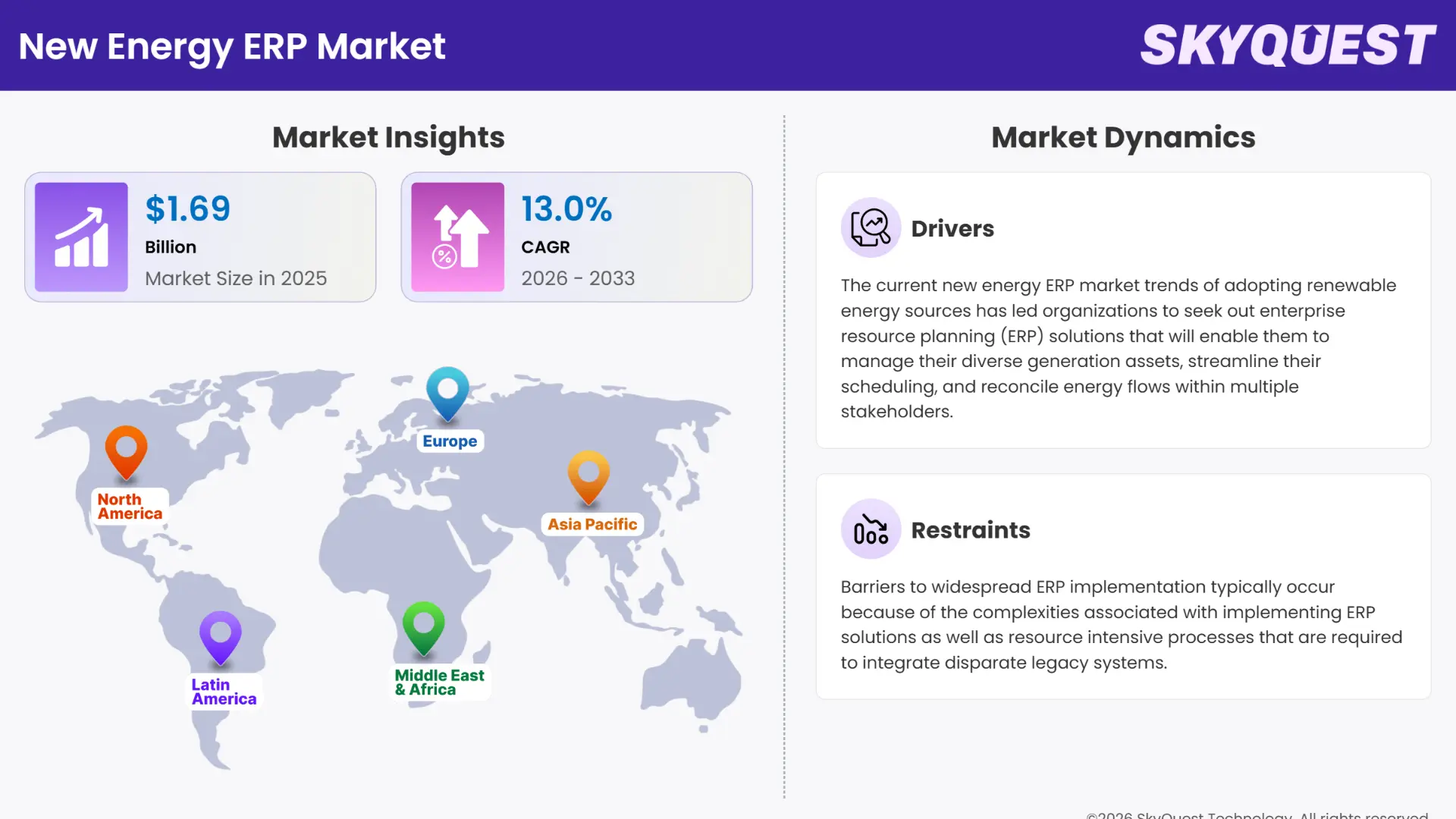
Global New Energy ERP Market size was valued at USD 1.50 Billion in 2024 and is poised to grow from USD 1.69 Billion in 2025 to USD 4.51 Billion by 2033, growing at a CAGR of 13.0% during the forecast period (2026-2033).
Key Takeaways: Market Trends & Insights
New energy ERP's primary factor driving the global energy transition is the convergence of decarbonization mandates, and regulatory complexity. New energy ERP refers to enterprise resource planning systems specifically designed for developers and operators of renewable energy (wind, solar, batteries) and electric vehicle assets that integrate financial, project execution, asset performance and compliance reporting. The significance of this market is that there are many projects being developed, as well as more variable generation and increased scrutiny from investors, which creates a demand for total lifecycle visibility and auditability of end-to-end processes.
Furthermore, solutions that provide this capability have evolved from mostly generic ERP add-ons to being complete cloud native platforms that integrate SCADA telemetry, IoT input and maintenance workflows. In addition, one of the main factors in pushing the global new energy ERP market forward is the need to turn volumes of data into actionable operations, which drives companies toward utilizing integrated systems that tie together forecasting, asset management, billing, and compliance.
Therefore, as project developers can close financial transactions faster by automating contract and cash flow reports using an integrated systems approach, electrical utility operators are reducing their curtailments using predictive maintenance based on IoT analytics. Likewise, an electrical utility may utilize an ERP-integrated merchant market interface system to bid aggregated distributed resources into the wholesale market and/or fleet operators may develop synchronization of EV charging schedules with grid signals to take advantage of time-of-use discounts.
How is AI Enhancing Operational Efficiency in the New Energy ERP Market?
The new energy ERP market is being completely transformed by AI in terms of operational efficiency, automated routine tasks, better forecasting, and bringing together distributed asset data into one view of operation. Other points include predictive maintenance for inverters and turbines; dispatch for matching generation and storage to actual demand; and document understanding to expedite workflows associated with contracts and invoicing. All leading ERP solutions now embed conversational agents (chatbots) and agent-based workflows, thereby allowing team members to focus on exception-based work, not repetitive work. Concurrently, these changes lead to less administrative friction and faster decision cycles for grid operators, developers, and service providers, as well as making renewable generation operations more resilient and adaptable to fluctuation.
Oracle NetSuite has announced the launch of its version 2022.6.1 of its innovative new NetSuite Next product, which includes advanced AI capabilities like embedded conversational assistants and digital workflows for use in managing renewable energy projects throughout their lifecycle. As a result, companies that use NetSuite to manage their energy operations, improve their forecasting capabilities by automating the planning processes, generate more accurate and actionable forecasting insights and turn documents into actionable items for their teams so they can scale their operations and react quickly to shifts in generation and market conditions.
To get more insights on this market click here to Request a Free Sample Report
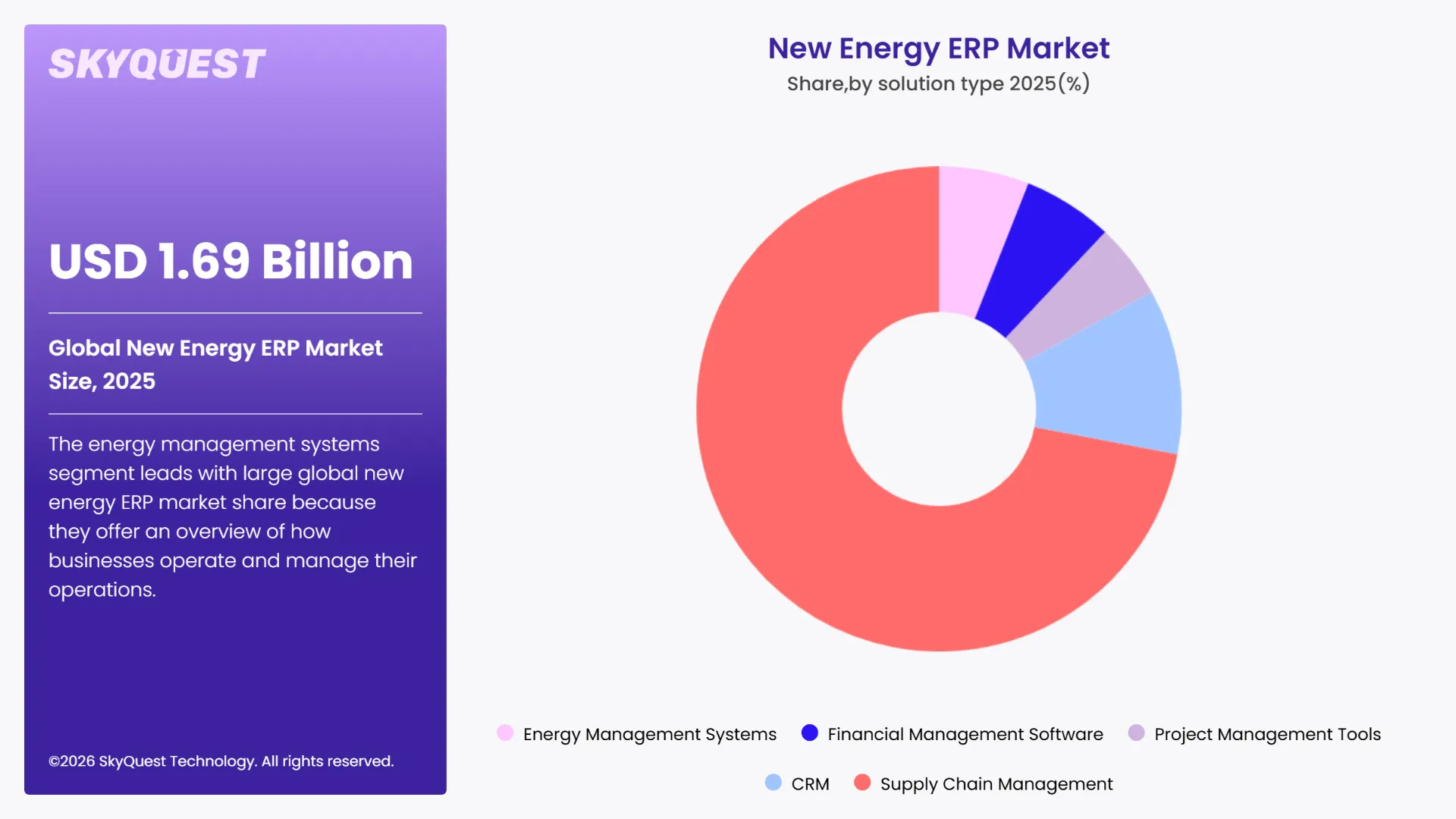
The global new energy ERP market is segmented into solution type, functionality, end-user industry, organization size, deployment model, and region. Based on solution type, the market is segmented into energy management systems, financial management software, project management tools, CRM, and supply chain management. Based on functionality, the market is segmented into financial management, operations management, human resource management, procurement management and compliance, and risk management. Based on end-user industry, the market is segmented into renewable energy, utility companies, manufacturing and transportation, and logistics. Based on organization size, the market is segmented into small enterprises, medium enterprises, and large enterprises. Based on the deployment model, the market is segmented into on-premises, cloud, and hybrid. Based on region, the market is segmented into North America, Europe, Asia Pacific, Latin America and Middle East & Africa.
The energy management systems segment leads with large global new energy ERP market share because they offer an overview of how businesses operate and manage their operations. This is the foundation for implementing new energy enterprise resource planning (ERP) functionality, but it is only one aspect of the sector to experience rapid growth. These systems enable companies to combine and analyze the real-time generation, storage, and demand signals, along with forecasting and asset health data, thus allowing for optimized dispatch, decreased curtailment, and enhanced reliability. This operational synergy is critical in encouraging the adoption of these systems by operators and project developers wishing to optimize asset performance and carry out the technical operations of their business in accordance with commercial goals.
As per global new energy ERP market outlook, the financial management software segment is experiencing explosive growth as organizations implement customized billing and revenue management modules designed to meet the complex monetization challenges faced by renewable energy companies. Companies increasingly look for ways to manage and track contracts, track incentives, and prepare integrated financial forecasts. The demand for these software solutions is increasing rapidly, allowing ERP vendors to provide monetization and investment planning tools that aid in financing new energy assets, determining asset value, and enabling commercial expansion of various types of new energy companies.
As per global new energy ERP market analysis, the cloud segment is in the lead because it provides the needed scale, continuous upgrades, and connection required by the new Energy ERP Ecosystems. The ability to process telemetry and analytics in a centralized manner allows for rapid deployment of distributed assets, while the elasticity of the platform minimizes friction associated with implementation for evolving project portfolios. This environment accelerates integration with third party services and IoT devices, thereby allowing operators to implement advanced optimization and compliance workflows, as well as to accelerate their cycle of innovation.
As per global new energy ERP market forecast, the hybrid deployment segment is growing more rapidly than any other model since organizations want a combination of on-premises management and cloud capacity. Hybrid solutions are attractive due to regulatory requirements and the need for low-latency processing, which necessitate having both on-premises and cloud analytic capabilities working for the purpose of coordinating projects, resulting in phased migration strategies and customized integrations that will provide more opportunities for interoperable ERP capabilities.
To get detailed segments analysis, Request a Free Sample Report
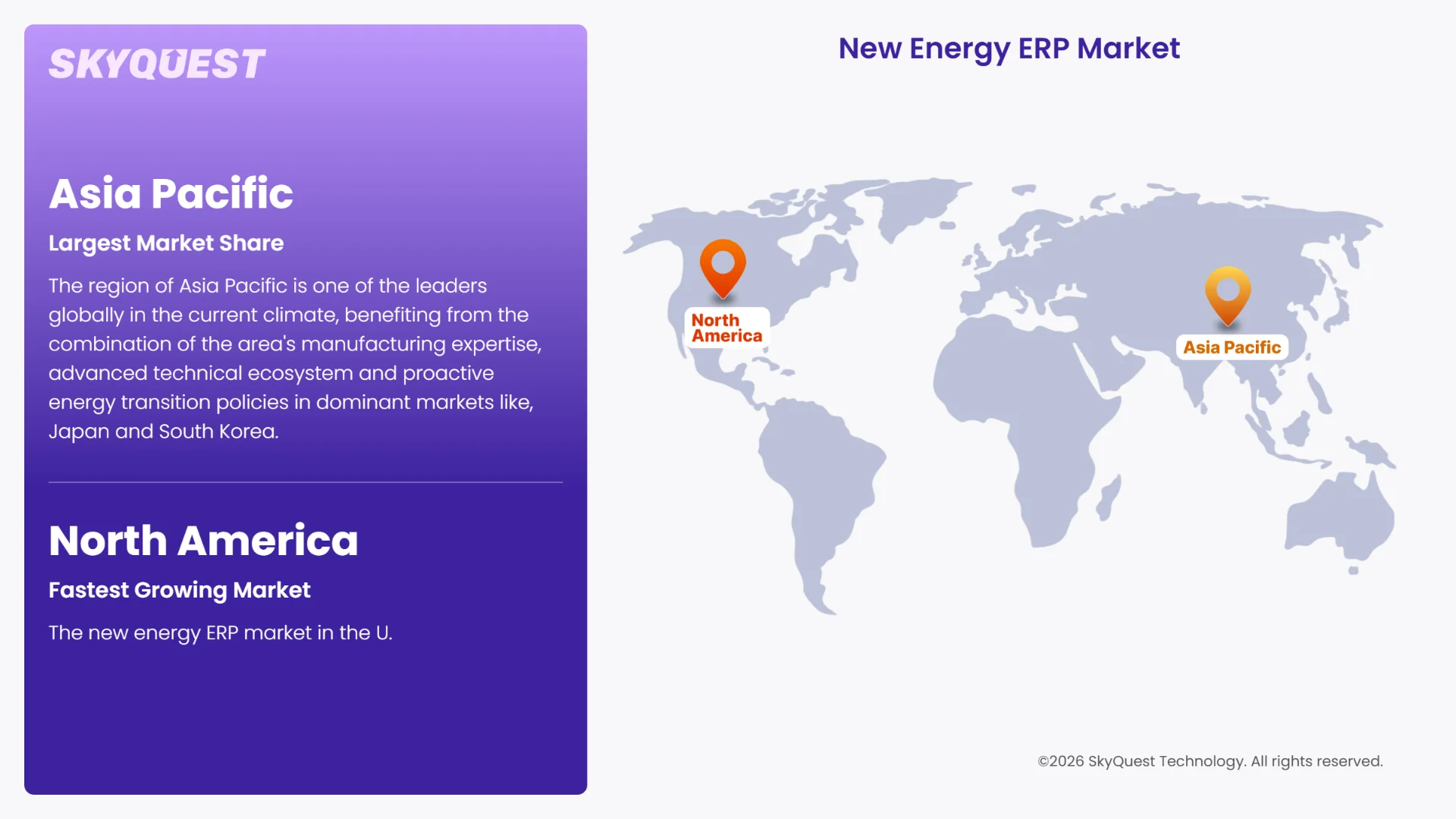
The region of Asia Pacific is one of the leaders globally in the current climate, benefiting from the combination of the area's manufacturing expertise, advanced technical ecosystem and proactive energy transition policies in dominant markets like, Japan and South Korea. The close integration between OEMs, component suppliers, and systems integrators provides the foundation for enhancing the adoption of ERP systems that are tailored specifically to meet the needs of renewable energy assets and distributed resources. Local ERP vendors and global software vendors are working collaboratively to provide modular, cloud-enabled solutions that are optimized for grid management and asset performance. Regulatory support, well-placed pilot projects, and a skilled engineering labour force encourage the rapid implementation of ERP systems, while cost-considerations associated with development and the existence of extensive supply chains facilitate scalable implementations across a broad base of the new energy applications.
As per global new energy ERP industry analysis, Japan market focuses specifically on the integration of asset performance, grid interface, and supply chain orchestration, facilitated through the collaboration of local system integrators and global ERP vendors. In the market, utilities and manufacturers of renewable energy plants and storage assets focus on delivering reliable and consistent products with standard interfaces and full lifecycle management.
The Korean new energy ERP market is driven by the collaboration between the technology providers, utilities, and manufacturing sectors on the digitalization of renewable generation, storage, and grid-integrated operations. ERP customization is supported by the emphasis on interoperability with smart grid platforms, enhanced asset monitoring capabilities, and predictive maintenance functions.
Rapid development of North America is being led by multiple types of corporate commitments, including large-scale investments from enterprises; well-established software ecosystems; and utilities that need a single source for the management of diversified generation and storage portfolios. Vendors are opening the market with many large enterprise software companies, along with niche companies providing specific applications, making these solutions readily available in the market. The rapid build-out of cloud infrastructure as well as the increased focus on cyber security have resulted in the increase of large entity operators’ confidence in the market to deploy solutions at scale.
The new energy ERP market in the U.S. is rapidly growing with broad utilization by utilities, independent developers and commercial customers similarly looking for integrated processes for the tracking of the performance of their assets, participating in markets and complying with regulatory requirements. The ERP Solutions are growing rapidly in terms of scaling, analytic, and connectability to support trading and grid participation models.
The Canada new energy ERP market is created from the collaboration of the utility providers, the governments and regulatory agencies and the systems integrators to create an environment for the renewable and storage resources to be integrated in a dependable manner. The ERP ssolutions are growing rapidly to be flexible and adaptable to the local market rules and configuration of the Grid, assist in managing the full lifecycle of the assets and support remote operation. The Canadian vendors are working with international vendors to provide modular, secure ERP platforms that support regulatory compliance, cross border co-ordination and operational efficiency.. WWhile at the same time, promote global new energy ERP market regional growth and innovation within the distributed energy resource management process.
Europe has become increasingly engaged in coordinated policy frameworks, industry partnerships,, and collaborative efforts, as well as providing an emphasis on the interoperability of grid operators, market platforms, and asset managers. Primary markets like the Germany, the UK's and France's are continuing to develop ERP capabilities in the new energy sector through high levels of engineering talent, well-established utility sectors, and active vendor communities that provide industry-specific software modules. Collaborative efforts across borders on market coupling and the establishment of harmonized technical standards are enabling integrated ERP solutions to manage both multijurisdictional operations and complex asset portfolios. Investment in digitalization, advanced analytical capability and cybersecurity are enhancing providers' offerings; while consortium-based pilot projects and public/private cooperation will continue to refine operational processes and improve integration patterns. Together, these investments are creating a maturing market that focuses on resilience, regulatory compliance, and operational transparency for various types of new energy applications.
As per global new energy ERP market regional forecast, Germany benefits from the integration of engineering expertise, automation providers and utility operators to create comprehensive solutions for wind, solar and storage asset management. The emphasis placed on interoperability with control systems; adherence to strict reliability standards; and use of advanced analytics supports customized deployments of ERP software solutions. System integrators and software vendors are collaborating to address the needs of the asset lifecycle and the requirements of the grid, enabling the delivery of modularized and secure ERP platforms that are aligned with best-in-class operational excellence and readiness for industrial deployment.
As per global new energy ERP market regional outlook, U.K. focuses on combining market integration, flexible operations, and sophisticated analytical capabilities to meet the needs of increasingly complex balancing activities in the market. ERP solutions have been developed to support utility-scale renewable energy generation and storage facilities, as well as distributed renewable energy generation resources, while also addressing issues related to regulatory compliance and interoperability with electricity market platforms. Through the establishment of collaborative pilot programs among equipment manufacturers, utilities and service companies, the features within ERP solutions are being refined. Modular ERP solutions, combined with consulting and systems integration services, enable the efficient implementation and optimization in operation of a variety of diverse types of renewable energy asset portfolios while providing the ability to scale.
The new energy ERP market growth in France employs the expertise of utilities, engineers and integrators to facilitate the integration of renewable energy and the deployment of storage systems. The ERP solutions for the French market include a strong emphasis on compliance; asset lifecycle modeling/planning; and access to, and integration with, utility grid operating systems. By collaboratively working with local manufacturers and global manufacturers, customized modules have been developed for renewable energy generation and storage. The features that ERP solutions in the French new energy ERP market deliver focused on reliability, secured operations and data-based optimization, so that utilities can effectively manage the increased complexity of managing their energy assets across all market structures and frameworks.
To know more about the market opportunities by region and country, click here to
Buy The Complete Report
Rising Renewable Energy Integration
Growing Corporate Commitment to Sustainability
High Implementation Complexity
Fragmented Regulatory Environments
Request Free Customization of this report to help us to meet your business objectives.
The competitive environment is rapidly evolving in the global new energy ERP sector as solutions are being brought to market through mergers, acquisitions, new product offerings, and partnerships between ERP suppliers, carbon platforms, and many niche renewable energy suppliers. Examples include IBM’s recent acquisition of a company that specializes in emissions data, numerous funding rounds that are enabling carbon SaaS companies to launch new products, and supplier integrations that allow for carbon accounting to be added to existing ERP functions.
SkyQuest’s ABIRAW (Advanced Business Intelligence, Research & Analysis Wing) is our Business Information Services team that Collects, Collates, Correlates, and Analyses the Data collected by means of Primary Exploratory Research backed by robust Secondary Desk research.
As per SkyQuest analysis, the global new energy ERP industry is being driven primarily by the global energy transition that forces operators to integrate decarbonization mandates, regulatory requirements and distributed renewables into unified enterprise workflows, while a second major driver is growing corporate focus on sustainability that demands consolidated reporting and emissions management. Adoption is tempered by high implementation complexity, where legacy systems, customization needs and prolonged deployments raise costs and delay benefits. Asia Pacific emerges as the dominant region due to strong manufacturing, regulatory support and integrated supply chains, and Energy Management Systems lead adoption as they provide the real time visibility and control essential to optimize generation, storage and grid interactions.
| Report Metric | Details |
|---|---|
| Market size value in 2024 | USD 1.50 Billion |
| Market size value in 2033 | USD 4.51 Billion |
| Growth Rate | 13.0% |
| Base year | 2024 |
| Forecast period | 2026-2033 |
| Forecast Unit (Value) | USD Billion |
| Segments covered |
|
| Regions covered | North America (US, Canada), Europe (Germany, France, United Kingdom, Italy, Spain, Rest of Europe), Asia Pacific (China, India, Japan, Rest of Asia-Pacific), Latin America (Brazil, Rest of Latin America), Middle East & Africa (South Africa, GCC Countries, Rest of MEA) |
| Companies covered | |
| Customization scope | Free report customization with purchase. Customization includes:-
|
To get a free trial access to our platform which is a one stop solution for all your data requirements for quicker decision making. This platform allows you to compare markets, competitors who are prominent in the market, and mega trends that are influencing the dynamics in the market. Also, get access to detailed SkyQuest exclusive matrix.
Table Of Content
Executive Summary
Market overview
Parent Market Analysis
Market overview
Market size
KEY MARKET INSIGHTS
COVID IMPACT
MARKET DYNAMICS & OUTLOOK
Market Size by Region
KEY COMPANY PROFILES
Methodology
For the New Energy ERP Market, our research methodology involved a mixture of primary and secondary data sources. Key steps involved in the research process are listed below:
1. Information Procurement: This stage involved the procurement of Market data or related information via primary and secondary sources. The various secondary sources used included various company websites, annual reports, trade databases, and paid databases such as Hoover's, Bloomberg Business, Factiva, and Avention. Our team did 45 primary interactions Globally which included several stakeholders such as manufacturers, customers, key opinion leaders, etc. Overall, information procurement was one of the most extensive stages in our research process.
2. Information Analysis: This step involved triangulation of data through bottom-up and top-down approaches to estimate and validate the total size and future estimate of the New Energy ERP Market.
3. Report Formulation: The final step entailed the placement of data points in appropriate Market spaces in an attempt to deduce viable conclusions.
4. Validation & Publishing: Validation is the most important step in the process. Validation & re-validation via an intricately designed process helped us finalize data points to be used for final calculations. The final Market estimates and forecasts were then aligned and sent to our panel of industry experts for validation of data. Once the validation was done the report was sent to our Quality Assurance team to ensure adherence to style guides, consistency & design.
Analyst Support
Customization Options
With the given market data, our dedicated team of analysts can offer you the following customization options are available for the New Energy ERP Market:
Product Analysis: Product matrix, which offers a detailed comparison of the product portfolio of companies.
Regional Analysis: Further analysis of the New Energy ERP Market for additional countries.
Competitive Analysis: Detailed analysis and profiling of additional Market players & comparative analysis of competitive products.
Go to Market Strategy: Find the high-growth channels to invest your marketing efforts and increase your customer base.
Innovation Mapping: Identify racial solutions and innovation, connected to deep ecosystems of innovators, start-ups, academics, and strategic partners.
Category Intelligence: Customized intelligence that is relevant to their supply Markets will enable them to make smarter sourcing decisions and improve their category management.
Public Company Transcript Analysis: To improve the investment performance by generating new alpha and making better-informed decisions.
Social Media Listening: To analyze the conversations and trends happening not just around your brand, but around your industry as a whole, and use those insights to make better Marketing decisions.
REQUEST FOR SAMPLE
 REQUEST FREE CUSTOMIZATION
Global New Energy Erp Market size was valued at USD 1.5 Billion in 2024 and is poised to grow from USD 1.69 Billion in 2025 to USD 4.51 Billion by 2033, growing at a CAGR of 13.0% during the forecast period (2026-2033).
Competitive landscape in the Global New Energy ERP market is accelerating as ERP vendors, carbon platforms, and niche renewables providers pursue regulatory-driven differentiation through M&A, partnerships, and product innovation. Examples include IBM acquiring an emissions data firm, major funding-led product rollouts by carbon SaaS providers, and supplier integrations that embed carbon accounting into ERP workflows. 'Microsoft', 'Oracle', 'SAP SE', 'Infor', 'Epicor', 'Ramco Systems', 'Sage', 'Workday', 'NetSuite', 'Kingdee', 'UNIT4', 'IBM', 'Kronos', 'Totvs', 'Digiwin', 'Coerstone', 'DoFort', 'YonYou', 'ABB', 'Siemens'
Rising integration of renewable energy sources increases demand for ERP solutions that can coordinate diverse generation assets, streamline scheduling, and reconcile energy flows across multiple stakeholders. By enabling consolidated data management, predictive maintenance planning, and standardized workflows, ERP systems reduce operational complexity and facilitate efficient asset utilization. They support interoperability between distributed resources, enhance visibility for grid operators and energy traders, and allow organizations to scale management practices as renewable portfolios expand, making ERP adoption a practical means to realize operational consistency and strategic energy objectives.
Ai Driven Operational Intelligence: Enterprise resource planning tailored for new energy now embeds advanced machine learning to anticipate maintenance needs, optimize energy flows, and coordinate distributed assets. Vendors are focusing on contextual models that translate operational signals into actionable workflows for operations, finance, and supply chain teams. This trend accelerates decision velocity, reduces unplanned downtime, and enables predictive planning across fleets and plants. Integration with real time telemetry and domain workflows becomes a strategic differentiator for solution providers and their enterprise customers and partners.
Asia Pacific Dominate the Global New Energy ERP Market?
New Energy ERP refers to enterprise resource planning solutions designed specifically for renewable energy developers, utilities, battery storage operators, and electric vehicle infrastructure providers. These platforms integrate financial management, project execution, asset performance monitoring, and compliance reporting into a single system.
Two major trends shaping the market are AI-driven operational intelligence and integrated asset optimization. ERP providers are embedding machine learning capabilities to enhance predictive maintenance, energy flow optimization, and operational decision-making. At the same time, organizations are increasingly adopting ERP platforms that provide a unified view of generation, storage, distribution, compliance, and asset lifecycle management to maximize efficiency and return on investment.


Want to customize this report? This report can be personalized according to your needs. Our analysts and industry experts will work directly with you to understand your requirements and provide you with customized data in a short amount of time. We offer $1000 worth of FREE customization at the time of purchase.
Feedback From Our Clients


 USA (+1) 351-333-4748

