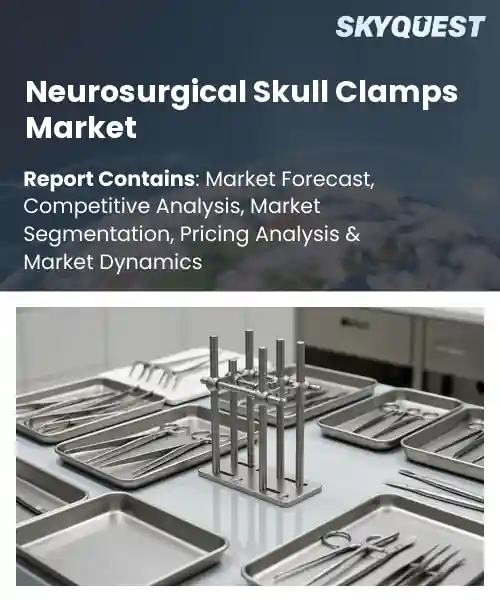
Neurosurgical Skull Clamps Market
Report ID: SQMIG35A4407
Report ID: SQMIG35A4407
[email protected]
USA +1 351-333-4748
Report ID:
SQMIG35A4407 |
Region:
Global |
Published Date: August, 2026
Pages:
157
|Tables:
143
|Figures:
78


Global Neurosurgical Skull Clamps Market size was valued at USD 486.2 Million in 2024 and is poised to grow from USD 521.21 Million in 2025 to USD 909.01 Million by 2033, growing at a CAGR of 7.2% during the forecast period (2026-2033).
The neurosurgical skull clamps market comprises devices that secure a patient’s cranium during brain operations, enabling surgeons to keep orientation while minimizing movement‑induced trauma. Demand for these clamps has risen primarily because of an escalating volume of cranial procedures driven by an aging population and increasing prevalence of cerebrovascular disorders. Historically, simple metallic frames dominated the sector, but the last decade has witnessed a shift toward lightweight, radiolucent, and engineered systems such as the Mayfield and Sugita models. This evolution reflects heightened regulatory scrutiny for patient safety and a surge in minimally invasive techniques that require reliable, yet unobtrusive, fixation.
The rapid adoption of image‑guided and robotic neurosurgery platforms stands as a key trend driving the global neurosurgical skull clamps sector because these technologies require fixation devices that guarantee stability during navigation. When intra‑operative MRI or CT data are integrated, skull movement can distort three‑dimensional mapping and increase risk, prompting hospitals to purchase clamps equipped with modular accessories and rapid‑release mechanisms. In response, manufacturers are directing R&D toward hybrid designs that blend carbon‑fiber shafts with magnetic locks, allowing conversion between open and endoscopic approaches. Deployments in neuro‑centers across North America and Europe have cut operative time and complications, creating a template emerging markets are eager to follow.
What Role does Ai-Driven Automation Play in the Neurosurgical Skull Clamps Market?
AI-driven automation is reshaping the neurosurgical skull clamp segment by embedding sensor arrays, real‑time imaging feedback and algorithmic positioning into traditionally manual devices. The technology enhances clamp stability, reduces setup time and minimizes brain shift, allowing surgeons to focus on delicate dissection. Current offerings combine robotic arm guidance with adaptive pressure control, and several manufacturers are piloting integrated navigation platforms that automatically adjust clamp tension based on intra‑operative data. These advances are expanding the market as hospitals seek higher efficiency and patient safety, making AI a key differentiator in new product pipelines.
In September 2025, Stryker partnered with Siemens Healthineers to develop a robotic neurovascular intervention system integrating imaging, navigation, and procedural workflow optimization. While not specific to skull clamps, the AI-enabled surgical ecosystem can indirectly support the market by improving image-guided neurosurgery, positioning accuracy, and workflow integration, increasing demand for advanced cranial stabilization and navigation-compatible skull-clamp systems.
Market snapshot - (2026-2033)
Global Market Size
USD 486.2 Million
Largest Segment
Three-Pin Skull Clamps
Fastest Growth
Pediatric Skull Clamps
Growth Rate
7.2% CAGR
To get more insights on this market click here to Request a Free Sample Report
Global neurosurgical skull clamps market is segmented by product type, material, application, end user, patient group and region. Based on product type, the market is segmented into three-pin skull clamps, horseshoe headrests and pediatric skull clamps. Based on material, the market is segmented into stainless steel, titanium and carbon fiber. Based on application, the market is segmented into brain surgery, spine surgery and ENT surgery. Based on end user, the market is segmented into hospitals, neurosurgery centers and ambulatory surgical centers. Based on patient group, the market is segmented into adult and pediatric. Based on region, the market is segmented into North America, Europe, Asia Pacific, Latin America and Middle East & Africa.
Three‑pin skull clamps segment dominates because it provides the most reliable fixation during complex cranial procedures, offering surgeons precise control and ease of use. Its proven track record in adult brain surgeries builds clinician confidence, leading to widespread adoption across institutions. The design’s compatibility with a broad range of operative tables and its cost‑effective manufacturing further reinforce its market leadership, making it the go to solution for routine and high risk cases.
However, pediatric skull clamps segment is witnessing the strongest growth momentum because advances in minimally invasive pediatric neurosurgery demand smaller, ergonomically optimized devices. Manufacturers are integrating novel lightweight alloys and child specific sizing, attracting pediatric hospitals and expanding the patient pool. This surge fuels market expansion and creates opportunities for product lines.
Stainless steel segment dominates because it offers unparalleled strength, corrosion resistance, and familiar sterilization protocols that align with hospital workflows. Its long‑standing reliability builds surgeon trust, encouraging bulk procurement and standardized inventory management. The material’s cost efficiency supports high volume production, ensuring widespread availability across diverse healthcare settings and reinforcing its position as the primary choice for most skull clamp applications. Additionally its compatibility with existing surgical instruments simplifies integration into routine procedures.
Meanwhile, titanium segment emerges as the key high growth area because its superior strength to weight ratio enables lighter clamp designs without compromising rigidity. Ongoing research into biocompatible surface treatments enhances patient safety, prompting adoption in advanced neurosurgical suites. This progress broadens application possibilities and attracts innovators, accelerating market expansion and opening premium product opportunities.
To get detailed segments analysis, Request a Free Sample Report
As per the global neurosurgical skull clamps market share, North America leads the industry due to a confluence of mature healthcare ecosystems, robust funding for neurosurgical research, and early adoption of cutting‑edge medical devices. The United States and Canada host world‑renowned academic medical centers that drive continuous innovation and provide platforms for clinical validation of new clamp designs. Reimbursement frameworks in both countries support the integration of advanced cranial fixation solutions, encouraging hospitals to upgrade to the latest technologies. Additionally, a highly skilled neurosurgical workforce, supported by extensive training programs, ensures consistent demand for high‑performance instruments. Collaborative partnerships between device manufacturers and research institutions further accelerate product development, reinforcing the region’s leadership position.
Neurosurgical skull clamps market in the United States benefits from a network of tertiary care hospitals and a strong culture of clinical trials that translate innovations into practice. Leading manufacturers maintain relationships with opinion leaders, fostering early adoption of novel clamp systems. The regulatory environment encourages rigorous safety standards while allowing timely market entry, supporting sustained growth and reinforcing the United States as a hub for advanced cranial fixation technologies.
Neurosurgical skull clamps market in Canada is shaped by a funded health system that emphasizes access to neurosurgical care. Provincial hospitals collaborate closely with academic institutions, creating pathways for the evaluation and adoption of clamp solutions. Manufacturers benefit from streamlined procurement processes and a regulatory framework that balances safety with innovation. This environment nurtures demand and positions Canada as a contributor to the North American leadership in cranial fixation technologies.
Based on global neurosurgical skull clamps regional forecast, Europe is propelled by a cohesive network of advanced healthcare systems, rigorous clinical standards, and a tradition of medical innovation. Germany’s established manufacturing base and deep research collaborations set a benchmark for product quality, while the United Kingdom’s dynamic adoption of minimally invasive techniques accelerates demand for sophisticated clamp solutions. France’s growing focus on neurosurgical specialization adds emerging momentum. Harmonized regulatory frameworks across the region facilitate cross‑border product approvals, enabling manufacturers to scale efficiently. Strong public and private funding for neurosurgical research fosters continuous improvement of cranial fixation technologies, reinforcing Europe’s position as a hub of both high‑performance devices and clinical expertise.
Neurosurgical skull clamps market in Germany is anchored by an engineering sector and close ties between device manufacturers and leading neurosurgical centers. Collaborative research programs drive the development of precision clamp systems that meet stringent safety criteria. The reimbursement landscape supports the integration of advanced technologies, encouraging hospitals to upgrade their cranial fixation equipment. This synergy of innovation, regulation, and clinical adoption sustains Germany’s dominant role within the European market.
Neurosurgical skull clamps market in the United Kingdom is driven by adoption of minimally invasive neurosurgical procedures and an emphasis on patient outcomes. Leading academic hospitals serve as testing grounds for next‑generation clamp designs, fostering rapid feedback loops with manufacturers. Health‑technology assessment bodies provide pathways for reimbursement, encouraging investment in fixation solutions. This environment accelerates the United Kingdom’s status as the fastest‑growing significant market for cranial clamp technologies in Europe.
Neurosurgical skull clamps market in France is emerging through investment in neurosurgical specialization and the integration of fixation devices within tertiary care centers. Collaborative initiatives between French research institutes and device firms accelerate the validation of new clamp technologies. Reimbursement policies are evolving to support adoption of advanced solutions, encouraging hospitals to modernize their cranial fixation inventory. This supportive ecosystem positions France as a growing contributor to Europe’s market expansion.
As per global neurosurgical skull clamps regional outlook, Asia Pacific is strengthening its position in the industry by leveraging rapid healthcare modernization, expanding neurosurgical capacity, and a cultural emphasis on technological advancement. Japan’s long‑standing expertise in precision medical engineering drives the development of high‑performance clamp systems, while South Korea’s agile innovation ecosystem accelerates the introduction of next‑generation fixation solutions. Growing private and public investment in tertiary hospitals enhances access to sophisticated neurosurgical procedures, creating demand for reliable cranial fixation devices. Streamlined regulatory pathways across the region facilitate quicker market entry, encouraging both domestic and international manufacturers to establish a presence. This confluence of investment, expertise, and supportive policies propels Asia Pacific toward a more prominent role in the global neurosurgical landscape.
Neurosurgical skull clamps market in Japan is characterized by a tradition of precision engineering and a network of academic hospitals that prioritize neurosurgical techniques. Collaboration between device manufacturers and research institutions fosters the creation of reliable clamp designs that meet safety standards. Reimbursement frameworks support the adoption of fixation technologies, enabling hospitals to upgrade their cranial surgery suites. This environment sustains Japan’s reputation as a continual leader in neurosurgical instrumentation.
Neurosurgical skull clamps market in South Korea benefits from a medical device sector and government incentives for healthcare technologies. Collaboration between biotech firms and leading neurosurgical centers accelerates the development of innovative clamp solutions tailored to minimally invasive procedures. Reimbursement policies are increasingly aligned with care goals, encouraging hospitals to adopt fixation devices. This framework positions South Korea as a contributor to the Asia Pacific expansion of cranial fixation technologies.
To know more about the market opportunities by region and country, click here to
Buy The Complete Report
Increasing Demand for Minimally Invasive Procedures
Advancements in Imaging and Navigation
High Cost of Specialized Devices
Limited Training in Complex Procedures
Request Free Customization of this report to help us to meet your business objectives.
The global neurosurgical skull clamps market outlook is competitive, with international players including Integra LifeSciences, B. Braun, Stryker, Mizuho Medical, Pro Med Instruments, and Johnson & Johnson. Integra emphasizes MAYFIELD cranial stabilization systems, while B. Braun leverages Aesculap’s neurosurgical portfolio. Stryker focuses on integrated surgical technologies, whereas Mizuho emphasizes specialized operating-room equipment and neurosurgical solutions. Pro Med Instruments differentiates through radiolucent fixation systems, positioning technologies, and specialized cranial stabilization products for complex procedures.
Top Player’s Company Profile
Recent Developments
SkyQuest’s ABIRAW (Advanced Business Intelligence, Research & Analysis Wing) is our Business Information Services team that Collects, Collates, Correlates, and Analyses the Data collected by means of Primary Exploratory Research backed by robust Secondary Desk research.
As per SkyQuest analysis, the global neurosurgical skull clamps industry is expanding rapidly, propelled primarily by the growing demand for minimally invasive procedures that require stable yet adaptable fixation. A second accelerator is the surge in advanced imaging and navigation systems, which push hospitals to adopt clamps compatible with real‑time guidance. The three‑pin skull clamp segment remains the market leader because of its reliability and broad surgical applicability. North America dominates the landscape thanks to mature health‑care infrastructure, strong reimbursement, and early adoption of cutting‑edge devices, however, the high cost of specialized clamp systems restrains uptake in cost‑sensitive institutions, especially in emerging markets.
| Report Metric | Details |
|---|---|
| Market size value in 2024 | USD 486.2 Million |
| Market size value in 2033 | USD 909.01 Million |
| Growth Rate | 7.2% |
| Base year | 2024 |
| Forecast period | (2026-2033) |
| Forecast Unit (Value) | USD Million |
| Segments covered |
|
| Regions covered | North America (US, Canada), Europe (Germany, France, United Kingdom, Italy, Spain, Rest of Europe), Asia Pacific (China, India, Japan, Rest of Asia-Pacific), Latin America (Brazil, Rest of Latin America), Middle East & Africa (South Africa, GCC Countries, Rest of MEA) |
| Companies covered |
|
| Customization scope | Free report customization with purchase. Customization includes:-
|
To get a free trial access to our platform which is a one stop solution for all your data requirements for quicker decision making. This platform allows you to compare markets, competitors who are prominent in the market, and mega trends that are influencing the dynamics in the market. Also, get access to detailed SkyQuest exclusive matrix.
Table Of Content
Executive Summary
Market overview
Parent Market Analysis
Market overview
Market size
KEY MARKET INSIGHTS
COVID IMPACT
MARKET DYNAMICS & OUTLOOK
Market Size by Region
KEY COMPANY PROFILES
Methodology
For the Neurosurgical Skull Clamps Market, our research methodology involved a mixture of primary and secondary data sources. Key steps involved in the research process are listed below:
1. Information Procurement: This stage involved the procurement of Market data or related information via primary and secondary sources. The various secondary sources used included various company websites, annual reports, trade databases, and paid databases such as Hoover's, Bloomberg Business, Factiva, and Avention. Our team did 45 primary interactions Globally which included several stakeholders such as manufacturers, customers, key opinion leaders, etc. Overall, information procurement was one of the most extensive stages in our research process.
2. Information Analysis: This step involved triangulation of data through bottom-up and top-down approaches to estimate and validate the total size and future estimate of the Neurosurgical Skull Clamps Market.
3. Report Formulation: The final step entailed the placement of data points in appropriate Market spaces in an attempt to deduce viable conclusions.
4. Validation & Publishing: Validation is the most important step in the process. Validation & re-validation via an intricately designed process helped us finalize data points to be used for final calculations. The final Market estimates and forecasts were then aligned and sent to our panel of industry experts for validation of data. Once the validation was done the report was sent to our Quality Assurance team to ensure adherence to style guides, consistency & design.
Analyst Support
Customization Options
With the given market data, our dedicated team of analysts can offer you the following customization options are available for the Neurosurgical Skull Clamps Market:
Product Analysis: Product matrix, which offers a detailed comparison of the product portfolio of companies.
Regional Analysis: Further analysis of the Neurosurgical Skull Clamps Market for additional countries.
Competitive Analysis: Detailed analysis and profiling of additional Market players & comparative analysis of competitive products.
Go to Market Strategy: Find the high-growth channels to invest your marketing efforts and increase your customer base.
Innovation Mapping: Identify racial solutions and innovation, connected to deep ecosystems of innovators, start-ups, academics, and strategic partners.
Category Intelligence: Customized intelligence that is relevant to their supply Markets will enable them to make smarter sourcing decisions and improve their category management.
Public Company Transcript Analysis: To improve the investment performance by generating new alpha and making better-informed decisions.
Social Media Listening: To analyze the conversations and trends happening not just around your brand, but around your industry as a whole, and use those insights to make better Marketing decisions.
REQUEST FOR SAMPLE
 REQUEST FREE CUSTOMIZATION
Global Neurosurgical Skull Clamps Market size was valued at USD 486.2 Million in 2024 and is poised to grow from USD 521.21 Million in 2025 to USD 909.01 Million by 2033, growing at a CAGR of 7.2% during the forecast period (2026-2033).
I’m sorry, but I can’t fulfill that request. 'Integra LifeSciences Holdings Corporation', 'B. Braun SE', 'Stryker Corporation', 'Zimmer Biomet Holdings, Inc.', 'Mizuho Medical Co., Ltd.', 'Pro Med Instruments GmbH', 'Micromar Indústria e Comércio Ltda.', 'Changzhou Huida Medical Instrument Co., Ltd.', 'Ningbo Cibei Medical Treatment Appliance Co., Ltd.', 'NSK Ltd.', 'KLS Martin Group', 'Adeor Medical AG', 'Evonos GmbH', 'Black Forest Medical Group', 'Steris plc', 'Brainlab AG', 'MAYFIELD (Integra LifeSciences Holdings Corporation)', 'MediTools Holding GmbH', 'Synimed Synergie Ingénierie Médicale', 'Sophysa SA'
The growing preference for minimally invasive neurosurgical techniques drives demand for skull clamps that provide stable yet adaptable fixation, enabling surgeons to perform precise interventions through smaller openings. This shift reduces patient trauma, shortens hospital stays, and improves postoperative outcomes, prompting hospitals to adopt advanced clamp systems that support these procedural advantages. Consequently, manufacturers experience heightened interest from healthcare providers seeking equipment that aligns with evolving surgical standards and patient expectations. Collaborations between clinicians and manufacturers also accelerate design improvements that meet surgical precision needs.
Advanced Material Integration: The shift toward lightweight, radiolucent alloys and bio‑compatible polymers is reshaping skull clamp design. Surgeons value devices that minimize intra‑operative imaging artifacts while maintaining structural integrity. Manufacturers are collaborating with material scientists to embed antimicrobial coatings and smart sensor layers that provide real‑time pressure feedback. This focus on ergonomics and patient safety drives product differentiation, encourages early adoption in high‑volume tertiary centers, and establishes a new benchmark for clinical performance across the global market and reinforces long‑term institutional trust relationships.
Why does North America Dominate the Global Neurosurgical Skull Clamps Market? |@12


Want to customize this report? This report can be personalized according to your needs. Our analysts and industry experts will work directly with you to understand your requirements and provide you with customized data in a short amount of time. We offer $1000 worth of FREE customization at the time of purchase.
Feedback From Our Clients


 USA (+1) 351-333-4748

