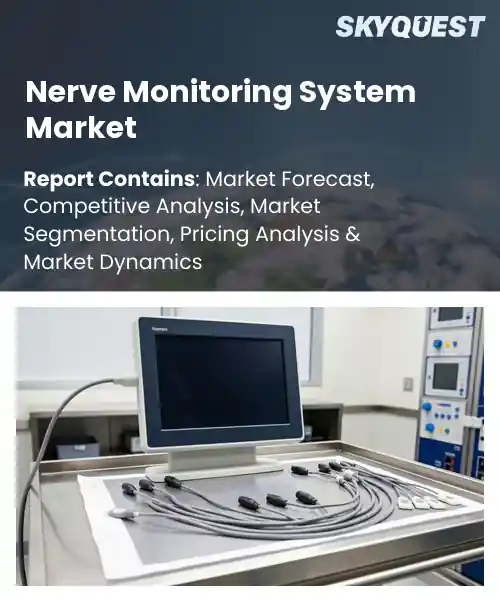
Nerve Monitoring System Market
Report ID: SQMIG35A3713
Report ID: SQMIG35A3713
[email protected]
USA +1 351-333-4748
Report ID:
SQMIG35A3713 |
Region:
Global |
Published Date: June, 2026
Pages:
157
|Tables:
143
|Figures:
78


Global Nerve Monitoring System Market size was valued at USD 1.52 Billion in 2024 and is poised to grow from USD 1.63 Billion in 2025 to USD 2.85 Billion by 2033, growing at a CAGR of 7.22% during the forecast period (2026-2033).
High demand for safer surgical procedures, increasing adoption of intraoperative neuromonitoring, rising prevalence of neurological and spinal disorders, advancements in surgical technologies, and growing emphasis on improving patient outcomes are driving sales of nerve monitoring systems.
As awareness regarding the clinical and financial advantages of nerve injury prevention grows, use of neuromonitoring has been adopted by healthcare facilities in a few geographical markets. New technical innovations are also significantly supporting market growth. Enhancements in sensor technology, software features, and the integration of neuromonitoring equipment with existing surgical instruments and systems have made them more reliable and precise, thus allowing surgeons to broaden the scope of nerve monitoring. Smaller, more comprehensive devices that are easy-to-use and offer immediate feedback tend to be used now in minimally invasive and complex surgeries so as to help the surgeons avoid nerve damage throughout the procedure, respond quickly in case of a nerve changeover, and minimize post-operative complications. The rising number of funds made available for portable monitoring applications, sophisticated analytics, and artificial intelligence-powered operations assistance devices is expected to generate numerous opportunities for already established players and help expand neuromonitoring applications in outpatient surgery settings and developing countries. Rising demand for intraoperative neuromonitoring to reduce surgical complications and preserve nerve function is expected to primarily drive nerve monitoring system market growth.
On the contrary, high equipment and procedure costs, limited availability of trained neuromonitoring professionals, reimbursement challenges, and regulatory complexities associated with medical devices are expected to impede nerve monitoring system market penetration through 2033.
How is AI Enhancing Real-time Accuracy of Nerve Monitoring Systems?
AI enhances nerve monitoring accuracy in surgical applications by integrating state-of-the-art signal processing with machine learning and real-time clinical decision support. Significant functions include intelligent noise filtering, automatic waveform detection and classification, and early warning mechanisms to differentiate nerve signal from operator db interference. The latest systems leverage multi-channel sensors and use edge and cloud-based analysis to improve speed of interpretation and reliability of results intraoperatively. As a market driven by surgery safety and efficiency concerns, these innovations assist surgeons in better problem-solving, reducing anxiety and enabling comprehensive remote monitoring capabilities.
Market snapshot - (2026-2033)
Global Market Size
USD 1.52 Billion
Largest Segment
Standalone Systems
Fastest Growth
Integrated Systems
Growth Rate
7.22% CAGR
To get more insights on this market click here to Request a Free Sample Report
Global nerve monitoring system market is segmented by product type, technology, application, end-user, distribution channel, and region. Based on product type, the market is segmented into standalone systems and integrated systems. Based on technology, the market is segmented into electromyography (EMG), evoked potentials, and direct nerve stimulation. Based on application, the market is segmented into spinal surgery, ENT surgery, thyroid surgery, and cardiovascular surgery. Based on end-user, the market is segmented into hospitals, ambulatory surgical centers, and specialty clinics. Based on distribution, the market is segmented into direct sales and distributors. Based on region, the market is segmented into North America, Europe, Asia Pacific, Latin America, and Middle East & Africa.
The standalone systems segment is predicted to spearhead the global nerve monitoring system market revenue generation in the future. These systems provide flexibility, portability and integration that match the verification in operating room workflows, such that it can be rapidly invested with all procedure types without needing to overhaul existing infrastructures. Modular interfaces and multimodal electrodes ease the choice for buying and training clinicians, thus exploding the adoption trend within surgical teams who wish for ever predictable performance, continuity of workflow and thus justification for investment and demand of incremental improvements from suppliers.
However, integrated systems are witnessing the strongest growth momentum as per this nerve monitoring system industry analysis. Surgical suites are seeking unified operative platforms integrating imaging, navigation, and neurophysiological feedback systems. Growth is driven by high levels of system interconnectivity, increased collaborations among vendors, and growing enthusiasm among clients to obtain a single vendor solution, which ensues in increased clinical use, offering bundled services and extended ongoing support offerings.
The Electromyography (EMG) segment is slated to account for the highest global nerve monitoring system market share going forward. Its direct measurement of muscle response offers clinically intuitive feedback that surgeons use at the moment to monitor nerve integrity. Due to neurophysiologists' knowledge of it, consistent electrode protocols and proven intraoperative utility (thyroid, ENT, spine), preference for its procurement, drives manufacturers to improve the device's signal fidelity and usability to that the clinician requirements for safe procedure execution are met.
However, direct nerve stimulation is emerging as the key high growth subsegment as technology advances to improve targeted activation and mapping precision permitting use in complex spine and cardiac access procedures. Regulatory guidance and innovative device designs drive adoption, expanding indications, and furthering the opportunities for integrated therapy monitoring and precision surgical workflows.
To get detailed segments analysis, Request a Free Sample Report
North America dominates the global nerve monitoring system market due to a combination of advanced clinical infrastructure, concentrated centers of surgical excellence and a robust ecosystem of device manufacturers and clinical research. High familiarity among surgical teams, strong collaboration between industry and leading academic centres, and established procedural pathways support widespread incorporation of monitoring technologies into routine practice. Reimbursement landscapes and procurement sophistication reduce adoption friction, while active participation in clinical studies and real world evidence generation reinforces clinical confidence. The presence of incumbent vendors, rapid technology iteration and well developed training programs further strengthen market leadership. Together these elements create a mature environment in which innovation, clinical validation and operational readiness drive sustained preference for North America in this segment.
Nerve monitoring system demand in the United States is driven by concentrated clinical expertise, extensive surgical volumes and strong infrastructure supporting advanced intraoperative monitoring. Adoption is reinforced by integrated hospital networks, established reimbursement frameworks and active engagement from clinicians and procurement groups. Collaborative care pathways and leading academic centers accelerate clinical integration and innovation, creating a mature environment where investment, provider familiarity and operational workflows underpin routine use and refinement.
Nerve monitoring system sales in Canada benefit from centralized health delivery, emphasis on clinician training and coordinated procurement strategies that support adoption of monitoring solutions. Referral centers and collaborations at the provincial level seem to facilitate uniformly adopted protocols and robust assurance programmes. Adoption of technology in the marketplace is directed by intensive collaboration between clinical stakeholders, device suppliers and regulatory agencies, thus enabling pragmatic evaluation of clinical value and surgical pathway incorporation where intensive outcomes assuarance and patient safety regimens are implemented.
Growing clinical acceptance, progressive regulatory alignment, and increasing emphasis on surgical safety across national health systems are creating new opportunities in the region. Additionally, there has been a surge in the number of dedicated surgical centers, training of clinicians to use these technologies, and the use of standardized intraoperative protocols to promote quicker adoption. Leading hospitals, professional societies, and device manufacturers also collaborate across borders and exchange knowledge to quickly share best practices. Market dynamics in this space are also influenced by the diversity of payers, as well as the existence of strategic procurement mechanisms that provide incentives for validated technologies with proven benefits for patient safety. Germany has the most well established clinical networks and provides the most significant support for the nerve monitoring industry; the UK has the most flexible adoption processes and the widest range of private sector involvement; and France continues to make progress through targeted programs that focus on improving the perioperative quality of care.
Nerve Monitoring System Market in Germany is supported by strong clinical networks, established device manufacturing expertise and a commitment to evidence-based practice that encourages use in tertiary hospitals and specialized surgical centers. Professional societies and academia are responsible for protocol standardization and clinician training. Buyers look for established technologies that offer benefits in terms of efficiency and clinical checks and balances, but clinical assessment and product development is increasingly about competition based on integration and predictable overall patient safety results.
Sales of nerve monitoring systems in the United Kingdom are backed by agile adoption pathways, a mixed provider landscape and engagement from surgical leaders promoting intraoperative monitoring. Centre level initiatives and local pilot initiatives will enable real world evidence generation, whilst specialist hospitals may desire solutions that prove clinical benefit. Training networks and professional institutions will facilitate dissemination of best practice to allow scale up to clinical integration with a pragmatic focus upon patient safety, flow and optimization initiatives.
Nerve monitoring system market in France is emerging via perioperative quality initiatives, concentrated expertise in academic hospitals and rising focus on standardized surgical pathways. Health authorities and clinical networks support targeted pilots where safety advantages are evident, while collaborative research and supplier involvement enable solutions. Training programs and guideline work increase clinician confidence, facilitating integration from specialized centers into wider surgical practice where patient outcomes and safety guide adoption decisions.
Asia Pacific is strengthening its presence in the nerve monitoring system market through increased investment in advanced surgical technologies, growing local manufacturing capacity, and targeted clinical initiatives that drive regional adoption. Major hospitals are developing integrated workflows that allow for intraoperative nerve monitoring and working closely with device manufacturers on developing solutions appropriate for their region. More established regulatory processes are allowing for faster entrance into the marketplace by treatments already proven to work; this has resulted in more facilities developing and implementing treatment plans suited to the clinical practices in the region. With improved education, raised levels of awareness related to intraoperative safety and an increase in the number of specialized surgical facilities, there will be a more favorable adoption environment for the use of these devices. All of these factors combined will allow the Asia Pacific region to become more than just another peripheral player; rather the Asia Pacific region will have established itself as a fully developed, highly strategic, unique and technologically sophisticated part of the world in regards to use of nerve monitoring devices.
Advanced hospital infrastructure, robust medical device research and development and clinician manufacturer collaboration to tailor solutions for local surgical practice support nerve monitoring system demand in Japan. Academic institutions and dedicated hospitals carry forward clinical assessment and improvement while a clearer regulatory pathway allows established systems to be used. Training and focus on perioperative safety reinforce clinician confidence, allowing the system to integrate seamlessly into the complex operative flow and maintain home interest.
Nerve monitoring system demand in South Korea advances through strong technology development, integration between device companies and leading hospitals and clinician training that supports procedural adoption. Attuning to minimally invasive procedure technology optimization in other fields escalates intra operative monitoring (IOM) concern, as local players stratify product localization collaborations, market entry regulation participations in clinical establishes, protocols standardization policies in clinical networks, all integrate oversight capacity across specialized surgical platforms.
To know more about the market opportunities by region and country, click here to
Buy The Complete Report
Advances In Sensor Technology
Rising Surgical Procedure Volumes
High Device And Maintenance Costs
Limited Reimbursement Policies
Request Free Customization of this report to help us to meet your business objectives.
The competitive landscape in the global nerve monitoring system market is defined by product differentiation through software enabled detection, strategic M and A, and partnerships that secure distribution and clinical validation. Established majors pursue acquisitions and regulatory clearances such as Medtronic’s NIM Vital expansion and Brainlab’s recent device and imaging acquisitions, while startups deploy AI and wearable innovations to win clinical pilots and OR integrations.
SkyQuest’s ABIRAW (Advanced Business Intelligence, Research & Analysis Wing) is our Business Information Services team that Collects, Collates, Correlates, and Analyses the Data collected by means of Primary Exploratory Research backed by robust Secondary Desk research.
As per SkyQuest analysis, surge in demand for safer surgical procedures, increasing adoption of intraoperative neuromonitoring, rising prevalence of neurological and spinal disorders, and advancements in surgical technologies are anticipated to drive the demand for nerve monitoring systems going forward. However, high equipment and procedure costs, limited availability of trained neuromonitoring professionals, reimbursement challenges, and regulatory complexities associated with medical devices are slated to slow down the adoption of nerve monitoring systems in the future. North America is slated to spearhead the demand for nerve monitoring systems owing to advanced healthcare infrastructure, high surgical procedure volumes, and strong adoption of innovative medical technologies. Development of AI-enabled signal analysis platforms, increasing adoption of real-time intraoperative decision support tools, and integration of advanced multimodal monitoring technologies are anticipated to be key trends driving the nerve monitoring system industry over the coming years.
| Report Metric | Details |
|---|---|
| Market size value in 2024 | USD 1.52 Billion |
| Market size value in 2033 | USD 2.85 Billion |
| Growth Rate | 7.22% |
| Base year | 2024 |
| Forecast period | (2026-2033) |
| Forecast Unit (Value) | USD Billion |
| Segments covered |
|
| Regions covered | North America (US, Canada), Europe (Germany, France, United Kingdom, Italy, Spain, Rest of Europe), Asia Pacific (China, India, Japan, Rest of Asia-Pacific), Latin America (Brazil, Rest of Latin America), Middle East & Africa (South Africa, GCC Countries, Rest of MEA) |
| Companies covered |
|
| Customization scope | Free report customization with purchase. Customization includes:-
|
To get a free trial access to our platform which is a one stop solution for all your data requirements for quicker decision making. This platform allows you to compare markets, competitors who are prominent in the market, and mega trends that are influencing the dynamics in the market. Also, get access to detailed SkyQuest exclusive matrix.
Table Of Content
Executive Summary
Market overview
Parent Market Analysis
Market overview
Market size
KEY MARKET INSIGHTS
COVID IMPACT
MARKET DYNAMICS & OUTLOOK
Market Size by Region
KEY COMPANY PROFILES
Methodology
For the Nerve Monitoring System Market, our research methodology involved a mixture of primary and secondary data sources. Key steps involved in the research process are listed below:
1. Information Procurement: This stage involved the procurement of Market data or related information via primary and secondary sources. The various secondary sources used included various company websites, annual reports, trade databases, and paid databases such as Hoover's, Bloomberg Business, Factiva, and Avention. Our team did 45 primary interactions Globally which included several stakeholders such as manufacturers, customers, key opinion leaders, etc. Overall, information procurement was one of the most extensive stages in our research process.
2. Information Analysis: This step involved triangulation of data through bottom-up and top-down approaches to estimate and validate the total size and future estimate of the Nerve Monitoring System Market.
3. Report Formulation: The final step entailed the placement of data points in appropriate Market spaces in an attempt to deduce viable conclusions.
4. Validation & Publishing: Validation is the most important step in the process. Validation & re-validation via an intricately designed process helped us finalize data points to be used for final calculations. The final Market estimates and forecasts were then aligned and sent to our panel of industry experts for validation of data. Once the validation was done the report was sent to our Quality Assurance team to ensure adherence to style guides, consistency & design.
Analyst Support
Customization Options
With the given market data, our dedicated team of analysts can offer you the following customization options are available for the Nerve Monitoring System Market:
Product Analysis: Product matrix, which offers a detailed comparison of the product portfolio of companies.
Regional Analysis: Further analysis of the Nerve Monitoring System Market for additional countries.
Competitive Analysis: Detailed analysis and profiling of additional Market players & comparative analysis of competitive products.
Go to Market Strategy: Find the high-growth channels to invest your marketing efforts and increase your customer base.
Innovation Mapping: Identify racial solutions and innovation, connected to deep ecosystems of innovators, start-ups, academics, and strategic partners.
Category Intelligence: Customized intelligence that is relevant to their supply Markets will enable them to make smarter sourcing decisions and improve their category management.
Public Company Transcript Analysis: To improve the investment performance by generating new alpha and making better-informed decisions.
Social Media Listening: To analyze the conversations and trends happening not just around your brand, but around your industry as a whole, and use those insights to make better Marketing decisions.
REQUEST FOR SAMPLE
 REQUEST FREE CUSTOMIZATION
Global Nerve Monitoring System Market size was valued at USD 1.52 Billion in 2024 and is poised to grow from USD 1.63 Billion in 2025 to USD 2.85 Billion by 2033, growing at a CAGR of 7.22% during the forecast period (2026-2033).
The competitive landscape in the global nerve monitoring system market is defined by product differentiation through software enabled detection, strategic M and A, and partnerships that secure distribution and clinical validation. Established majors pursue acquisitions and regulatory clearances such as Medtronic’s NIM Vital expansion and Brainlab’s recent device and imaging acquisitions, while startups deploy AI and wearable innovations to win clinical pilots and OR integrations. 'Medtronic plc (NIM)', 'Nihon Kohden Corporation', 'Natus Medical (Neurology)', 'Inomed Medizintechnik', 'Compumedics', 'Micromar', 'Bovie Medical (Symmetry)', 'Axia Medical Solutions', 'ProNerve LLC', 'Neurosign Surgical (Magstim)', 'ITC (Intraoperative Testing)', 'Ambu A/S', 'Stryker Corporation', 'Xltek (Natus)', 'Cadwell Laboratories', 'Signal Medical Corporation', 'Dr. Langer Medical', 'Dantec Dynamics (Noraxon)', 'NeuroPace Inc.', 'OrthoSoft (Zimmer Biomet)'
Improved sensor designs and higher fidelity signal acquisition enhance the accuracy and reliability of nerve monitoring systems, enabling surgeons to detect neural structures with greater confidence during procedures. By reducing false signals and improving responsiveness, these technological advances facilitate broader clinical adoption, support expansion into complex surgical specialties, and encourage investment in training and integration. Manufacturers can leverage miniaturization and enhanced algorithms to create more user friendly devices, which in turn promotes procurement by hospitals seeking solutions that reduce intraoperative neurological injury risk.
Ai Enabled Interpretation: Manufacturers and clinical teams are integrating AI and advanced signal processing to enhance real-time nerve identification, reduce interpretation variability and streamline operative workflows. Machine learning models assist in filtering noise, highlighting clinically relevant patterns and suggesting alerts, enabling faster decisions and consistent documentation. This trend fosters greater confidence among surgeons, supports training in complex procedures, and encourages collaboration between medtech firms and software developers to deliver turnkey platforms that blend hardware reliability with intelligent, user-centric decision support and workflow efficiency.
Why does North America Dominate the Global Nerve Monitoring System Market? |@12


Want to customize this report? This report can be personalized according to your needs. Our analysts and industry experts will work directly with you to understand your requirements and provide you with customized data in a short amount of time. We offer $1000 worth of FREE customization at the time of purchase.
Feedback From Our Clients


 USA (+1) 351-333-4748

