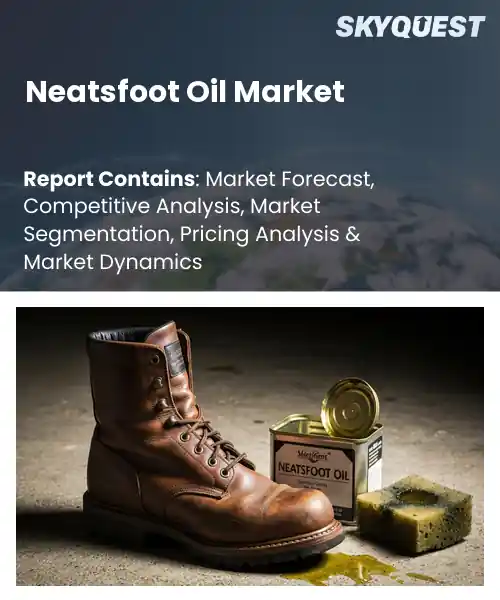
Neatsfoot Oil Market
Report ID: SQMIG15E3420
Report ID: SQMIG15E3420
[email protected]
USA +1 351-333-4748
Report ID:
SQMIG15E3420 |
Region:
Global |
Published Date: April, 2026
Pages:
157
|Tables:
142
|Figures:
78


Global Neatsfoot Oil Market size was valued at USD 312.0 Million in 2024 and is poised to grow from USD 330.1 Million in 2025 to USD 518.23 Million by 2033, growing at a CAGR of 5.8% during the forecast period (2026-2033).
Neatsfoot oil market is principally driven by enduring demand for natural leather conditioning agents used across equestrian tack, footwear, and conservation; that primary driver shapes production and distribution dynamics. The market comprises raw neatsfoot oil refined for consumer and industrial uses, blending historical artisanal techniques with modern processing to meet regulatory standards. It matters because treated leather retains flexibility and longevity, reducing replacement cycles and preserving cultural artifacts, thereby creating value for manufacturers and conservators. Over time the market shifted from localized rendering to global supply chains, faced competition from synthetics, and recently gained renewed interest amid sustainability trends globally.Following that market context, the principal growth factor is shifting buyer preference toward natural, biodegradable leather care, which has led manufacturers and conservators to favor neatsfoot over petroleum alternatives, expanding demand in restoration and premium segments. As brands pursue product longevity, tanneries and saddle makers integrate neatsfoot into finishing lines, reducing rejects and costs while improving tactile quality. Regulatory limits on volatile compounds push formulators toward refined animal oils, creating opportunities for stabilized neatsfoot blends with premium pricing. In practice this manifests in larger B2B contracts with equestrian suppliers, museum conservation projects, and artisanal shoemakers seeking certified, traceable conditioning agents.
How is AI improving demand forecasting in the Neatsfoot oil market?
AI is improving demand forecasting in the Neatsfoot oil market by integrating diverse data streams to create more responsive predictions. Key aspects include demand sensing from retail orders and craft trends, SKU level modeling, supply chain visibility and scenario simulation. The current state in this niche market is fragmented distribution and variable seasonal demand for saddlery, boot repair and leather restoration. AI systems make sense of unstructured signals such as social chatter and shipment updates and feed planners with faster insights. This allows distributors and manufacturers to rebalance inventory, smooth production and respond to shifts without relying solely on historical orders.Fiebing Company September 2025, was named in a Neatsfoot Oil Market Outlook report and that renewed attention to analytics. AI driven demand sensing helps convert the report signals into tighter regional stocking and more responsive production, improving efficiency and supporting steady market growth.
Market snapshot - (2026-2033)
Global Market Size
USD 312.0 Million
Largest Segment
Refined Neatsfoot Oil
Fastest Growth
Blended Neatsfoot Oil
Growth Rate
5.8% CAGR
To get more insights on this market click here to Request a Free Sample Report
Global neatsfoot oil market is segmented by product type, application, end user, distribution channel, formulation and region. Based on product type, the market is segmented into Refined Neatsfoot Oil, Unrefined Neatsfoot Oil and Blended Neatsfoot Oil. Based on application, the market is segmented into Leather Conditioning, Wood Treatment and Industrial Lubrication. Based on end user, the market is segmented into Manufacturers, Retail Consumers and Others. Based on distribution channel, the market is segmented into Online Sales and Offline Sales. Based on formulation, the market is segmented into Pure Oil and Additive Formulated. Based on region, the market is segmented into North America, Europe, Asia Pacific, Latin America and Middle East & Africa.
Refined Neatsfoot Oil segment dominates because refined product offers consistent purity and predictable performance that align with manufacturers' quality standards for conditioning and finishing leathers. Its controlled processing reduces odor and variability, enabling easier integration into industrial formulation and retail offerings while enhancing shelf stability and regulatory compliance. These qualities reduce formulation risk and procurement complexity, prompting brands and suppliers to prioritize refined grades for premium leather care applications.
However, Blended Neatsfoot Oil is witnessing the strongest growth due to its ability to combine neatsfoot properties with complementary oils and additives that broaden use and lower cost barriers. These blends enable tailored performance for wood treatment and consumer applications, unlocking new retail opportunities and quickening product innovation cycles.
Leather Conditioning segment dominates because this application captures the core utility of neatsfoot oil in restoring, softening, and protecting animal hides, which drives steady demand from manufacturers and specialty care providers. Its established role in preserving leather quality informs product specifications and marketing focus, prompting producers to prioritize formulations and quality controls that deliver consistent conditioning outcomes, thereby reinforcing the application as the principal revenue driver across product portfolios.
Meanwhile, Industrial Lubrication is emerging as the most rapidly expanding application due to growing interest in bio based lubricants and performance tuned formulations that leverage neatsfoot oil's lubricity and biodegradability. Demand from equipment maintenance and niche machinery drives innovation in additive formulated offerings, widening industrial adoption and creating new commercial channels for suppliers.
To get detailed segments analysis, Request a Free Sample Report
North America commands a leading position due to a confluence of supply chain depth, longstanding industrial know how, and broad end use adoption. The region benefits from mature leather processing industries, extensive equine and recreational markets that demand leather care products, and a strong network of distributors and aftermarket channels that support product availability. Manufacturers have invested in formulation expertise and quality assurance practices that align with professional and consumer expectations. Additionally, integrated sourcing from animal processing facilities and established logistics infrastructure enable consistent raw material flows. Collaborative relationships between leather goods producers, restorers, and chemical formulators reinforce market leadership through product innovation, brand recognition, and reliable supply relationships that meet both craft and industrial requirements.
Neatsfoot Oil Market in United States reflects a mature ecosystem where legacy brands and specialist formulators coexist with artisan suppliers. Demand is driven by diverse use cases including leather restoration, equestrian care, and craft maintenance. Distribution channels are well established across professional outlets and specialty retailers. Manufacturers emphasize product consistency, traceability, and compatibility with traditional leather practices. Collaboration between leather workshops and formulators supports product adaptation for specific professional needs and heritage restoration projects.
Neatsfoot Oil Market in Canada is shaped by a combination of artisan demand and regional leather manufacturing activity. Interest from outdoor, equestrian, and heritage craft communities sustains steady application for conditioning and preservation. Canadian suppliers focus on compliance with regional standards and emphasize sustainable sourcing and transparency. Distribution leans toward specialty retailers and professional channels that serve small batch producers and independent restorers. The market favors products that balance traditional performance with responsible supply chain practices.
Europe is experiencing marked expansion driven by strong demand from premium leather goods, restoration of heritage items, and a growing artisan and boutique repair sector. Consumer preference for natural treatments and craftsmanship aligned with sustainable sourcing has elevated interest in traditional conditioning oils. Regulatory frameworks and standards encourage product quality and traceability, supporting cross border trade and professional use. Investment in tanning and finishing expertise, particularly in specialized clusters, reinforces supply of both raw materials and technical knowledge. Partnerships between local artisans, luxury brands, and chemical formulators facilitate adoption of tailored formulations that meet high aesthetic and longevity expectations, positioning the region as a dynamic growth area for leather care solutions.
Neatsfoot Oil Market in Germany is characterized by industrial strength in leather manufacturing and technical formulation capabilities. Demand stems from both industrial applications and specialized restoration workshops. German producers emphasize quality control, process integration, and certification pathways that reassure professional users. Distribution networks serve tannery clusters and technical customers, enabling close collaboration on product specifications. The market favors solutions that integrate with mechanized finishing processes while meeting elevated expectations for longevity and material compatibility.
Neatsfoot Oil Market in United Kingdom is marked by a resurgence in craft leatherwork and heritage restoration that supports emerging demand. Specialist repairers, bespoke shoemakers, and equestrian care providers seek reliable conditioners that preserve traditional finishes. Local suppliers and small scale formulators engage closely with end users to refine product characteristics for heritage applications. Distribution is concentrated through specialist retailers and trade suppliers that cater to restorers and artisans. The landscape favors innovation in packaging and application methods that suit professional workflows.
Neatsfoot Oil Market in France is experiencing rapid uptake driven by the luxury leather goods sector and a vibrant artisan community. Fashion houses and boutique ateliers prioritize conditioning treatments that uphold premium material appearance and longevity. Local demand is amplified by restoration ateliers and bespoke leather craftsmen who require high quality, natural formulations. Suppliers focus on aligning products with aesthetic expectations and crafting methods while ensuring provenance and sustainable sourcing. The market environment supports fast adoption of specialized products that meet luxury standards.
Asia Pacific is advancing its role through expansion of leather goods manufacturing, growing domestic demand for quality leather care, and increasing technical capability among formulators. Regional producers are integrating traditional conditioning products into broader leather finishing and maintenance offerings to serve both local and export oriented industries. Collaborative sourcing relationships and improving logistics enhance raw material accessibility and supply reliability. Emphasis on product customization for regional leathers and climate conditions supports broader adoption. Investment in trade partnerships, quality assurance practices, and targeted distribution into professional and retail channels is enabling the region to build stronger market presence and respond to evolving consumer and industrial requirements.
Neatsfoot Oil Market in Japan is defined by meticulous attention to material care and high expectations for finish and durability. Demand originates from luxury leather repair workshops, bespoke shoemakers, and precision oriented craft sectors. Suppliers concentrate on refined formulations that preserve appearance and enhance suppleness without compromising leather character. Distribution is oriented toward specialist outlets and professional networks that prioritize product provenance and application guidance. Collaboration between artisans and formulators supports tailored solutions suited to domestic craftsmanship standards.
Neatsfoot Oil Market in South Korea is growing as leather goods production and consumer interest in quality maintenance increase. The market benefits from agile formulators adapting products to local leather types and climate influences. Retail and professional channels are expanding, connecting manufacturers with restoration specialists and boutique producers. Emphasis on product education and targeted marketing helps raise awareness among consumers seeking long term care solutions. Suppliers focus on blending traditional performance with modern packaging and application convenience to meet evolving preferences.
To know more about the market opportunities by region and country, click here to
Buy The Complete Report
Rising Demand In Leather Care
Preference For Natural Conditioners
Concerns Over Oxidation Effects
Regulatory And Sourcing Challenges
Request Free Customization of this report to help us to meet your business objectives.
The competitive landscape in the global neatsfoot oil market is defined by long-established refiners facing pressure from biomaterials entrants and sustainability-focused chemical groups. Competition is driven by partnerships and product innovation, for example Arkema’s sustainable neatsfoot line and J H Ritchie’s co‑branding partnership with a luxury leather maker. Firms pursue targeted technology upgrades and selective channel alliances to protect leather and equestrian end markets.
Top Player’s Company Profile
Recent Developments
SkyQuest’s ABIRAW (Advanced Business Intelligence, Research & Analysis Wing) is our Business Information Services team that Collects, Collates, Correlates, and Analyses the Data collected by means of Primary Exploratory Research backed by robust Secondary Desk research. As per SkyQuest analysis, the global neatsfoot oil market is driven primarily by enduring demand for natural leather conditioning agents used across equestrian tack, footwear and conservation, and is further supported by growing consumer preference for natural, biodegradable leather care and formulation advances that expand use cases. However, regulatory and sourcing challenges related to animal-derived oils and concerns about oxidation or darkening of leather restrain broader adoption. North America continues to dominate the market due to mature supply chains and extensive end-use adoption, while the leather conditioning application remains the leading segment, anchoring steady B2B and retail demand and shaping product innovation and distribution strategies.
| Report Metric | Details |
|---|---|
| Market size value in 2024 | USD 312.0 Million |
| Market size value in 2033 | USD 518.23 Million |
| Growth Rate | 5.8% |
| Base year | 2024 |
| Forecast period | (2026-2033) |
| Forecast Unit (Value) | USD Million |
| Segments covered |
|
| Regions covered | North America (US, Canada), Europe (Germany, France, United Kingdom, Italy, Spain, Rest of Europe), Asia Pacific (China, India, Japan, Rest of Asia-Pacific), Latin America (Brazil, Rest of Latin America), Middle East & Africa (South Africa, GCC Countries, Rest of MEA) |
| Companies covered |
|
| Customization scope | Free report customization with purchase. Customization includes:-
|
To get a free trial access to our platform which is a one stop solution for all your data requirements for quicker decision making. This platform allows you to compare markets, competitors who are prominent in the market, and mega trends that are influencing the dynamics in the market. Also, get access to detailed SkyQuest exclusive matrix.
Table Of Content
Executive Summary
Market overview
Parent Market Analysis
Market overview
Market size
KEY MARKET INSIGHTS
COVID IMPACT
MARKET DYNAMICS & OUTLOOK
Market Size by Region
KEY COMPANY PROFILES
Methodology
For the Neatsfoot Oil Market, our research methodology involved a mixture of primary and secondary data sources. Key steps involved in the research process are listed below:
1. Information Procurement: This stage involved the procurement of Market data or related information via primary and secondary sources. The various secondary sources used included various company websites, annual reports, trade databases, and paid databases such as Hoover's, Bloomberg Business, Factiva, and Avention. Our team did 45 primary interactions Globally which included several stakeholders such as manufacturers, customers, key opinion leaders, etc. Overall, information procurement was one of the most extensive stages in our research process.
2. Information Analysis: This step involved triangulation of data through bottom-up and top-down approaches to estimate and validate the total size and future estimate of the Neatsfoot Oil Market.
3. Report Formulation: The final step entailed the placement of data points in appropriate Market spaces in an attempt to deduce viable conclusions.
4. Validation & Publishing: Validation is the most important step in the process. Validation & re-validation via an intricately designed process helped us finalize data points to be used for final calculations. The final Market estimates and forecasts were then aligned and sent to our panel of industry experts for validation of data. Once the validation was done the report was sent to our Quality Assurance team to ensure adherence to style guides, consistency & design.
Analyst Support
Customization Options
With the given market data, our dedicated team of analysts can offer you the following customization options are available for the Neatsfoot Oil Market:
Product Analysis: Product matrix, which offers a detailed comparison of the product portfolio of companies.
Regional Analysis: Further analysis of the Neatsfoot Oil Market for additional countries.
Competitive Analysis: Detailed analysis and profiling of additional Market players & comparative analysis of competitive products.
Go to Market Strategy: Find the high-growth channels to invest your marketing efforts and increase your customer base.
Innovation Mapping: Identify racial solutions and innovation, connected to deep ecosystems of innovators, start-ups, academics, and strategic partners.
Category Intelligence: Customized intelligence that is relevant to their supply Markets will enable them to make smarter sourcing decisions and improve their category management.
Public Company Transcript Analysis: To improve the investment performance by generating new alpha and making better-informed decisions.
Social Media Listening: To analyze the conversations and trends happening not just around your brand, but around your industry as a whole, and use those insights to make better Marketing decisions.
REQUEST FOR SAMPLE
 REQUEST FREE CUSTOMIZATION


Want to customize this report? This report can be personalized according to your needs. Our analysts and industry experts will work directly with you to understand your requirements and provide you with customized data in a short amount of time. We offer $1000 worth of FREE customization at the time of purchase.
Feedback From Our Clients


 USA (+1) 351-333-4748

