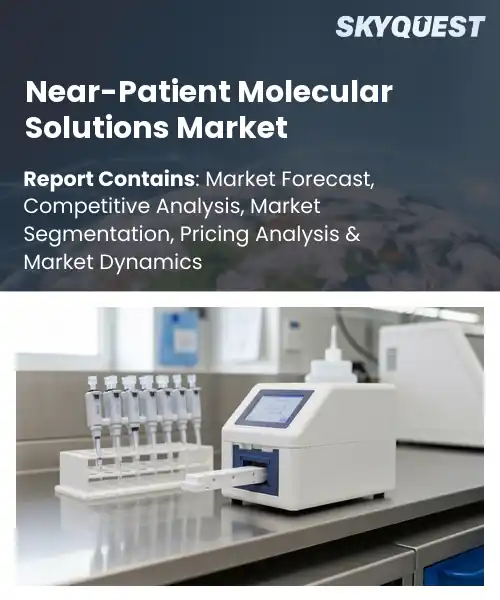
Near-Patient Molecular Solutions Market
Report ID: SQMIG35A3211
Report ID: SQMIG35A3211
[email protected]
USA +1 351-333-4748
Report ID:
SQMIG35A3211 |
Region:
Global |
Published Date: February, 2026
Pages:
157
|Tables:
97
|Figures:
76


Global Near-Patient Molecular Solutions Market size was valued at USD 1.1 Billion in 2024 and is poised to grow from USD 1.21 Billion in 2025 to USD 2.62 Billion by 2033, growing at a CAGR of 10.1% during the forecast period (2026-2033).
The primary driver of the near-patient molecular solutions industry has been the imperative for rapid, accurate diagnostics outside centralized laboratories, a demand amplified by successive infectious disease outbreaks and the need for decentralized care. This sector encompasses compact platforms that perform nucleic acid amplification and detection at or near the point of care, enabling clinicians to make immediate treatment decisions and public health officials to execute faster containment strategies. Over two decades the field evolved from bench PCR assays to portable, cartridge-based systems such as Cepheid GeneXpert and Abbott ID NOW, with COVID-19 catalyzing investment, regulatory flexibility and widespread deployment.Building on that decentralization imperative, the primary determinant accelerating global adoption is technological miniaturization combined with integrated workflows, because smaller, automated platforms lower per-test time and skill requirements, which in turn reduces cost and expands settings where testing is feasible. As a consequence, emergency departments and community clinics can use cartridge systems for rapid respiratory panels to triage patients and pharmacies can offer on-site sexually transmitted infection screening, improving treatment timeliness and surveillance. Regulatory pathways and payor reimbursement further amplify uptake by de-risking investment, generating opportunities in emerging markets and enabling developers to pursue multiplex assays and home-based molecular diagnostics.
How is AI enhancing diagnostic accuracy in the near-patient molecular solutions market?
AI is improving diagnostic accuracy in the near patient molecular solutions market by combining advanced pattern recognition with assay specific intelligence. Key aspects are automated signal analysis that reduces subjective interpretation, embedded quality checks that catch poor samples, and integration of molecular results with clinical context to refine calling. The market is shifting toward compact, connected PCR platforms that use on device algorithms and cloud based analytics to lower operator variability and shorten time to reliable results. Real world examples include algorithmic flagging of borderline amplification curves and adaptive interpretation that reduces unnecessary repeat testing and supports faster clinical action.Roche January 2025, received FDA clearance and a CLIA waiver for its cobas liat STI assays. This development highlights how AI enabled digital support and remote quality monitoring can bolster near patient molecular accuracy, speeding confident diagnosis and enabling same visit treatment pathways.
Market snapshot - (2026-2033)
Global Market Size
USD 1.1 Billion
Largest Segment
Infectious Diseases Testing Kits
Fastest Growth
Infectious Diseases Testing Kits
Growth Rate
10.1% CAGR
To get more insights on this market click here to Request a Free Sample Report
Global near-patient molecular solutions market is segmented by product type, technology, end user and region. Based on product type, the market is segmented into Infectious Diseases Testing Kits, Cardio Metabolic Monitoring Kits, Pregnancy & Fertility Testing Kits, Coagulation Monitoring Kits, Hematology Testing Kits, Urinalysis Testing Kits, Glucose Monitoring Kits and Others. Based on technology, the market is segmented into PCR-Based Technologies, Genetic Sequencing-Based Technologies, Hybridization Based Technologies and Microarray-Based Technologies. Based on end user, the market is segmented into Hospitals, Homecare Settings, Diagnostic Laboratories and Research Laboratories. Based on region, the market is segmented into North America, Europe, Asia Pacific, Latin America and Middle East & Africa.
PCR-Based Technologies segment dominates because its well established amplification chemistry and compatibility with compact, cartridgeized platforms deliver rapid, reliable detection suited to decentralized settings. The straightforward workflow and strong analytical sensitivity shorten time to actionable results, which encourages clinical adoption and supports easier regulatory pathways. Broad industry support and mature supply chains further lower deployment barriers, embedding PCR as the foundational approach for near patient molecular testing.
However, Genetic Sequencing-Based Technologies are witnessing the strongest growth momentum as their capacity to provide comprehensive pathogen and variant information meets rising clinical and surveillance needs. Continued miniaturization and streamlined library workflows, alongside evolving regulatory acceptance and clinician interest in precision profiling, accelerate adoption and create new opportunities for expanded near patient diagnostic and surveillance applications.
Infectious Diseases Testing Kits segment dominates because these kits address the primary clinical need for fast, actionable pathogen identification at the point of care. Their direct influence on treatment decisions and infection control makes them procurement priorities for providers. Manufacturers design these kits for simplified sample to answer workflows and regulatory compliance, which reduces operational burden and speeds adoption across decentralized care settings, establishing infectious disease testing as the core near patient application.
However, Cardio Metabolic Monitoring Kits are witnessing the strongest growth momentum as molecular biomarkers gain traction in chronic disease management. Advances in multiplex assays and miniaturized platforms, together with demand for risk stratification and therapy monitoring in outpatient and homecare settings, are driving adoption and unlocking new near patient preventive and long term management opportunities.
To get detailed segments analysis, Request a Free Sample Report
North America combines a dense concentration of advanced diagnostic infrastructure, favorable regulatory pathways, strong private and public investment, and integrated healthcare networks that together support broad adoption of near-patient molecular solutions. Collaborative ecosystems linking academic medical centers, biotechnology firms, and diagnostic manufacturers accelerate product development and clinical validation. Reimbursement clarity and well-established laboratory networks enable rapid deployment in diverse care settings from acute care to community clinics. Market leaders maintain local manufacturing and service capabilities that reduce supply chain friction and enhance customer support. A culture of early clinical adoption and focus on precision medicine drive demand for decentralized testing modalities, while strategic partnerships and targeted commercialization strategies consolidate regional leadership. Efforts to integrate digital health tools and real world evidence into diagnostic workflows further strengthen clinical utility and payer engagement.
Near-Patient Molecular Solutions Market in the United States is supported by a mature ecosystem of clinical laboratories, academic research centers, and commercial diagnostic companies that prioritize rapid innovation and scalability. Strong private investment, experienced commercialization teams, and clinical trial activity enable fast clinical validation and adoption across care settings. Established reimbursement frameworks and integrated healthcare systems facilitate deployment, while local manufacturing and service networks improve supply resilience and customer engagement.
Near-Patient Molecular Solutions Market in Canada benefits from a strong emphasis on equitable access, with public healthcare systems driving demand for decentralized diagnostics that can reach community and remote settings. Collaboration between provincial health authorities, academic institutions, and domestic suppliers focuses on cost effectiveness, quality assurance, and integration with electronic health records. Procurement frameworks encourage adoption in hospitals and clinics, while partnerships with global manufacturers support technology transfer and capacity.
The rapid expansion in Europe reflects a combination of health policy focus on decentralized diagnostics, strong public and private investment in translational research, and active engagement of national health systems in adopting point of care molecular testing. Cross-border collaboration among research institutions, diagnostic manufacturers, and clinical networks accelerates validation and implementation. Regulatory evolution and health technology assessment processes that emphasize clinical utility and cost effectiveness create clearer pathways for market entry. Procurement mechanisms and pilot initiatives at national and regional levels support uptake in hospitals and primary care. Local manufacturing hubs and partnerships with international vendors improve supply chain reliability, while workforce training and digital integration enhance clinical adoption across diverse care settings. Increasing alignment between payers and providers on reimbursement for clinically proven assays, alongside consolidation among diagnostic companies, further accelerates commercialization and broad clinical deployment across national systems.
Near-Patient Molecular Solutions Market in Germany benefits from a dense industrial base of diagnostic manufacturers, hospital laboratories, and coordinated public health institutions that prioritize quality and validated workflows. National reimbursement mechanisms and rigorous standards support routine adoption in acute care and specialty centers. Collaboration between industry and research institutes fosters local innovation and evaluation. Supply chain capabilities and vendor networks underpin deployment, while clinician engagement drives integration into diagnostic pathways.
Near-Patient Molecular Solutions Market in the United Kingdom is propelled by national health services engagement, innovation hubs, and emphasis on access to validated assays. Centralized procurement and pilot programs encourage deployment in hospitals and community settings. Academic and industry partnerships translate new technologies into practice, while regulatory and appraisal processes that emphasize clinical value support payer acceptance. Attention to digital integration and workforce upskilling aids adoption across care pathways nationally.
Near-Patient Molecular Solutions Market in France is characterized by growing interest from public health authorities and regional hospital networks seeking to expand access to molecular diagnostics outside central laboratories. Emphasis on clinical utility and cost effectiveness guides evaluation and adoption in hospital care. Collaborations between academic centers, regional labs, and suppliers support local validation and deployment. Procurement and pilot programs demonstrate value, while investments in training and connectivity foster integration.
Asia Pacific is strengthening its position through a mix of targeted government initiatives, growing domestic manufacturing capabilities, and increasing collaboration between local industry and international partners. Market dynamics emphasize decentralized testing to meet diverse healthcare access needs across urban and rural settings, driving demand for adaptable, robust platforms. Regulatory authorities in several markets are evolving frameworks to support clinical validation and market entry, while investments in workforce training and laboratory networks improve operational readiness. Localized innovation, including adaptation of assays for endemic conditions, and investments in connectivity and digital workflows enhance clinical utility. Strategic partnerships, regional distribution networks, and rising procurement activity underpin broader commercialization and sustained growth across the region. Public private collaborations and pilot initiatives demonstrate contextual value in primary care and emergency settings, while emphasis on cost effective solutions encourages broader adoption by payers and healthcare providers.
Near-Patient Molecular Solutions Market in Japan reflects strong adoption by advanced hospital systems, active engagement from domestic diagnostic manufacturers, and rigorous regulatory and quality frameworks that support clinical confidence. Emphasis on integrating diagnostics with electronic health records and hospital workflows enables efficient use in specialty and care settings. Collaborative research between universities and industry drives localized assay development, while established service networks and manufacturing capabilities support reliable deployment and maintenance.
Near-Patient Molecular Solutions Market in South Korea benefits from a highly innovative technology ecosystem, strong domestic diagnostic companies, and public sector initiatives that promote decentralized testing. Integration with digital platforms and streamlined laboratory networks enhances rapid clinical adoption across hospitals and community clinics. Local manufacturing strength and export orientation support scaling models. Partnerships between industry, academia, and health agencies drive validation efforts and tailored solutions for national testing priorities effectively.
To know more about the market opportunities by region and country, click here to
Buy The Complete Report
Rapid Adoption Of Point Of Care
Advancements In Molecular Diagnostics
Regulatory Approval Complexity
High Cost Of Implementation
Request Free Customization of this report to help us to meet your business objectives.
Competitive dynamics in the global near-patient molecular solutions market are driven by consolidation, platform acquisitions and platform innovation as incumbents and specialist entrants seek rapid decentralization. Recent strategic moves include Roche's acquisition of LumiraDx point of care assets and OraSure's purchase of CRISPR diagnostics developer Sherlock Biosciences, while Thermo Fisher and others expanded point-of-care portfolios through targeted acquisitions and partnerships.
Top Player’s Company Profile
Recent Developments
SkyQuest’s ABIRAW (Advanced Business Intelligence, Research & Analysis Wing) is our Business Information Services team that Collects, Collates, Correlates, and Analyses the Data collected by means of Primary Exploratory Research backed by robust Secondary Desk research. As per SkyQuest analysis, the global near patient molecular solutions market is being propelled primarily by rapid adoption of point of care testing while regulatory approval complexity remains a significant restraint that slows product introductions and raises development burdens. North America leads the market due to advanced diagnostic infrastructure, favorable reimbursement and strong industry ecosystems, and PCR based technologies remain the dominant technical segment because of their reliability and fit with cartridgeized platforms. Continued advancements in molecular diagnostics, including miniaturization, connectivity and AI enhanced workflows, act as a second major driver that expands use cases into clinics and homecare, supporting sustained growth despite regulatory and implementation challenges.
| Report Metric | Details |
|---|---|
| Market size value in 2024 | USD 1.1 Billion |
| Market size value in 2033 | USD 2.62 Billion |
| Growth Rate | 10.1% |
| Base year | 2024 |
| Forecast period | (2026-2033) |
| Forecast Unit (Value) | USD Billion |
| Segments covered |
|
| Regions covered | North America (US, Canada), Europe (Germany, France, United Kingdom, Italy, Spain, Rest of Europe), Asia Pacific (China, India, Japan, Rest of Asia-Pacific), Latin America (Brazil, Rest of Latin America), Middle East & Africa (South Africa, GCC Countries, Rest of MEA) |
| Companies covered |
|
| Customization scope | Free report customization with purchase. Customization includes:-
|
To get a free trial access to our platform which is a one stop solution for all your data requirements for quicker decision making. This platform allows you to compare markets, competitors who are prominent in the market, and mega trends that are influencing the dynamics in the market. Also, get access to detailed SkyQuest exclusive matrix.
Table Of Content
Executive Summary
Market overview
Parent Market Analysis
Market overview
Market size
KEY MARKET INSIGHTS
COVID IMPACT
MARKET DYNAMICS & OUTLOOK
Market Size by Region
KEY COMPANY PROFILES
Methodology
For the Near-Patient Molecular Solutions Market, our research methodology involved a mixture of primary and secondary data sources. Key steps involved in the research process are listed below:
1. Information Procurement: This stage involved the procurement of Market data or related information via primary and secondary sources. The various secondary sources used included various company websites, annual reports, trade databases, and paid databases such as Hoover's, Bloomberg Business, Factiva, and Avention. Our team did 45 primary interactions Globally which included several stakeholders such as manufacturers, customers, key opinion leaders, etc. Overall, information procurement was one of the most extensive stages in our research process.
2. Information Analysis: This step involved triangulation of data through bottom-up and top-down approaches to estimate and validate the total size and future estimate of the Near-Patient Molecular Solutions Market.
3. Report Formulation: The final step entailed the placement of data points in appropriate Market spaces in an attempt to deduce viable conclusions.
4. Validation & Publishing: Validation is the most important step in the process. Validation & re-validation via an intricately designed process helped us finalize data points to be used for final calculations. The final Market estimates and forecasts were then aligned and sent to our panel of industry experts for validation of data. Once the validation was done the report was sent to our Quality Assurance team to ensure adherence to style guides, consistency & design.
Analyst Support
Customization Options
With the given market data, our dedicated team of analysts can offer you the following customization options are available for the Near-Patient Molecular Solutions Market:
Product Analysis: Product matrix, which offers a detailed comparison of the product portfolio of companies.
Regional Analysis: Further analysis of the Near-Patient Molecular Solutions Market for additional countries.
Competitive Analysis: Detailed analysis and profiling of additional Market players & comparative analysis of competitive products.
Go to Market Strategy: Find the high-growth channels to invest your marketing efforts and increase your customer base.
Innovation Mapping: Identify racial solutions and innovation, connected to deep ecosystems of innovators, start-ups, academics, and strategic partners.
Category Intelligence: Customized intelligence that is relevant to their supply Markets will enable them to make smarter sourcing decisions and improve their category management.
Public Company Transcript Analysis: To improve the investment performance by generating new alpha and making better-informed decisions.
Social Media Listening: To analyze the conversations and trends happening not just around your brand, but around your industry as a whole, and use those insights to make better Marketing decisions.
REQUEST FOR SAMPLE
 REQUEST FREE CUSTOMIZATION


Want to customize this report? This report can be personalized according to your needs. Our analysts and industry experts will work directly with you to understand your requirements and provide you with customized data in a short amount of time. We offer $1000 worth of FREE customization at the time of purchase.
Feedback From Our Clients


 USA (+1) 351-333-4748

