
Navigation, Imaging and Positioning Solutions Market
Report ID: SQMIG45I2358
Report ID: SQMIG45I2358
[email protected]
USA +1 351-333-4748
Report ID:
SQMIG45I2358 |
Region:
Global |
Published Date: February, 2026
Pages:
157
|Tables:
127
|Figures:
77


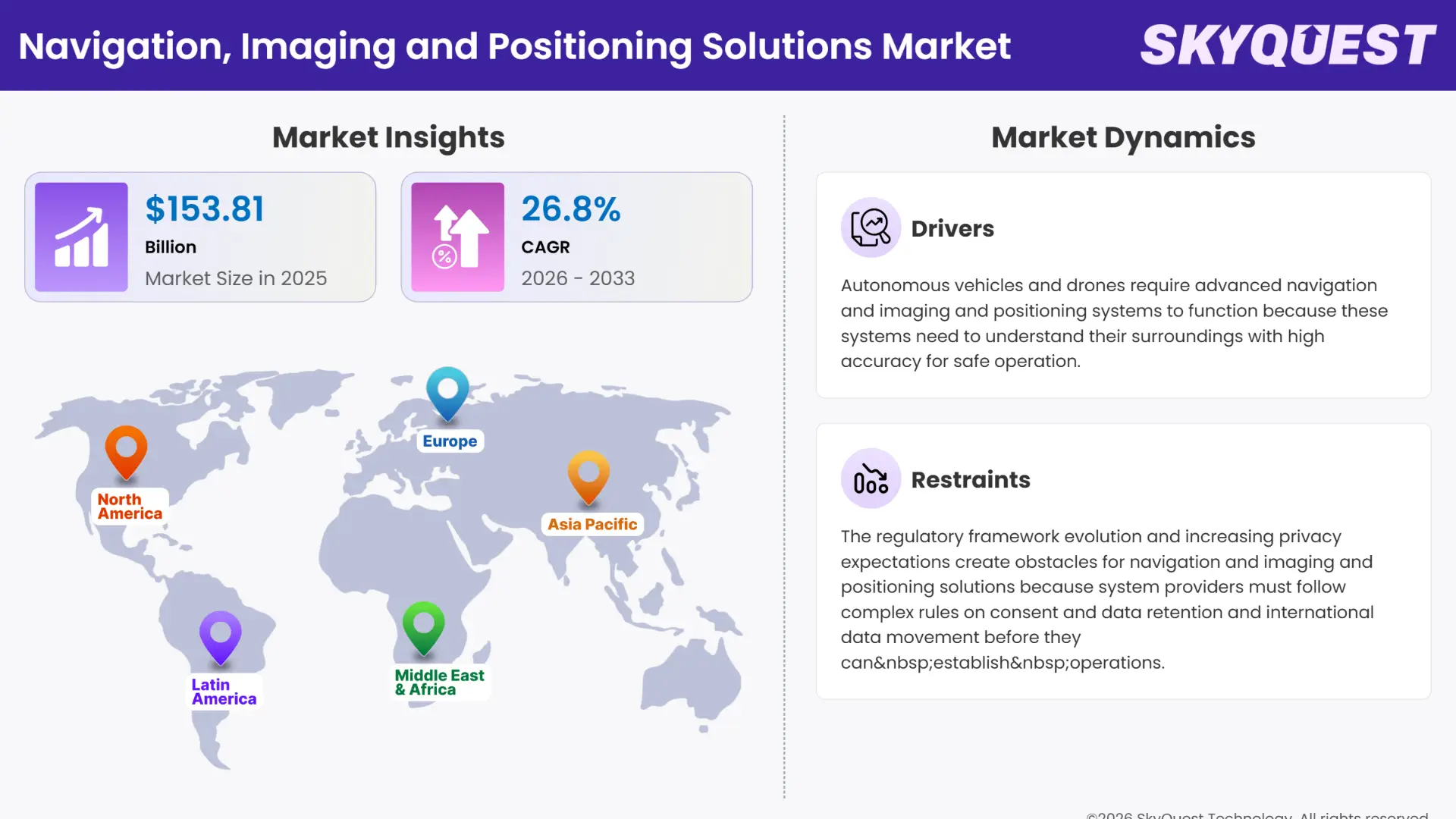
Global Navigation, Imaging and Positioning Solutions Market size was valued at USD 121.3 Billion in 2024 and is poised to grow from USD 153.81 Billion in 2025 to USD 1027.86 Billion by 2033, growing at a CAGR of 26.8% during the forecast period (2026-2033).
Key Takeaways: Market Trends & Insights
Global navigation, imaging, and positioning products that enable location determination and spatial image acquisition and environmental mapping for decision support. Precise position information is essential for transportation systems and infrastructure development and military operations because it has advanced from basic GPS to systems that combine GNSS with inertial sensors and LiDAR and computer-vision technology. The spread of enterprise components into common smartphone capabilities resulted from lower costs and miniaturization while new technologies like autonomous vehicles and precision agriculture and aerial mapping created a need for ultra-accurate centimeter-level measurements. Real-time kinematic corrections modified surveying operations which led to safer power lines and bridge inspections through drone sensor fusion.
Moreover, the global navigation, imaging, and positioning solutions market growth is driven because sensor fusion technology combined with connection systems and artificial intelligence creates dependable spatial intelligence from unprocessed data. The combination of GNSS with inertial measurements and LiDAR with camera systems enables multiple sensors to deliver accurate positioning solutions which assist operators in urban canyons and under trees while they operate autonomous vehicles and delivery drones. Real-time corrections and map updates receive support from edge computing and low-latency networks which generate new options for smart-city traffic control and asset management. RTK-enabled tractors demonstrate how unified positioning systems help farmers increase their harvests while LiDAR-equipped drones help decrease inspection times and create safer working conditions.
How is AI Improving Accuracy in Navigation, Imaging, and Positioning Solutions?
AI enhances navigation imaging and positioning accuracy through its combination of sensor fusion technology with learned error models and advanced image reconstruction methods. AI powered GNSS correction algorithms achieve their primary function through their combination of adaptive fusion for LiDAR radar and camera data and neural methods which eliminate noise from images and recreate previously lost details. The current environment favors models which learn environment specific biases because they provide better performance in urban canyons and indoor space and contested signal areas than fixed filters do. The demand in the market for autonomous systems and precision mapping technologies drives businesses to rapidly adopt neural SLAM and AI enhanced correction services which enable practical deployments of these technologies in real-world applications.
To get more insights on this market click here to Request a Free Sample Report
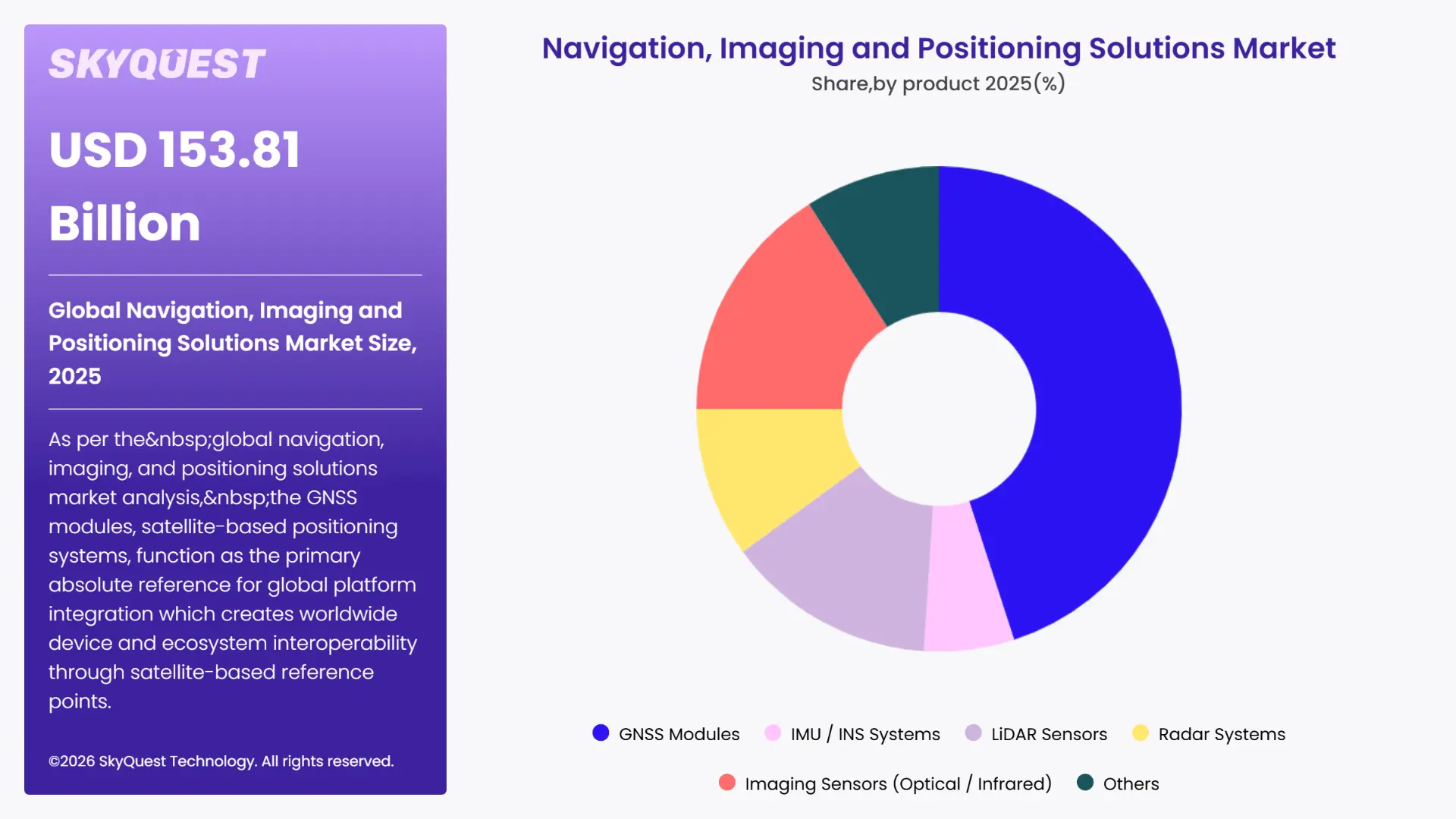
The global navigation, imaging, and positioning solutions market is segmented based on product, technology, application, industry vertical, and region. By product, the market includes GNSS modules, IMU/INS systems, LiDAR sensors, radar systems, imaging sensors (optical/infrared), and others. Based on technology, it is categorized into inertial navigation, mechanical waves, and electromagnetic waves. In terms of application, the market is segmented into defense, maritime, land & surveying, photonics, and space. Based on industry vertical, it covers aerospace & defense, automotive & transportation, marine, construction & surveying, healthcare, consumer electronics, agriculture, and others. Geographically, the market is divided into North America, Europe, Asia Pacific, Latin America, and the Middle East & Africa.
As per the global navigation, imaging, and positioning solutions market analysis, the GNSS modules, satellite-based positioning systems, function as the primary absolute reference for global platform integration which creates worldwide device and ecosystem interoperability through satellite-based reference points. Signal processing capacity and reduced device dimensions and sensor compatibility create a system foundation which enables reliable navigation and imaging across multiple platforms. The established supply chains and OEM demand for plug-and-play modules drive growing adoption of the system, which leads to changes in both solution architectures and vendor investment decisions.
Whereas the IMU/INS systems now witness the fastest growth because GNSS denied environments require systems that deliver trustworthy dead reckoning capability. The improved MEMS sensors and sensor fusion algorithms now enable deployment on compact platforms while driving integrated package development to cultivate resilient navigation solutions for autonomous and safety-critical applications.
According to the global navigation, imaging, and positioning solutions market forecast, the electromagnetic waves lead the market because they serve as the foundation for radio and radar and optical sensor systems which offer high-resolution sensing capabilities and long-distance detection abilities and multiple communication methods essential for navigation and imaging technologies. The system enables precise target measurement through its physical attributes, which provide accurate distance measurements and Doppler effect calculations and thereby enhances target tracking and situational awareness. The central role of this technology leads to widespread platform adoption while creating a complete market ecosystem for advanced positioning systems.
Whereas the field of mechanical waves sees its most rapid expansion because underwater navigation and close-range navigation now use both ultrasonic and acoustic techniques. The evolution of transducer technology, which enables the development of new sonar and tactile imaging systems, establishes pathways for creating specialized positioning solutions which use confined space operations.
To get detailed segments analysis, Request a Free Sample Report
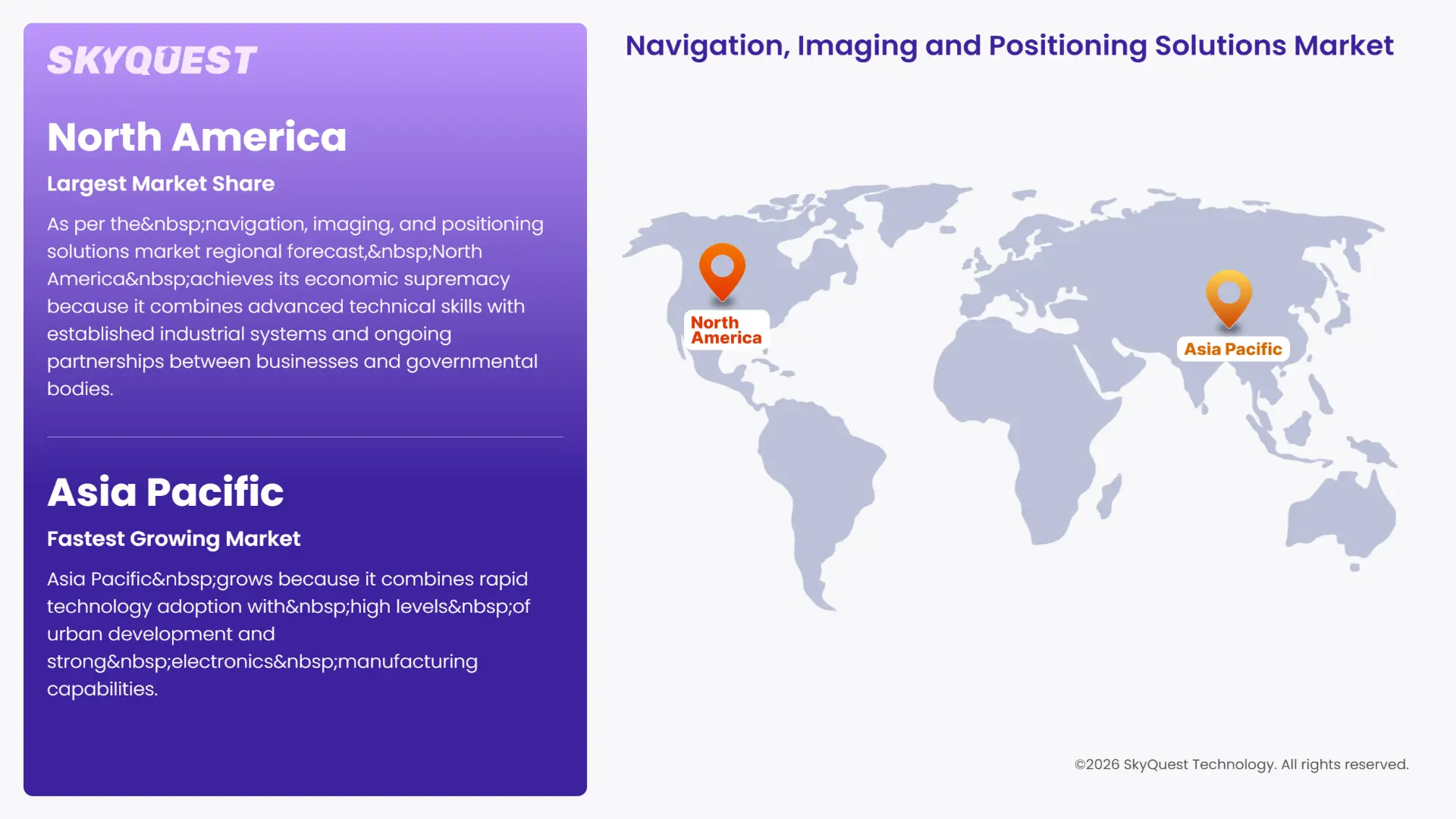
As per the navigation, imaging, and positioning solutions market regional forecast, North America achieves its economic supremacy because it combines advanced technical skills with established industrial systems and ongoing partnerships between businesses and governmental bodies. The region contains leading aerospace and defense companies, major automobile manufacturers, and top technology firms which together drive progress and create advanced technological products. The advanced venture capital system, together with the developed procurement network, permits swift business growth for new navigation and imaging solutions.
Existing satellite and terrestrial systems combined with top research centers and effective intellectual property systems enable ongoing advancements in sensor development and software creation and system integration work. The combined needs of the transportation, mapping, defense, and consumer electronics sectors establish strong demand in the market which advanced manufacturing capabilities and worldwide supply chain connections guarantee that local solutions will achieve global distribution and impact.
The United States navigation and imaging and positioning solutions industry operates through a broad defense and space and automotive development base which includes top semiconductor and sensor production companies. The market shows strong systems integration abilities while startup companies develop their businesses through testing their products in large commercial and government facilities. National laboratories and universities work together with private companies to create advanced positioning and imaging solutions which they test through multiple use cases.
The Canadian navigation and imaging and positioning solutions sector develops specialized solutions because of its expertise in Arctic navigation and geospatial analytics and remote sensing technologies. Research institutions and government agencies which work with industry partners create novel techniques. The domestic market requires rugged systems which function reliably for natural resource extraction and public safety measures and transportation operations. The domestic market requires systems which can withstand harsh conditions. International partnerships assist companies in bringing their specialized technologies to global markets.
Asia Pacific grows because it combines rapid technology adoption with high levels of urban development and strong electronics manufacturing capabilities. Regional authorities create continuous demand for advanced positioning and imaging systems through their smart city programs and digital mapping projects, and updated transportation systems. Local supply chains for sensors and semiconductors enable companies to develop products quickly while maintaining their ability to produce cost-effective products. Homegrown technology champions and a growing ecosystem of specialized suppliers and system integrators facilitate cross border deployment. Public organizations help develop urban logistics systems while industrial automation technologies and precision agriculture solutions open new markets. Future navigation and imaging solutions will become commercial products through public procurement programs and research partnerships.
The Japanese navigation and imaging and positioning solutions market penetration depends on three key elements which include precision manufacturing and robotics and automotive system integration and sensor technology development. The national focus on creating reliable and miniaturized products enables industries to produce high quality imaging and positioning equipment for their transportation and healthcare needs. Corporate laboratories work closely with universities to develop new algorithms and hardware products which Japanese companies use for domestic markets and worldwide export activities.
The South Korean navigation and imaging and positioning solutions market benefits from its active consumer electronics business which creates strong sensor and imaging component markets through its semiconductor production activities. Major corporations and innovative startups work together to create smart devices which include positioning and imaging capabilities. Domestic solutions achieve success in related fields through their focus on system integration and their quick product development and export-driven business model. The domestic market requires systems which can withstand harsh conditions. International partnerships assist companies in bringing their specialized technologies to global markets.
Europe enhances its position through unified policy backing and spending on national defense resources and its extensive network of dedicated suppliers and research institutions. Transportation and maritime and critical infrastructure industries adopt new technology through secure positioning systems and international standard protocols and systems that work together. Aerospace and automotive and photonics industries develop major technical expertise through their leading companies while small and medium enterprises create specialized products and system parts. Joint research initiatives together with public sector acquisition of high precision systems create business opportunities for new imaging and navigation technologies. Integrated solutions get deployed across international borders when safety and privacy and regulatory certainty get emphasized, which improves regional security.
The German Navigation Imaging and Positioning Solutions Market uses its solid engineering foundation and its concentrated network of automotive suppliers to create industrial automation and mobility solutions for precise positioning and imaging. The market requires reliable products that can work with manufacturing systems while enabling collaboration between original equipment manufacturers and specialized technology companies. Germany based solution providers develop advanced industrial sensors and full system integration solutions and standards-compliant systems for use in difficult industrial scenarios.
The UK Navigation, Imaging, and Positioning Solutions Market depends on aerospace and defense and advanced research base, which develops new imaging analytics and reliable positioning solutions. The startup ecosystem together with testing facilities enables new mapping and urban mobility and maritime operations applications to be developed. Public sector partnerships together with the commercialization of research findings help the market transform technical advancements into operational systems.
The French navigation, imaging, and positioning solutions market operates through its established aerospace sector and specialized research institutions, which create top-tier capabilities for satellite imaging and photonic technology and navigation system development. The market demonstrates strong collaboration between major defense contractors and technology-focused enterprises and research institutions to deliver complete solutions for defense and aviation and transportation sectors. The system reliability focus and export-driven development approach help domestic product lines to progress.
To know more about the market opportunities by region and country, click here to
Buy The Complete Report
Integration with Autonomous Systems
Autonomous vehicles and drones require advanced navigation and imaging and positioning systems to function because these systems need to understand their surroundings with high accuracy for safe operation. Manufacturers and solution providers invest in sensor fusion and resilient software and interoperable platforms because this creates an innovation cycle that improves product functionality and market reach. Companies that focus on transportation and logistics and inspection processes will drive product market growth because they need to satisfy rising autonomy expectations.
Proliferation of Location Based Services
Organizations in consumer and enterprise and public sector markets have increased their dependence on location-based services because they need navigation and imaging and positioning systems to create experience-based environments. Service providers need higher accuracy together with seamless system integration and dependable network coverage, which leads vendors to improve their systems performance and their ability to scale. Sensor ecosystems and mapping updates and software tools are being developed to meet demand, which will enable more deployment scenarios and create faster innovation cycles that benefit applications across diverse fields from retail to urban services to emergency response operations.
Regulatory and Privacy Concerns
The regulatory framework evolution and increasing privacy expectations create obstacles for navigation and imaging and positioning solutions because system providers must follow complex rules on consent and data retention and international data movement before they can establish operations. Compliance obligations create uncertainty, which makes companies delay their investments while they conduct legal evaluations and risk assessments that halt product launches and make it difficult for smaller businesses to enter the market. The need to comply with multiple regulations from different jurisdictions leads to operational challenges, which require organizations to implement additional security measures that will delay their ability to use new solutions.
High Integration and Deployment Costs
The high costs of deploying systems together with the need for full system integration create a major obstacle for organizations, which need to validate their existing infrastructure, test their system compatibility, and teach their staff to use advanced navigation and imaging systems. The engineering requirements and long commissioning process and ongoing system maintenance make it hard for smaller organizations to buy products, which reduces early adopter numbers and decreases market activity. Financial risks make decision makers choose small upgrades instead of major system implementations, which slows down the adoption of new technology.
Request Free Customization of this report to help us to meet your business objectives.
The navigation, imaging, and positioning solutions market competition uses M&A deals together with deep tech partnerships and unique intellectual property to help established companies merge their reliable PNT systems while new businesses develop their own satellite groups and L5 receiving technology. Hexagon acquired Septentrio to strengthen its assured positioning system; TrustPoint partnered with Hexagon and NovAtel on C-band PNT trials, and oneNav and Xona advanced L5 direct receivers and LEO Pulsar prototypes to address autonomy and anti-jam needs.
AI-enhanced Mapping: The development of advanced machine learning together with computer vision technologies enables users to create detailed context-aware maps which change according to real-time environmental changes. The solution uses multiple data sources to generate semantic information and forecast future developments while enabling users to receive ongoing updates, which results in better decision-making capabilities through various industrial applications. Vendors need their products to support both scalable model deployment and ongoing learning functions while maintainingsupport for their existing legacy systems across different operational scenarios. The trend enables companies to create unique user experiences together with new service models which generate revenue from spatial intelligence while they develop partnerships that create value for their business ecosystem.
Edge Sensor Fusion: Shifting processing toward edge devices reduces latency while it enables systems to maintain accurate positioning and imaging capabilities in areas without network access. Manufacturers use multi-modal sensors together with modular software stacks to provide users with determination of performance that users can deploy easily while their systems need less bandwidth. The movement enables a new type of application which requires on-device space autonomy together with secure local inference and adaptive calibration that works in changing environmental conditions. Ecosystem collaboration allows chipset vendors to work together with software integrators and systems providers, which results in faster development of standardized interfaces and developer tools that create unique vertical solutions for commercial purposes.
SkyQuest’s ABIRAW (Advanced Business Intelligence, Research & Analysis Wing) is our Business Information Services team that Collects, Collates, Correlates, and Analyses the Data collected by means ofPrimary Exploratory Research backed by robust Secondary Desk research.
As per SkyQuest analysis, the ability to connect systems with autonomous machines drives development because it requires precise spatial recognition, while data usage becomes difficult because of regulatory and privacy rules that limit data access. North America leads the market because of its strong defense sector and advanced research capabilities together with its established supply networks, while GNSS Modules dominate the market because they deliver the primary absolute reference system understood across all platforms. Location-based services enable users to access new services, which leads to increased demand from both consumers and businesses who need precise location measurement and comprehensive mapping capabilities. The combination of these market forces together with AI enhanced sensor fusion and edge processing capabilities will create strong market growth until 2033, which will demand organizations to comply with regulations while making substantial integration investments.
| Report Metric | Details |
|---|---|
| Market size value in 2024 | USD 121.3 Billion |
| Market size value in 2033 | USD 1027.86 Billion |
| Growth Rate | 26.8% |
| Base year | 2024 |
| Forecast period | 2026-2033 |
| Forecast Unit (Value) | USD Billion |
| Segments covered |
|
| Regions covered | North America (US, Canada), Europe (Germany, France, United Kingdom, Italy, Spain, Rest of Europe), Asia Pacific (China, India, Japan, Rest of Asia-Pacific), Latin America (Brazil, Rest of Latin America), Middle East & Africa (South Africa, GCC Countries, Rest of MEA) |
| Companies covered |
|
| Customization scope | Free report customization with purchase. Customization includes:-
|
To get a free trial access to our platform which is a one stop solution for all your data requirements for quicker decision making. This platform allows you to compare markets, competitors who are prominent in the market, and mega trends that are influencing the dynamics in the market. Also, get access to detailed SkyQuest exclusive matrix.
Table Of Content
Executive Summary
Market overview
Parent Market Analysis
Market overview
Market size
KEY MARKET INSIGHTS
COVID IMPACT
MARKET DYNAMICS & OUTLOOK
Market Size by Region
KEY COMPANY PROFILES
Methodology
For the Navigation, Imaging and Positioning Solutions Market, our research methodology involved a mixture of primary and secondary data sources. Key steps involved in the research process are listed below:
1. Information Procurement: This stage involved the procurement of Market data or related information via primary and secondary sources. The various secondary sources used included various company websites, annual reports, trade databases, and paid databases such as Hoover's, Bloomberg Business, Factiva, and Avention. Our team did 45 primary interactions Globally which included several stakeholders such as manufacturers, customers, key opinion leaders, etc. Overall, information procurement was one of the most extensive stages in our research process.
2. Information Analysis: This step involved triangulation of data through bottom-up and top-down approaches to estimate and validate the total size and future estimate of the Navigation, Imaging and Positioning Solutions Market.
3. Report Formulation: The final step entailed the placement of data points in appropriate Market spaces in an attempt to deduce viable conclusions.
4. Validation & Publishing: Validation is the most important step in the process. Validation & re-validation via an intricately designed process helped us finalize data points to be used for final calculations. The final Market estimates and forecasts were then aligned and sent to our panel of industry experts for validation of data. Once the validation was done the report was sent to our Quality Assurance team to ensure adherence to style guides, consistency & design.
Analyst Support
Customization Options
With the given market data, our dedicated team of analysts can offer you the following customization options are available for the Navigation, Imaging and Positioning Solutions Market:
Product Analysis: Product matrix, which offers a detailed comparison of the product portfolio of companies.
Regional Analysis: Further analysis of the Navigation, Imaging and Positioning Solutions Market for additional countries.
Competitive Analysis: Detailed analysis and profiling of additional Market players & comparative analysis of competitive products.
Go to Market Strategy: Find the high-growth channels to invest your marketing efforts and increase your customer base.
Innovation Mapping: Identify racial solutions and innovation, connected to deep ecosystems of innovators, start-ups, academics, and strategic partners.
Category Intelligence: Customized intelligence that is relevant to their supply Markets will enable them to make smarter sourcing decisions and improve their category management.
Public Company Transcript Analysis: To improve the investment performance by generating new alpha and making better-informed decisions.
Social Media Listening: To analyze the conversations and trends happening not just around your brand, but around your industry as a whole, and use those insights to make better Marketing decisions.
REQUEST FOR SAMPLE
 REQUEST FREE CUSTOMIZATION
Global Navigation, Imaging And Positioning Solutions Market size was valued at USD 121.3 Billion in 2024 and is poised to grow from USD 153.81 Billion in 2025 to USD 1027.86 Billion by 2033, growing at a CAGR of 26.8% during the forecast period (2026-2033).
The competitive landscape is marked by strategic M&A, deep tech alliances and differentiated IP as incumbents consolidate assured PNT stacks while startups pursue alternative constellations and L5 first receivers. For example Hexagon acquired Septentrio to bolster assured positioning, TrustPoint partnered with Hexagon and NovAtel on C-band PNT trials, and oneNav and Xona advanced L5 direct receivers and LEO Pulsar prototypes to address autonomy and anti jam needs. 'Garmin', 'Trimble', 'Hexagon AB', 'TomTom', 'DJI', 'Northrop Grumman', 'Inmarsat', 'Leica Geosystems', 'Raytheon', 'Rockwell Collins', 'Thales Group', 'Harris Corporation', 'FLIR Systems', 'Qualcomm', 'Teledyne Technologies', 'Navico', 'Navteq', 'QinetiQ', 'SBG Systems', 'Omnicom Navigation'
Integration with autonomous vehicles and drones has heightened demand for advanced navigation, imaging and positioning solutions because these systems require precise spatial awareness to operate safely and reliably. Manufacturers and solution providers are incentivized to invest in sensor fusion, resilient software and interoperable platforms, creating a cycle of innovation that broadens product capabilities and applicability. As autonomy priorities expand across transportation, logistics and inspection use cases, market uptake is reinforced by cross industry collaboration and rising expectations for performance and robustness.
Ai Enhanced Mapping: Adoption of advanced machine learning and computer vision is accelerating the creation of richer, context-aware maps that adapt to dynamic environments. Solutions leverage heterogeneous data sources to infer semantics, predict changes, and enable real-time updates, improving decision quality across industries. Vendors prioritize scalable model deployment, continuous learning, and interoperability with legacy systems to support diverse use cases. The trend drives differentiation through enhanced user experiences and new service offerings that monetize spatial intelligence while fostering ecosystem partnerships and value realization.
Why does North America Dominate the Global Navigation, Imaging and Positioning Solutions Market? |@12


Want to customize this report? This report can be personalized according to your needs. Our analysts and industry experts will work directly with you to understand your requirements and provide you with customized data in a short amount of time. We offer $1000 worth of FREE customization at the time of purchase.
Feedback From Our Clients


 USA (+1) 351-333-4748

