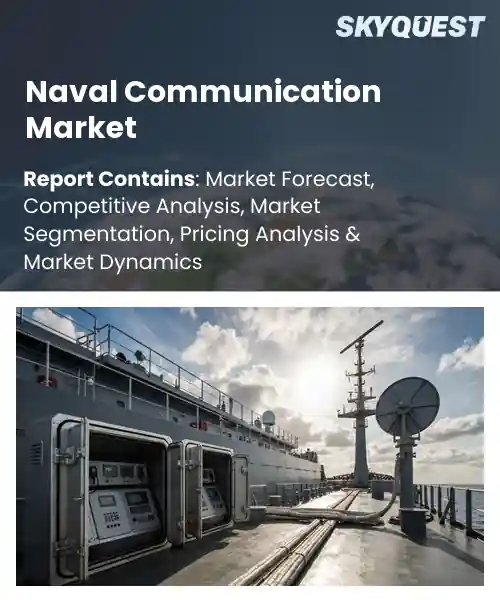
Naval Communication Market
Report ID: SQMIG20A2680
Report ID: SQMIG20A2680
[email protected]
USA +1 351-333-4748
Report ID:
SQMIG20A2680 |
Region:
Global |
Published Date: June, 2026
Pages:
157
|Tables:
147
|Figures:
78


Global Naval Communication Market size was valued at USD 3.17 Billion in 2024 and is poised to grow from USD 3.34 Billion in 2025 to USD 5.13 Billion by 2033, growing at a CAGR of 5.5% during the forecast period (2026-2033).
The naval communications market includes hardware, software, and services that facilitate voice, data, and tactical messaging among ships, aircraft, and shore stations. Its importance lies in the fact that dependable connectivity is the bedrock for maritime situational awareness, command and control, and coalition operations. The main driver is the growing defense modernizations and network centric doctrines which require robust, anti jam and encrypted links for beyond line of sight engagements. The market has evolved over decades from analog radio and HF systems to satellite communications, line of sight data links and integrated IP networks, as demonstrated by the transition from legacy VHF HF radios to SATCOM terminals and Link 16 on modern frigates.
One of the key factors propelling the global naval communication market is the incorporation of robust satellite and mesh networking technologies, which add redundancy and minimize the risk of single point failures, thus facilitating unceasing tactical data flow in contested seas, building upon network centric doctrines. This allows navies to achieve real time targeting, unmanned vehicle control and multi-domain information sharing. Examples include Aegis-equipped destroyers using SATCOM relays to track ballistic missiles and coordinating unmanned surface vessels through mesh links during exercises. Falling commercial SATCOM costs and a focus on interoperability create market opportunities for modular, upgradeable systems and expansion in lifecycle support.
How is AI enhancing secure naval communications in contested maritime environments?
AI is bolstering secure naval communications with adaptive signal processing, anomaly detection and autonomous network management. Key features are strong waveforms that adjust in the presence of jamming, AI based classification of radio frequency activity and automated link selection between satellite, line of sight and underwater channels. Today, software defined radios and machine learning are being built into communications suites to reduce operator workload and maintain confidentiality and availability. The market dynamics will be in favor of vendors that combine sensing, networking and C5ISR so fleets can operate in contested electromagnetic environments with unmanned assets and distributed sensors enhancing situational awareness.
L3Harris May 2026 unveiled Wraith Shield, turning tactical radios into AI-enabled RF sensing and protection nodes, demonstrating how onboard AI can detect hostile emissions, automate spectrum deconfliction and feed command systems to enhance survivability and communications efficiency in contested maritime operations.
Market snapshot - (2026-2033)
Global Market Size
USD 3.17 Billion
Largest Segment
Satellite Communication
Fastest Growth
Software Defined Radio
Growth Rate
5.5% CAGR
To get more insights on this market click here to Request a Free Sample Report
Global naval communication market is segmented by system type, platform, technology focus, application, sales channel and region. Based on system type, the market is segmented into Satellite Communication, Software Defined Radio, Underwater Communication and Others. Based on platform, the market is segmented into Ships, Submarines, Unmanned Naval Vehicles and Others. Based on technology focus, the market is segmented into Private 5G Networks, AI spectrum Management, LEO Satellite Terminals and Others. Based on application, the market is segmented into Intelligence Surveillance Reconnaissance, Command Control Operations and Others. Based on sales channel, the market is segmented into Government Defense Procurement, Defense System Integrators and Others. Based on region, the market is segmented into North America, Europe, Asia Pacific, Latin America and Middle East & Africa.
Satellite Communication segment dominates because it provides beyond-line-of-sight connectivity that underpins persistent maritime command and data exchange across widely dispersed fleets. Its inherent ability to link platforms regardless of surface conditions, combined with resilient multi-layered links and vendor ecosystem support, drives adoption as the backbone for long-range ISR, C2 and collaborative mission sets, enabling system interoperability and redundancy that reduce operational risk and maintain situational awareness.
However, Software Defined Radio is emerging as the most rapidly expanding area in the Naval Communication Market due to waveform agility, rapid field reconfiguration and easier integration with legacy and future systems. Its software-centric upgrades accelerate capability deployment, enable multi-mission platforms and create opportunities for interoperable, cost-effective modernization across ship classes and unmanned assets.
AI Spectrum Management segment leaders, as automated frequency allocation and intelligent interference mitigation optimize scarce electromagnetic resources under contested conditions. AI-powered tools reduce operator workload and improve link reliability by predicting spectral congestion and dynamically assigning priority channels, enabling more effective C2 and ISR missions. This is an investment driver in capabilities because adaptive spectrum control directly improves survivability, mission continuity and efficient coexistence with a variety of naval communications and electronic warfare systems.
The fastest growing area is that of Private 5G Networks providing low-latency high-bandwidth local meshes enabling sensor fusion, onboard processing and distributed autonomy. Their predictable performance and network slicing enable specialized maritime applications and rapid deployment of edge services, opening the door to new operational concepts and vendor opportunities across naval platforms and mission profiles.
To get detailed segments analysis, Request a Free Sample Report
North America is dominant, thanks to the availability of concentrated defense technology ecosystems, mature procurement frameworks and deep operational experience across blue water and littoral operations. Major defense primes, specialized suppliers, established satellite and tactical communications infrastructure enable rapid integration of advanced secure networks and resilient architectures. The emphasis on interoperability with allies, the test ranges, the training schools are very strong and they speed up the deployment of capabilities. Significant investment in research and development and cooperation between industry, the military and research institutions stimulates innovation in the areas of cryptographic protection, electronic warfare resilience and networked command and control. Supply chain depth and legacy platform upgrade programs support demand for modernized naval communication suites, and foster leadership in the development and deployment of systems. Secure communications investment is also driven by geostrategic responsibilities in several maritime theaters and a focus on maritime domain awareness. Strong aftermarket support and integrated lifecycle services also benefit the industrial base and drive modernization across fleets.
The U.S. Naval Communication Market is a vibrant ecosystem of defense primes, advanced platform integration, and cutting-edge satellite and tactical communications solutions. Adoption of secure resilient networks is being driven by procurement systems and operational experience. Technology maturation is supported by a focus on interoperability with allied forces, a strong testing infrastructure and extensive research capabilities. Focus areas include secure datalinks, electronic protection and integrated command and control solutions for fleet operations.
Canadian Naval Communication Market Emphasizes Interoperability with Allied Fleets and Tailored Solutions for Coastal and Arctic Domain Awareness. Priorities for procurement are for resilient satellite links and secure tactical networks, and systems optimized for patrol and search operations. Modernisation and testing in challenging environments supported by international suppliers. The emphasis is on secure command and control, sensor fusion and communications to provide enhanced situational awareness, which is driving adoption in a variety of naval platforms and regional security missions.
The Asia Pacific region is experiencing growth due to the increasing importance of maritime security, fleet modernization programs, and the rising indigenous defense industrial capabilities. Regional navies look for improved integration of command, control, communications, computers, intelligence, surveillance and reconnaissance to enable distributed operations in large maritime areas. Enhanced domestic shipbuilding and electronics industries, and increased cooperation with international suppliers, drive the expanded adoption of resilient satellite, radio frequency and data link technologies. The focus on interoperability during multinational exercises and the imperative to secure maritime trade routes are driving investment in secure communications, electronic protection and networked situational awareness. Policy emphasis on self reliance and export potential promotes local innovation while flexible procurement and partnership models enable fast capability insertion across surface, subsurface and auxiliary platforms.
Japan’s Naval Communication Market is centered on advanced integration of domestic electronics expertise with maritime platform requirements with an emphasis on secure satellite links, robust datalinks and anti jamming capabilities. Procurement strategies promote interoperability with allied forces, and advance indigenous solutions for island defense and fleet connectivity. Partnerships between technology companies and naval facilities allow for rapid prototyping and fielding of resilient command and control systems for complex littoral and open ocean operations.
South Korea’s Naval Communication Market: South Korea is home to a strong shipbuilding and defense electronics industry that is geared toward secure communications and network-centric warfare capabilities for its domestic market. Support multi domain operations. Focus on tactical datalinks, satellite communications resilience, and electronic protection integration. Government programs and the private sector are working together to accelerate the development of systems and architectures. Procurement and modernization decisions are based on interoperability with partner navies, emphasis on redundancy and cyber resilience.
Europe is digging in, coordinating modernization efforts, standardizing interoperable architectures and increasing cooperation between its defense industries and navies. Stress the interoperable requirements across alliances for joint procurement and phased upgrades of legacy platforms. Common standards for secure communications and electronic security. Investment in sovereign technologies and combinations of satellite and terrestrial communications options reduce dependencies and improve resiliency. Public-private partnerships and cross-border research collaborations are accelerating the evolution of sensor fusion, data link and cryptographic solutions. The emphasis on certification, exportability and lifecycle support is a way of seeking competitive advantage in international tenders, while integrated training and multinational exercises stress interoperability and support incremental improvement of naval communication capabilities. Supporting Small and Medium Enterprises in National Supply Chains to Promote Niche Innovation. More focus on spectrum management, modular open architectures increase export readiness.
Germany Naval Communication Market capitalizes on advanced engineering and an industrial base to deliver secure, interoperable communications for surface and sub surface platforms. Defense manufacturers and research institutions collaborate on building resilient radio systems, satellite terminals and command and control integration. Standardization in alliance frameworks and exportable design is the focus that breeds competitiveness. Spectrum management, cyber protection and integration with sensor networks are procurement and ongoing modernization focus areas.
United Kingdom Naval Communication Market is centered on deployable communications and integration across fleet formations. Expeditionary and coalition operations are supported by advanced satellite terminals, secure datalinks, and electronic protection solutions. Defense primes, naval command structures and research centers are intimately connected and support rapid fielding of resilient command and control suites. Procurement and upgrade strategies for fleet communications are shaped by cyber hardening, interoperability with allied networks, and scalable modular systems to increase readiness.
The French naval communication market benefits from integrated naval programmes and a strong electronics and aerospace sector that supplies secure communication suites. Sovereign capabilities and exportable systems will ensure strategic and expeditionary fleet needs are met. Shipbuilders, system integrators and research institutes are collaborating to advance resilient datalinks, satellite communications and cryptographic protections. Interoperability of alliance frameworks, life cycle support and training ensures deployable, adaptable communications for surface, sub surface naval vessels.
To know more about the market opportunities by region and country, click here to
Buy The Complete Report
Enhanced Satellite Communication Capabilities
Integration Of Secure Data Links
High Implementation and Maintenance Costs
Regulatory Compliance and Interoperability
Request Free Customization of this report to help us to meet your business objectives.
The global naval communication market is competitive with focused consolidation, strategic distribution partnerships and fast-paced product innovation. Recent examples, including E-Space acquiring CommAgility, satellite operators signing distribution agreements with maritime integrators like OneWeb and Marlink, and the emergence of VDES platforms and underwater mesh networking, all push vendors to provide resilient SATCOM, software-defined radios and integrated surface-to-underwater solutions.
SkyQuest’s ABIRAW (Advanced Business Intelligence, Research & Analysis Wing) is our Business Information Services team that Collects, Collates, Correlates, and Analyses the Data collected by means of Primary Exploratory Research backed by robust Secondary Desk research.
As per SkyQuest analysis, a key driver is rising defense modernization and network-centric doctrines that push navies to adopt resilient, beyond-line-of-sight links and integrated sensor and command systems. A second driver is AI-enabled spectrum management and adaptive waveforms that improve link reliability under contested conditions. The market is restrained by high implementation and maintenance costs that slow procurement and lifecycle upgrades. North America remains the dominating region thanks to a dense defense ecosystem and deep R&D investment, while satellite communication is the dominating segment as it provides persistent, long-range connectivity essential for ISR, command and coalition operations. Vendors who deliver modular, upgradeable and interoperable solutions will capture the largest opportunities.
| Report Metric | Details |
|---|---|
| Market size value in 2024 | USD 3.17 Billion |
| Market size value in 2033 | USD 5.13 Billion |
| Growth Rate | 5.5% |
| Base year | 2024 |
| Forecast period | (2026-2033) |
| Forecast Unit (Value) | USD Billion |
| Segments covered |
|
| Regions covered | North America (US, Canada), Europe (Germany, France, United Kingdom, Italy, Spain, Rest of Europe), Asia Pacific (China, India, Japan, Rest of Asia-Pacific), Latin America (Brazil, Rest of Latin America), Middle East & Africa (South Africa, GCC Countries, Rest of MEA) |
| Companies covered |
|
| Customization scope | Free report customization with purchase. Customization includes:-
|
To get a free trial access to our platform which is a one stop solution for all your data requirements for quicker decision making. This platform allows you to compare markets, competitors who are prominent in the market, and mega trends that are influencing the dynamics in the market. Also, get access to detailed SkyQuest exclusive matrix.
Table Of Content
Executive Summary
Market overview
Parent Market Analysis
Market overview
Market size
KEY MARKET INSIGHTS
COVID IMPACT
MARKET DYNAMICS & OUTLOOK
Market Size by Region
KEY COMPANY PROFILES
Methodology
For the Naval Communication Market, our research methodology involved a mixture of primary and secondary data sources. Key steps involved in the research process are listed below:
1. Information Procurement: This stage involved the procurement of Market data or related information via primary and secondary sources. The various secondary sources used included various company websites, annual reports, trade databases, and paid databases such as Hoover's, Bloomberg Business, Factiva, and Avention. Our team did 45 primary interactions Globally which included several stakeholders such as manufacturers, customers, key opinion leaders, etc. Overall, information procurement was one of the most extensive stages in our research process.
2. Information Analysis: This step involved triangulation of data through bottom-up and top-down approaches to estimate and validate the total size and future estimate of the Naval Communication Market.
3. Report Formulation: The final step entailed the placement of data points in appropriate Market spaces in an attempt to deduce viable conclusions.
4. Validation & Publishing: Validation is the most important step in the process. Validation & re-validation via an intricately designed process helped us finalize data points to be used for final calculations. The final Market estimates and forecasts were then aligned and sent to our panel of industry experts for validation of data. Once the validation was done the report was sent to our Quality Assurance team to ensure adherence to style guides, consistency & design.
Analyst Support
Customization Options
With the given market data, our dedicated team of analysts can offer you the following customization options are available for the Naval Communication Market:
Product Analysis: Product matrix, which offers a detailed comparison of the product portfolio of companies.
Regional Analysis: Further analysis of the Naval Communication Market for additional countries.
Competitive Analysis: Detailed analysis and profiling of additional Market players & comparative analysis of competitive products.
Go to Market Strategy: Find the high-growth channels to invest your marketing efforts and increase your customer base.
Innovation Mapping: Identify racial solutions and innovation, connected to deep ecosystems of innovators, start-ups, academics, and strategic partners.
Category Intelligence: Customized intelligence that is relevant to their supply Markets will enable them to make smarter sourcing decisions and improve their category management.
Public Company Transcript Analysis: To improve the investment performance by generating new alpha and making better-informed decisions.
Social Media Listening: To analyze the conversations and trends happening not just around your brand, but around your industry as a whole, and use those insights to make better Marketing decisions.
REQUEST FOR SAMPLE
 REQUEST FREE CUSTOMIZATION
Global Naval Communication Market size was valued at USD 3.17 Billion in 2024 and is poised to grow from USD 3.34 Billion in 2025 to USD 5.13 Billion by 2033, growing at a CAGR of 5.5% during the forecast period (2026-2033).
Competition in the global naval communication market is driven by targeted consolidation, strategic distribution partnerships, and rapid product innovation; notable examples include E-Space’s acquisition of CommAgility, distribution agreements between satellite operators and maritime integrators such as OneWeb and Marlink, and the rise of VDES platforms and underwater mesh networking that push vendors to deliver resilient SATCOM, software-defined radios, and integrated surface-to-underwater solutions. 'Lockheed Martin', 'Northrop Grumman', 'Raytheon Technologies (RTX)', 'General Dynamics', 'Thales Group', 'L3Harris Technologies', 'Leonardo', 'BAE Systems', 'Saab', 'Indra Sistemas', 'Rohde & Schwarz', 'Elbit Systems', 'Ultra Electronics', 'Cisco Systems', 'Aselsan', 'Honeywell', 'Kongsberg', 'Cobham', 'Immarsat', 'Navantia'
Improved satellite communication capabilities expand reach, reliability, and bandwidth for naval operations, enabling sustained beyond line of sight connectivity and more robust data exchange between vessels and command centers. This enhancement supports adoption of advanced communication suites and encourages investment in interoperable systems, because stakeholders prioritize resilient, long range links for situational awareness and mission coordination. As satellite technologies evolve, navies are more willing to equip fleets with integrated communication platforms, which drives procurement cycles and stimulates vendor innovation across hardware, software, and service segments.
Autonomy And Unmanned Integration: Naval forces are increasingly deploying autonomous surface and underwater platforms, driving demand for robust, low latency links that support command, control and sensor data exchange. This trend emphasizes secure, adaptive networking, intelligent edge processing to reduce bandwidth usage, and standardized interfaces enabling human machine teaming. Vendors are shifting toward scalable communication suites that can be integrated across manned and unmanned assets to enhance distributed operations, situational awareness and mission flexibility in contested and congested maritime environments.
Why does North America Dominate the Global Naval Communication Market? |@12


Want to customize this report? This report can be personalized according to your needs. Our analysts and industry experts will work directly with you to understand your requirements and provide you with customized data in a short amount of time. We offer $1000 worth of FREE customization at the time of purchase.
Feedback From Our Clients


 USA (+1) 351-333-4748

