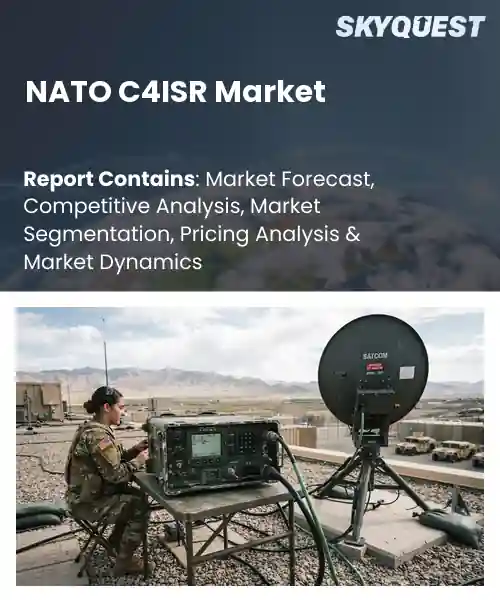
NATO C4ISR Market
Report ID: SQMIG20A2944
Report ID: SQMIG20A2944
[email protected]
USA +1 351-333-4748
Report ID:
SQMIG20A2944 |
Region:
Global |
Published Date: November, 2026
Pages:
157
|Tables:
123
|Figures:
77


Global Nato C4Isr Market size was valued at USD 95.16 Billion in 2024 and is poised to grow from USD 98.37 Billion in 2025 to USD 128.24 Billion by 2033, growing at a CAGR of 3.37% during the forecast period (2026-2033).
The NATO C4ISR market encompasses command, control, communications, computers, intelligence, surveillance and reconnaissance systems that enable allied forces to share data across air, land and sea domains. Its significance stems from the alliance’s need to maintain collective situational awareness and rapid decision‑making in contested environments. The primary driver today is the accelerating integration of artificial‑intelligence‑enhanced sensor networks, which promise to reduce latency between threat detection and response. Historically, the market evolved from bulky, stovepiped radio sets in the Cold War to network‑centric architectures during the Kosovo and Afghanistan campaigns, illustrating how operational lessons have shaped procurement toward interoperable, software‑defined platforms. The next decisive factor influencing the global NATO C4ISR market is the push for joint‑multinational cyber‑resilience, which creates a cascade of growth opportunities across hardware, cloud services and training. As adversaries expand electronic‑warfare capabilities, NATO members must adopt hardened encrypted links that survive coordinated jamming, prompting spending on quantum‑resistant encryption modules and redundant satellite back‑bones. Real‑world examples such as the Enhanced Forward Presence’s integrated battlefield management system in the Baltic states show how secure data fusion improves force synchronization and reduces casualties. Consequently, vendors delivering scalable, secure architectures are positioned to capture a share of upcoming contracts, accelerating market expansion.
How is AI-driven automation reshaping NATO's C4ISR procurement strategies?
AI driven automation is reshaping NATO’s C4ISR procurement by prioritising modular, software centric solutions that can learn and adapt across the battlespace. The alliance now evaluates bids not only on hardware performance but on the ability of algorithms to fuse sensor data, predict threats and streamline command cycles. This shift has accelerated contracts for cloud based analytics, autonomous drones and intelligent networking kits, reducing legacy platform lifecycles and lowering logistics footprints. Nations are pooling requirements to leverage economies of scale, while NATO’s Joint Capability Group actively pilots open architecture standards that enable rapid integration of third party AI modules. The result is a procurement landscape that rewards flexibility, rapid fielding and continuous algorithmic upgrades.Lockheed Martin March 2024 unveiled an AI enabled Joint All Domain Command and Control node that integrates NATO sensor feeds into a single predictive dashboard. The system automates threat correlation and decision support, cutting analyst workload and accelerating response times, thereby reinforcing the alliance’s drive toward faster data centric procurement.
Market snapshot - (2026-2033)
Global Market Size
USD 95.16 Billion
Largest Segment
Command & Control Systems
Fastest Growth
Surveillance Systems
Growth Rate
3.37% CAGR
To get more insights on this market click here to Request a Free Sample Report
Global nato c4isr market is segmented by system type, platform, application, end user and region. Based on system type, the market is segmented into Command & Control Systems, Communications Systems, Computers & Information Systems, Intelligence Systems, Surveillance Systems and Reconnaissance Systems. Based on platform, the market is segmented into Land-Based Systems, Naval Systems, Airborne Systems and Space-Based Systems. Based on application, the market is segmented into Battlefield Management, Situational Awareness, Intelligence Gathering & Analysis, Secure Military Communications and Border & Maritime Surveillance. Based on end user, the market is segmented into NATO Armed Forces, Defense Agencies and Military Intelligence Organizations. Based on region, the market is segmented into North America, Europe, Asia Pacific, Latin America and Middle East & Africa.
Command and Control Systems segment dominates because they integrate mission planning, execution, and after action review across allied forces, providing a unified decision making backbone. Their ability to fuse data from disparate sources and disseminate orders in real time creates a common operational picture, which is essential for coalition coherence and rapid response. Built on interoperable standards and supported by joint training, they receive upgrades that reinforce their central role in NATO operations.
However, Intelligence Systems segment is the most rapidly expanding area within the NATO C4ISR market as advances in sensor fusion, machine learning, and open source analytics enable deeper insight extraction from battlefield data. Growing demand for threat assessment and decision support drives investment, positioning these capabilities as a catalyst for modernization and operational advantage.
Secure Military Communications segment dominates because it ensures that command exchange, data transfer, and voice traffic remain confidential and resilient against cyber and electronic threats. End to end encryption, adaptive waveforms, and hardened network architectures enable seamless interoperability across diverse NATO platforms, maintaining operational tempo even under contested conditions. Continuous upgrades driven by emerging threat actors and the necessity for assured connectivity reinforce its priority status within alliance procurement strategies.
Meanwhile, Border and Maritime Surveillance segment emerges as the fastest growing area in the NATO C4ISR market as sensor networks, aerial and surface platforms, and analytics converge to monitor zones. Focus on migration, illicit trafficking, and hybrid threats fuels procurement, while integration with networks expands situational awareness, creating revenue streams and driving adoption.
To get detailed segments analysis, Request a Free Sample Report
North America leverages deep historical ties to NATO, extensive defense budgets, and a mature industrial base that integrates cutting‑edge technology across command, control, communications, computers, intelligence, surveillance and reconnaissance. The United States provides doctrinal leadership and drives interoperable standards, while Canada contributes robust research ecosystems and collaborative procurement frameworks. Together they sustain a resilient supply chain, foster continuous innovation through public‑private partnerships, and maintain a large pool of skilled personnel. This ecosystem creates an environment where advanced C4ISR solutions are rapidly developed, fielded, and refined, reinforcing the region’s position as the benchmark for operational effectiveness and strategic influence within the alliance.
NATO C4ISR Market in the United States benefits from a concentration of premier defense contractors, a strong emphasis on joint operational testing, and close alignment with alliance policy. The ecosystem encourages rapid prototyping and scaling of network‑centric capabilities, while institutional investments in cyber resilience and data fusion enhance overall system reliability. Collaboration across federal agencies and multinational exercises further embeds interoperability, ensuring that emerging technologies transition smoothly into operational use.
NATO C4ISR Market in Canada is shaped by a commitment to collaborative research and an emphasis on modular, export‑ready solutions. Canadian firms prioritize integration of indigenous sensor technologies with NATO‑standard data links, reinforcing alliance connectivity. Government programs promote partnerships with allied counterparts, focusing on joint training and operational testing. This approach leverages Canada’s expertise in harsh environment operations, adding valuable resilience to the broader NATO C4ISR architecture.
Europe’s expansion is propelled by a convergence of strategic imperatives, heightened investment in joint defense initiatives, and a revitalized emphasis on technological sovereignty. Nations are embracing interoperable architectures that align with NATO standards while fostering domestic innovation ecosystems. Collaborative programs across the continent facilitate shared R&D, risk sharing, and streamlined acquisition pathways, enhancing the speed of technology adoption. Growing concerns about hybrid threats have amplified focus on resilient communications, advanced analytics, and integrated sensor networks, positioning Europe as a dynamic engine of capability development within the alliance.
NATO C4ISR Market in Germany is characterized by a vigorous drive toward digital battlefield integration and a strong industrial base that blends traditional engineering with emerging software expertise. German enterprises prioritize scalable network architectures and sophisticated data processing, supporting alliance missions with high‑precision situational awareness. Close alignment with European research institutions accelerates the translation of academic breakthroughs into operational tools, reinforcing Germany’s role as a catalyst for rapid capability evolution.
NATO C4ISR Market in the United Kingdom benefits from a long‑standing commitment to joint operational doctrine and a robust defense sector focused on secure communication and intelligence fusion. The UK places particular emphasis on expeditionary capabilities, ensuring that deployed forces maintain seamless connectivity across diverse theatres. Integration of advanced analytics and artificial intelligence enhances decision‑making speed, while continuous participation in NATO exercises solidifies the UK’s position as a leading contributor to alliance interoperability.
NATO C4ISR Market in France is emerging through a strategic blend of sovereign technology development and active engagement in multinational projects. French firms concentrate on resilient satellite communications, advanced sensor suites, and collaborative command platforms that align with NATO standards. Emphasis on cyber‑defense integration and modular system design enables rapid adaptation to evolving threat landscapes, positioning France as a growing influence in the alliance’s collective C4ISR capability set.
Asia Pacific nations are expanding their NATO C4ISR footprint by adopting alliance‑compatible standards, deepening bilateral cooperation, and investing in indigenous research that complements NATO’s technological roadmap. Both Japan and South Korea are focusing on resilient network infrastructures, sophisticated signal processing, and integrated reconnaissance platforms that enhance joint operational awareness. Participation in NATO‑led exercises and technology exchange programs facilitates knowledge transfer and harmonization of procedures. This proactive engagement, combined with strong domestic defense industries, enables the region to contribute valuable capabilities and diversify the alliance’s global C4ISR ecosystem.
NATO C4ISR Market in Japan emphasizes high‑precision sensor integration and secure, low‑latency communication links that support coalition operations. Japanese firms leverage advanced robotics and autonomous systems to augment traditional surveillance, while governmental initiatives promote alignment with NATO data exchange protocols. Continuous involvement in joint training enhances tactical interoperability, positioning Japan as a reliable partner in alliance network resilience.
NATO C4ISR Market in South Korea focuses on robust cyber‑defense architectures and rapid data analytics to support real‑time battlefield insight. South Korean industry combines cutting‑edge radar technologies with open‑architecture software platforms, facilitating seamless integration with NATO command networks. Ongoing collaboration through multilateral drills reinforces procedural compatibility and underscores South Korea’s commitment to strengthening collective security.
To know more about the market opportunities by region and country, click here to
Buy The Complete Report
Increasing Interoperability Among Allies
Adoption Of AI‑Enabled Decision Tools
Budgetary Constraints Across Member States
Complex Integration With Legacy Systems
Request Free Customization of this report to help us to meet your business objectives.
The NATO C4ISR market is shaped by intense competition among legacy defense giants and agile newcomers, with firms leveraging strategic M&A, cross‑border partnerships, and rapid tech innovation to secure contracts; Thales’ 2023 acquisition of cyber‑security specialist Cybergate bolstered its secure‑link portfolio, while Lockheed Martin’s 2022 joint venture with NATO’s Joint All‑Domain Command and Control program accelerated integration of AI‑driven sensor fusion across allied forces.
Top Player’s Company Profile
Recent Developments
SkyQuest’s ABIRAW (Advanced Business Intelligence, Research & Analysis Wing) is our Business Information Services team that Collects, Collates, Correlates, and Analyses the Data collected by means of Primary Exploratory Research backed by robust Secondary Desk research. As per SkyQuest analysis, the NATO C4ISR market is propelled primarily by the push for greater interoperability among allied forces, which fuels demand for integrated platforms that share data in real time. A second major driver is the rapid adoption of AI‑enabled decision tools that automate sensor fusion and shorten command cycles, prompting vendors to prioritize modular, software‑centric solutions. The market is led by North America, where deep defense budgets and a mature industrial base support the largest share of contracts. Command and control systems dominate the segment landscape because they provide the backbone for unified operational pictures. However, budgetary constraints across several member states act as a restraint, slowing full‑scale modernization and prompting more incremental upgrades.
| Report Metric | Details |
|---|---|
| Market size value in 2024 | USD 95.16 Billion |
| Market size value in 2033 | USD 128.24 Billion |
| Growth Rate | 3.37% |
| Base year | 2024 |
| Forecast period | (2026-2033) |
| Forecast Unit (Value) | USD Billion |
| Segments covered |
|
| Regions covered | North America (US, Canada), Europe (Germany, France, United Kingdom, Italy, Spain, Rest of Europe), Asia Pacific (China, India, Japan, Rest of Asia-Pacific), Latin America (Brazil, Rest of Latin America), Middle East & Africa (South Africa, GCC Countries, Rest of MEA) |
| Companies covered |
|
| Customization scope | Free report customization with purchase. Customization includes:-
|
To get a free trial access to our platform which is a one stop solution for all your data requirements for quicker decision making. This platform allows you to compare markets, competitors who are prominent in the market, and mega trends that are influencing the dynamics in the market. Also, get access to detailed SkyQuest exclusive matrix.
Table Of Content
Executive Summary
Market overview
Parent Market Analysis
Market overview
Market size
KEY MARKET INSIGHTS
COVID IMPACT
MARKET DYNAMICS & OUTLOOK
Market Size by Region
KEY COMPANY PROFILES
Methodology
For the NATO C4ISR Market, our research methodology involved a mixture of primary and secondary data sources. Key steps involved in the research process are listed below:
1. Information Procurement: This stage involved the procurement of Market data or related information via primary and secondary sources. The various secondary sources used included various company websites, annual reports, trade databases, and paid databases such as Hoover's, Bloomberg Business, Factiva, and Avention. Our team did 45 primary interactions Globally which included several stakeholders such as manufacturers, customers, key opinion leaders, etc. Overall, information procurement was one of the most extensive stages in our research process.
2. Information Analysis: This step involved triangulation of data through bottom-up and top-down approaches to estimate and validate the total size and future estimate of the NATO C4ISR Market.
3. Report Formulation: The final step entailed the placement of data points in appropriate Market spaces in an attempt to deduce viable conclusions.
4. Validation & Publishing: Validation is the most important step in the process. Validation & re-validation via an intricately designed process helped us finalize data points to be used for final calculations. The final Market estimates and forecasts were then aligned and sent to our panel of industry experts for validation of data. Once the validation was done the report was sent to our Quality Assurance team to ensure adherence to style guides, consistency & design.
Analyst Support
Customization Options
With the given market data, our dedicated team of analysts can offer you the following customization options are available for the NATO C4ISR Market:
Product Analysis: Product matrix, which offers a detailed comparison of the product portfolio of companies.
Regional Analysis: Further analysis of the NATO C4ISR Market for additional countries.
Competitive Analysis: Detailed analysis and profiling of additional Market players & comparative analysis of competitive products.
Go to Market Strategy: Find the high-growth channels to invest your marketing efforts and increase your customer base.
Innovation Mapping: Identify racial solutions and innovation, connected to deep ecosystems of innovators, start-ups, academics, and strategic partners.
Category Intelligence: Customized intelligence that is relevant to their supply Markets will enable them to make smarter sourcing decisions and improve their category management.
Public Company Transcript Analysis: To improve the investment performance by generating new alpha and making better-informed decisions.
Social Media Listening: To analyze the conversations and trends happening not just around your brand, but around your industry as a whole, and use those insights to make better Marketing decisions.
REQUEST FOR SAMPLE
 REQUEST FREE CUSTOMIZATION


Want to customize this report? This report can be personalized according to your needs. Our analysts and industry experts will work directly with you to understand your requirements and provide you with customized data in a short amount of time. We offer $1000 worth of FREE customization at the time of purchase.
Feedback From Our Clients


 USA (+1) 351-333-4748

