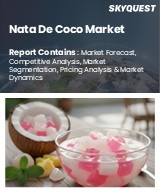
Nata De Coco Market
Report ID: SQMIG30I2677
Report ID: SQMIG30I2677
[email protected]
USA +1 351-333-4748
Report ID:
SQMIG30I2677 |
Region:
Global |
Published Date: January, 2026
Pages:
191
|Tables:
114
|Figures:
69


Global Nata De Coco Market size was valued at USD 3.7 Billion in 2024 and is poised to grow from USD 3.91 Billion in 2025 to USD 6.09 Billion by 2033, growing at a CAGR of 5.7% during the forecast period (2026–2033).
Growth is supported by the increasing usage of nata de coco as a clean-label and low-calorie ingredient in beverages, yogurts, frozen desserts, and snack cups. Its chewy texture and natural fiber content make it popular among health-conscious consumers who are looking for alternatives to high-sugar inclusions. In 2024, the Asia-Pacific continued to maintain its leading position, supported by rich coconut production together with high domestic consumption in key markets such as the Philippines, Indonesia, and Thailand, finding wide applications in ready-to-drink beverages and fruit cups. Steady growth was seen in North America, as Asian-inspired flavors found mainstream retail favorable. In Europe, the segment also saw its share expand on the back of innovations in clean-label desserts and supermarket private-label launches. Improvement of cube firmness continued to be pursued by manufacturers together with consistent syrup systems and aseptic packaging solutions that extend shelf life and maintain texture. Sustainability also influenced the market, with recyclable laminates and portion-controlled packs gaining traction in 2024. Though there are certain risks, such as the volatility in the supply of coconuts and price swings driven by unfavorable climatic conditions, contract farming, diversified sourcing, and stabilized formulations have been important strategies to help the companies tide over these challenges. The outlook remains positive as retailers broaden their private-label assortment and foodservice operators incorporate nata de coco into premium beverages and modern desserts.
How Will AI Reshape Fermentation, Flavor Innovation, And Global Supply Chains in The Nata De Coco Market?
Artificial intelligence is increasingly shaping the nata de coco market through changing production processes, ensuring consistency, and bringing greater efficiency to supply chains. Global nata de coco market strategies in 2024 explained that AI-powered monitoring systems-which, in turn, track microbial activity, sugar levels, and temperature in real-time-are being adopted by fermentation plants in order to decrease defects and improve yields. Supply chain platforms integrated AI-based forecasting tools to handle coconut-sourcing volatility and ensure a steady raw material supply, especially within the Asia-Pacific region. This report has pointed out that in North America and Europe, AI-enabled consumer analytics has identified flavor trends and packaging preferences, thus driving manufacturers toward new product launches such as flavored nata de coco beverages and low-sugar snack cups. AI-enabled quality control with image recognition contributes to further waste reduction at the identification of inconsistencies in packaging lines. Altogether, these enable manufacturers to attain higher efficiency, traceability, and responsiveness to the market in the production and distribution of nata de coco.
Market snapshot - 2026-2033
Global Market Size
USD 3.51 Billion
Largest Segment
Cubes
Fastest Growth
Beverages
Growth Rate
3.8% CAGR
To get more insights on this market click here to Request a Free Sample Report
Global Nata De Coco Market is segmented by Nature, Application, Distribution / Channel and region. Based on Nature, the market is segmented into Conventional Nata de Coco and Organic Nata de Coco. Based on Application, the market is segmented into Food & Beverages, Cosmetics & Personal Care and Others. Based on Distribution / Channel, the market is segmented into B2B and B2C. Based on region, the market is segmented into North America, Europe, Asia Pacific, Latin America and Middle East & Africa.
Cubes are a leading type in the nata de coco market in 2024 due to their versatility across beverages, desserts, and snack items. The inherent chewy texture and neutral taste of cubes make them very suitable for mixing with flavored syrups-the base for most commercial and household applications. In 2024, Philippine producers started exporting more cubes to Japan and South Korea for use in bubble teas, fruit salads, and yogurts. While this was happening, demand from various European café chains and retail points for ready-to-eat cube-based snack cups further solidified the position of cubes as the leading product type in the global market.
Beverages are growing the fastest in 2024, with beverage manufacturers introducing product innovations such as nata de coco-infused juices, functional waters, and dairy alternatives. The segment continues to benefit from consumer preference for refreshing drinks that have low calories and added texture value. South Korean beverage companies developed yogurt drinks with nata de coco in 2024, while Indian players expanded the lines of fruit juices with cube inclusions. It is considered the most dynamic growth driver due to rapid adoption via convenience stores and foodservice outlets.
The Original flavor will remain the most developed in 2024 due to its positioning as the default option for bulk exports, foodservice applications, and household use. It is neutral, hence versatile, in desserts, flavored syrups, and beverage formulations due to its nature. Japanese and European manufacturers have scaled demand for original nata de coco in 2024 to integrate into puddings, dairy-based products, and fruit cocktails, thus reaffirming its position as the globally dominant flavor category.
Fruit-flavored nata de coco is growing the fastest, with strawberry, mango, lychee, and pineapple driving innovation in both snack cups and beverages. In the Asia-Pacific region, flavored nata de coco products, mostly offered in small and affordable packs, are gaining more appeal, especially among younger consumers in Thailand and Vietnam. In 2024, U.S. specialty retailers also introduced tropical-flavored nata de coco drinks, targeting adventurous and health-conscious buyers. This variety-driven trend puts fruit-flavored nata de coco as the fastest-emerging flavor category in the world.
To get detailed segments analysis, Request a Free Sample Report
According to the global nata de coco regional forecast, in 2024, the Asia-Pacific region dominated the market with abundant coconut production, great cultural integration, and strong demand across beverages and desserts. Major producing countries such as the Philippines, Indonesia, and Thailand maintain their exports to major beverage and dairy players globally. Japan and South Korea have sustained high-end demand, particularly for flavored drinks and retail cups. Continuous innovation in the areas of syrup systems, aseptic packaging, and sustainability cements the lead of the Asia-Pacific region to become the backbone for the world's consumption and supply of nata de coco.
According to the global nata de coco regional outlook, in 2024, Japan continued to show strong demand for nata de coco across bubble teas, yogurts, and dairy desserts. Local beverage players extended premium portfolios using nata inclusions; meanwhile, retail stores actively pushed ready-to-eat dessert cups. To meet the wellness and environmental concerns of the consumers the clean-label positioning and recyclable packaging have also been emphasized. These innovations have continued to set Japan among the most advanced and consumer-driven nata de coco markets across the Asia-Pacific region.
As per the global nata de coco regional analysis, in 2024, nata de coco started to see rapid growth in South Korea with the rise of yogurt drinks, fruit-based beverages, and café offerings. For its part, retailers expanded their clean-label dessert portfolio, and foodservice players developed aseptically nata-infused drinks to attract younger, health-conscious consumers. Manufacturers invested in aseptic packaging to maintain the quality and prolong the shelf life of nata de coco. These developments mark South Korea's strong role in the advancement of the adoption of nata de coco in the competitive food and beverage sector in the Asia-Pacific region.
According to the global nata de coco market forecast, North America held the second-largest share of the nata de coco market in 2024, supported by growing demand for clean-label, fiber-rich desserts and beverages. Both the US and Canada enjoyed the rise of Asian-inspired cafes, bubble tea outlets, and private-label launches in supermarkets. Manufacturers emphasized recyclable packaging, portion-controlled packs, and low-sugar syrups to appeal to health trends that are continually evolving. Digital grocery platforms and foodservice chains further accelerated the category's adoption and anchored the strong role of North America in the growth of nata de coco globally.
According to the global nata de coco market outlook, the United States dominated the regional demand for nata de coco in 2024 due to the increasing popularity of bubble teas, smoothies, and fruit desserts. Imports from Southeast Asia ensured consistent supply, while U.S. retailers pushed ready-to-eat nata cups and beverages under private-label brands. Clean-label innovation, sustainable packaging, and expanded foodservice menus have entrenched the country's leadership in making the U.S. a central hub for premium nata de coco adoption in North America.
As per the global nata de coco market analysis, Canada witnessed continuous growth in nata de coco in 2024, with more consumers turning to flavored drinks, yogurts, and healthy desserts. New formats include snack cups of nata, beverages targeted at different consumer segments, and foodservice chains that introduced fusion drinks with the ingredient. Food manufacturers also positioned eco-friendly packaging and clean-label claims to appeal to the sustainability agenda of consumers. All these factors combined make Canada a regular contributor to growth, further cementing its position in the growing North American nata de coco market.
According to the global nata de coco industry analysis, Europe accounted for the third position in the nata de coco market in 2024, driven by rising consumer demand for low-calorie desserts, clean-label developments, and sustainability policies. Supermarkets expanded their private-label nata snack cups, while dairy manufacturers unveiled cube-in-yogurt formats to meet the functional food trends. Eco-certified packaging solutions cropped up with the rise of regulators promoting greener materials. Driving growth in 2024 in Germany, the UK, and France is innovation, health-oriented assortment, and the popularity of Asian-inspired beverages and desserts.
According to the global nata de coco market trends, Germany led the European demand for nata de coco in 2024, with good adoption in yogurts, chilled snacks, and premium desserts. Local retailers have highlighted 'clean-label' certification and eco-friendly packaging in the market. Flavored versions of the nata drink have entered the market through cafes. Supplies have been stable, underpinned by imports from Asia.
As per the global nata de coco industry trends, Innovations identified include bubble tea, smoothies, and plant-based desserts, which supported strong growth in the United Kingdom in 2024. Nata snack cups and functional beverages were launched by retailers, while the number of flavored nata offerings in foodservice chains increased. Sustainability initiatives, especially recyclable packaging, strengthened adoption and made the UK one of the most dynamic and fast-evolving markets for innovative nata de coco products.
As per the global nata de coco industry, France expanded the consumption of nata de coco in 2024, and demand was mainly concentrated in cafés, patisseries, and fruit-based desserts. In addition, French consumers preferred nata inclusions in yogurts and tropical drinks. Local manufacturers of food items emphasized biodegradable packaging and flavor innovations, especially positioned for EU sustainability targets. It has, therefore, secured the growing position of France within the Nata de coco market in Europe.
To know more about the market opportunities by region and country, click here to
Buy The Complete Report
Growing Demand for Functional and Healthy Snacks
Expansion of Ready-to-Drink Beverages
Volatility in Coconut Supply Chains
Competition from Substitutes and Alternatives
Request Free Customization of this report to help us to meet your business objectives.
According to global nata de coco market statistics, there has been intense rivalry among established Asian producers, regional exporters, and emerging specialty food brands in 2024. Leading companies compete on quality consistency, cube transparency, and syrup innovation, while many firms focus on eco-friendly packaging solutions and extended shelf-life solutions for health-conscious consumers. Regional exports to global beverage and dessert manufacturers are dominated by big players from Thailand, the Philippines, and Indonesia. Companies in North Asia will be differentiated by product diversification, including low-sugar nata de coco beverages and fruit-based snack cups. Sustainability has taken center stage, with investments in water recycling and waste management, coupled with AI-assisted fermentation that improves yield. Partnerships with dairy and plant-based drink manufacturers further strengthen competitive positioning by extending the application fields of nata de coco beyond traditional desserts. Companies remain focused on regional consolidation, with a strategic intent to secure long-term contracts with global foodservice chains and modern retail outlets. Growth driven by innovation has been replacing the competitive landscape, with leadership defined by flavor variety, product format, and sustainability credentials.
SkyQuest’s ABIRAW (Advanced Business Intelligence, Research & Analysis Wing) is our Business Information Services team that Collects, Collates, Correlates, and Analyses the Data collected by means of Primary Exploratory Research backed by robust Secondary Desk research.
As per SkyQuest analysis, key drivers of market growth include robust growth supported by demand for healthy, clean-label, and functional food ingredients. Most forms of consumption are dominated by cubes, as they are widely used in beverages, fruit cups, yogurts, and desserts; the fastest-growing drinks segment, because brands use nata inclusions for texture and differentiation. For now, offline retail and foodservice remain the biggest distribution networks, but online platforms are gaining share at an increasing pace driven by subscription formats, variety packs, and flavored innovations. Supply chains reliant on coconuts expose producers to the vagaries of climate, while growth in certain formats is constrained by limitations on shelf life and packaging. Flavoring innovation, syrup stability, and aseptic packaging enhance the product's reach. Nevertheless, the outlook remains bright: consumer interest in fiber-rich and low-calorie inclusions is growing unabated, hence making nata de coco a sustainable and versatile ingredient in global food and beverage categories saw its share expand on the back of innovations in clean-label desserts and supermarket private-label launches.
| Report Metric | Details |
|---|---|
| Market size value in 2024 | USD 3.7 Billion |
| Market size value in 2033 | USD 6.09 Billion |
| Growth Rate | 5.7% |
| Base year | 2024 |
| Forecast period | 2026-2033 |
| Forecast Unit (Value) | USD Billion |
| Segments covered |
|
| Regions covered | North America (US, Canada), Europe (Germany, France, United Kingdom, Italy, Spain, Rest of Europe), Asia Pacific (China, India, Japan, Rest of Asia-Pacific), Latin America (Brazil, Rest of Latin America), Middle East & Africa (South Africa, GCC Countries, Rest of MEA) |
| Companies covered |
|
| Customization scope | Free report customization with purchase. Customization includes:-
|
To get a free trial access to our platform which is a one stop solution for all your data requirements for quicker decision making. This platform allows you to compare markets, competitors who are prominent in the market, and mega trends that are influencing the dynamics in the market. Also, get access to detailed SkyQuest exclusive matrix.
Table Of Content
Executive Summary
Market overview
Parent Market Analysis
Market overview
Market size
KEY MARKET INSIGHTS
COVID IMPACT
MARKET DYNAMICS & OUTLOOK
Market Size by Region
KEY COMPANY PROFILES
Methodology
For the Nata De Coco Market, our research methodology involved a mixture of primary and secondary data sources. Key steps involved in the research process are listed below:
1. Information Procurement: This stage involved the procurement of Market data or related information via primary and secondary sources. The various secondary sources used included various company websites, annual reports, trade databases, and paid databases such as Hoover's, Bloomberg Business, Factiva, and Avention. Our team did 45 primary interactions Globally which included several stakeholders such as manufacturers, customers, key opinion leaders, etc. Overall, information procurement was one of the most extensive stages in our research process.
2. Information Analysis: This step involved triangulation of data through bottom-up and top-down approaches to estimate and validate the total size and future estimate of the Nata De Coco Market.
3. Report Formulation: The final step entailed the placement of data points in appropriate Market spaces in an attempt to deduce viable conclusions.
4. Validation & Publishing: Validation is the most important step in the process. Validation & re-validation via an intricately designed process helped us finalize data points to be used for final calculations. The final Market estimates and forecasts were then aligned and sent to our panel of industry experts for validation of data. Once the validation was done the report was sent to our Quality Assurance team to ensure adherence to style guides, consistency & design.
Analyst Support
Customization Options
With the given market data, our dedicated team of analysts can offer you the following customization options are available for the Nata De Coco Market:
Product Analysis: Product matrix, which offers a detailed comparison of the product portfolio of companies.
Regional Analysis: Further analysis of the Nata De Coco Market for additional countries.
Competitive Analysis: Detailed analysis and profiling of additional Market players & comparative analysis of competitive products.
Go to Market Strategy: Find the high-growth channels to invest your marketing efforts and increase your customer base.
Innovation Mapping: Identify racial solutions and innovation, connected to deep ecosystems of innovators, start-ups, academics, and strategic partners.
Category Intelligence: Customized intelligence that is relevant to their supply Markets will enable them to make smarter sourcing decisions and improve their category management.
Public Company Transcript Analysis: To improve the investment performance by generating new alpha and making better-informed decisions.
Social Media Listening: To analyze the conversations and trends happening not just around your brand, but around your industry as a whole, and use those insights to make better Marketing decisions.
REQUEST FOR SAMPLE
 REQUEST FREE CUSTOMIZATION


Want to customize this report? This report can be personalized according to your needs. Our analysts and industry experts will work directly with you to understand your requirements and provide you with customized data in a short amount of time. We offer $1000 worth of FREE customization at the time of purchase.
Feedback From Our Clients


 USA (+1) 351-333-4748

