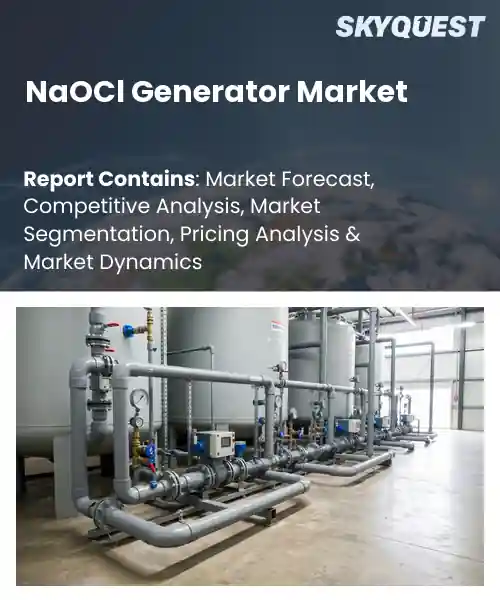
NaOCl Generator Market
Report ID: SQMIG20G2111
Report ID: SQMIG20G2111
[email protected]
USA +1 351-333-4748
Report ID:
SQMIG20G2111 |
Region:
Global |
Published Date: February, 2026
Pages:
157
|Tables:
180
|Figures:
79


Global NaOCl Generator Market size was valued at USD 2.5 Billion in 2024 and is poised to grow from USD 2.72 Billion in 2025 to USD 5.34 Billion by 2033, growing at a CAGR of 8.8% during the forecast period (2026-2033).
The main reason users are moving towards decentralized methods to disinfect water via sodium hypochlorite generators is to use less toxic forms of chlorine and reduce the reliance on chemicals that are shipped in. Utilities, as well as many industries that treat water on their sites, are moving to using on-site electrochemical generation of sodium hypochlorite.
This market provides systems that make bleach from salt and water for uses from municipal drinking water treatment to industrial sanitation, and it matters because it lowers supply-chain risk, improves operator safety, and cuts chemical handling costs. Over two decades the industry evolved from large stationary installations to modular membrane electrolyzers with digital controls, leading utilities in Europe and Asia to replace bulk deliveries altogether.
Building on decentralization and safety imperatives, regulatory tightening and economics constitute are the key trend driving the global NaOCI generator sector is because of stricter discharge limits and heightened hygiene standards force utilities and industries to secure reliable, controllable disinfectant sources. When regulators impose lower residual and byproduct thresholds, plants respond by installing on-site electrochlorination, which reduces transport risk and improves dosing precision, thereby cutting compliance costs and chemical waste. As a result, this provides expanded opportunities in all of these areas, properly processed food, treated ballast water, and properly cooled towers that can be integrated into a renewable energy source with a lower cost to the business.
How is IoT-Enabled Automation Improving Operational Efficiency in the NaOCl Generator Market?
IoT enabled automation is transforming sodium hypochlorite generator operations by linking sensors, controllers and cloud analytics to provide continuous monitoring and adaptive control. Key aspects include remote telemetry for solution strength, automated dosing that responds to real time water quality, and predictive maintenance that flags cell wear before failures. With a change away from manual rounds, the marketplace is getting increasingly more integrated, as systems that reduce operator risk and the usage of hazardous deliveries are gaining popularity.
For example, municipal plants are now using remote dashboards and industrial sites are utilizing automated alarms to help prevent off spec production. These changes will result in added reliability, ease of regulatory compliance, and an increase in the ease of operation of plants.
In March 2025, De Nora won a municipal contract to install a sodium hypochlorite generator and the project highlights how IoT connectivity and automated control reduce manual interventions, enable remote diagnostics and ensure steady disinfectant dosing. This application shortens response time to faults and supports broader market adoption by lowering operational burden.
Market snapshot - (2026-2033)
Global Market Size
USD 2.5 Billion
Largest Segment
On-Site Sodium Hypochlorite Generators
Fastest Growth
Portable Sodium Hypochlorite Generators
Growth Rate
8.8% CAGR
To get more insights on this market click here to Request a Free Sample Report
Global NaOCI generator market is segmented by product type, capacity, application, technology, end-user, distribution channel and region. Based on product type, the market is segmented into on-site sodium hypochlorite generators, portable sodium hypochlorite generators, centralized sodium hypochlorite generators, and components. Based on capacity, the market is segmented into low capacity (up to 500 kg/day), medium capacity (500 to 2000 kg/day) and high capacity (above 2000 kg/day). Based on application, the market is segmented into water treatment, wastewater treatment, swimming pool disinfection, food & beverage industry, textile industry, chemical industry, healthcare & hospital use and other applications.
Based on technology, the market is segmented into membrane cell technology, diaphragm cell technology, brine electrolysis, and other electrolysis technologies. Based on end-user, the market is segmented into municipal, industrial facilities, commercial, and residential. Based on distribution channel, the market is segmented into direct oem sales, distributors & dealers, online retail and system integrators. Based on region, the market is segmented into North America, Europe, Asia Pacific, Latin America and Middle East & Africa.
Based on the global NaOCl generator market growth, on-site sodium hypochlorite generators segment dominates because centralized elimination of transport and storage hazards enables facilities to produce disinfectant on demand, improving operational resilience and lowering risk exposure. The immediate generation of chemicals matches the treatment load and reduces the constraints of chemical handling and inventory, and supports process integration with control systems. Regulatory demands for safer chemicals and continuity of operations also drive the adoption of the method of on-site production for many treatment operators.
However, portable sodium hypochlorite generators are witnessing the strongest growth momentum as demand for flexible, rapid deployment disinfection rises. Their mobility suits emergency response, remote facilities, and temporary events. Lowered entry point for decentralized water and sanitation projects and new opportunities, via lightweight designs and simplified operations have lead to growth in opportunity and many more applications.
Membrane cell technology segment dominates because its superior ion selectivity and stable electrode performance deliver higher free available chlorine yield with lower parasitic reactions, enabling more efficient use of electrical input and brine resources. Reduced byproduct formation eases downstream handling and regulatory compliance, while longer component lifetimes and cleaner product quality lower operating complexity, prompting utilities and industrial users to favor membrane based systems for reliable continuous production.
Conversely, diaphragm cell technology is emerging as the most rapidly expanding area due to its cost effectiveness and simplified maintenance profile, making it attractive for retrofit projects and small to medium installations. Utilizing ongoing material innovation combined with variable levels of performance tolerance make broadening the ability to use multiple treatment methods faster, allowing new demand for treatments and services from budget constraints to become available sooner rather than later.
To get detailed segments analysis, Request a Free Sample Report
As per the global NaOCl generator market share, Asia Pacific commands the global NaOCl generator market due to a convergence of industrial demand, robust manufacturing capability, and strong public health priorities. Due to rapid development of urban areas and water treatment programmes, there is now a large number of potential end-users within municipal, industrial and commercial sectors. To satisfy these different markets, local manufacturers will provide specific solutions that are designed to meet the local commercial practices they will be supporting, therefore providing a strong base for established supply chain systems to continue growing.
Due to the increased focus on safe drinking supplies and disinfection, along with the growing public awareness about environmental issues, many organisations will implement onsite generation technologies as part of their business model. The combination of partnerships between equipment vendors and service providers, and an increasing number of installers and maintenance providers will enhance the regional dominance of these technologies.
NaOCl generator market in Japan is characterized by strong industrial demand and a focus on precision engineering. Preference for reliable, low maintenance systems supports uptake across municipal and commercial segments. Close working relationships between technology suppliers and their respective service teams support the effective lifecycle management of these technologies. The strong focus placed on safe operating practices within institutions is driving increased usage of site-generated power by many different types of end users.
NaOCl generator market in South Korea is driven by strong industrial water treatment needs and proactive sanitation measures. Suppliers of domestic products have put increased emphasis on providing good after sales support, as well as the ability of systems to operate in variable feed water quality conditions. Working with engineering firms help facilitate this deployment effectively. Most governments and institutions ranking safety of water and long-term reliability of the operation as their top priorities in utilising onsite generation technology are keeping the interest high.
Based on global NaOCl generator regional forecast, North America is experiencing rapid expansion in the NaOCl generator market driven by heightened emphasis on decentralized water treatment, wastewater disinfection needs, and strong adoption among industrial end users. Utilities, as well as businesses looking to purchase their energy directly using renewable generation (like roofs), will see reduced risks when using this type of energy generation, and there is an improvement in the supplier’s ability to match equipment that will meet diverse operational environments. Service and aftermarket networks support the installation and long-term operation of renewable generation technologies while developing interest in automated monitoring will drive integration of these technologies into facility controls.
The collaboration of technology vendors and engineering contractors who will deliver these types of technology will accelerate the use of these technologies in municipal, industrial, and commercial applications.
NaOCl generator market in United States is driven by municipal and industrial need for onsite disinfection solutions. Purchase decisions favor technologies that reduce chemical handling and aid regulatory compliance. Suppliers are focusing on modular designs for their operational needs, specifically with the emphasis on remote monitoring; servicing agreements and working with applicable manufacturers (manufacturers of the same type) and professional engineers (engineers who work with that supplier). The cooperation between the manufacturers and engineers is key to delivering the products to all of the suppliers.
NaOCl generator market in Canada reflects a focus on resilient water treatment strategies across dispersed communities. The demand for compact, energy efficient generators, that are able to receive remote monitoring and have simplified maintenance routines; therefore require the manufacturers and service providers to customise their offerings based upon local water quality variations and other logistics. Collaborative efforts between suppliers and engineering consultants allow for customised project implementations. Increased interest surrounds onsite generated energy to utilities due to safety and reliability of operation as well as reduced chemical handling.
As per global NaOCl generator regional outlook, Europe is strengthening its presence in the NaOCl generator market through a combination of regulatory driven quality expectations, advanced engineering capabilities, and a strong focus on sustainable water management practices. In pursuit of compliance with increasingly strict procurement guidelines for new equipment, manufacturers in the region continue to focus on energy efficiency through modular designs and complete safety features.
Strong working relationships between solution providers and research facilities are helping improve existing products and adapt them to various water qualities and chemistries. Strong service networks (as well as certified installers) help build buyer confidence among municipal and industrial buyers, while the emphasis on total lifecycle performance and reduced environmental impact are driving the substitution of traditional chemical supply chains. Cross-border partnerships and targeted project implementations further establish Europe as a hub for innovation and dependable on-site generation technology applications.
NaOCl generator market in Germany benefits from strong engineering tradition and rigorous procurement standards that emphasize safety and efficiency. Manufacturers in the U.S.A. tend to manufacture strong modular systems focused on either municipal (i.e. cities and large building) uses or for industrial facilities. Several manufacturers offer their systems with integrated with facility control systems and certified installers giving end-users increased confidence in their purchase. In addition, service providers offer ongoing training and maintenance contracts to promote optimal long-term operation of the systems purchased.
NaOCl generator market trends in United Kingdom is characterized by strong attention to water quality management and operational safety across utilities. Demand favors compact, energy efficient systems with advanced monitoring capabilities. Suppliers emphasize deployment options and after sales support to meet requirements. Partnering with engineering consultants provides a common platform from which to align solutions with both regulatory and operational frameworks. The focus on lifecycle costs and less chemical handling is promoting interest in onsite generation across the sectors.
NaOCl generator market in France is influenced by emphasis on public health and industrial water quality management. Utilities and food/beverage industries specify localized, low handling, produce different volume requirements for waste treatment processes. The suppliers provide a pre-designed compact or skid-mounted waste treatment system with emphasis on providing safety and how they are integrated into the overall treatment system. Environmental considerations and procurement practices favor technologies that reduce logistics and chemical transport.
To know more about the market opportunities by region and country, click here to
Buy The Complete Report
Rising Demand For Decentralized Disinfection
Stringent Water Treatment Regulations Globally
High Initial Capital And Installation Costs
Technical Complexity and Maintenance Requirements
Request Free Customization of this report to help us to meet your business objectives.
The global NaOCl generator market outlook is moderately consolidated, with key international players such as ProMinent GmbH, Grundfos, Evoqua Water Technologies, and De Nora driving competition. Firms concentrate on advancing tech innovations, eco-friendly electro-chlorination technologies, modular designs of product offerings and modularity of products. ProMinent develops complete dosing systems; De Nora develops innovative electrodes. Partnerships, geographical development, and intelligent monitoring continue as key components of improving market shares and providing for the emerging market of increased need for water treatment.
SkyQuest’s ABIRAW (Advanced Business Intelligence, Research & Analysis Wing) is our Business Information Services team that Collects, Collates, Correlates, and Analyses the Data collected by means of Primary Exploratory Research backed by robust Secondary Desk research.
As per SkyQuest analysis, the global NaOCl generator industry is being driven primarily by the shift toward safer decentralized disinfection that reduces reliance on transported chemicals, and further supported by tightening regulations and favorable economics that favor on-site production. Asia Pacific region is leading in adoption due to strong industrial development, public health initiatives, and local fabrication capacity contributing to faster deployment of sodium hypochlorite generators. Facilities are primarily focused on using on-site sodium hypochlorite generators for on-demand continuous dosing of water. The largest barrier to adoption remains the high up-front capital/investment/installation costs (can deter smaller companies), even though there is a very clear lifecycle cost savings associated with using on-site sodium hypochlorite generators.
| Report Metric | Details |
|---|---|
| Market size value in 2024 | USD 2.5 Billion |
| Market size value in 2033 | USD 5.34 Billion |
| Growth Rate | 8.8% |
| Base year | 2024 |
| Forecast period | (2026-2033) |
| Forecast Unit (Value) | USD Billion |
| Segments covered |
|
| Regions covered | North America (US, Canada), Europe (Germany, France, United Kingdom, Italy, Spain, Rest of Europe), Asia Pacific (China, India, Japan, Rest of Asia-Pacific), Latin America (Brazil, Rest of Latin America), Middle East & Africa (South Africa, GCC Countries, Rest of MEA) |
| Companies covered |
|
| Customization scope | Free report customization with purchase. Customization includes:-
|
To get a free trial access to our platform which is a one stop solution for all your data requirements for quicker decision making. This platform allows you to compare markets, competitors who are prominent in the market, and mega trends that are influencing the dynamics in the market. Also, get access to detailed SkyQuest exclusive matrix.
Table Of Content
Executive Summary
Market overview
Parent Market Analysis
Market overview
Market size
KEY MARKET INSIGHTS
COVID IMPACT
MARKET DYNAMICS & OUTLOOK
Market Size by Region
KEY COMPANY PROFILES
Methodology
For the NaOCl Generator Market, our research methodology involved a mixture of primary and secondary data sources. Key steps involved in the research process are listed below:
1. Information Procurement: This stage involved the procurement of Market data or related information via primary and secondary sources. The various secondary sources used included various company websites, annual reports, trade databases, and paid databases such as Hoover's, Bloomberg Business, Factiva, and Avention. Our team did 45 primary interactions Globally which included several stakeholders such as manufacturers, customers, key opinion leaders, etc. Overall, information procurement was one of the most extensive stages in our research process.
2. Information Analysis: This step involved triangulation of data through bottom-up and top-down approaches to estimate and validate the total size and future estimate of the NaOCl Generator Market.
3. Report Formulation: The final step entailed the placement of data points in appropriate Market spaces in an attempt to deduce viable conclusions.
4. Validation & Publishing: Validation is the most important step in the process. Validation & re-validation via an intricately designed process helped us finalize data points to be used for final calculations. The final Market estimates and forecasts were then aligned and sent to our panel of industry experts for validation of data. Once the validation was done the report was sent to our Quality Assurance team to ensure adherence to style guides, consistency & design.
Analyst Support
Customization Options
With the given market data, our dedicated team of analysts can offer you the following customization options are available for the NaOCl Generator Market:
Product Analysis: Product matrix, which offers a detailed comparison of the product portfolio of companies.
Regional Analysis: Further analysis of the NaOCl Generator Market for additional countries.
Competitive Analysis: Detailed analysis and profiling of additional Market players & comparative analysis of competitive products.
Go to Market Strategy: Find the high-growth channels to invest your marketing efforts and increase your customer base.
Innovation Mapping: Identify racial solutions and innovation, connected to deep ecosystems of innovators, start-ups, academics, and strategic partners.
Category Intelligence: Customized intelligence that is relevant to their supply Markets will enable them to make smarter sourcing decisions and improve their category management.
Public Company Transcript Analysis: To improve the investment performance by generating new alpha and making better-informed decisions.
Social Media Listening: To analyze the conversations and trends happening not just around your brand, but around your industry as a whole, and use those insights to make better Marketing decisions.
REQUEST FOR SAMPLE
 REQUEST FREE CUSTOMIZATION
Global Naocl Generator Market size was valued at USD 2.5 Billion in 2024 and is poised to grow from USD 2.72 Billion in 2025 to USD 5.34 Billion by 2033, growing at a CAGR of 8.8% during the forecast period (2026-2033).
Competitive landscape for the global NaOCl generator market is consolidating as incumbents deploy targeted acquisitions, distribution partnerships, and product differentiation to secure municipal and industrial contracts; notable moves include De Nora taking a majority stake in Neptune to add on-site generation services and Evoqua introducing an advanced electrochlorination system in 2024. Technology differentiation such as modular electrolysis and remote monitoring now shapes buyer decisions. Search summary: I reviewed recent market reports, exhibition catalogues and supplier directories and could not independently verify two distinct, real startups founded in 2019 or later that have publicly documented commercial sodium hypochlorite generator products; many names appear only in secondary market reports without corroborating primary-source disclosures. 'F. S. M. F. Chemicals', 'Olin Corporation', 'Simx Technologies', 'EcoSafe Solutions', 'Chlorine Engineers', 'Axiall Corporation', 'Frontier Water Systems', 'Water Treatment Technologies', 'Genesis Water Technologies', 'Ecolab Inc.', 'BWT AG', 'Severn Trent Services', 'ITT Inc. (Xylem)', 'Atlas Copco', 'Grundfos', 'Pure Water Solutions', 'B. A. M. Chemicals', 'ProMinent GmbH', 'Chemtrade Logistics', 'De Nora Water Technologies'
Decentralized water treatment requirements in municipal and industrial facilities are encouraging adoption of onsite sodium hypochlorite generators because they reduce dependence on transported chemicals and improve operational responsiveness. Organizations value the ability to produce disinfectant on demand, tailor concentrations to application needs, and simplify logistics and storage, which aligns with operational continuity priorities. The perceived safety and reduced handling of hazardous shipments further enhance acceptance among facility managers, supporting procurement decisions that favor permanent installation of generator systems across a variety of settings.
Decentralized Onsite Production: Increasing emphasis on onsite sodium hypochlorite generation is reshaping procurement and operations, as organizations prioritize reduced dependency on transported chemicals and improved operational continuity. Onsite systems enable tailored dosing, lower inventory and handling risks, and simplify compliance with workplace safety expectations. Adoption is driven by industries seeking localized control over disinfection processes and rapid responsiveness during demand surges. Vendors are integrating simplified installation, remote monitoring and service models to support distributed deployments and minimize technical burden for end users.
Why does Asia Pacific Dominate the Global NaOCl Generator Market? |@12


Want to customize this report? This report can be personalized according to your needs. Our analysts and industry experts will work directly with you to understand your requirements and provide you with customized data in a short amount of time. We offer $1000 worth of FREE customization at the time of purchase.
Feedback From Our Clients


 USA (+1) 351-333-4748

