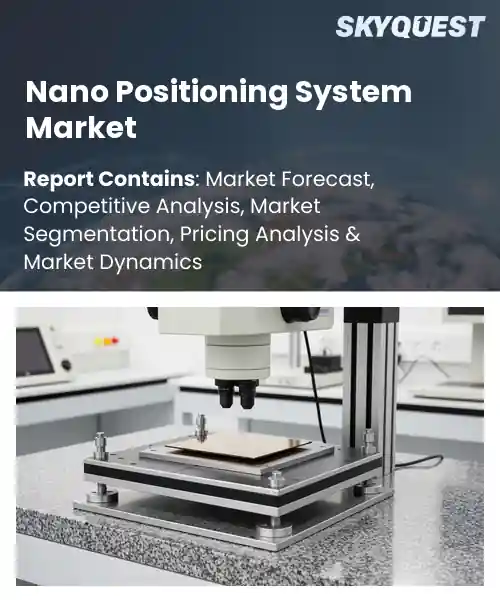
Nano Positioning System Market
Report ID: SQMIG45K2251
Report ID: SQMIG45K2251
[email protected]
USA +1 351-333-4748
Report ID:
SQMIG45K2251 |
Region:
Global |
Published Date: May, 2026
Pages:
157
|Tables:
152
|Figures:
78


Global Nano Positioning System Market size was valued at USD 3.1 Billion in 2024 and is poised to grow from USD 3.39 Billion in 2025 to USD 6.84 Billion by 2033, growing at a CAGR of 9.2% during the forecast period (2026-2033).
The market for nano positioning is mainly focused on motion technologies that help position items with great precision at the nanometer level, used in semiconductor manufacturing, microscopy, photonics, and aerospace testing applications. The main growth factor in this industry is related to the growing need to manufacture smaller and more complex products. Indeed, over the past two decades, the development in this area was stimulated by the requirements related to the reduction of semiconductor devices. It began from mechanical positioning and advanced towards active feedback during the 1990s and 2000s and now includes high-bandwidth actuator technology coupled with AI compensation.
In light of such commercialization motives, system integration and sensor fusion will become the critical aspect driving worldwide development since the use of high-resolution encoders with predictive control will help decrease the drift and cycle times, leading to greater productivity in fabrication and less defect occurrence. With the adoption of this technology, potential business can be created through advanced packaging, quantum device assembly, and probe metrology in which nanometer stability directly impacts the output. For instance, improving overlay control in lithography decreases the need for rework and allows shrinking nodes, while nanostage-based single molecule studies increase drug discovery, thus resulting in continuous demand for tailor-made equipment, lifecycle service, and aftermarket sales.
How is AI Enhancing Precision in the Nano Positioning System Market?
AI is increasing precision in the nano positioning systems market through better control and adaptability. Main elements include predictive control systems to counter drift, adaptive feedback mechanisms that correct perturbations dynamically, and sensing technology that blends optical and positional sensors for clear results. Present day trends have AI more integrated into high end controller and metrology equipment used for photonics manufacture and research due to the growing requirement for accuracy. AI assisted optical coupling protocols, automatic calibration, and predictive maintenance not only improve repeatability but are scalable for mass production.Physik Instrumente January 2026 launched its newest multi axis nanopositioning system using artificial intelligence for fast optical alignment and control. This development will decrease the setup process time and stabilize positional stability under changing conditions, thus fueling growth in the market segment.
Market snapshot - (2026-2033)
Global Market Size
USD 3.1 Billion
Largest Segment
Multi-Axis Nano Positioning Systems
Fastest Growth
Multi-Axis Nano Positioning Systems
Growth Rate
9.2% CAGR
To get more insights on this market click here to Request a Free Sample Report
Global nano positioning system market is segmented by type, component, technology, application, end use industry and region. Based on type, the market is segmented into 2D Nano Positioning Systems, 3D Nano Positioning Systems and Multi-Axis Nano Positioning Systems. Based on component, the market is segmented into Controllers, Positioning Stages, Actuators, Sensors and Software. Based on technology, the market is segmented into Piezoelectric Positioning, Electromechanical Positioning and Magnetostrictive Positioning. Based on application, the market is segmented into Semiconductor Manufacturing, Microscopy, Nanotechnology Research, Biomedical Applications, Optics & Photonics and Robotics & Automation. Based on end use industry, the market is segmented into Electronics & Semiconductor, Healthcare & Life Sciences, Aerospace & Defense, Research Institutions, Industrial Manufacturing and Others. Based on region, the market is segmented into North America, Europe, Asia Pacific, Latin Americaand Middle East & Africa.
The Multi-Axis Nano Positioning Systems segment is the leader because of the advantages offered by multi-axis systems where there is an ability to coordinate movement along multiple axes to perform complicated operations like aligning, tilting, and scanning, which are required in modern applications of fabrication and research work. The capability to incorporate well with controllers, sensors, and automation systems leads to lesser error accumulation and shorter process loops, hence making the multi-axis systems preferred for precision assembling and optical alignments.
However, the three-dimensional nano positioning systems segment is witnessing faster growth owing to increasing needs for three-axis control in volumetric imaging and additive nanofabrication. Improvements in compact actuators and control algorithms coupled with rising use in research and biomedical applications is leading to wider adoption in this segment.
Positioning Stages win due to the ability of stages to provide the mechanical interface and mechanical movement that is at the foundation of nanometer-level positioning accuracy. This is due to the stability, load-bearing capacity, and minimal amount of drift necessary for accurate positioning on a consistent basis. Stage kinematics along with feedback minimizes mechanical error. There is great need for custom stage designs in the fields of semiconductors, microscopy, and automation.
But there is fast-paced development going on in the area of actuators because of improvements in piezoelectric and electromechanical systems that are responsible for increasing the resolution and speed necessary for nanoscale dynamics control. Advancements in miniature, high-throughput actuators combined with more sophisticated feedback mechanisms have made possible entirely new modes of scanning and sensing.
To get detailed segments analysis, Request a Free Sample Report
The Asia Pacific region takes the lead in the world’s nano positioning system market as a result of the presence of well-developed manufacturing ecosystems, efficient R&D activities, and close interaction between the industry and academic organizations. The availability of technology hubs facilitates continuous innovation of precision motion control systems and allows their easy integration into the supply chain of semiconductors, optical instruments, and other advanced equipment. Local companies have extensive know-how regarding semiconductor manufacturing and consumer electronics, enabling them to develop a wide array of products. Investments in facilities, engineering expertise, and favorable procurement policies of leading manufacturers help maintain a competitive vendor landscape. Cross-border procurement channels, alongside an openness to using innovative metrology approaches, strengthen the region’s capabilities to overcome nano alignment issues.
There exists a deep level of integration between nano-positioning systems, precision manufacturing and research organizations. The local players are more concerned with providing highly reliable solutions with incremental innovations based on their needs as per customers from semiconductor and optical metrology markets. There exists strong partnership between system integrators and end-users which helps in designing custom solutions as well as quick prototyping.
Nano Positioning Systems Market of South Korea is greatly supported by the incorporation of this technology with semiconductor manufacturing and electronics supply chains. The local manufacturers focus on smaller size, accuracy, and integration because of cooperation with their original equipment manufacturers (OEMs) and research institutes. Focus on the fast turnaround time and good engineering skills facilitates customization of the positioning systems to meet various purposes.
North America sees significant growth in the market for nano positioning systems thanks to technology clusters, substantial investments made by ventures and corporations in sophisticated instruments, and strong interactions between researchers and industry professionals. The need for precise manufacturing, high-end laboratories, and innovative medical devices ensures that highly advanced positioning systems are used. Special attention to building a modular system design and integrating them with automation and control software speeds up their implementation. Services-based sales models and existing supply networks allow companies to scale up their offerings fast, while the presence of engineering talent in the local market and customization options let vendors cater to the needs of specific use cases. A wide network of system integrators, suppliers of components, and third-party service providers supports market maturity, allowing for the implementation of multi-axis systems that come with thorough calibration.
Market for Nano Positioning System in USA is propelled by the presence of state-of-the-art research facilities, active involvement of venture capital, and a large number of system integrators. Applications in areas like precision manufacturing, aerospace and medical devices have created demand for multi-axis systems and platforms. Focus on automation and integration of control software facilitates their implementation. Availability of after sales service and engineering solutions makes implementation smoother.
Nano Positioning System Market in Canada presents a combination of high research expertise and industrial capacity, with attention given to collaboration and application development. Domestic suppliers concentrate on providing services related to integration, design, and deployment of products for instrumentation and photonics industries. The presence of nearby supply chains in North America, along with collaboration with research institutions, makes it possible to create specific solutions for customers.
Europe is strengthening its position within the nano positioning system market by combining special engineering know-how, good industry research collaborations, and application development in the areas of automobile, aerospace, and science. Local manufacturers typically focus on engineering accuracy, temperature compensation, and vibration damping for tough operational conditions. The involvement in joint research programs and collaborative supply relations helps with the transfer of knowledge and standardized methods. An established network of precision part manufacturers and integrators allows for the implementation of custom-made and reliable applications, with service provisions and calibration services helping with successful deployment of the systems. Metrological competence and strong academic-industry partnership leads to application-oriented development in photonics and micro-fabrication. European suppliers utilize system engineering expertise and strict quality control standards to comply withindustry certification specifications and provide maintenance and calibration services.
Market for Nano Positioning System in Germany is based on precision engineering and an extensive supply chain of motion control parts suppliers. The domestic manufacturers have concentrated on durability, heat management, and compatibility with automated industrial processes to meet the demands of manufacturing and automotive industries. Collaborations with applied research organizations have been effective in fostering innovations. In addition, the comprehensive after sales service along with stringent quality processes improves system dependability and makes them more suitable for manufacturing environments.
UK Nano Positioning Systems Market is characterized by well-established academic studies on photonics and nanotechnology in combination with flexible engineering companies which transform innovations into positioning products. Activities in the market are centered on custom design, stages, and integration of optical systems. Collaborations through technology clusters and technology transfer processes assist in commercializing the technology. Well-organized aftersales services, calibration, and validation are key to ensuring adoption of the technology by labs and industries.
Nano Positioning System Market in France is driven by strengths in optics, photonics, and research that contribute to the development of precise positioning systems. There is collaboration among firms and labs to manufacture highly precise positioning stages and control systems for use in scientific instrument applications and semiconductor operations. Stress is laid on customization, stability, and system design to cater to a variety of applications. Good industry-academia relations and service-driven vendors help in transferring prototypes to products and calibrating systems.
To know more about the market opportunities by region and country, click here to
Buy The Complete Report
Advancements in Precision Control
Advancements in precision control technology through better feedback, actuator, and sensor technologies help improve the performance of nano-positioning in terms of positioning accuracy and repeatability. The improved performance broadens its applications in industries requiring high degrees of motion precision at the level of sub-micron or sub-nanometer, because of increased reliability and throughput in processes and inspections. Better control makes integration easier, leading to increased confidence in the system, hence encouraging the adoption of such systems.
Growing Demand in Semiconductor Manufacturing
As there is an increasing requirement for extreme accuracy and repeatability in the semiconductor production process, it is natural that nanometer positioning technology will attract investments since such devices are capable of performing wafer positioning, lithography steps, and metrology operations with high accuracy. With their introduction into semiconductor production facilities, they help make the process controlled more effectively and provide better results in terms of performance consistency, thus making equipment suppliers and fabs concentrate on developing motion solutions.
High System Development Costs
High costs of development and implementation for highly precise components, specialized actuators, and custom control systems pose a limitation on growth due to the high barrier to entry set against smaller manufacturers and customers. Such issues will prompt buyers to refrain from upgrading their systems or purchase products that are less efficient, especially during financial crises. The necessity for high investments in such projects will limit flexibility and speed of adaptation of new nano positioning solutions for different markets.
Limited Standardization Across Platforms
The lack of standardization in the domain of interface design, communication protocols, and performance evaluation makes it difficult to enhance interoperability while making integration more complicated. Customization is required for each implementation, making development expensive and risky while reducing efficiency. In the absence of standardized measures and certification mechanisms, consumers may be wary of committing to any particular technology, whereas suppliers will find it difficult to guarantee compatibility across platforms, thereby stalling progress in the field of nano positioning systems.
Request Free Customization of this report to help us to meet your business objectives.
The nano positioning system market competition has heated up as players seek through acquisitions and partnerships, among others, to gain more semiconductor and quantum customers. The market pressure is increasing owing to the demand for nano positioning systems from photonics and semiconductor assembly, leading companies to diversify their offerings to include cryogenic and multi-axis options. Recent developments include an acquisition by a motion control expert and launches of cryo stages and flexure stages.
Photonics Integration: The integration of photonics into nano positioning solutions provides high-sensitivity and non-contact measurement while contributing to increased stability in handling delicate samples. The integration of optical interferometry techniques and photonic circuitry is becoming popular among system designers for decreasing mechanical components, increasing bandwidth, and providing reliable systems for stable environments. Such technologies have made possible compact low-drift systems that appeal to semiconductor manufacturing, bioengineering research, and precision metrology application segments looking for minimal disruptions. Suppliers are modifying their roadmaps for designing modular optical and electromechanical systems that are easy to integrate into platforms.
Motion Control using Artificial Intelligence: Artificial intelligence-based motion control is transforming the future of nano positioning through predictive algorithms that anticipate and offset various forms of drifts, heat effects, and non-linearities. Using machine learning algorithms, the controller personalizes the control feedback based on particular payloads and process conditions, making tuning faster and providing increased consistency. Thanks to edge computing and ecosystems that facilitate software integration, such capabilities can be seamlessly integrated into workflows along with third party instruments. Competency in software becomes a competitive advantage for manufacturers who build tool-chains and training programs for customers.
SkyQuest’s ABIRAW (Advanced Business Intelligence, Research & Analysis Wing) is our Business Information Services team that Collects, Collates, Correlates, and Analyses the Data collected by means ofPrimary Exploratory Research backed by robust Secondary Desk research.
As per SkyQuest analysis, the growth drivers of the global nano positioning systems market include the demand for precision in the size reduction and increased complexities, along with the improved stability and throughput from advancements in integration and sensor fusion technologies. The limitations of the market arise from high costs associated with developing these systems, leading to slow procurement cycles and higher entry barriers. Asia Pacific continues to be the leading region because of its well-established manufacturing clusters and strong connections to semiconductor and photonics production networks. Among the different types of nano positioning systems, multi axis nano positioning systems are expected to gain the highest traction since they offer coordinated motion capabilities across multiple degrees of freedom.
| Report Metric | Details |
|---|---|
| Market size value in 2024 | USD 3.1 Billion |
| Market size value in 2033 | USD 6.84 Billion |
| Growth Rate | 9.2% |
| Base year | 2024 |
| Forecast period | (2026-2033) |
| Forecast Unit (Value) | USD Billion |
| Segments covered |
|
| Regions covered | North America (US, Canada), Europe (Germany, France, United Kingdom, Italy, Spain, Rest of Europe), Asia Pacific (China, India, Japan, Rest of Asia-Pacific), Latin America (Brazil, Rest of Latin America), Middle East & Africa (South Africa, GCC Countries, Rest of MEA) |
| Companies covered |
|
| Customization scope | Free report customization with purchase. Customization includes:-
|
To get a free trial access to our platform which is a one stop solution for all your data requirements for quicker decision making. This platform allows you to compare markets, competitors who are prominent in the market, and mega trends that are influencing the dynamics in the market. Also, get access to detailed SkyQuest exclusive matrix.
Table Of Content
Executive Summary
Market overview
Parent Market Analysis
Market overview
Market size
KEY MARKET INSIGHTS
COVID IMPACT
MARKET DYNAMICS & OUTLOOK
Market Size by Region
KEY COMPANY PROFILES
Methodology
For the Nano Positioning System Market, our research methodology involved a mixture of primary and secondary data sources. Key steps involved in the research process are listed below:
1. Information Procurement: This stage involved the procurement of Market data or related information via primary and secondary sources. The various secondary sources used included various company websites, annual reports, trade databases, and paid databases such as Hoover's, Bloomberg Business, Factiva, and Avention. Our team did 45 primary interactions Globally which included several stakeholders such as manufacturers, customers, key opinion leaders, etc. Overall, information procurement was one of the most extensive stages in our research process.
2. Information Analysis: This step involved triangulation of data through bottom-up and top-down approaches to estimate and validate the total size and future estimate of the Nano Positioning System Market.
3. Report Formulation: The final step entailed the placement of data points in appropriate Market spaces in an attempt to deduce viable conclusions.
4. Validation & Publishing: Validation is the most important step in the process. Validation & re-validation via an intricately designed process helped us finalize data points to be used for final calculations. The final Market estimates and forecasts were then aligned and sent to our panel of industry experts for validation of data. Once the validation was done the report was sent to our Quality Assurance team to ensure adherence to style guides, consistency & design.
Analyst Support
Customization Options
With the given market data, our dedicated team of analysts can offer you the following customization options are available for the Nano Positioning System Market:
Product Analysis: Product matrix, which offers a detailed comparison of the product portfolio of companies.
Regional Analysis: Further analysis of the Nano Positioning System Market for additional countries.
Competitive Analysis: Detailed analysis and profiling of additional Market players & comparative analysis of competitive products.
Go to Market Strategy: Find the high-growth channels to invest your marketing efforts and increase your customer base.
Innovation Mapping: Identify racial solutions and innovation, connected to deep ecosystems of innovators, start-ups, academics, and strategic partners.
Category Intelligence: Customized intelligence that is relevant to their supply Markets will enable them to make smarter sourcing decisions and improve their category management.
Public Company Transcript Analysis: To improve the investment performance by generating new alpha and making better-informed decisions.
Social Media Listening: To analyze the conversations and trends happening not just around your brand, but around your industry as a whole, and use those insights to make better Marketing decisions.
REQUEST FOR SAMPLE
 REQUEST FREE CUSTOMIZATION
Global Nano Positioning System Market size was valued at USD 3.1 Billion in 2024 and is poised to grow from USD 3.39 Billion in 2025 to USD 6.84 Billion by 2033, growing at a CAGR of 9.2% during the forecast period (2026-2033).
Competition in the global nano positioning systems market is intensifying as incumbents pursue acquisitions, targeted partnerships, and rapid product innovation to capture semiconductor and quantum customers. Market demand from photonics and semiconductor assembly is pushing firms to widen portfolios and add cryogenic and multi axis solutions. Recent activity includes a strategic acquisition by a motion specialist and new cryogenic and flexure stage launches. 'Physik Instrumente (PI)', 'Thorlabs', 'Aerotech', 'Newport Corporation', 'SmarAct', 'OptoSigma', 'Zaber Technologies', 'Nanomotion', 'Queensgate Instruments', 'Attocube Systems', 'Mad City Labs', 'Cedrat Technologies', 'Prior Scientific', 'Piezosystem Jena', 'Nanosurf', 'Basler', 'Hexagon AB', 'Renishaw', 'Parker Hannifin', 'MKS Instruments'
Advances in precision control technologies, including improved feedback architectures, refined actuator designs, and more responsive sensor integration, enhance the achievable positioning accuracy and repeatability of nano positioning systems. This capability expands applicability across industries that demand submicron or subnanometer motion stability by enabling more reliable process control, finer inspection, and higher throughput workflows. Improved control reduces setup complexity and integration risk, fostering greater confidence among system integrators and end users, which encourages adoption and investment in next generation positioning solutions.
Integration Of Photonics: Integration of photonics within nano positioning systems enables fine, noncontact sensing and improved stability for delicate sample handling. System designers increasingly combine optical interferometry and integrated photonic circuits to reduce mechanical reliance, improve bandwidth, and deliver reliability in stable environments. This convergence produces compact, low-drift modules attractive to semiconductor inspection, biotechnology research, and precision metrology users seeking minimal disturbance. Suppliers realign roadmaps to offer modular optical-electromechanical assemblies that simplify platform integration and speed technology transfer between lab and factory contexts.
Why does Asia Pacific Dominate the Global Nano Positioning System Market? |@12


Want to customize this report? This report can be personalized according to your needs. Our analysts and industry experts will work directly with you to understand your requirements and provide you with customized data in a short amount of time. We offer $1000 worth of FREE customization at the time of purchase.
Feedback From Our Clients


 USA (+1) 351-333-4748

