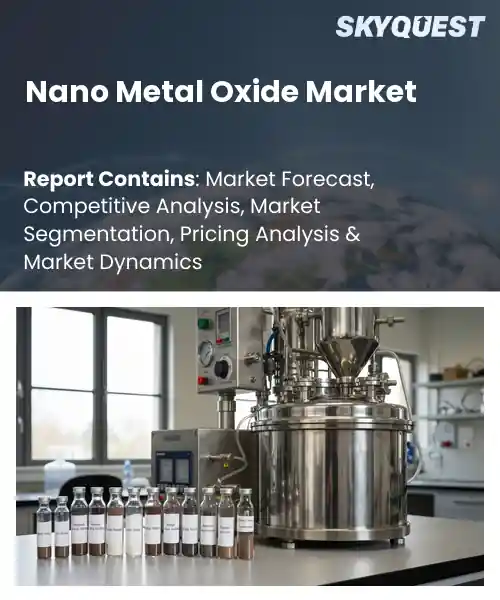
Nano Metal Oxide Market
Report ID: SQMIG15E3524
Report ID: SQMIG15E3524
[email protected]
USA +1 351-333-4748
Report ID:
SQMIG15E3524 |
Region:
Global |
Published Date: May, 2026
Pages:
157
|Tables:
94
|Figures:
76


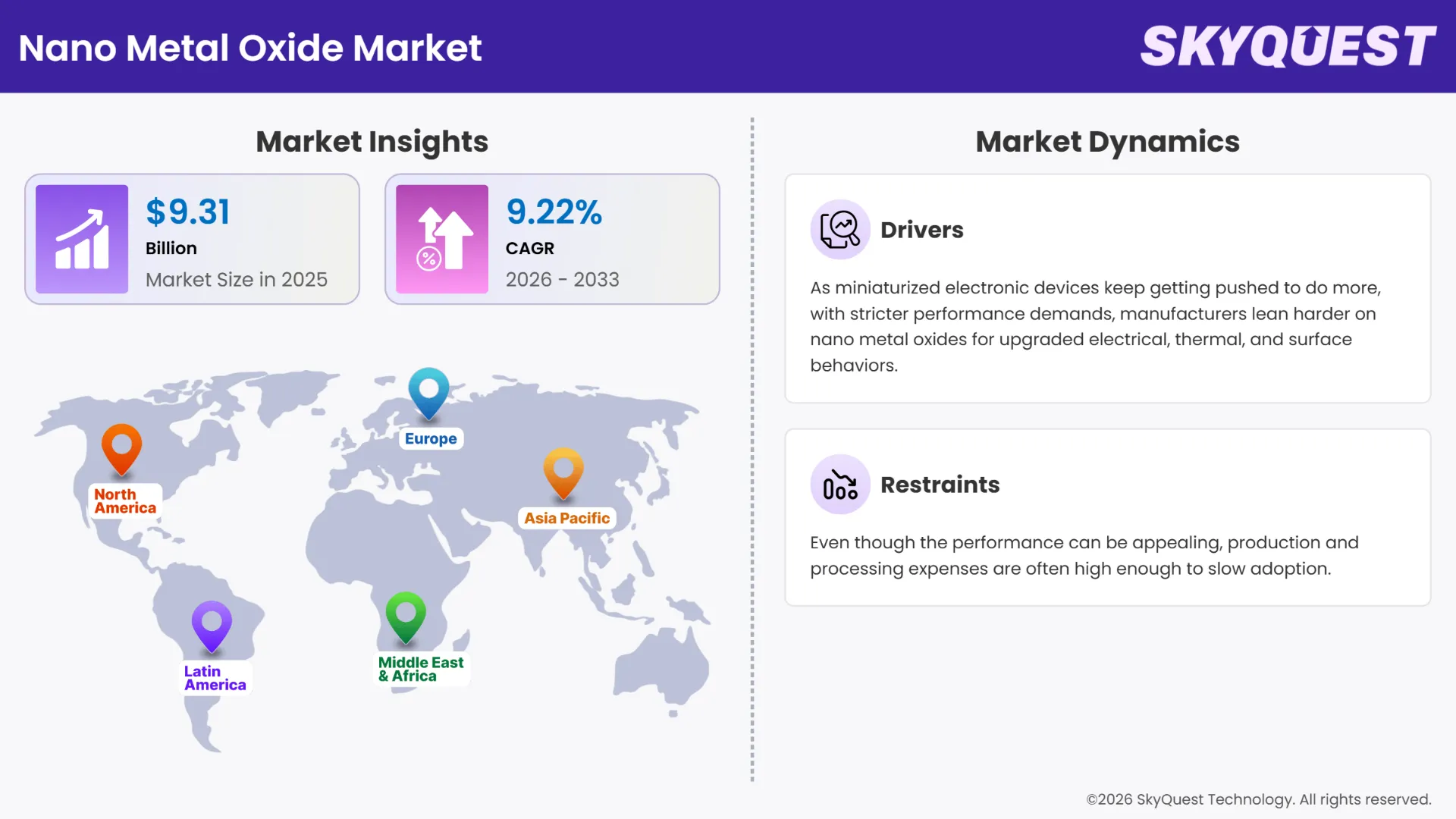
Global Nano Metal Oxide Market size was valued at USD 8.52 Billion in 2024 and is poised to grow from USD 9.31 Billion in 2025 to USD 18.85 Billion by 2033, growing at a CAGR of 9.22% during the forecast period (2026-2033).
The nano metal oxide market growth is being pushed by this persistent need for better material performance in electronics, energy storage, catalysis, and much environmental cleanup. In practice, the market basically includes nanoscale oxides, like titanium dioxide, zinc oxide, iron oxide, and aluminum oxide, where being on that tiny scale gives a higher surface area, changes in band gap behavior, and different surface reactions. All of that tends to mean better efficiency and, as they say, new functionalities. The whole importance angle is also tied to enabling smaller, less energy-hungry devices and cleaner industrial workflows, which makes sense. The sector evolved since the starting as academic proof of concept work, then it moved toward commercial uses such as TiO2 in sunscreens and ZnO in gas sensors, and that was supported by manufacturing scale-up, even if it wasn’t always smooth.
Now, building on that manufacturing scale-up, one pivotal factor accelerating the nano metal oxide market penetration is electrification and clean energy, which increases demand for advanced electrodes and catalysts. As electric vehicle and storage markets expand, manufacturers are adding nano metal oxides into cathodes, anodes, and even coatings, to boost capacity retention and extend cycle life. That, in turn, drives higher procurement and a lot more R&D spending. At the same time, tighter environmental regulations are nudging the adoption of nanocatalysts and photocatalytic TiO2 for air and water purification, so more commercial opportunities show up in industrial remediation. Then there are the cost reductions from scale effects and cross-sector partnerships, which make it easier for antimicrobial coatings and smart sensors to use these materials. It becomes this feedback loop, innovation encourages more market growth globally.
AI is helping production efficiency by tightening how the synthesis runs, how scale-up is handled, and how quality is verified. The important parts are predictive process models, which are used to keep yields stable; machine learning helps tune recipes and cuts development timelines, and computer vision can spot defects while coating and drying, sometimes before they become bigger issues. The current situation is a blend of materials informatics that started in research labs, and more automation at the factory level, which is where the real throughput comes from. The demand from batteries, catalysts, and advanced coatings is encouraging producers to adopt AI, because they want scale without losing those nanoscale properties that make the whole thing worthwhile. In terms of real outcomes, AI-driven discovery and automated monitoring make scaling up more reliable and reducing waste is witnessed.
To get more insights on this market click here to Request a Free Sample Report
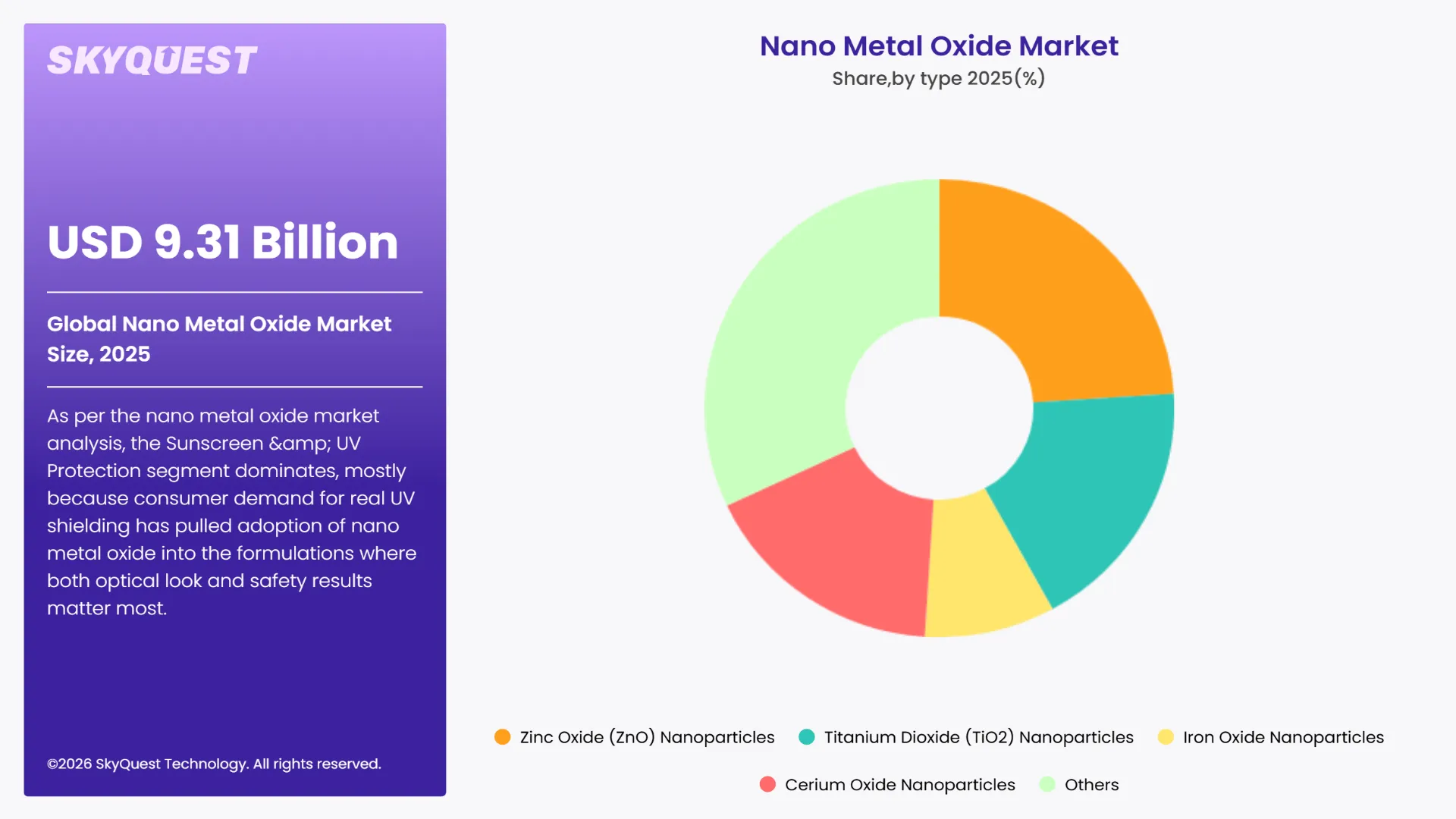
The global nano metal oxide market is segmented by type, application, end use, and region. Based on type, the market is segmented into Zinc Oxide (ZnO) Nanoparticles, Titanium Dioxide (TiO2) Nanoparticles, Iron Oxide Nanoparticles, Cerium Oxide Nanoparticles, and Others. Based on application, the market is segmented into Cosmetics & Personal Care, Electronics, Energy, Biomedical, and Paints & Coatings. Based on end-use, the market is segmented into Sunscreen & UV Protection, Semiconductors, and Catalysis. Based on region, the market is segmented into North America, Europe, Asia Pacific, Latin America, and the Middle East & Africa.
As per the nano metal oxide market analysis, the Sunscreen & UV Protection segment dominates, mostly because consumer demand for real UV shielding has pulled adoption of nano metal oxide into the formulations where both optical look and safety results matter most. Nano metal oxides deliver broad spectrum absorption and good dispersion stability, which allow attractive aesthetic and functional outcomes, so formulators tend to prioritize these materials. On top of that, the regulatory spotlight stays on safe inorganic filters and skin compatibility with a proven track record, which basically routes research, manufacturing scale-up, and even supply chain investment toward sunscreen applications.
Meanwhile, semiconductors are showing the strongest growth momentum since miniaturization and advanced device requirements keep pushing the adoption of high-purity nano metal oxides for dielectric, sensing, and thermal control roles. Newer particle engineering and integration techniques are opening better performance windows, which pulls OEM interest higher and also supports a wave of novel electronic applications, which in turn expands downstream demand and creates more supplier opportunities.
According to the nano metal oxide market forecast, the Zinc Oxide (ZnO) Nanoparticles segment dominates because it mixes UV blocking, antimicrobial activity, and tunable electronic properties in a way that fits lots of application types across cosmetics, coatings, and biomedical uses. There is also the ease of synthesis, adaptable surface chemistry, and compatibility with organic matrices, so formulators and device makers lean toward ZnO variants. This broad usefulness concentrates R&D work, manufacturing throughput, and supply chain priority on zinc oxide products within the nano metal oxide market.
However, the Titanium Dioxide (TiO2) Nanoparticles category is predicted to have the largest nano metal oxide market share, driven by improvements in visible light active formulations, photocatalytic environmental uses, and durable coating technologies. Better doping routes and surface modifications keep widening use cases in energy and self-cleaning surfaces, so investment increases and new product architectures appear. That broadens supplier ecosystems and eventually speeds up downstream adoption too.
To get detailed segments analysis, Request a Free Sample Report
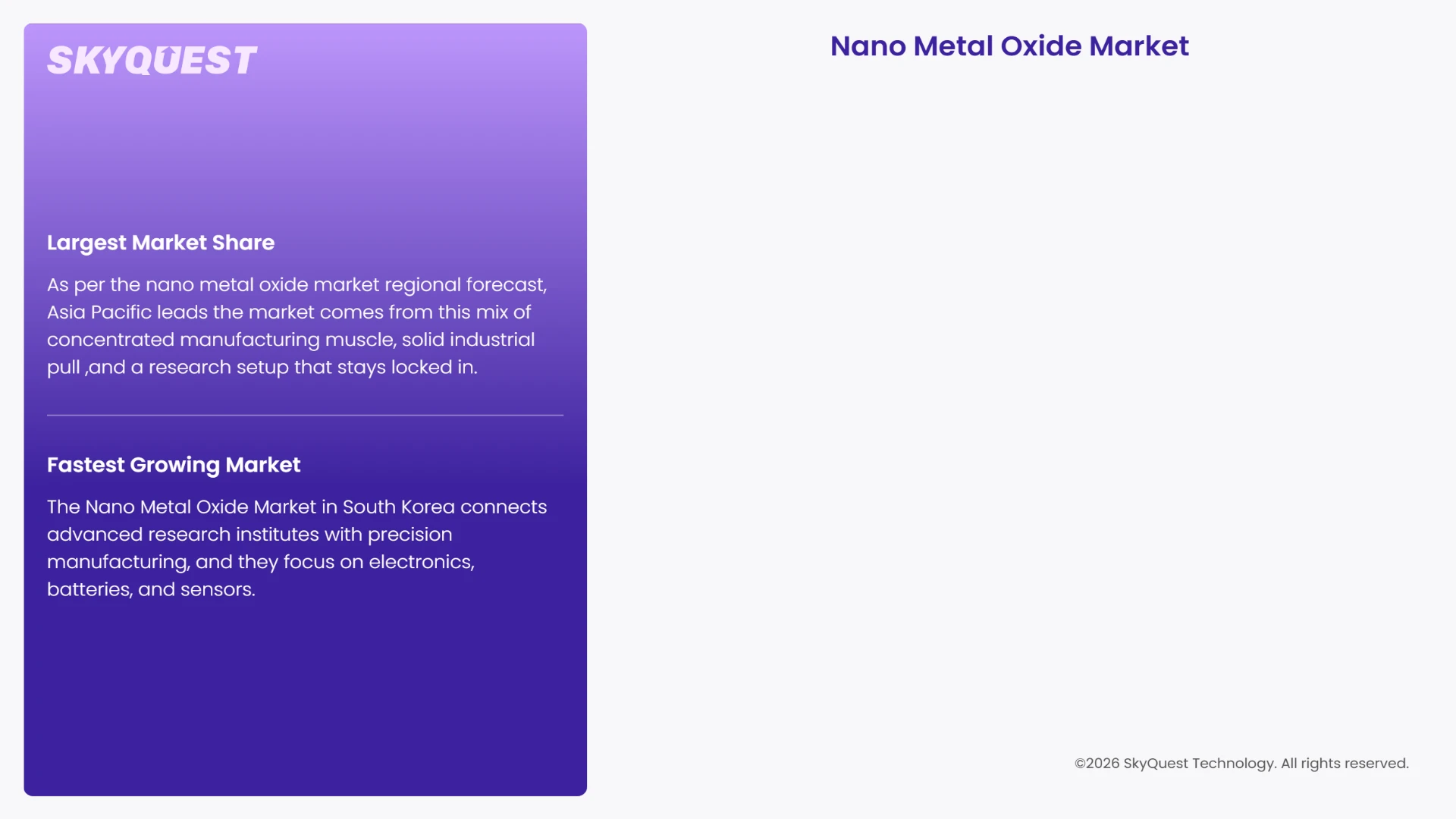
As per the nano metal oxide market regional forecast, Asia Pacific leads the market comes from this mix of concentrated manufacturing muscle, solid industrial pull ,and a research setup that stays locked in. Big economies in the region build connected supply chains so synthesis can be scaled, surface functionalization know how gets used fast, and application development keeps moving through electronics, energy storage, coatings, and catalysts. When private companies team up with public research groups, the whole technology transfer thing speeds up and commercialization follows. There’s also a crowded little ecosystem of specialty chemical producers, device makers, and advanced material folks, so demand shows up quickly and iteration cycles are almost constant. On top of that , policy frameworks that encourage industrial upgrade and material innovation make adoption easier. And because many big consumer electronics and automotive markets are nearby , local testing and deployment happen more naturally, so the region stays both a production and an application center.
Japan Nano Metal Oxide Market
The Nano Metal Oxide Market in Japan leans into advanced materials study and this tight academia-to-precision manufacturing relationship, with emphasis on electronic and energy uses. Businesses and research centers usually pick controlled synthesis, thin film integration, and reliability testing for consumer devices and industrial gear. A steady supplier base helps with scale-up while joint consortia push adoption across high-value segments, and that keeps Japan's role as a technology leader for oxide nanomaterials reinforced.
South Korea Nano Metal Oxide Market
The Nano Metal Oxide Market in South Korea connects advanced research institutes with precision manufacturing, and they focus on electronics, batteries, and sensors. Industry players stress nanoscale engineering, surface modification, and fast prototyping to meet tough performance expectations. There is a lively startup scene too, and it runs in parallel with long-established conglomerates to boost commercialization and operational resilience. Collaborative initiatives that stitch industry, academia, and government together help mature the technology, which then supports broader industrial adoption of nano metal oxide technologies, broadly too.
The rapid nano metal oxide market penetration in North America is shaped by strong applied research , heavy industrial demand for performance tweaks, and an innovation ecosystem that actually supports movement. Major technology firms and specialist material suppliers work with universities and national laboratories to turn lab progress into processes that can scale. There’s a clear focus on high-value end uses like energy storage systems, electronic components, and advanced coatings ,which helps guide development and supports early adoption. A mature manufacturing base along with refined quality and regulatory rules also helps lower the risk of commercialization. Venture capital and corporate investment routes let startups grow, while strategic partnerships between OEMs and material developers speed up integration into final products. Overall, these factors put the region in a strong position as a big adopter and innovator for nano metal oxide technologies.
United States Nano Metal Oxide Market
The Nano Metal Oxide Market in the United States builds from wide applied research, electronics, energy supply networks, and access to capital markets that back commercial scale-up. Universities and national laboratories collaborate, so new nano oxide formulations can be translated into manufacturable products. Material optimization usually follows demand from the semiconductor, battery, and coatings sectors. Strong testing, certification, and quality services reduce the friction that comes with entering the market, while corporate partnerships help materials fit into established manufacturing ecosystems.
Canada Nano Metal Oxide Market
The Nano Metal Oxide Market in Canada uses strong university research channels, specialized materials companies, and a collaborative innovation culture to move nano oxide technologies forward. Their key focus areas include energy storage, environmental remediation, and industrial coatings, where surface properties bring real performance benefits. Supportive public programs and industry consortia help pilot projects move ahead and validate technology. With proximity to supply chain partners and export-oriented manufacturers, Canadian developers can scale and integrate nano metal oxide solutions into real operations.
Europe is slowly but steadily strengthening its position in the nano metal oxide market, not just with bigger budgets, but more like with research excellence that actually gets used, and cross-border collaboration and a standards-led mindset, where safe and sustainable material development is always the core point, somehow. The regional priorities also look at how to translate results from lab scale into industrial use, because pilot success doesn't always “stick” at scale. On top of that, public-private partnerships are being encouraged, and regulatory frameworks are being aligned, so market entry feels less like a maze, while environmental and health considerations remain very much in the picture. There is also a network of specialized manufacturers, testing laboratories, and advanced end users, working in an iterative loop for validation of material performance, more or less. Circular economy principles and sustainable manufacturing processes are getting more attention too, which pushes resource efficient synthesis and lifecycle management, in practical terms. Collaborative clusters and innovation hubs across key countries let expertise pool together, and this helps Europe carve out distinct competitive advantages in advanced oxide nanomaterials. Finally, investment in skills development and pilot scale infrastructure keeps commercialization momentum moving, even when timelines are tight.
Germany Nano Metal Oxide Market
The Nano Metal Oxide Market in Germany tends to prioritize precision manufacturing, high-quality standards, and engineering applications, which encourages broader oxide nanomaterial deployment. Research institutes, together with industry partners, collaborate on scalable production as well as rigorous performance testing, especially for automotive, industrial, and energy sectors. There’s also a long-standing tradition of process engineering that supports efficient transition from pilot to manufacturing, in other words. Industry clusters and supplier networks help with material qualification, so stakeholders can integrate nano metal oxide solutions into demanding industrial applications, without too much guesswork.
United Kingdom Nano Metal Oxide Market
The Nano Metal Oxide Market in the United Kingdom builds on strong academic centers, a startup-focused ecosystem, and active manufacturers to push nano oxide innovation forward. Research around functional materials, coatings, and energy applications is supported through collaborative consortia, which helps enable scale-up and market validation. Industry engagement with tech transfer efforts and commercial partners helps speed up prototype development, more or less right away. There is also a clear focus on regulatory alignment and sustainable production, which supports adoption, while testing facilities provide the qualification needed for integration into real products.
France Nano Metal Oxide Market
The Nano Metal Oxide Market in France matches serious materials science research with specialized chemical manufacturers to drive nano oxide applications. Collaborative projects between academia and industry often target energy, catalysis, and coatings, with attention on sustainable synthesis and environmental performance, not just outcomes. Regional clusters and innovation programs support pilot production and industrial validation, so research centers and firms can translate laboratory developments into commercially viable nano metal oxide solutions across multiple industrial sectors, even when requirements get complicated.
To know more about the market opportunities by region and country, click here to
Buy The Complete Report
Drivers
Increasing Demand From Electronics
Growth In Energy Storage
Restraints
High Production and Processing Costs
Regulatory and Safety Concerns
Request Free Customization of this report to help us to meet your business objectives.
The competitive landscape of the global nano metal oxide market is shaped by this active consolidation, selective venture-scale scaling, and application-driven tech differentiation. There is Strategic M&A, like platform rollups in nanomaterials, and targeted partnerships between early-stage companies and clinical or cosmetics partners. And then there’s proprietary process innovation, too, with the goal to steer particle morphology, which ends up raising entry barriers a bit.
Top Player’s Company Profile
Recent Developments in the Nano Metal Oxide Market
SkyQuest’s ABIRAW (Advanced Business Intelligence, Research & Analysis Wing) is our Business Information Services team that Collects, Collates, Correlates, and Analyses the Data collected by means of Primary Exploratory Research backed by robust Secondary Desk research.
As per SkyQuest analysis, a key driver is the accelerating electrification and clean energy demand, which boosts the role of nano metal oxides in both batteries and catalysts. Then there is a second driver that feels like miniaturization and steadily increasing performance demands in electronics. A major restraint, though, is the high production, and processing costs, which slow broader adoption. The dominating region is Asia Pacific because integrated manufacturing research links and supply chains, all move together, and the dominating segment is Sunscreen and UV Protection, where consumer pull, and regulatory help play in favor of inorganic oxide filters. Overall, these dynamics point to solid growth potential, as long as cost, scale-up problems, and regulatory hurdles are handled through innovation and partnerships.
| Report Metric | Details |
|---|---|
| Market size value in 2024 | USD 8.52 Billion |
| Market size value in 2033 | USD 18.85 Billion |
| Growth Rate | 9.22% |
| Base year | 2024 |
| Forecast period | 2026-2033 |
| Forecast Unit (Value) | USD Billion |
| Segments covered |
|
| Regions covered | North America (US, Canada), Europe (Germany, France, United Kingdom, Italy, Spain, Rest of Europe), Asia Pacific (China, India, Japan, Rest of Asia-Pacific), Latin America (Brazil, Rest of Latin America), Middle East & Africa (South Africa, GCC Countries, Rest of MEA) |
| Companies covered |
|
| Customization scope | Free report customization with purchase. Customization includes:-
|
To get a free trial access to our platform which is a one stop solution for all your data requirements for quicker decision making. This platform allows you to compare markets, competitors who are prominent in the market, and mega trends that are influencing the dynamics in the market. Also, get access to detailed SkyQuest exclusive matrix.
Table Of Content
Executive Summary
Market overview
Parent Market Analysis
Market overview
Market size
KEY MARKET INSIGHTS
COVID IMPACT
MARKET DYNAMICS & OUTLOOK
Market Size by Region
KEY COMPANY PROFILES
Methodology
For the Nano Metal Oxide Market, our research methodology involved a mixture of primary and secondary data sources. Key steps involved in the research process are listed below:
1. Information Procurement: This stage involved the procurement of Market data or related information via primary and secondary sources. The various secondary sources used included various company websites, annual reports, trade databases, and paid databases such as Hoover's, Bloomberg Business, Factiva, and Avention. Our team did 45 primary interactions Globally which included several stakeholders such as manufacturers, customers, key opinion leaders, etc. Overall, information procurement was one of the most extensive stages in our research process.
2. Information Analysis: This step involved triangulation of data through bottom-up and top-down approaches to estimate and validate the total size and future estimate of the Nano Metal Oxide Market.
3. Report Formulation: The final step entailed the placement of data points in appropriate Market spaces in an attempt to deduce viable conclusions.
4. Validation & Publishing: Validation is the most important step in the process. Validation & re-validation via an intricately designed process helped us finalize data points to be used for final calculations. The final Market estimates and forecasts were then aligned and sent to our panel of industry experts for validation of data. Once the validation was done the report was sent to our Quality Assurance team to ensure adherence to style guides, consistency & design.
Analyst Support
Customization Options
With the given market data, our dedicated team of analysts can offer you the following customization options are available for the Nano Metal Oxide Market:
Product Analysis: Product matrix, which offers a detailed comparison of the product portfolio of companies.
Regional Analysis: Further analysis of the Nano Metal Oxide Market for additional countries.
Competitive Analysis: Detailed analysis and profiling of additional Market players & comparative analysis of competitive products.
Go to Market Strategy: Find the high-growth channels to invest your marketing efforts and increase your customer base.
Innovation Mapping: Identify racial solutions and innovation, connected to deep ecosystems of innovators, start-ups, academics, and strategic partners.
Category Intelligence: Customized intelligence that is relevant to their supply Markets will enable them to make smarter sourcing decisions and improve their category management.
Public Company Transcript Analysis: To improve the investment performance by generating new alpha and making better-informed decisions.
Social Media Listening: To analyze the conversations and trends happening not just around your brand, but around your industry as a whole, and use those insights to make better Marketing decisions.
REQUEST FOR SAMPLE
 REQUEST FREE CUSTOMIZATION
Global Nano Metal Oxide Market size was valued at USD 8.52 Billion in 2024 and is poised to grow from USD 9.31 Billion in 2025 to USD 18.85 Billion by 2033, growing at a CAGR of 9.22% during the forecast period (2026-2033).
The competitive landscape of the global nano metal oxide market is defined by active consolidation, selective venture-scale scaling and application-driven technology differentiation. Strategic M&A such as platform rollups in nanomaterials, targeted partnerships between startups and clinical or cosmetics partners, and proprietary process innovation to control particle morphology are driving competition and entry barriers. 'American Elements', 'Nanophase Technologies', 'Evonik Industries', 'US Research Nanomaterials', 'SkySpring Nanomaterials', 'NanoGram Corporation', 'Meliorum Technologies', 'Strem Chemicals', 'nanoComposix', 'Nanoshel LLC', 'Umicore NV', 'BASF SE', 'US Nano', 'Sigma-Aldrich (Merck)', 'Alfa Aesar (Thermo Fisher)', 'Reade International', 'IoLiTec Ionic Liquids Technologies', 'PlasmaChem GmbH', 'Nanotechnology Inc.', 'CW Nano'
The proliferation of miniaturized electronic devices with higher performance requirements has increased reliance on nano metal oxides for improved electrical, thermal, and surface properties. Manufacturers favor these materials because they enable better functionality in compact components, enhance reliability, and support novel device architectures. This sustained adoption by electronics producers stimulates research and production scale up, encourages supplier investment, and fosters ecosystem development across value chains, thereby creating a reinforcing cycle that drives expanded use of nano metal oxide materials in consumer and industrial electronic applications.
Advanced Energy Storage Integration: Nano metal oxides are increasingly central to next generation energy storage systems, enhancing electrode surfaces and ion transport through tailored morphologies and high surface area architectures. Demand is driven by the need for faster charging, improved lifecycle stability, and integration into flexible and wearable devices. Collaboration between materials scientists and device manufacturers accelerates commercialization, while scalable synthesis approaches focus on reproducibility and performance consistency. The trend supports product formats and partnerships across energy, consumer electronics, and industrial power management sectors.
Why does Asia Pacific Dominate the Global Nano Metal Oxide Market? |@12


Want to customize this report? This report can be personalized according to your needs. Our analysts and industry experts will work directly with you to understand your requirements and provide you with customized data in a short amount of time. We offer $1000 worth of FREE customization at the time of purchase.
Feedback From Our Clients


 USA (+1) 351-333-4748

