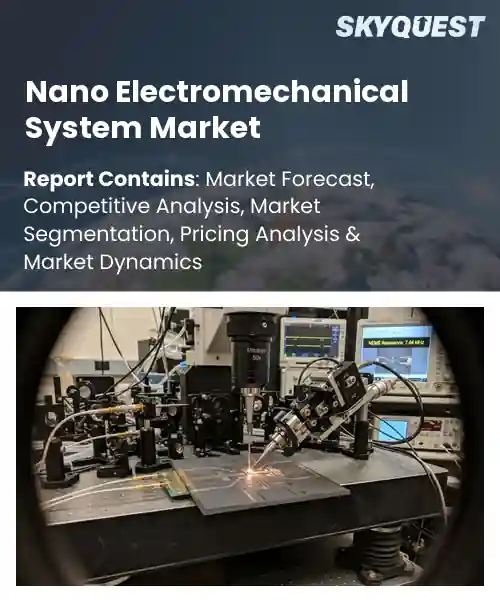
Nano Electromechanical System Market
Report ID: SQMIG45K2426
Report ID: SQMIG45K2426
[email protected]
USA +1 351-333-4748
Report ID:
SQMIG45K2426 |
Region:
Global |
Published Date: August, 2026
Pages:
157
|Tables:
147
|Figures:
78


Global Nano Electromechanical System Market size was valued at USD 11.84 Billion in 2024 and is poised to grow from USD 14.04 Billion in 2025 to USD 54.97 Billion by 2033, growing at a CAGR of 18.6% during the forecast period (2026-2033).
Nano electromechanical systems, or NEMS, combine mechanical elements at the nanometer scale with circuitry to enable sensitivity and speed in sensing, actuation, and signal processing. The market emerged from the convergence of semiconductor miniaturization, materials breakthroughs, and rising demand for power devices. As feature sizes shrank from micrometers to nanometers, engineers gained the ability to fabricate resonators that vibrate at frequencies, opening pathways for mass spectrometry and timing. Demonstrations in 2010 showed NEMS resonators detecting protein molecules, prompting research consortia and capital to fund production. This evolution transformed a field into a sector poised to reshape telecommunications, healthcare, and defense. The market expands as NEMS become embedded in Internet‑of‑Things devices, where low power draw and tiny sensors extend battery life and improve data quality. When designers add NEMS accelerometers to wearable health monitors, the devices record motion patterns that help detect arrhythmia, prompting hospitals and insurers to adopt the technology. Aerospace programs also choose NEMS pressure sensors for altitude measurement because lighter weight reduces launch costs, leading manufacturers to invest in custom NEMS modules. These cause‑and‑effect links attract global venture capital, rapidly speed standardization, and invite emerging semiconductor firms to diversify beyond new classic logic chips in the market today.
How is AI-driven automation influencing the Nano electromechanical system market?
AI‑driven automation is reshaping the Nano electromechanical system market by streamlining design cycles and enhancing precision manufacturing. Machine‑learning models predict optimal geometries, reducing trial‑and‑error in micro‑fabrication, while robotic assembly lines improve yield and lower defect rates. These tools enable faster integration of NEMS sensors into consumer electronics, medical devices, and industrial IoT, making products more reliable and cost‑effective. As developers adopt AI‑assisted simulation, the time from concept to prototype shrinks, encouraging broader adoption across sectors that demand ultra‑small, low‑power components. The overall ecosystem benefits from tighter feedback loops, accelerating innovation and expanding market opportunities.In June 2024, a leading nano‑electromechanical device maker announced an AI‑optimized production line, highlighting how intelligent automation cuts cycle time and boosts component consistency, reinforcing growth and efficiency in the sector.
Market snapshot - (2026-2033)
Global Market Size
USD 11.84 Billion
Largest Segment
Nano Sensors
Fastest Growth
Nano Sensors
Growth Rate
18.6% CAGR
To get more insights on this market click here to Request a Free Sample Report
Global nano electromechanical system market is segmented by component, material, application, end-use industry, manufacturing technology and region. Based on component, the market is segmented into Nano Sensors, Nano Actuators, Nano Resonators and Nano Switches. Based on material, the market is segmented into Silicon, Carbon Nanotubes, Graphene and Other Nanomaterials. Based on application, the market is segmented into Sensing, Signal Processing, Medical Devices and Communications. Based on end-use industry, the market is segmented into Electronics, Healthcare, Telecommunications and Aerospace & Defense. Based on manufacturing technology, the market is segmented into Top-Down Fabrication and Bottom-Up Fabrication. Based on region, the market is segmented into North America, Europe, Asia Pacific, Latin America and Middle East & Africa.
Nano Sensors segment dominates because they provide the core functionality that enables ultra precise detection of physical, chemical, and biological signals at the nanoscale. Their inherent sensitivity and low power consumption make them indispensable for integrating NEMS into emerging IoT and biomedical platforms. Continuous improvements in fabrication techniques and signal to noise ratios reinforce their central role, driving supplier investment and fostering ecosystem development across multiple end use sectors globally and commercially, rapidly today.
However, Nano Actuators segment is witnessing the strongest growth momentum because advancements in micro machining and material engineering are unlocking higher force output and faster response times. These capabilities enable more sophisticated motion control functions in wearable robotics and precision instrumentation, expanding the addressable market and creating new revenue streams for NEMS manufacturers.
Carbon Nanotubes segment leads because their extraordinary mechanical strength, high aspect ratio, and exceptional electrical conductivity provide a unique combination that enhances the sensitivity and durability of NEMS devices. Their ability to transmit strain and charge efficiently enables designers to achieve higher resonant frequencies while maintaining structural integrity. Ongoing research into scalable synthesis and functionalization further solidifies their attractiveness, prompting strong adoption in high performance sensor and actuator applications across the industry.
Meanwhile, Graphene segment emerges as the key high growth area because its atomically thin lattice delivers unparalleled flexibility, superior thermal conductivity, and tunable electronic properties that are ideal for next generation resonators and switches. The material’s compatibility with flexible substrates and emerging roll to roll processes is accelerating its integration, unlocking new market niches and expanding overall NEMS adoption.
To get detailed segments analysis, Request a Free Sample Report
Asia Pacific commands the leading position in the Nano Electromechanical System market due to a confluence of advanced manufacturing capabilities, deep research expertise, and proactive policy frameworks. The region’s legacy in semiconductor and MEMS production provides a solid foundation for scaling nano‑scale devices, while strong university‑industry partnerships accelerate innovation cycles. Government initiatives that prioritize high‑tech development and provide funding for nanofabrication infrastructure create an environment conducive to rapid commercialization. Moreover, the presence of major consumer electronics and medical device manufacturers drives demand for ultra‑compact, high‑performance components, reinforcing the region’s competitive edge on the global stage. The region also benefits from a supply chain that links component suppliers, foundries, and assembly services, enabling efficient production flows. A skilled talent pool, cultivated through engineering curricula and professional development, ensures that firms can adopt design methodologies. Export‑oriented strategies amplify the region’s influence, allowing domestic innovations to reach international markets and shape global standards.
Nano Electromechanical System Market in Japan benefits from deep expertise in precision engineering, robust supply chain, and close collaboration between universities and industry. The ecosystem encourages rapid prototyping and scaling of nano‑scale devices for sensors, actuators, and biomedical applications. Strong emphasis on quality standards and export orientation further reinforces Japan role as a technology hub within the region. Investment in nanofabrication facilities and incentives for manufacturing momentum and attract partnerships.
Nano Electromechanical System Market in South Korea thrives on a synergistic blend of strong semiconductor heritage, aggressive government R&D programs, and vibrant startup culture. The focus on miniaturized sensors and energy‑harvesting devices aligns with national priorities for smart manufacturing and healthcare innovation. Close ties between research institutes and large conglomerates accelerate technology transfer, while export‑focused strategies expand the country influence across global supply chains in emerging markets and research collaborations.
North America experiences rapid expansion of the Nano Electromechanical System market driven by a robust innovation ecosystem, strong intellectual property protection, and substantial investment in advanced research facilities. The United States and Canada host leading universities and research labs that generate cutting‑edge technologies, which are quickly commercialized by agile startups and established firms. Close collaboration between defense, aerospace, and healthcare sectors creates diverse application opportunities, while a culture of venture capital funding accelerates product development cycles. Additionally, a mature manufacturing base and emphasis on high‑performance standards enable the region to meet demanding customer requirements and capture a growing share of global demand. Regulatory frameworks that promote safety while encouraging innovation provide a pathway for approvals. Cross‑border collaborations with European and Asian partners facilitate exchange and broaden market access. The emphasis on sustainability drives development of energy‑efficient nano‑actuators and sensors, aligning with environmental goals and attracting interest from private sectors.
Nano Electromechanical System Market in United States benefits from a dense network of research universities, venture capital ecosystems, and leading technology corporations. The focus on high‑performance sensors and micro‑actuators aligns with defense, aerospace, and consumer electronics demands. Strong collaboration between federal laboratories and private firms accelerates prototype validation, while a mature supply chain ensures rapid scaling. Emphasis on sustainability drives development of low‑power nano‑devices for emerging Internet of Things applications.
Nano Electromechanical System Market in Canada leverages strong governmental research programs and a collaborative academic environment to foster innovation. Emphasis on precision manufacturing and biomedical nano‑devices aligns with national health‑care priorities and clean‑technology initiatives. Close ties between provincial innovation hubs and multinational partners facilitate technology transfer and market entry. The regulatory landscape supports rapid certification, enabling Canadian firms to supply high‑reliability components to aerospace and medical sectors worldwide globally today.
Europe is strengthening its position in the Nano Electromechanical System market through coordinated research initiatives, high‑quality manufacturing standards, and a focus on sustainable technology development. The European Union’s strategic programs encourage cross‑border collaboration among member states, fostering a shared knowledge base that accelerates innovation cycles. Strong emphasis on precision engineering and certification processes ensures that European products meet stringent performance and safety criteria, appealing to demanding sectors such as automotive, aerospace, and medical devices. The region also benefits from a network of specialized suppliers and a tradition of standards harmonization, which simplifies integration for OEMs. Collaborative platforms linking academia, industry, and policy makers further enhance the speed at which innovations move from lab to market, ensuring Europe remains competitive in the evolving nano‑electromechanical landscape.
Nano Electromechanical System Market in Germany is driven by engineering expertise and a strong industrial base focused on precision manufacturing. Collaborative research clusters combine university knowledge with corporate R&D, fostering rapid development of high‑performance sensors and actuators for automotive and medical sectors. Stringent quality certifications and a reputation for reliability enable German firms to secure premium contracts worldwide. Ongoing investment in sustainable production methods further enhances the market’s long‑term resilience.
Nano Electromechanical System Market in United Kingdom benefits from a ecosystem of research institutions, innovative startups, and established aerospace and defense manufacturers. Emphasis on miniaturized sensing technologies aligns with national priorities for smart infrastructure and health monitoring. Strong collaboration between government innovation funds and venture capital accelerates commercialization pathways. The UK’s rigorous testing standards and focus on cybersecurity ensure that nano‑electromechanical solutions meet the high reliability demands of critical applications.
Nano Electromechanical System Market in France is propelled by strong governmental support for research and a network of specialized engineering firms. Collaboration between leading universities and automotive, aerospace, and medical device manufacturers drives the creation of sensors and actuators with precision. Emphasis on eco‑design and energy efficiency aligns with national sustainability goals, fostering the development of nano‑devices. The French regulatory framework facilitates rapid certification, enabling market entry for innovative solutions.
To know more about the market opportunities by region and country, click here to
Buy The Complete Report
Advanced Material Innovations
Integration With IoT Platforms
High Manufacturing Costs
Regulatory and Safety Concerns
Request Free Customization of this report to help us to meet your business objectives.
The Nano Electromechanical System market is shaped by intense rivalry as incumbents and emerging firms chase performance gains, driving rapid adoption of ultra‑low‑power resonators and sensors; competitive pressure fuels strategic M&A, such as larger semiconductor groups acquiring niche NEMS developers, while partnerships like MIT.nano’s START.nano program accelerate technology transfer, and firms push tech innovation through integrated MEMS‑NEMS platforms that promise new applications in healthcare and IoT.
Top Player’s Company Profile
Recent Developments
SkyQuest’s ABIRAW (Advanced Business Intelligence, Research & Analysis Wing) is our Business Information Services team that Collects, Collates, Correlates, and Analyses the Data collected by means of Primary Exploratory Research backed by robust Secondary Desk research. As per SkyQuest analysis, the global nano‑electromechanical system market is being propelled primarily by advanced material innovations that boost resonant frequencies and durability, while seamless integration with IoT platforms serves as a second catalyst by enabling real‑time data and remote control across sectors. The market’s growth is tempered by high manufacturing costs, which stem from specialized clean‑room processes and limit price competitiveness. Asia Pacific dominates the landscape, leveraging strong semiconductor heritage, research ecosystems and supportive policies to outpace other regions. Within the product mix, nano sensors lead the segment hierarchy, delivering the ultra‑precise detection needed for emerging wearable, healthcare and smart‑manufacturing applications.
| Report Metric | Details |
|---|---|
| Market size value in 2024 | USD 11.84 Billion |
| Market size value in 2033 | USD 54.97 Billion |
| Growth Rate | 18.6% |
| Base year | 2024 |
| Forecast period | (2026-2033) |
| Forecast Unit (Value) | USD Billion |
| Segments covered |
|
| Regions covered | North America (US, Canada), Europe (Germany, France, United Kingdom, Italy, Spain, Rest of Europe), Asia Pacific (China, India, Japan, Rest of Asia-Pacific), Latin America (Brazil, Rest of Latin America), Middle East & Africa (South Africa, GCC Countries, Rest of MEA) |
| Companies covered |
|
| Customization scope | Free report customization with purchase. Customization includes:-
|
To get a free trial access to our platform which is a one stop solution for all your data requirements for quicker decision making. This platform allows you to compare markets, competitors who are prominent in the market, and mega trends that are influencing the dynamics in the market. Also, get access to detailed SkyQuest exclusive matrix.
Table Of Content
Executive Summary
Market overview
Parent Market Analysis
Market overview
Market size
KEY MARKET INSIGHTS
COVID IMPACT
MARKET DYNAMICS & OUTLOOK
Market Size by Region
KEY COMPANY PROFILES
Methodology
For the Nano Electromechanical System Market, our research methodology involved a mixture of primary and secondary data sources. Key steps involved in the research process are listed below:
1. Information Procurement: This stage involved the procurement of Market data or related information via primary and secondary sources. The various secondary sources used included various company websites, annual reports, trade databases, and paid databases such as Hoover's, Bloomberg Business, Factiva, and Avention. Our team did 45 primary interactions Globally which included several stakeholders such as manufacturers, customers, key opinion leaders, etc. Overall, information procurement was one of the most extensive stages in our research process.
2. Information Analysis: This step involved triangulation of data through bottom-up and top-down approaches to estimate and validate the total size and future estimate of the Nano Electromechanical System Market.
3. Report Formulation: The final step entailed the placement of data points in appropriate Market spaces in an attempt to deduce viable conclusions.
4. Validation & Publishing: Validation is the most important step in the process. Validation & re-validation via an intricately designed process helped us finalize data points to be used for final calculations. The final Market estimates and forecasts were then aligned and sent to our panel of industry experts for validation of data. Once the validation was done the report was sent to our Quality Assurance team to ensure adherence to style guides, consistency & design.
Analyst Support
Customization Options
With the given market data, our dedicated team of analysts can offer you the following customization options are available for the Nano Electromechanical System Market:
Product Analysis: Product matrix, which offers a detailed comparison of the product portfolio of companies.
Regional Analysis: Further analysis of the Nano Electromechanical System Market for additional countries.
Competitive Analysis: Detailed analysis and profiling of additional Market players & comparative analysis of competitive products.
Go to Market Strategy: Find the high-growth channels to invest your marketing efforts and increase your customer base.
Innovation Mapping: Identify racial solutions and innovation, connected to deep ecosystems of innovators, start-ups, academics, and strategic partners.
Category Intelligence: Customized intelligence that is relevant to their supply Markets will enable them to make smarter sourcing decisions and improve their category management.
Public Company Transcript Analysis: To improve the investment performance by generating new alpha and making better-informed decisions.
Social Media Listening: To analyze the conversations and trends happening not just around your brand, but around your industry as a whole, and use those insights to make better Marketing decisions.
REQUEST FOR SAMPLE
 REQUEST FREE CUSTOMIZATION


Want to customize this report? This report can be personalized according to your needs. Our analysts and industry experts will work directly with you to understand your requirements and provide you with customized data in a short amount of time. We offer $1000 worth of FREE customization at the time of purchase.
Feedback From Our Clients


 USA (+1) 351-333-4748

